Jiangsu · Wuxi
Wuxi Film Studios: The Sets China Built to Film Its Own Classics, and Then Could Not Bring Itself to Demolish
In 1987 China Central Television built an outdoor location base on the shore of Lake Tai so it could adapt the country's greatest novels. It put up a Tang palace, a Three Kingdoms fortress and a Song capital, filmed the definitive versions of Romance of the Three Kingdoms and Water Margin in them, and then discovered that the sets earned more money standing still than they ever had on camera.
5A View location, maps and nearby scenic areasThere is a category of Chinese tourist attraction that Western visitors consistently misread, and this is the purest example of it.
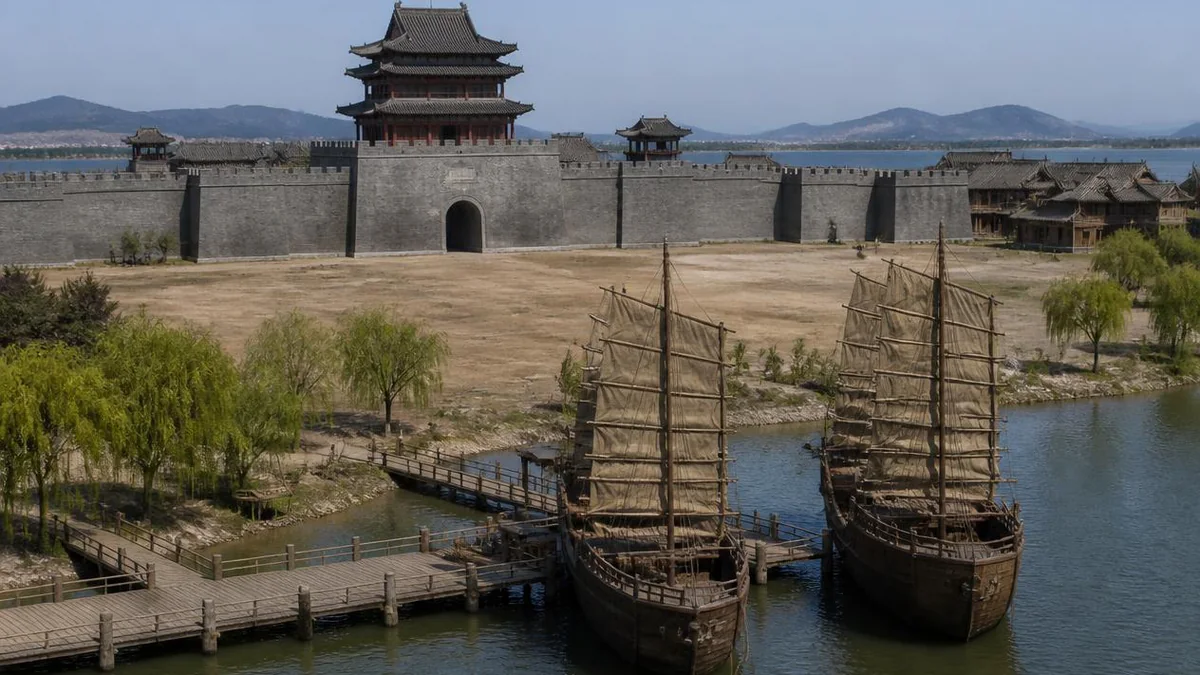
The CCTV Wuxi Film and Television Base occupies about 100 hectares of land and 200 hectares of water on the shore of Lake Tai, in Wuxi’s Binhu district. It contains a Tang imperial palace, a Three Kingdoms military city with a fleet of warships moored offshore, and a reconstruction of the Song dynasty capital. None of it is old. All of it was built to be filmed, and all of it is real in a way a theme park is not: these are the sets on which the definitive Chinese-language adaptations of two of the Four Great Classical Novels were actually shot.
It is not a replica of history. It is a preserved production facility, and the productions it preserves are the ones through which most living Chinese people first encountered their own classical literature.
Build it by shooting in it
The operating doctrine had a four-character name: let the drama carry the construction.
CCTV needed to adapt the great novels. Adapting them required sets — palaces, city walls, docks, streets — that did not exist anywhere in China as standing structures. Rather than build temporary sets and strike them, the network built permanent ones, budgeted against specific productions, and kept them.
Three drama projects produced the three cities. The Tang Emperor Ming produced Tang City. Romance of the Three Kingdoms produced Three Kingdoms City. Water Margin produced Water Margin City. Each was a line item in a television budget that turned into permanent architecture.
It was supposed to be a holiday complex for staff
The origin is more bureaucratic and much funnier than the result.
In November 1982, Wu Lengxi, the minister in charge of broadcasting and television, proposed building a creative retreat — apartments for the national broadcasting system’s writers and staff — at Wuxi. CCTV’s leadership went and looked at the site, and came back with a different conclusion: what would actually be useful here was an outdoor location centre for television drama.
The facility was completed in April 1987 and named the CCTV Wuxi Exterior Location Base. A proposal for a writers’ holiday complex had become the most important film studio in the country.
The first attraction was made of leftovers
What opened first was not a set at all. It was the props cupboard.
CCTV’s serialisation of Journey to the West had left behind partial sets and a quantity of properties. In early 1988 these were assembled into a Journey to the West Art Palace, which opened to the public on 1 October 1988.
The very first thing the public paid to see at Wuxi was the residue of a production that had already wrapped. The entire subsequent history of the site is contained in that decision.
Tang City, 1991
Construction of the Tang City began in 1990 and finished on 1 May 1991, built for The Tang Emperor Ming — a serial about Emperor Xuanzong, whose reign contains both the high point of Tang civilisation and the rebellion that ended it, and whose love affair with the consort Yang Guifei is the most retold romance in Chinese history.
The set is gilded and ornate in a way the other two are not: an imperial garden, a Tang palace, and a version of the Huaqing Pool, the hot-spring complex outside Xi’an where Xuanzong and Yang Guifei wintered, and which is the scene of the most famous long poem in the language on the subject.
Tang City carries an odd official status. It was rated in the first batch of 3A scenic areas, while its neighbours were rated in the first batch of 5A in May 2007 — the oldest of the three cities is graded two full levels below the two that came after it.
Three Kingdoms City, 1994
The decision was taken in May 1992 to build a Three Kingdoms city on the northern flank of Junzhang Hill. Ground was broken in April 1993. It opened to the public in August 1994, covering roughly 35 hectares.
The production it was built for is CCTV’s Romance of the Three Kingdoms: 84 episodes, and still the standard adaptation. To understand its cultural position, the closest Western equivalent would be a BBC Iliad that every literate person had seen and could quote.
The set is deliberately heavy and severe. The Wu palace and inner court, the bronze tripods, Cao Cao’s naval camp and Wu’s naval camp on the water, and Zhou Yu’s reviewing platform — where the young Wu commander who won the Battle of Red Cliffs would have mustered his fleet. Because the base sits on Lake Tai, the naval sets are on real water with real ships, which is why the river-battle sequences in the 1994 serial look the way they do.
The temple that is a copy of a temple in a story about a temple
Among the buildings in Three Kingdoms City is a Ganlu Temple, and it is the most philosophically interesting structure on the site.
There is a real Ganlu Temple. It stands on Beigu Hill at Zhenjiang, about 200 kilometres from here, and it was genuinely founded in the third century.
In Romance of the Three Kingdoms — a fourteenth-century novel, not a history — that temple is the setting for the scene in which Liu Bei is married to the sister of his rival Sun Quan in a political alliance that is also a trap. It is one of the best-known episodes in the book. Historians are clear that the betrothal-at-the-temple scene is the novelist’s invention.
So: a real temple, borrowed by a novel for a fictional scene, then rebuilt here in the 1990s as a set so that the scene the novel invented could be filmed. Visitors to Zhenjiang are shown the authentic temple where the thing did not happen. Visitors to Wuxi are shown the inauthentic temple where it was filmed. Both are worth seeing, and the relationship between them is a better lesson in how Chinese historical memory works than any museum caption.
Water Margin City, and a street named after a painting
Water Margin City was built for CCTV’s Water Margin, the adaptation of the fourteenth-century novel about a hundred and eight outlaws who take to the marshes against a corrupt government — Chinese literature’s founding text on the moral legitimacy of rebellion.
Where Three Kingdoms City is austere, this one is ornamental and urban: an imperial palace, the Fan Lou tavern, an imperial way, Zishi Street, and out on the water the outlaws’ stronghold of Liangshan Marsh itself.
The centrepiece is a street called Qingming Shanghe Street, and the name is a small marvel of layered representation. Along the River During the Qingming Festival is the most famous painting in Chinese art: a Northern Song scroll, five metres long, showing the streets, bridges, shops and crowds of the capital in extraordinary detail. It is the primary visual source for what a Song city looked like.
The street here is a three-dimensional construction of that painting, built so that a television adaptation of a novel set in the Song could be filmed in something resembling the Song. You are walking through a scroll.
Elsewhere on the site are a Beijing courtyard house and an old Shanghai street, for productions that need the last two centuries instead of the first fifteen.
Red Cliffs, filmed on the wrong lake
The reason the naval sets matter more than they look is that they exist to stage one battle.
In the winter of 208 CE, an allied fleet under the Wu commander Zhou Yu, with Liu Bei’s forces alongside, met Cao Cao’s far larger northern army on the Yangtze and destroyed it with fire ships. The Battle of Red Cliffs stopped Cao Cao from taking the south, and produced the three-way division of China that gives the period its name. It is the single most retold military engagement in Chinese history.
In the novel it runs for eight chapters and contains the book’s most quoted episodes: borrowing arrows from the enemy with straw-stuffed boats, borrowing an east wind by ritual, and the chain stratagem — persuading Cao Cao to link his ships together for stability, which is precisely what made them impossible to separate once one of them was burning.
To film that, CCTV needed warships on open water, two opposing naval camps, and a commander’s platform. Lake Tai supplied the water. Cao’s camp and Wu’s camp face each other across it, and Zhou Yu’s reviewing platform looks out over the fleet. The battle happened on the Yangtze, several hundred kilometres away, at a site whose location is itself disputed — but the sequence a generation of viewers remembers was shot here, on a lake in Wuxi, with real hulls and real fire.
The show called The Chain Stratagem in the daily performance schedule is that plot point, staged for tourists on the ground where it was filmed. Very little at this site is accidental.
Twenty shows a day, mostly on horseback
The base runs more than twenty live performances daily, and they are the thing to plan around rather than an afterthought.
Most are mounted combat. The repertoire is named directly from the novels: Three Heroes Fight Lü Bu, The Chain Stratagem, Yan Qing Takes the Ring, Yang Zhi Sells His Sabre, alongside music and martial-arts displays and a Tang-styled song-and-dance piece.
These are performed by professional stunt riders on the same ground where the serials were shot, which gives them a specificity that stage combat at a theme park does not have. The staff here have been staging cavalry charges for thirty years.
What CCTV was doing in those years
Wuxi only makes sense inside a larger project, and the project was extraordinary.
Between 1986 and 1998, China Central Television adapted all four of the Four Great Classical Novels: Journey to the West in 1986, Dream of the Red Chamber in 1987, Romance of the Three Kingdoms in 1994, and Water Margin in 1998. Four productions, twelve years, running to hundreds of episodes, made with state resources, enormous casts, and a stated commitment to fidelity that later commercial adaptations have not matched.
They landed at the exact moment television sets became normal in Chinese homes. For an entire generation, these serials are the novels — the faces, the voices, the theme music, the specific way a line is delivered. Chinese viewers quote them the way English speakers quote a handful of film adaptations of Shakespeare, except more universally, because there were essentially no competing versions.
Two of those four were physically built at Wuxi. That is the site’s actual claim on your attention. Not that it looks like ancient China, but that it is where a national canon was turned into images, in the decade when the whole country was watching.
Two cities built from the same painting
There is a second place in China that constructed Along the River During the Qingming Festival as an actual walkable environment, and comparing the two tells you something.
Kaifeng — the Northern Song capital the scroll depicts — opened the Qingming Riverside Garden in 1998 as a theme park: the painting rendered at scale, on the ground where its subject stood, with costumed performance and market streets, built to give visitors an experience of Bianjing.
Wuxi built its version to point a camera at it, several hundred kilometres from the city in question, as a by-product of adapting a novel set in that period.
One is a reconstruction in the right place for the purpose of showing people the past. The other is a set in the wrong place for the purpose of making television. Both are, in the plainest sense, fake. But the Wuxi street has a documentary claim the Kaifeng park does not: the footage shot on it is now itself a historical artefact, thirty years old, and the sets are the location where that artefact was produced.
This is worth holding onto, because “is it authentic?” turns out to be the wrong question at almost every constructed site in China. The better question is what is it evidence of — and a film set is very good evidence of the film.
The reversal
Here is what actually happened to the CCTV Wuxi base, and it is the part worth taking away.
In June 1997 CCTV floated the base’s assets as a listed company, CTV Media — stock code 600088 — of which the Wuxi base became a directly held branch. A state broadcaster’s production facility became a publicly traded asset.
By a 2012 report, the base had hosted more than 250 productions across its first two decades. But tourism had grown to eighty per cent of revenue, it drew 2.3 million visitors in 2011, and it was deliberately capping itself at around thirty crews a year — because film crews interfere with paying visitors.
Read that again. A studio built so that television could be made, now limiting how much television gets made there, because the sets earn more standing still. Tang City may simply be closed when someone is shooting in it: the film work has become the disruption.
What you are looking at
The honest description of Wuxi Film Studios is that it is a museum of a specific decade of Chinese television, and that this is more interesting than a fake ancient city would have been.
Between the late 1980s and the late 1990s, a state broadcaster with a serious budget and an unusually literary mandate adapted the great classical novels for a country that was about to change completely. Those serials are the version of Three Kingdoms, of Water Margin, of Journey to the West that a generation carries in its head. The palaces, the naval camps, the painted street and the counterfeit temple are where that work physically happened.
Nothing here is old. Everything here is where something real was made. Those are not the same claim, and the site is much better once you stop expecting the first one.
The LoreLens app can tell you which scene was shot where at Wuxi Film Studios, and which episode of the novel it comes from.
Location profile
Where it is

Frequently asked questions
Is this the same thing as Hengdian?
No, and the difference matters. Wuxi came first. China Central Television established this base on 20 April 1987; Hengdian World Studios in Zhejiang did not begin until 1996. Wuxi is the original Chinese film-studio-as-tourist-city, and it was built for a specific reason — CCTV needed somewhere to shoot its adaptations of the classic novels and had no standing sets for pre-modern China. Hengdian is far larger today and takes most of the production work. Wuxi is the older and, historically, the more consequential of the two.
Which parts are 5A?
Only some of it, which surprises people. When the first batch of 5A ratings was issued in May 2007, the Three Kingdoms and Water Margin area received 5A. Tang City, the oldest of the three sets, was rated in the first batch of 3A. The operator's own material states it this way. So the site as a whole is often described as 5A when strictly the rating attaches to two of the three cities, and Tang City sits two grades below its neighbours despite being the one that started the whole enterprise.
What was actually filmed here?
The two productions that justify the place are CCTV's Romance of the Three Kingdoms, whose 84 episodes are still the standard adaptation in Chinese, and CCTV's Water Margin. Tang City was built for The Tang Emperor Ming, completed in 1991. Beyond those, the base reported having hosted more than 250 domestic and international productions in its first two decades, among them The Imperial Concubine Yang, The Smiling Proud Wanderer and Grand Mansion Gate, and scenes from more recent hits such as Ming Dynasty and Story of Minglan were shot against these structures.
Can you still see filming?
Sometimes, and it can work against you. As of a 2012 report the base was deliberately limiting itself to around thirty productions a year, because tourism had become the larger business and crews get in the way of visitors. The practical consequence is that Tang City may be closed to the public when a crew is working inside it. If Tang City specifically is what you came for, check before you travel.
How much does it cost?
Figures circulating on third-party sites — around 90 yuan for Three Kingdoms City, 85 for Water Margin City, 65 for Tang City, and 150 for a Three Kingdoms plus Water Margin combined ticket — are unofficial and not recent, so treat them as an order of magnitude rather than a price. Verify through official channels before going. The two 5A cities together are a full day, and the live shows are the reason to time your visit rather than just turn up.