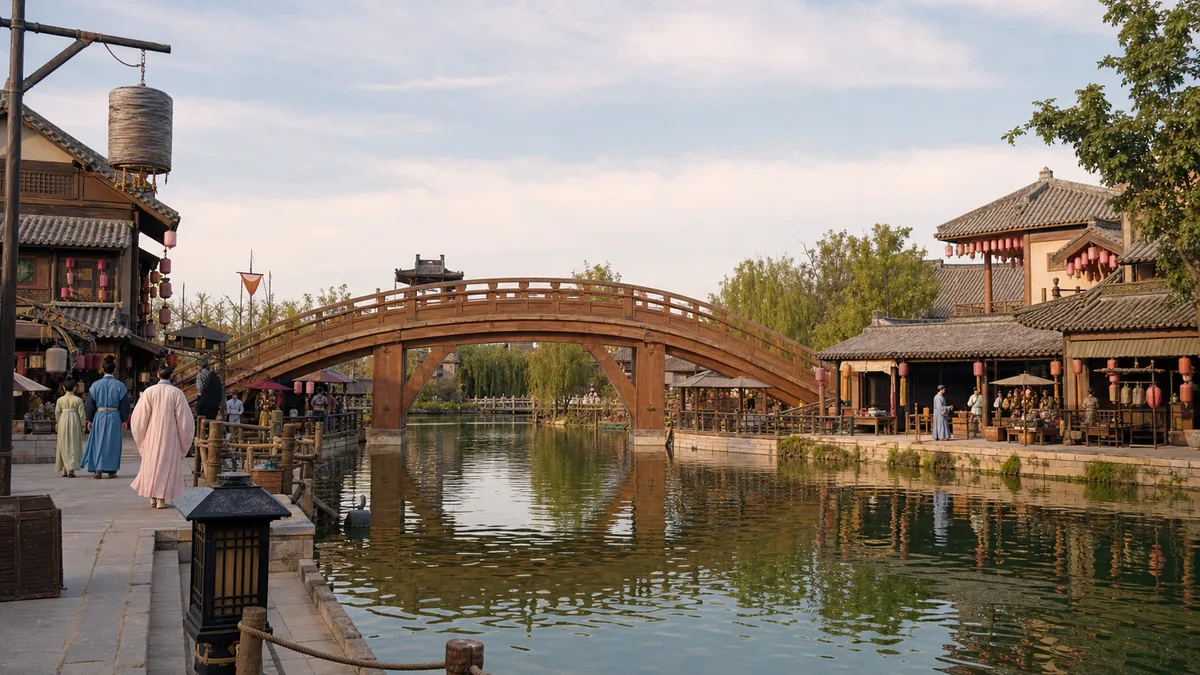
Henan · Kaifeng
Qingming Riverside Garden: Walking into a Modern Scroll
Compare a 1998 theme park with Zhang Zeduan's handscroll, then use bridges, markets and performances to ask how modern Kaifeng stages the memory of Northern Song Bianjing.
5A View location, maps and nearby scenic areasPause at the recreated Rainbow Bridge and watch two kinds of movement. Below, modern visitors queue for photographs and performers work a timed scene. In the famous painting that inspired the park, a crowded bridge and a boat approaching beneath it create a knot of attention—but the figures never actually move.
That gap is the key to Qingming Riverside Landscape Garden, opened in 1998 on the west side of Longting Lake in Kaifeng. It turns motifs from Zhang Zeduan’s Qingming Shanghe Tu into a walkable, commercial and theatrical environment. The park is valuable precisely when you remember that it is a late-twentieth-century interpretation, not a surviving Northern Song street.
Carry four layers in your head: the twelfth-century handscroll; Northern Song Bianjing, which the painting interprets rather than photographs; the modern park built from selected motifs; and today’s programme of shows, shops, lighting and costume play. Ask which layer you are seeing before calling anything “authentic.”
Begin in 1998, not 960
The park’s subject is the Northern Song dynasty (960–1127), but its physical history begins in the 1990s. It officially opened to visitors in 1998. Timber-like façades, tiled roofs, gates, bridges and waterside shops were constructed for a modern visitor economy, with contemporary structure, services, fire codes, utilities and crowd circulation behind the historical styling.
This distinction does not reduce the park to a “fake.” Reconstruction, theatre and themed design can teach through scale, sound and participation. A painted handscroll cannot let you walk beneath a bridge or hear a market. The park can. The responsible claim is that it interprets Song culture, not that Zhang Zeduan painted an architectural blueprint later rebuilt stone for stone.
No street here survived intact from Bianjing. Kaifeng’s urban ground has been transformed by later dynasties, warfare, rebuilding, Yellow River floods and sediment. Even where a modern structure uses a historical name or cites the Song building manual Yingzao Fashi, its location, material, scale and function need separate evidence before being treated as an exact reconstruction.
Look behind the façade. Speakers, stage machinery, electrical light, food outlets and safety barriers are not embarrassing intrusions; they reveal how a modern theme park produces its historical atmosphere. Keeping them in view makes the experience more intelligent, not less enjoyable.
Unroll the painting before walking the park
The Song handscroll attributed to Zhang Zeduan is only about 25 centimetres high but approximately 5.3 metres long. It is now held by the Palace Museum in Beijing and is normally protected from continuous display. Hundreds of later copies and adaptations exist, so an image labelled “Qingming scroll” may not be Zhang’s Song version.
A handscroll is read gradually, traditionally from right to left, revealing one section while the rest remains rolled. Zhang’s composition moves from quieter outskirts through river traffic and the bridge to dense urban streets. It uses shifting viewpoints rather than the single optical perspective of a photograph. Roofs, boats and roads are adjusted so the viewer can keep reading the action.
Bring a high-resolution image from a reputable museum source if possible. Compare relationships, not a checklist of “814 people” or another exact count: totals differ according to whether a partial figure, animal, building or boat is included. More importantly, the painting does not supply identity cards. A person near a stall may plausibly be a customer, porter or proprietor, but costume and position do not make every biography certain.
The conventional English title is Along the River During the Qingming Festival. Scholars have debated whether “Qingming” names the festival or season, praises a well-ordered age, or carries another meaning; “shanghe” has also received different readings. Use the familiar title, but do not turn one translation into proof that every figure is celebrating Tomb-Sweeping Day.
Bianjing ran on water, labour and administration
Kaifeng was Bianjing, also called the Eastern Capital, of the Northern Song. It was not prosperous merely because shops looked busy. The capital depended on canals linking it to grain, goods and tax resources from other regions. The painted river, commonly identified with the Bian River system, is therefore infrastructure as much as scenery.
Look at work rather than only abundance. Boat crews control vessels; porters shift cargo; vendors occupy small frontages; animals, carts and pedestrians compete for space. Bridges concentrate movement and risk. Restaurants and signs imply supply chains, cooking fuel, water, waste and regulation that the painting cannot show in full.
The scroll is unusually rich visual evidence for clothing, transport, building types and commercial activity. It is not a census or a neutral security camera. Zhang selected, compressed and arranged. Some scholars read the bustle as celebration of imperial order; others see warnings in weakly guarded gates, traffic danger or dependence on canal supply. The same detail may support more than one interpretation.
After the Jin conquest ended Northern Song rule in 1127, the court re-established itself in the south. Kaifeng continued as a major city under changing regimes, but Bianjing’s lost splendour became a powerful object of memory. The park stages that remembered capital, not an urban world preserved unchanged beneath its paving.
The Rainbow Bridge teaches slow looking
The scroll’s bridge scene is famous because it condenses architecture, trade and suspense. People cluster along a high wooden span while a vessel approaches the opening below. Figures on deck, riverbank and bridge seem to react, yet the exact sequence—what has gone wrong, what each person shouts, whether collision follows—remains an interpretation of gestures frozen in paint.
Use that uncertainty in the park. Compare the recreated bridge’s width, railings, slope and commercial use with the painted structure. Ask what had to change for modern crowd loading, handrails, maintenance and performance sightlines. A structure can quote the silhouette of the painting without reproducing its engineering or measurements.
Then watch people. The original scroll rewards peripheral vision: a rider may unsettle a street, a porter bends beneath a load, a shop sign redirects attention, a child or animal appears at the edge. The modern park often concentrates attention through costumes, announcements and stages. One image lets the eye choose its pace; the other schedules a focal point.
Do not climb a barrier to imitate the painted viewpoint. Bridges can bottleneck during parades and popular scenes. Take the wide frame from a bank or an offset path, including water and crowd movement, then make closer details where you do not obstruct circulation.
A handscroll becomes architecture by making choices
To turn a 5.3-metre image into a park, designers had to enlarge, omit and connect. A painted gate becomes an entrance or backdrop. A small shop becomes a business that needs storage and power. A river bend becomes managed water. Spaces drawn beside one another may be separated to handle crowds; additions may draw on broader Song culture, later copies of the scroll or modern expectations rather than Zhang’s composition.
The result is best read as adaptation. Film does something similar when it builds a three-dimensional set from a novel: decisions about scale, sequence, missing information and audience movement create a new work. Historical accuracy can be stronger in one detail and freer in another.
Shop signs, craft demonstrations and food stalls can introduce technologies or urban occupations. Ask three questions before accepting a label: Is this visible in Zhang’s Song scroll? Is it documented elsewhere for Northern Song Kaifeng? Or is it a contemporary visitor activity wearing Song-style design? More than one answer can be true, but they are not interchangeable.
The park also draws on later cultural memory. Popular stories about famous officials, generals and entertainers may involve people from different decades, or episodes absent from the painting. A performance can be meaningful without pretending that every character once met on this exact street.
Performance turns evidence into present-tense emotion
Street scenes, acrobatics, processions, combat displays and large water-based productions give the park its energy. They transform a silent image into voice, music, danger and applause. They also require a script: named protagonists, a beginning, a climax and an ending that Zhang’s continuous scroll often leaves open.
One bridge between history and performance is Meng Yuanlao’s Dongjing Menghua Lu, whose title can be translated “A Record of Dreaming of Splendour in the Eastern Capital.” Writing after Northern Song Bianjing had been lost, Meng remembered markets, festivals, food and entertainment in remarkable detail. His record is precious, but “dreaming” warns that memory and longing shape the view.
The phrase Dongjing Menghua now echoes in a major evening production commonly associated with the park. That is a modern echo of a medieval act of remembering: memoir becomes stage, water becomes scenery and spectators buy a seat inside nostalgia. Production name, season, cast, running time, ticket and weather policy can change; confirm current details rather than treating any online clip as tonight’s promise.
Daytime performances deserve the same distinction. They may combine historical figures, folk skills, later legends and modern stunt practice. Ask what source a scene interprets and what it invents to communicate quickly. Enjoyment and source criticism can occupy the same seat.
Build a route around questions, not every show
For a painting-first visit, begin with a quiet circuit before the largest crowds. Find the river, Rainbow Bridge, market façades and gate imagery, comparing each with a saved image of the scroll. Choose only two or three performances after you understand the spatial vocabulary.
For a performance-first visit, obtain the current programme at the entrance and mark locations as well as times. Consecutive shows on opposite sides of the park may be impossible without running. Leave a buffer for crowd barriers, full venues and changed start times. A headline production may use reserved seating or separate admission.
For families, alternate one scheduled scene with unscripted exploration. Children can look for transport, animals, signs, jobs and bridge hazards in the scroll rather than memorising dynasties. Be clear that a costumed performer is working and a rented costume does not turn the wearer into a Song resident.
A substantial half day is enough for a selective comparison. A full day accommodates more shows, meals and rest; an evening programme may require an additional ticket and a longer stay. Opening, re-entry, last admission, show cancellation and night-tour arrangements are operational facts—check dated official notices.
Costume, food and photographs need labels too
Costume rental can make the park playful, but “Song-style” covers a spectrum from researched reproduction to fantasy influenced by later dynasties, television and current fashion. Garment cut, fabric, hairstyle and accessories may not belong to the same century. Ask the shop what is included, how long fitting takes, and whether make-up, hair, deposits, photographs or late return cost extra.
Do not use costume as licence to caricature historical people. Avoid blocking worship-like spaces, stages or narrow bridges for a portrait. Ask before photographing another visitor closely, especially children. Performers may permit photography from the audience but still need aisles and safety zones kept clear.
Food works the same way. A stall can introduce Kaifeng flavour without proving that its present recipe, packaging or chilli level appears in the twelfth-century scroll. Distinguish local tradition, reconstructed Song idea and modern theme-park product. Allergy information and vegetarian definitions may need direct confirmation.
For photography, use a moderate telephoto lens to isolate layered roofs and performers, and a wider frame to show that the park is a contemporary public space. Follow current rules on flash, drones, tripods and commercial shoots. Night lighting is designed spectacle, not evidence that Bianjing streets looked that colour.
Leave by returning from spectacle to observation
Most main paths are engineered for high visitor volume, but bridges, thresholds, cobbled styling, long distances and sudden crowd controls can create barriers. Ask for the current step-free route around raised bridges and performance areas. Wheelchair users and visitors with limited stamina should also confirm accessible seating, toilets and evacuation arrangements for any large show.
Kaifeng summers can be hot; rain makes decorative paving slick, and winter evenings can feel exposed near water. Carry permitted water, protect hearing-sensitive children during loud effects and agree on a meeting point when parade barriers split a group. Do not attach a narrow train connection to the advertised end of a weather-dependent production.
Before leaving, return to the Rainbow Bridge after a performance has moved on. The modern bridge will be quieter, yet speakers, lights and shops remain. That is not a failure of illusion. It is the clearest evidence that each era builds a different Bianjing: Zhang arranged ink and colour; Meng Yuanlao arranged memory; the park arranges bodies, buildings and time slots.
Make one final photograph with the crowd included. The point is not to erase 1998 in pursuit of 1120, but to see why a city still wants to enter this scroll. Then lower the camera and choose one small action—a boatman leaning, a vendor calling, a child looking over a rail—to remember. Close observation is the most faithful bridge between painting and park.
Continue to the Taihao Fuxi Mausoleum for a living ritual landscape rather than a theme-park reconstruction, to Mount Mangdang for Western Han archaeology and later legend, or to the Longmen Grottoes for monuments physically carved across Northern Wei and Tang history.
Location profile
Where it is

Frequently asked questions
Is Qingming Riverside Landscape Garden an original Song dynasty neighbourhood?
No. The park opened in 1998 and is a modern cultural theme park inspired by Zhang Zeduan's Northern Song handscroll and later ideas of Song architecture and urban life. Its streets, bridges and halls are interpretations, not surviving buildings from twelfth-century Bianjing.
Is the original Along the River During the Qingming Festival scroll in the park?
No. The Song handscroll attributed to Zhang Zeduan is held by the Palace Museum in Beijing and is displayed only under limited conservation conditions. The park translates selected motifs into buildings and performances; confirm current exhibitions if you want to see a reproduction on site.
How much time should I allow for Qingming Riverside Landscape Garden?
A focused walk comparing the park with the scroll can take a substantial half day. A full daytime programme, meals, larger shows and a separate evening production can fill much longer. Performance times, last entry and crowd controls change, so build the visit from the current schedule.
Are shows and costume rental included in the admission ticket?
Some street performances may be included while major reserved productions, rentals, make-up, photographs or special experiences can cost extra. Packages and schedules change. Check exactly what your dated ticket covers, including cancellation and deposit terms, before paying.