Henan · Shangqiu
Mount Mangdang: Enter the Rock-Cut Kingdom of Liang
Move among low hills and rock-cut chambers to understand the Western Han kings of Liang, painted tomb ceilings and grave goods—then separate archaeology from the later legend of Liu Bang killing a white serpent.
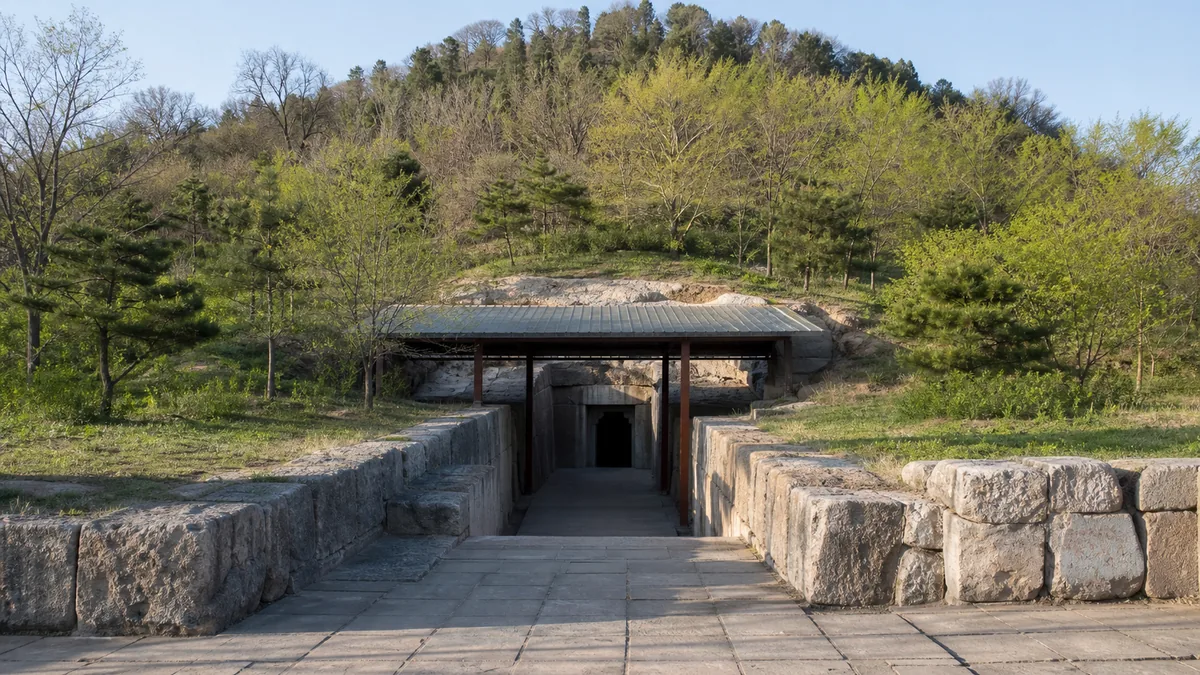
5A View location, maps and nearby scenic areasStep from daylight into a cut-stone passage and wait before moving on. The air cools, voices flatten against the rock, and the corridor seems less like a cave than an underground building. Door pivots, side chambers and carefully squared walls show that this space was planned as architecture, then excavated into a hill.
Outside, Mount Mangdang—mahng-dahng—does not resemble a single alpine summit. It is a cluster of more than ten low hills rising from the Huang-Huai plain near Yongcheng; commonly cited high points are only around 150 metres above sea level. Its importance lies underground and across several separated visitor zones, not in a demanding ascent.
Plan by named site, not by “the mountain”: choose which Liang royal tombs and mural interpretation you want; check which chambers are open; add the Liu Bang legend area only as a separate layer of memory. Entrances, combined admission, shuttles and photography rules can change by tomb.
Low hills concealed a royal cemetery
The Mangdang hill group looks modest because the surrounding plain is broad and level. That contrast made the rocky outcrops useful landmarks and, during the Western Han dynasty (206 BCE–9 CE), prestigious places for the rulers of the regional Kingdom of Liang to bury their dead. Archaeologists have identified a large group of royal and elite tombs across multiple hills rather than one compact cemetery behind a single gate.
The difference between hill elevation and tomb significance matters. A chamber can extend far into rock even when the summit above is low. Ramps, entrances, museum buildings, memorial landscapes and modern roads now divide the visitor experience. A map may group everything as “Mangdang Mountain Tourism Area,” but that administrative label does not erase the physical distance between tomb clusters.
Start outside by locating the plain, the individual hill and the cut entrance. Then ask how quarried debris was removed, where workers approached and how a burial procession could move through the slope. The hill is not simply a container. Its bedrock allowed a royal household to translate above-ground halls, storerooms and thresholds into a permanent subterranean plan.
Liang was a kingdom inside the Han empire
The Han court governed through commanderies and through kingdoms granted to imperial relatives. Liang, centred on Suiyang in the region of present-day Shangqiu, occupied a strategic and wealthy part of the eastern empire. Its kings belonged to the Liu imperial clan, but their resources and authority changed as emperors repeatedly adjusted the balance between regional kings and the central court.
The best-known ruler is Liu Wu, King Xiao of Liang, a younger brother of Emperor Jing. During the Rebellion of the Seven States in 154 BCE, Liang forces defended Suiyang and helped block the rebels’ westward movement. The episode strengthened Liu Wu’s political weight, while his wealth and court culture became part of later accounts of Liang splendour. He died in 144 BCE.
This context explains the tombs better than a list of treasure. Rock-cut complexes express a royal household operating inside an imperial system: related to the emperor, locally powerful, yet never fully independent. Successive Liang rulers and consorts were buried in the hill group, but identifications and tomb numbers should follow the label at each entrance. Do not transfer a plan, owner or object from one famous tomb to every chamber you enter.
Cutting a palace into stone required organised labour
Many Mangdang tombs were hewn horizontally or diagonally into bedrock, with corridors and chambers cut to measured shapes. Some surfaces were finished, plastered or painted; stone doors and architectural fittings controlled movement between spaces. Other parts used masonry or additional construction. “Rock-cut tomb” describes the dominant method, not a claim that every visible surface is untouched natural rock.
Imagine the sequence: survey a hill, open an approach, remove great volumes of stone, square the corridor, create chambers, manage drainage and ventilation, finish surfaces, install doors, move the burial assemblage inside, then close the entrance. Tool marks are the nearest thing to the workers’ signatures. Large royal tombs required quarrying knowledge, transport, supervision and sustained labour from people whose names rarely entered historical texts.
Room-like labels—front hall, rear chamber, storeroom, latrine, bath or ice room—appear in interpretation because underground plans imitate elite living arrangements. Use them carefully. A side room’s function depends on its fittings and finds, and similar shapes need not have identical uses. The strongest evidence comes from the excavated relationship among architecture, traces and objects, not from how familiar a room feels today.
Walk the chamber sequence as a controlled threshold
At an open tomb, pause at each change of level or width. A long passage controls approach; a door socket marks a closable boundary; a central room distributes movement; a smaller side chamber narrows the body and the social function. These transitions made the tomb an ordered afterlife residence rather than an accidental hollow.
Look upward as well as sideways. A ceiling can carry painted imagery, traces of plaster, soot or water staining. The present lighting is installed for safety and interpretation and can distort colour. Modern floors, rails, stairs and reinforcement should not be mistaken for Han fabric. Conversely, a clean edge is not automatically modern: skilled cutting could produce remarkably regular planes.
Humidity, carbon dioxide, temperature and visitor contact affect both comfort and conservation. Staff may limit group size, close a side chamber or change the route without the entire attraction closing. Do not hold a door, lean against the rock, touch pigment or step off the walkway for a symmetrical frame. The slowest threshold is often the most informative part of the visit.
Liu Wu’s tomb story is larger than one chamber
Tombs conventionally associated with King Xiao and his queen are among the best-known complexes in the Mangdang group. Their scale and room divisions demonstrate the resources of the Liang court, but ancient robbery, later disturbance and modern conservation mean visitors do not encounter a sealed royal household exactly as it was left.
Liu Wu’s political story gives cause, turn and consequence to the architecture. Imperial kinship granted him a kingdom; war made Liang strategically indispensable; accumulated power and ambition also made the Han court cautious about succession and regional autonomy. After his death, his domain was divided among heirs, and later Liang kings ruled in a different balance of power. The tomb landscape preserves not one stable institution but generations of adjustment between family privilege and imperial control.
Do not let monumental scale erase the labour or the dead. Royal chambers required workers to cut and finish rock, craftspeople to make fittings and burial goods, attendants to manage ceremonies, and later guards and communities to live with the site. Any displayed bones or burial traces belong to people, not to a horror attraction. Keep voices low and give funeral space priority over dramatic posing.
Murals turned the ceiling into a moving cosmos
The Shiyuan mural tomb is famous for a large painted composition conventionally described through clouds, dragons, a tiger, a vermilion bird and other celestial or directional imagery. Names such as the Four Symbols help viewers recognise an East Asian cosmological vocabulary, but interpretation depends on the complete composition, tomb date and ritual context. A photographed fragment should not be detached into a generic “Han zodiac.”
Painted ceilings expanded a stone chamber beyond its physical limit. Flowing cloud forms and powerful creatures could orient the deceased within a structured cosmos, express protection and status, and turn the roof into something visually mobile. Exact meanings are debated; a label that says “may represent” should not become certainty in translation.
Pigment is vulnerable to light, moisture, salts, temperature change and breath from crowds. The original mural, a replica, a digital reproduction and a relocated display are not interchangeable. Follow the label at the specific place and do not write that every famous image remains in the room where tourists currently stand. Flash can be banned even when phone photography is allowed. Seeing less light is sometimes the condition for the painting to survive.
Grave goods only speak when their context survives
Jade, bronze, pottery, seals, chariot fittings and other objects associated with the Liang tombs reveal wealth, craft, administration, ritual and ideas about the body after death. Some royal burials used jade pieces or suits; many tombs were robbed or disturbed. Counts and attributions depend on excavation records, joins, inscriptions and later study.
Avoid making one spectacular object stand for every tomb. A museum case may bring together material from different hills, loans, replicas or comparative finds. Read the findspot and inventory number. If a label identifies an object only as “from the Mangdang tomb group,” do not assign it to Liu Wu, his queen or Shiyuan by appearance.
Robbery is also part of the evidence. Empty sockets, broken doors and scattered fragments show how burial wealth attracted later intrusion. Archaeology does more than recover valuables: soil layers, nail positions, pigment traces and small sherds can reconstruct what disturbance removed. The modern echo is clear—buying an undocumented antiquity repeats the loss of context that robbed tombs already suffered.
The white serpent belongs to Han origin memory
Another part of the scenic area commemorates Liu Bang, the rebel leader who became the Han dynasty’s founding emperor in 202 BCE. Later historical tradition tells that, before his rise, he killed a white serpent blocking a road. In the story, an old woman laments: “The son of the White Emperor has been slain by the son of the Red Emperor.” The omen recasts a local act as cosmic proof of Liu Bang’s destiny.
The tale supplies a neat arc: an ordinary local official defies danger, a supernatural explanation reveals his mandate, and later victory makes the omen seem prophetic. It survives in popular retellings, monuments and the phrase “raising an uprising after slaying the serpent.” Yet the narrative was shaped in texts written after the supposed event, and archaeology has not verified the precise killing or a securely proven spot on Mangdang Mountain.
Treat statues, markers and reconstructed settings as a history of remembrance. They show how later communities attached the Han founder to this landscape and how modern tourism visualises the tale. This layer can enrich the tomb visit if it remains separate: Liang royal burials are archaeological complexes; the white-serpent stop is a materialised narrative about dynastic origins.
Build a route around open tombs, not every icon
For a first visit, choose one major rock-cut royal complex, one mural-focused interpretation and one museum or overview. This establishes architecture, imagery and portable objects without repeating corridors until fatigue sets in. Add the Liu Bang memorial zone only if you want the contrast between excavated evidence and later legend.
For an archaeology route, record the Chinese name of each tomb, hill and entrance before moving. Compare corridor width, chamber plan and conservation method rather than trying to memorise every royal title. For a family route, prioritise an accessible overview and one well-managed chamber; long underground sequences, darkness and damp air may be tiring or frightening.
Sites are spread among low hills, and a ticket-office map may distinguish zones more clearly than a general navigation app. Combined tickets, separate gates, parking, scenic vehicles and last entry can change. Confirm which tombs are actually open, whether a shuttle stops at each chosen entrance, and whether re-entry is allowed. Leave margin for queues and do not anchor a train connection to an advertised minimum visit time.
Photograph thresholds and leave the dead in peace
Rock-cut routes involve slopes, stone stairs, low light, damp surfaces, tight turns and sometimes limited ventilation. A low mountain is not automatically an easy visit. Visitors using wheelchairs or walking aids should ask which museum spaces, exterior viewpoints and tomb approaches are step-free; many original chambers may not be. People with claustrophobia can still learn from plans, models and exterior cuts without entering every corridor.
Photography restrictions must be checked at each tomb. Never use flash or a video light on murals unless expressly permitted; do not set a tripod in a narrow passage; do not photograph exposed remains or other visitors at a grave without consent. Barriers protect fragile surfaces and unstable or unmonitored rooms. A closed chamber is not an invitation to look for a side door.
Outside, use the low hill against the wide plain to explain why Mangdang matters. Inside, frame a permitted doorway or rail to show the transition from landscape to designed underground space. At the end, return to daylight and look back at the modest slope. It now contains a kingdom’s politics, quarried labour, painted cosmology, damaged inventories and later legends. Take the last photograph outside; let the final chamber remain uncollected.
Continue to Yinxu for an earlier royal landscape written on bone, to the Taihao Fuxi Mausoleum for living ritual around a culture hero, or to Qing Ming Shang He Garden to compare archaeology with a modern performance of the past.
Location profile
Where it is

Frequently asked questions
Are all the Liang royal tombs at one entrance?
No. Mount Mangdang is a group of low hills with several tomb, museum and legend-related visitor zones. Individual tomb entrances, combined tickets, internal vehicles and open chambers can change. Confirm the day's map and the Chinese name of each stop before boarding a shuttle or meeting a driver.
Can visitors enter original Western Han tomb chambers?
Some excavated rock-cut chambers are normally presented for entry or close viewing, while others may be closed for conservation, safety or research. Dampness, steps and narrow passages also affect access. Check the day's open list and never cross a barrier into an unstaffed chamber.
Can I photograph the tomb murals?
Photography rules can differ by tomb and may change with conservation monitoring. Flash, video lights, tripods and close approach can be prohibited even when handheld photography is allowed. Read the sign at the exact chamber and ask staff; a ticket does not imply permission to photograph fragile pigment or human remains.
Did Liu Bang really kill a white serpent at Mount Mangdang?
The story belongs to later historical and literary tradition about Liu Bang's rise and has long been associated with this landscape. It is not an archaeologically verified event with a securely proven spot. Visit the memorial setting as evidence of how later generations narrated Han origins, not as a preserved scene from the episode.