Henan · Zhoukou
Taihao Fuxi Mausoleum: An Ancestor Remembered in Ritual
Follow Huaiyang's long ritual axis from its Ming- and Qing-period gates to the revered mound, understand Fuxi as a culture hero rather than an archaeologically verified ruler, and visit living worship with care.
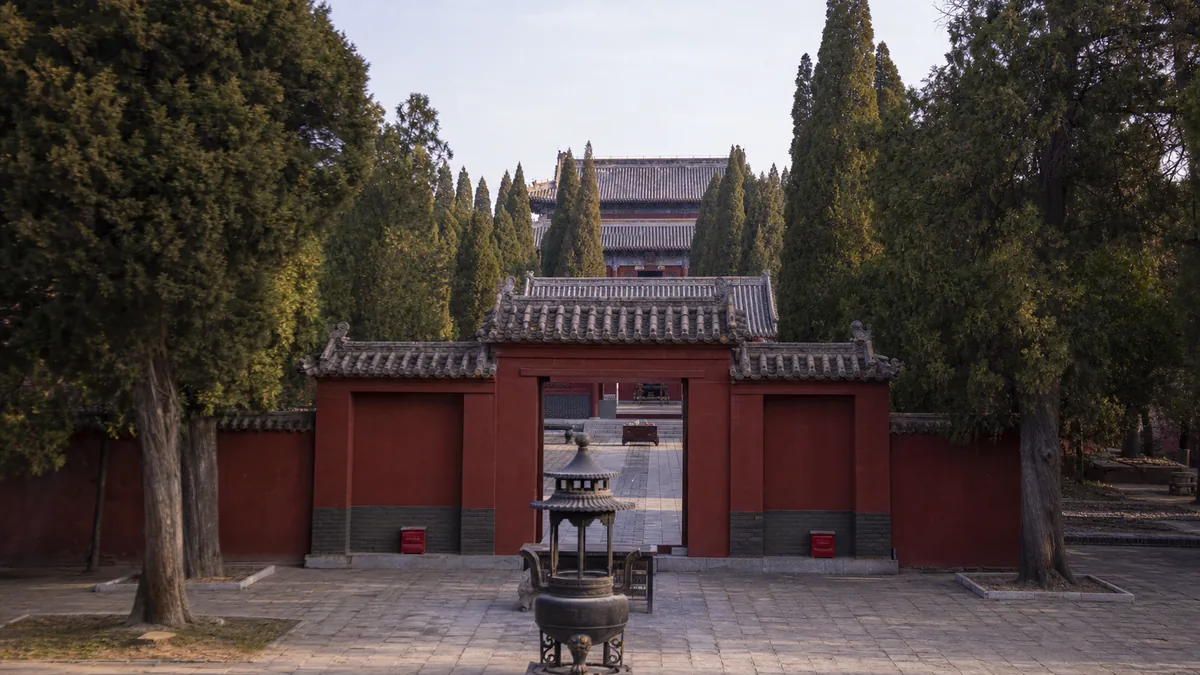
5A View location, maps and nearby scenic areasEnter the first gate at Taihao Fuxi Mausoleum and pause before crossing the next threshold. The view narrows through a doorway, opens into a courtyard, then narrows again. Roofs, stone paths and old trees pull the eye steadily north. Only near the far end does the revered mound become the destination of the axis.
This sequence in Huaiyang District, Zhoukou, is more informative than asking immediately whether the mound is “really” Fuxi’s grave. Fuxi—pronounced approximately foo-shee in Mandarin—is a foundational culture hero in Chinese tradition, credited by later texts with ordering human life and reading patterns in the cosmos. The place preserves centuries of ritual, architecture and community memory. It does not preserve an archaeologically identified body of a datable ruler called Fuxi.
Read the site in three layers: the visible gates and halls are principally shaped by Ming, Qing and later work; the worship is a living practice renewed by each generation; Fuxi belongs to cultural memory rather than a verified biography. Nearby prehistoric archaeology is important, but it remains a separate category and site.
The central axis teaches you how to approach
The mausoleum-temple complex is organized as a long, predominantly north-south ritual sequence. Visitors pass gates commonly translated by names such as Wuchao Gate, Daoyi Gate, Xiantian Gate and Taiji Gate, then reach major halls including Tongtian Hall before approaching inner structures and the mound. Transliteration and access labels vary; the important fact on site is the repeated control of movement.
Each threshold changes status. The outer courts accommodate arrival and crowds. The main halls focus offerings and representations of the culture ancestor. The inner section slows visitors before the mound. Architecture therefore does not merely decorate a tomb: it turns walking into a graded approach from public space to a revered centre.
Look along the paving line rather than only at façades. Compare the broad central path with side circulation, raised thresholds with worn crossings, and ceremonial front doors with routes used by staff. Roof colour, bracket sets and stone elements reveal repair and replacement as well as age. “Ancient complex” does not mean every tile or timber is from one period.
The long symmetry can suggest permanence, yet its use is flexible. Barriers, incense management and visitor flow may redirect the ideal axis, especially during ritual gatherings. Follow the operating route: respecting a living site matters more than forcing a perfectly centred photograph.
Ming and Qing institutions made the form we see
Tradition places reverence for Fuxi in remote antiquity, but the visible complex has a more documentable architectural history. Imperial ritual systems, local administration and community worship all shaped it. The Ming court incorporated sites associated with culture ancestors into official ceremonial geography, and substantial Ming-period building established much of the axial order later repaired under the Qing and in modern times.
Fire, weather, political change, heavy use and routine decay required repeated intervention. Timber halls survive through replacement: a column foot is repaired, roof tiles renewed, painted surfaces reapplied and drainage corrected. The result is a historical continuity carried by institutions and practice, not a sealed construction untouched since mythical times.
This distinction protects, rather than diminishes, the monument. A Ming or Qing gate is evidence for how those societies organized ancestry, legitimacy and space. A recent repair shows what the present community chooses to maintain. Calling the entire complex “built by Fuxi” would erase the craftspeople, donors, officials, ritual specialists and residents who actually sustained it.
Public measurements of the precinct can differ according to whether gardens, approach spaces, fairground or the core protected compound are counted. Instead of treating one area figure as timeless, observe the practical scale: several thresholds separate the street from the mound, and crowds can fill the intervals very differently on an ordinary morning and a major fair day.
Fuxi is a culture ancestor, not an excavated king
Fuxi appears in Chinese tradition among primordial sovereigns and culture bringers. Later accounts connect him with the Eight Trigrams, fishing nets, domestication, music, marriage customs and the ordering of social life. These attributions explain beginnings: they gather many slow, collective human developments into the actions of a memorable ancestor.
The textual traditions were compiled and changed across centuries. Names and identities such as Taihao and Fuxi were combined, distinguished or reinterpreted in different sources. There is no contemporary inscription, securely dated burial assemblage or excavated biography that allows archaeologists to identify a historical individual Fuxi and place his remains beneath this mound.
For visitors familiar with origin figures such as Rome’s Romulus, the analogy is useful only up to a point. A culture hero can organize identity, ethics and civic memory without functioning as a modern, documentable biography. Fuxi belongs to a specifically Chinese web of cosmology, lineage and ritual and should not be reduced to a Chinese version of someone else.
Use careful language: “tradition honours Fuxi here,” “the mound is revered as his mausoleum,” or “later texts credit him with…” Avoid “archaeologists found Fuxi’s grave.” The first statements describe observable and documented cultural practice; the last claims evidence that does not exist.
“Looking up and down” became a story of civilization
A famous passage in the Xici, or Appended Statements associated with the Yijing, says that in ancient times Fuxi “looked up to observe the images in heaven and looked down to observe the patterns on earth.” It continues by connecting such observation with the creation of the Eight Trigrams and ways of ordering life.
This is not a quotation recorded from Fuxi’s mouth. The text belongs to a much later literary and philosophical tradition. Its value lies in how it imagines culture: knowledge begins by comparing sky, land, animal markings and the human body, then converting perceived relationships into signs.
Around the complex, trigram imagery and explanations of invention turn that passage into a visual programme. Nets, tools, music or social customs may be presented as single gifts from the ancestor. Read them as a compressed genealogy of civilization, not as a patent register with an identifiable inventor and date.
The modern echo is everywhere. School lessons, family-origin narratives, cultural festivals and digital graphics continue to use Fuxi as a symbol of pattern, kinship and shared beginnings. The old phrase “look up and look down” can also guide the visit: look up at roof alignments and down at worn paving, then ask what generations have added between them.
Worship keeps the place from becoming a static museum
People come to honour an ancestor, seek blessings, offer incense, fulfil vows or participate in communal ritual. Their reasons are not identical, and visitors should not turn worshippers into a colourful spectacle. Stand aside when a family bows, keep voices low near an altar and never rearrange offerings for a photograph.
Incense operation can change with air quality, fire prevention, crowd conditions and festival rules. Use only designated burners or offerings, and follow staff if flame or quantity is restricted. More smoke does not mean more respect. A quiet bow without buying anything can be appropriate; non-worshippers do not need to imitate rites they do not understand.
Local craft and performance also belong to the living landscape. Clay figures commonly called nini gou, food stalls, music and processions may appear in fair culture. Claims that a craft is a “living fossil” are evocative tourism language, not literal archaeological dating. Ask vendors about makers and current practice rather than treating people as survivors from prehistory.
This distinction reveals the human chain behind the monument: ritual leaders, cleaners, craftspeople, stallholders, security workers, pilgrims and residents all produce the site visitors meet today. Heritage is not only inherited timber; it is repeated work.
The temple fair changes the whole visit
Huaiyang’s major Fuxi temple fair follows the lunar calendar and is commonly associated with the span from the second day of the second lunar month to the third day of the third. Exact Gregorian dates shift every year. Official ceremonies, performances, vendor areas, traffic controls, tickets, reservation procedures and attendance rules also change.
On an ordinary day, the axial sequence is easier to read, old trees and rooflines are clearer, and worship can feel intimate. During the fair, the meaningful subject is collective participation: families return, vendors extend the ritual economy, performances occupy public space and the approach itself becomes part of the event. Neither experience is the “authentic” one at the expense of the other.
The trade-off is crowd pressure. A courtyard that takes minutes to cross on a quiet day can become a controlled queue. Roads may close, pickup points move and phone service slow. Save the entrance name and a meeting point in Chinese, carry minimal belongings and do not attach a narrow onward connection.
Check the current year’s Huaiyang and scenic-area notices rather than converting a traditional lunar range into a permanent schedule. A video from a record crowd year does not predict this year’s scale, and an announced festival does not guarantee every ritual or performance will be public.
The mound is revered evidence, not identified remains
At the far end of the axis, the earthen mound has a different visual language from the timber halls. Trees, a marker and enclosed space focus attention on a place treated as the mausoleum of Taihao Fuxi. What you can directly observe is the maintained mound, inscriptions, offerings, controlled approach and the behaviour of people who honour it.
Those observations support a history of commemoration. They do not reveal who, if anyone, was originally buried within the earth. Without an excavation that securely identifies remains and context—and without an independently documented historical Fuxi—archaeology cannot confirm the traditional attribution.
Do not treat this uncertainty as an invitation to demand excavation. Burial and ritual landscapes have ethical, religious and conservation value that does not depend on opening them. Nor should a lack of biographical proof turn reverence into “mere superstition.” The historically demonstrable subject is a community’s durable practice of locating origins here.
Keep to barriers, do not touch the marker or mound and avoid playful poses. If photography is restricted, the rule may protect both ritual attention and physical conservation. A photograph of people grieving, praying or making a private vow requires consent, even when taken from a public route.
Pingliangtai belongs to a separate archaeological story
The wider Huaiyang area contains important archaeology, including Pingliangtai Ancient City, a separate site known for the material remains of an early walled settlement and sophisticated drainage in prehistoric China. Excavated walls, surfaces, pottery and infrastructure can be studied through archaeological context and dating.
That evidence matters enormously, but proximity does not turn it into proof for the mausoleum’s attribution. “People lived in this region in deep antiquity” and “this mound contains a named culture hero” are different propositions. Several millennia of local settlement history cannot be collapsed into one biography.
Plan Pingliangtai as another venue with its own entrance, displays, access and current opening conditions. Do not assume it lies inside the mausoleum circuit or that one ticket and timetable cover both. Museum interpretation can change as research advances, which is a strength of archaeology rather than a weakness.
To compare categories elsewhere in Henan, Yinxu offers excavated royal precincts, inscriptions and tomb contexts tied to late Shang history. Mount Mangdang shows how documented Han royal tombs coexist with later Liu Bang legends. Qingming Riverside Landscape Garden demonstrates a third category: a modern performance park inspired by a historical scroll.
Walk gently enough to notice who is using the axis
A quiet first visit can proceed gate by gate, pausing at the edge of each courtyard before entering the main hall zone and then the mound precinct. During a fair or ceremony, let the operating queue replace this ideal route. Check current admission, last entry, ritual access and bag or identity requirements; none should be assumed permanent.
For architecture photographs, use one doorway to frame the next and include a person at respectful distance for scale. Side light catches roof profiles and old tree trunks. Do not block the central route for symmetry, use flash inside halls without permission or hold a camera over someone making an offering.
The axis is mostly level compared with a mountain site, but accessibility is not automatically complete. High thresholds, stone edges, uneven paving, long distances and dense crowds can form barriers. Wheelchair users and visitors with limited stamina should confirm step-free side gates, ramps, accessible toilets, rest points and whether festival barriers interrupt the usual route.
At the end, turn south and look back through the thresholds. You have not verified the grave of a prehistoric king. You have seen something that can be documented with equal seriousness: Ming- and Qing-shaped architecture, repaired by later hands, organizing a living community’s relationship with an ancestral figure.
The opening view now carries more than symmetry. Every gate separates another category—building from belief, tradition from biography, archaeology from reverence—while allowing them to remain in one landscape. Make the last photograph only after the path clears, then leave the axis to the people who have come not merely to see it, but to use it.
Location profile
Where it is

Frequently asked questions
Is Taihao Fuxi Mausoleum a scientifically verified tomb of a historical ruler?
No. The site is a major ritual landscape dedicated to Fuxi, a foundational culture hero in Chinese tradition. Its mound and long history of worship are culturally significant, but archaeology has not verified Fuxi as a datable historical individual buried here. The surviving architectural complex is principally a legacy of Ming, Qing and later rebuilding and repair.
When is the Huaiyang Fuxi temple fair?
The major fair is traditionally associated with the second and third lunar months and is commonly described around the period from the second day of the second lunar month to the third day of the third. Gregorian dates, duration, ceremonies, ticketing, traffic controls and crowd limits can change each year, so consult that year's official Huaiyang or scenic-area notice.
Can non-worshippers enter, and how should visitors behave?
Visitors who are not worshipping can normally experience the site, but should yield space to ritual participants, avoid stepping between a person and an altar, never handle offerings, and ask before photographing faces. Follow current rules for incense, flames, interior photography and restricted areas; large ritual days may use separate queues or controls.
Is Pingliangtai Ancient City part of the Fuxi mausoleum?
No. Pingliangtai is a separate archaeological site in the wider Huaiyang area, known for material evidence of an early walled settlement and drainage. Its excavated chronology is valuable for understanding prehistoric communities, but it does not prove that the Taihao mound contains Fuxi or turn a culture hero into an identified archaeological person.