Henan · Anyang
Yinxu: Read a Shang Capital from Earth and Bone
Cross Yinxu's palace foundations, Fu Hao's tomb, royal cemetery and new museum to see how oracle bones turned a low archaeological landscape into an unusually detailed record of late Shang power.
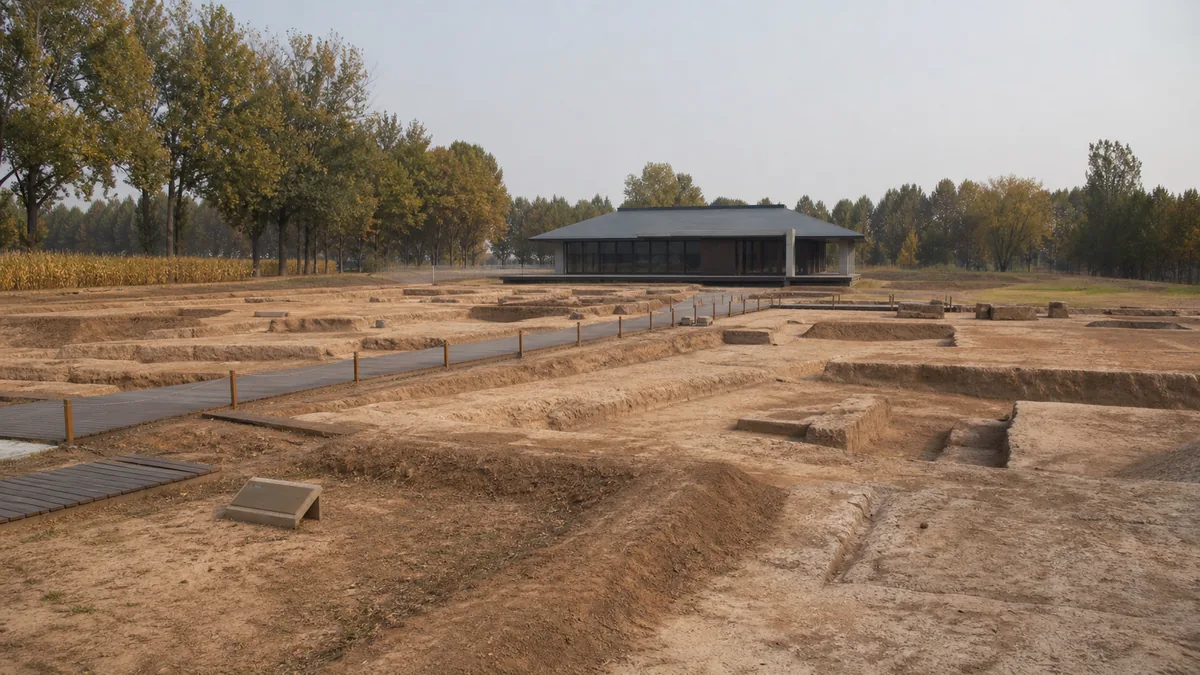
5A View location, maps and nearby scenic areasStop at the edge of a rectangular patch of compacted earth in the Palace and Royal Ancestral Shrine Area. There is no bronze-roofed palace to photograph. Low foundations, postholes and protective planting ask you to reconstruct walls that disappeared more than three millennia ago. The apparent emptiness is the first honest fact about Yinxu—pronounced roughly yin-shyoo, “the ruins of Yin.”
Then look for the Huan River on the site map. The late Shang capital extended across its banks, and today’s visit is divided accordingly. Fu Hao’s tomb sits within the Xiaotun palace-temple core; the newer Yinxu Museum is a separate, purpose-built stop nearby; the royal cemetery is roughly 2.5 kilometres northwest, across the river. These are related parts of one capital, not adjoining galleries inside one park.
Build the capital in three layers: begin indoors with labelled objects if you need context; walk the palace-temple ground to match objects with places; add the royal cemetery only with time and confirmed transport. Current tickets, reservations, shuttles and entrances can change, so use the dated official visitor map rather than an old itinerary.
The low ground is the first exhibit
Yinxu rewards a different kind of looking from a palace or cave temple. Roof timber, painted walls and most above-ground architecture are gone. What survives are relationships: a rammed-earth platform beside a road, a line of postholes, a storage pit cut by a later trench, workshops away from ceremonial buildings, and burials separated by rank and location.
The palace-temple zone lies around Xiaotun, on the south side of the Huan. Archaeologists identified many building foundations and sacrificial pits here, but labels such as “palace,” “temple” and “ancestral shrine” describe interpretations based on plan, finds and comparison. They should not turn every exposed rectangle into a room with a known name. Conservation shelters and reconstructed outlines help the eye, yet they are modern aids rather than surviving Shang walls.
Use people for scale. A modest earthen platform could carry a substantial timber hall because hangtu, or rammed earth, was compacted layer by layer inside temporary forms. Look at a protected section from the side: its horizontal bands are the labour record. Elite architecture depended on teams who quarried earth, carried water, tamped foundations, felled wood and maintained a capital whose monumentality was spread horizontally rather than concentrated in stone towers.
A capital grew on both banks of the Huan
Yinxu is the archaeological name for the last major capital of the Shang dynasty, conventionally dated here from about 1300 to 1046 BCE. Later texts associate the move to Yin with King Pan Geng. Archaeology securely demonstrates a late Shang political and ritual centre at Anyang, but it cannot confirm every detail in narratives written centuries afterward.
Twelve kings ruled during the Anyang phase according to the combined inscriptional and transmitted record. The capital was not a neat walled rectangle like many later Chinese cities. Palatial and ancestral precincts, neighbourhoods, clan cemeteries, bronze foundries, bone workshops and roads occupied a broad landscape. Published estimates for “Yinxu’s area” range from about 24 to more than 30 square kilometres because researchers count different surveyed remains and keep revising the edge as new settlements and workshops are found. UNESCO’s inscribed property is smaller than the entire archaeological spread; heritage boundaries and ancient urban extent are not the same measurement.
After the Zhou conquest around 1046 BCE, the royal centre ceased to function in its old form, although people did not simply vanish overnight. Later occupation, farming, river change and construction covered or disturbed parts of the site. That long afterlife explains why the visitor encounters fragments rather than a city abandoned in a single sealed moment. The Huan is not scenery beside the capital. It supplied water, shaped movement and now separates the most visited archaeological zones.
Oracle bones are questions, not an alphabet chart
The best-known finds are pieces of ox shoulder blade and turtle plastron prepared for royal divination. A diviner applied heat to hollows; cracks formed; the king or specialists interpreted them. Some surfaces were then inscribed with a date, diviner, charge or proposition, and occasionally a verification of what happened. The repeated opening translated as “Crack-making on the guisi day, Que divined …” sounds formal because it records procedure: day, named practitioner, then the issue placed before the ancestors or powers.
Questions concerned rain, harvest, warfare, hunting, illness, childbirth, ritual offerings and the coming days. The bones therefore resemble a royal ritual archive combining court diary, campaign register and ancestral consultation more than a book for ordinary readers. They are not quite a Chinese Rosetta Stone: no parallel translation unlocked them. Scholars decipher signs by matching repeated contexts, later forms of Chinese characters and archaeological evidence.
Roughly 150,000 inscribed fragments are often cited from Anyang and the antiquities market, with more than 4,000 distinct sign forms catalogued. Counts differ because broken pieces may join, graphic variants can be split or grouped, and new finds continue. Only a portion of the signs can be read with broad agreement. This is the earliest large, mature body of Chinese writing known, not necessarily the first moment anyone wrote Chinese. In the galleries, choose one complete inscription and follow the crack, line direction and translated question before admiring a case full of tiny fragments.
Earth foundations and bronzes describe one system
Shang bronze vessels can dominate photographs, but they were products of an urban network. Yinxu workshops used piece-mould casting: a model helped form clay mould sections, an inner core created the hollow, and molten bronze filled the space between. Complex relief and inscriptions could be built into this carefully planned assembly. Large vessels required mining and transport networks, fuel, clay preparation, alloy knowledge and coordinated labour—not merely one inspired artist pouring metal.
Many vessels served food and drink offerings in exchanges between the living elite and royal ancestors. Animal-mask designs conventionally called taotie are real visual patterns; confident claims that every motif represented one specific deity are not. Look for seams, handles, flanges and short inscriptions as evidence of manufacture and ownership. A vessel’s weight is impressive, but its position inside a tomb or ritual set can reveal more than a superlative.
Bone hairpins, jade ornaments, chariot fittings and tools restore lives beyond the banquet vessel. Craft quarters show people processing bone and casting metal at scale. Some were skilled specialists; some labour may have been coerced. Access to imported shell, jade and metal shows long-distance exchange, while lavish ritual deposits show how unevenly those resources were distributed. At Yinxu, technical achievement and concentrated power cannot be separated.
Fu Hao appears in both archive and grave
The tomb of Fu Hao—foo how, also called Lady Hao—was excavated in 1976 under archaeologist Zheng Zhenxiang. It lies within the palace-temple zone, not in the separate royal cemetery. Because the pit had escaped major ancient robbery, it preserved the only intact Shang royal burial so far excavated scientifically with its contents, making an unusual bridge between a named person in inscriptions and objects placed at death.
Oracle records present Fu Hao as a consort of King Wu Ding who conducted rituals, held an estate and led military campaigns. They also ask about her health and childbirth. That archive prevents her from becoming only a romantic “warrior queen,” while weapons in her tomb prevent a reading that reduces elite Shang women to domestic roles. Cause, turn and consequence are visible: royal position gave her authority; campaigns and ritual duties made that authority public; her death led Wu Ding to address her in later divinations as a powerful ancestor.
The tomb yielded more than 1,900 registered objects, including bronzes, jades, bone objects, weapons and thousands of cowrie shells. Published totals vary with classification. Human and dog remains were also placed with the burial. State the evidence without turning the victims into theatrical detail: their presence records a hierarchy in which one elite afterlife could require other lives. At the pit, keep voices low, obey photography rules and remember that the grave is evidence of both Fu Hao’s exceptional agency and other people’s denied agency.
The royal cemetery makes power’s violence visible
Across the Huan and northwest of Xiaotun, the Royal Cemetery Area at Xibeigang contains immense cross-shaped and rectangular tombs, ramps, sacrificial pits and later display structures. The royal tombs were robbed repeatedly, so their surviving contents cannot be compared simply with intact Fu Hao inventories. Their scale still communicates an enormous mobilisation of labour and ritual resources.
Archaeologists have found human and animal victims in many contexts at Yinxu. Some people were buried as attendants in elite graves; others were killed in collective sacrificial events. Inscriptional terms, body treatment, age and origin studies help researchers distinguish practices, but interpretation continues. Avoid the easy phrase “the Shang were brutal” as though violence belonged only to a distant culture. Ask instead who controlled ritual, whose names entered the archive, whose bodies became deposits, and what the evidence lets scholars say—or not say—about captives, dependants and local communities.
Visitor presentation may expose pits, replicas or skeletal remains. Do not point cameras into another visitor’s face for a reaction, pose over a burial, touch protective structures or use remains as a comic backdrop. Children can be prepared in advance: explain that archaeology studies real people and that the purpose of viewing is to understand an unequal society, not to seek a fright. If this material is distressing, the outdoor perimeter and interpretive panels can provide context without close viewing.
Excavation changed both Chinese history and archaeology
Oracle bones entered collectors’ markets before their source was understood. Their inscriptional importance was recognized in 1899, traditionally associated with scholar Wang Yirong, and investigators later traced many pieces to Xiaotun. Market discovery also destroyed context: once a bone leaves its pit without a record of layer and companions, much of its story disappears.
Systematic excavation began in 1928 under the Institute of History and Philology of Academia Sinica. Li Ji and a multidisciplinary team helped establish field recording, typology and laboratory study within Chinese archaeology. Work paused amid war and upheaval, then continued under later institutions. Zheng Zhenxiang’s discovery of Fu Hao’s tomb shows the modern echo: a name read in texts could be tested against a carefully excavated context, while the grave in turn corrected assumptions about gender and authority.
Do not translate this history into “legend became fact” too neatly. Inscriptions confirm Shang kings and events, material remains reveal institutions and production, and transmitted texts preserve some memories—but the three evidence streams ask different questions. Yinxu entered the UNESCO World Heritage List in 2006 because its urban remains, writing, craft and burial evidence preserve an exceptional late Shang civilisation. Listing did not end excavation; much of the ancient capital remains underground precisely because preservation can be safer than exposing it.
The new museum returns objects to their contexts
The purpose-built Yinxu Museum, opened in 2024, greatly expanded the indoor interpretation of Shang civilisation. Its architecture and exhibition design are contemporary; the antiquity lies in excavated objects and documented contexts, not in the building’s bronze-coloured surfaces. Treat it as a reading room for the landscape rather than a replacement for the landscape.
Begin with chronology and a site map. Then choose a few object families—oracle bones, bronze ritual sets, jade, chariots and craft debris—and repeatedly ask three questions: where was it found, what accompanied it, and what conclusion rests on that context? A masterpiece without proven findspot can be visually powerful but historically quieter than an ordinary tool recovered from a recorded workshop floor.
Displays rotate for conservation and research; famous objects associated with Yinxu may also belong to national or provincial collections elsewhere. Replicas, digital joins and reconstructions should be labelled, and they can explain scale better than an original fragment alone. Photograph labels as well as objects if permitted. The museum and archaeological park may use separate reservations or combined arrangements, and popular dates can introduce timed entry. Confirm the current official notice, passport or identity-document requirement, baggage rules and re-entry policy before arrival.
Let one question choose your route
For a first visit, begin at the museum so the script, chronology and city plan are familiar. Continue to the palace-temple zone, where foundation outlines, oracle-bone find contexts and Fu Hao’s tomb turn labels into places. Add the royal cemetery last if current transfer arrangements and your energy allow. The distance is short by road but not an intuitive continuation on foot, and gates or bridges may not match the straight line on a map.
For an archaeology-first route, reverse the order: read the low foundations in soft morning light, then use the museum to test what you thought you saw. For a short route, choose museum plus palace-temple zone and leave the cemetery for another visit; this is more coherent than racing through all three. A specialist can spend most of a day on inscriptions and excavation history alone.
Allow slack for security, reservations and transfers. Hours, ticket combinations, free or paid shuttles and last departures can change. Check the official Yinxu museum/scenic-area channels on the day and show staff the Chinese names 殷墟博物馆, 宫殿宗庙遗址 and 王陵遗址 when confirming where to board. If you continue through Henan, compare archaeological evidence at Longmen Grottoes, modern historical staging at Qing Ming Shang He Garden, or twentieth-century engineering memory at Red Flag Canal.
Photograph evidence, then return to the earth
The museum is the easier accessibility base: controlled temperature, lifts and seating are commonly available, though galleries are extensive. Outdoors, expect long paths, uneven paving, thresholds, glare, summer heat, winter wind and limited shelter. Looking into the Fu Hao tomb or some cemetery presentations may involve steps. Visitors using wheelchairs or walking aids should ask about current step-free entrances, accessible vehicles and toilets rather than assume every mapped line is barrier-free.
For photographs, use raking morning or late-afternoon light to reveal shallow foundation edges. Include a path or person at a respectful distance to show horizontal scale. In the museum, reflections make a polarising filter useful if permitted, but flash, tripods and photography of remains may be restricted. Never cross a rope for a cleaner frame, and do not rearrange offerings or interpretive material.
Before leaving, return to the first compacted-earth rectangle. It now carries timbers, ritual work, diviners, craft specialists, Fu Hao’s recorded decisions and the people whose names did not survive. Yinxu’s achievement is not that every silence has been deciphered. It is that cracks in bone and layers in earth can be compared without pretending they say more than they do. Make one last wide photograph with plenty of empty ground; then lower the camera and give that incompleteness time to register.
Location profile
Where it is
Frequently asked questions
Is Yinxu one museum or several separate places?
Yinxu is a large archaeological landscape, not one building. The palace-temple zone and Fu Hao's tomb form the Xiaotun core; the purpose-built Yinxu Museum is a separate indoor stop nearby; and the royal cemetery lies roughly 2.5 kilometres to the northwest across the Huan River. Tickets, combined admission and transfers can change, so confirm the current map and transport arrangement before starting.
How long should I allow for Yinxu?
A focused museum-plus-palace visit can occupy most of a half day. Adding the royal cemetery, slow reading of the oracle-bone galleries and transfer time makes a full day more comfortable. Entry slots, opening hours and last shuttles vary, so avoid fixing a tight onward train around an assumed finish time.
Can visitors see original oracle bones and the real Tomb of Fu Hao?
The museum normally displays original excavated objects, although individual pieces rotate for conservation. The excavated tomb pit of Fu Hao is in the palace-temple zone, while many of its best-known bronzes, jades and other grave goods are protected in museum collections. Check gallery notices rather than assuming every famous object will be on view.
Is Yinxu suitable for visitors with limited mobility?
The new museum is the most controlled indoor environment, but the archaeological zones involve outdoor distances, uneven surfaces, thresholds and exposed weather; the view into Fu Hao's tomb may also require steps. Ask the site about step-free routes, wheelchairs, accessible toilets and transfers between zones before arrival.