Henan · Luoyang
Longmen Grottoes: Reading a Buddhist Cliff
Follow the Yi River from intimate donor niches to the monumental Vairocana, then cross the water to see how devotion, damage and conservation have reshaped the cliff.
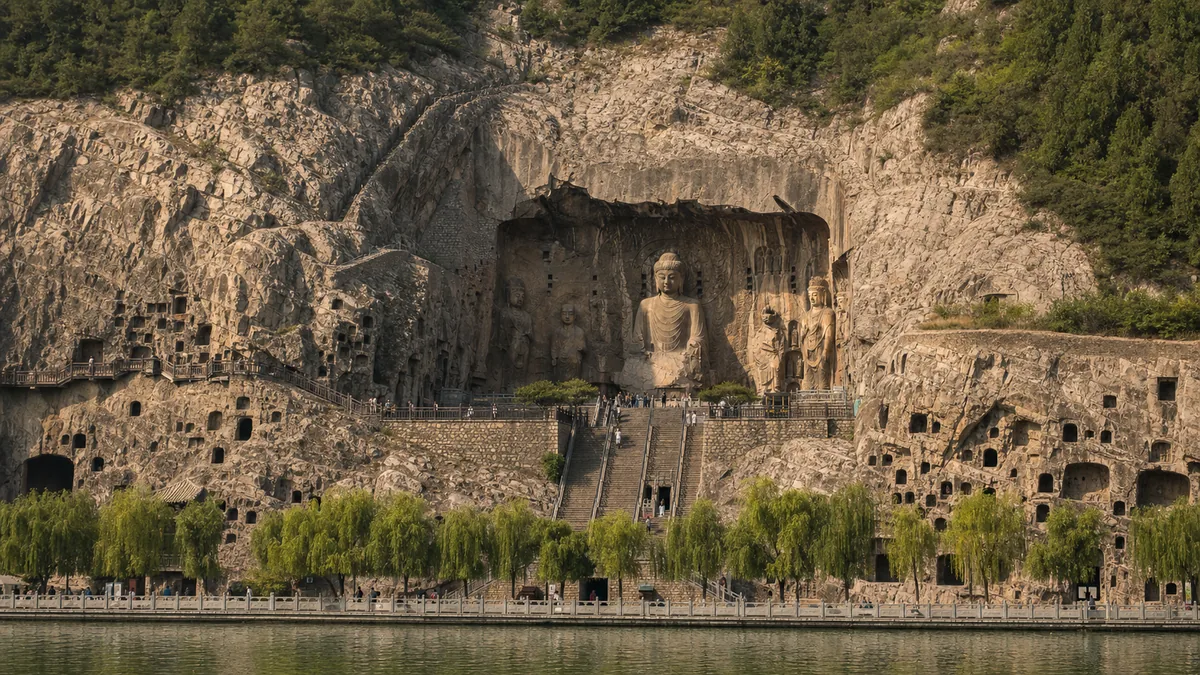
5A View location, maps and nearby scenic areasStand on the west bank of the Yi River and let your eyes adjust to the pale limestone. At first the cliff looks perforated. Then doorways, halos, tiny seated Buddhas and empty rectangular scars separate from the rock. Some figures are no bigger than a hand; others occupy an entire open sanctuary.
This is Longmen—pronounced roughly “long-men,” and literally “Dragon Gate”—about 13 kilometres south of central Luoyang. The river passes between the hills of Longmen to the west and Xiangshan to the east. For several centuries, that natural gateway became a surface on which emperors, court women, monks, officials and ordinary donors made Buddhist belief visible.
Use the river as your plan: walk the principal grotto sequence southward on the west bank first; give Fengxian Temple unhurried time; then decide whether the bridge, east-bank views, Xiangshan Temple and Bai Garden justify the extra distance and stairs. Current entrances, bridge access and shuttles should be confirmed on arrival.
Read the cliff as an archive, not one cave
“Grottoes” can suggest a single underground complex. Longmen is instead a long accumulation of caves, shallow niches, reliefs, inscriptions and architectural cuttings distributed along both banks, with the overwhelming concentration of famous sculpture on the west cliff. The main carved frontage extends for roughly a kilometre. Its sequence is historical rather than neatly planned.
Look for three scales. First are the monumental chambers and open sanctuaries that announce imperial resources. Second are human-sized caves whose central Buddha, attendants and wall reliefs create a contained devotional world. Third are thousands of small niches commissioned for merit, remembrance, recovery from illness or the welfare of relatives. The smallest marks are not decorative filler; they preserve participation by donors with very different means.
The stone also carries absences. Empty sockets may indicate decay, lost fittings or removed sculpture; chisel scars may belong to original making, repair or deliberate cutting. Limited pigment survives, so today’s grey and ochre should not be mistaken for the original effect: many images were coloured, and some details may have been gilded. Longmen is closer to a damaged manuscript than to a gallery installed in one moment.
Luoyang turned Buddhist devotion into stone
Large-scale carving began in the late fifth century, closely connected with the Northern Wei court’s move from Pingcheng, present-day Datong, to Luoyang under Emperor Xiaowen in 494. Work at Longmen is commonly dated from around 493. The dynasty’s rulers had Xianbei origins, while court reform increasingly adopted institutions and styles associated with the Chinese imperial tradition. Buddhism offered both personal devotion and a powerful language of rulership.
Early Northern Wei figures often have elongated bodies, patterned robes and composed, somewhat abstract faces. They are not failed attempts at Tang naturalism. Their line, proportion and spiritual reserve express a different visual ideal. Court-sponsored chambers stood beside niches funded by monks, officials, lay associations and families, making the cliff both political and personal.
After the Northern Wei fractured, carving continued at changing intensity. The Tang dynasty (618–907) produced Longmen’s greatest new concentration, especially in the seventh and early eighth centuries, when Luoyang again served as an imperial capital. Bodies became fuller, drapery gained weight and guardian figures seem to twist against the stone. Tang patronage under Emperor Gaozong and Wu Zetian culminated in the ensemble now called Fengxian Temple.
Later work was more intermittent rather than ending neatly in 907. Today’s site is chiefly a Northern Wei-to-Tang achievement, altered by worship, repair, weathering, removal and conservation. In 2000, UNESCO inscribed Longmen under criteria (i), (ii) and (iii), recognizing exceptional artistic creation and evidence of a major cultural tradition.
Why the totals never quite agree
UNESCO’s overview describes about 2,300 caves and niches, almost 110,000 Buddhist stone statues, more than 60 stupas and about 2,800 inscriptions. Longmen’s own widely repeated count is more exact in one category—2,345 caves and niches—and usually says over 100,000 images. Both can be responsible summaries.
The difference begins with definitions. Is a shallow opening a cave, a niche or part of a larger cave wall? Should a damaged outline count as a statue? Can every thumb-sized Buddha in a repeated field be identified separately? Inventories made at different dates also respond to erosion, fragments, inaccessible surfaces and improving survey methods. Translation can blur the Chinese term commonly rendered as “caves and niches.”
Use the figures as orders of magnitude, not a scavenger hunt. Compare one enormous figure with a wall of miniature Buddhas: patronage could proclaim imperial scale or multiply a modest offering. Documentation lets conservators track cracks, water staining, biological growth and loss, but false precision hides that Longmen contains many campaigns, not a stable inventory.
Guyang and Binyang preserve voices of patronage
At Guyang Cave, one of Longmen’s earliest major caves, do not focus only on the central image. The walls are crowded with niches and dedicatory texts created largely in the late fifth and early sixth centuries. Many celebrated examples of Northern Wei calligraphy at Longmen come from here. Their angular, energetic characters are now studied as art, but they originally named donors and stated religious intentions.
The famous “Twenty Selected Inscriptions of Longmen” are a later scholarly canon rather than the only twenty texts worth noticing; nineteen are conventionally associated with Guyang Cave. Their survival turns apparently repetitive niches into a social record. Princes and officials had visibility, yet monks, lay believers and donor groups also appear. The artisans who quarried, drew, carved and painted the images are much less consistently named.
The Binyang caves prevent another easy simplification. Binyang Middle Cave was an ambitious Northern Wei imperial commission, begun under Emperor Xuanwu in honour of his parents and completed only after prolonged work. The north and south caves visible beside it contain substantial Tang intervention or completion. “Three Binyang Caves” is therefore a spatial label, not proof that all three were made together in one style.
Compare faces and robes across the group. Northern Wei figures tend toward linear elegance; Tang figures occupy space with greater volume. Yet dating by one feature is risky: unfinished programmes resumed, surfaces were repaired and campaigns overlapped.
Fengxian Temple makes cosmic order bodily
The west-bank route builds toward Fengxian Temple, an open cliff sanctuary rather than an enclosed cave. Its principal ensemble was completed in the 670s, commonly dated to around 672–675, during the reign of Emperor Gaozong. An inscription records major imperial involvement, including a contribution associated with Empress Wu, the future ruler Wu Zetian.
At the centre sits Vairocana, known in Chinese here as Lushena (Lúshènà, roughly “loo-shen-ah”), the cosmic Buddha whose radiance and wisdom permeate the Buddhist universe. The surviving figure is about 17 metres high; the head is about 4 metres and each ear nearly 2 metres. Those numbers impress, but the ensemble explains the scale better. Disciples, bodhisattvas, heavenly kings and muscular guardians form a ranked court around the calm centre.
Move your attention from face to face. Vairocana’s eyes are lowered without closing; the mouth carries a controlled softness. The disciple Kasyapa appears aged and concentrated, while Ananda is youthful. Bodhisattvas wear elaborate jewellery. Farther out, armour, swelling muscles and a trampled demon turn protection into motion. Like the sculpted portals of a medieval European cathedral, the ensemble uses a hierarchy of figures to make an invisible moral cosmos legible—but its doctrine, patrons and visual language are specifically Buddhist and Tang Chinese.
You may hear that Vairocana’s face is a portrait of Wu Zetian. Her patronage and political importance make the association compelling, and later viewers have read her image into the Buddha’s authoritative composure. No surviving text establishes a literal portrait commission. Say that the face has been associated with Wu, not that archaeologists have identified it as her likeness.
Ten thousand Buddhas make repetition meaningful
Monumentality is only half of Longmen. Wanfo Cave, the “Cave of Ten Thousand Buddhas,” is named for the dense ranks of tiny seated images covering its walls. An inscription dates its completion to 680. The conventional count here is 15,000 small Buddhas, a devotional multiplication that overwhelms the eye precisely because no single miniature demands centre stage.
Nearby caves and niches reveal comparable changes of scale: a hand raised in reassurance, a lotus ceiling, musicians, donor processions or a few characters squeezed beneath a frame. In Buddhist practice, commissioning an image could generate merit and direct it toward parents, deceased relatives, the emperor or all sentient beings. Repetition was action, not an absence of imagination.
It also depended on labour. Quarry workers prepared stone, designers set programmes, carvers moved from rough blocks to details, and painters completed surfaces from scaffolds. Inscriptions preserve who paid or prayed more readily than who inhaled stone dust; an unfinished niche may expose the workers’ sequence better than a masterpiece.
Do not touch even a plain-looking wall. Oils, abrasion and the cumulative pressure of millions of visitors matter at a site already weakened by fissures and water. Photography restrictions, barriers and platform capacity can change with conservation work; follow the signs at each cave rather than assuming one rule covers the entire cliff.
Missing faces belong to the history too
Some of Longmen’s most confronting surfaces are headless bodies and clean-edged cavities. Natural weathering, rock instability and centuries of human action all caused loss, but many sculptures were deliberately removed during the late nineteenth and especially early twentieth centuries, when political disorder, illicit dealing and an international market for Chinese Buddhist art converged. Fragments from Longmen entered private collections and museums overseas as well as collections within China.
Calling every absence “erosion” hides that history; calling every damaged face “foreign theft” also overstates what the stone alone can prove. Some images were vandalized in earlier religious or political upheavals, some were quarried out for sale, some fractured naturally, and some losses have incomplete records. Researchers use old photographs, matching breaks, inscriptions and material study to identify dispersed pieces.
Museum display can isolate a beautiful head from its body, cave and donor text. At Longmen, the empty cut restores context and asks whether digital reunification, loans or return can repair more than appearance.
Conservation now addresses water seepage, temperature change, soluble salts, air pollution, biological growth, vibration and crowd pressure. Stabilising the cliff may require drainage, monitoring and restricted access rather than a visibly “new” surface. UNESCO status does not freeze Longmen outside time; it increases the duty to manage continuing change without turning ancient sculpture into a reconstruction.
Walk the west bank first—and accept the stairs
For a first visit, use the west bank as the narrative spine. From the usual northern approach, smaller Tang caves introduce iconography before the Northern Wei density of Binyang and Guyang. Lotus Cave rewards looking overhead when access allows; Wanfo Cave demonstrates repetition; Fengxian Temple provides the monumental climax farther south. Exact one-way controls and open platforms can change, so use the day’s map rather than forcing this sequence against barriers.
A selective route beats cave fatigue. Ask how Northern Wei bodies differ from Tang bodies, who appears in inscriptions, how scale changes devotion and where loss is visible. Minor niches then remain relevant, and Fengxian becomes more than the biggest photo stop.
The west-bank walkway includes repeated flights of stone steps, narrow landings and uneven or polished surfaces. Heat, rain, winter ice and dense crowds magnify the effort. Footwear with grip matters; so does leaving room on platforms instead of stopping at a stair mouth. Visitors with limited mobility should ask staff which major views are currently reachable without steps and whether any assistance or alternative viewpoint is operating.
Allow a substantial half day for the main caves. Opening hours, ticketing, identity requirements, shuttle routes and last entry are operational details, not permanent facts. Confirm current notices through the official scenic-area channels and at the visitor centre, particularly if you plan an onward train the same day.
Cross to the east bank for distance and afterlife
Near the southern end, a bridge commonly allows visitors to cross the Yi River and return north on the east bank. This is not simply an exit. Distance recomposes the west cliff: Fengxian’s figures become part of a carved landscape, and the concentration of niches is easier to grasp than when your nose is close to the limestone. A moderate telephoto lens from across the river can show sanctuary, cliff and visitors together.
The east side also adds Xiangshan Temple and Bai Garden, associated with the Tang poet Bai Juyi (772–846), who called himself the Lay Buddhist of Xiangshan and was buried here. A line attributed to his record of restoring the temple says, “Among the scenic places around Luoyang, Longmen comes first.” Its force is geographical as much as promotional: river, gate-like hills, caves and temple formed one lived landscape for him. His support for Xiangshan Temple turned appreciation into patronage; the garden and tomb keep that connection present for modern visitors.
Treat the temple as a living religious space: give worshippers room, avoid intrusive portraits and follow hall signs. Bai Garden and the tomb are commemorative landscapes, not props. Access and photography rules can vary.
The trade-off is energy. East-bank paths and temple approaches add distance and climbing after an already stair-heavy west-bank circuit. If time or knees are limited, cross only if the broad view matters to you, or use the currently designated exit without treating the omitted attractions as failure. Verify bridge and exit arrangements before starting: a route that looks circular on an old map may operate differently during repairs or crowd controls.
Let the river complete the image
Longmen photographs best as a relationship, not a close-up alone. On the west bank, side light brings shallow carving and chisel texture forward; flat midday light can help you study recessed faces. Do not use flash, tripods or selfie equipment where prohibited, and never lean across a barrier. From the east bank, include the Yi River as negative space between the working cliff and your viewpoint. Haze, water level and illumination are conditional, so do not build the visit around a guaranteed reflection or night-lighting schedule.
Before leaving, look back at the surface that first seemed perforated. You can now separate Northern Wei line from Tang volume, donor text from empty scar, intimate repetition from imperial scale. The river has carried you from close reading to historical distance.
Longmen’s achievement is not that 100,000 figures survived unchanged. It is that enough relationships remain—between image and inscription, patron and artisan, body and absence, cliff and opposite bank—to make careful looking an ethical act. Take the wide photograph from across the river if your route permits, then lower the camera for one minute: the most honest final view includes both the radiance still carved in stone and the spaces history cut away.
Continue to Mount Song and Shaolin for another Henan landscape where Buddhist institutions, imperial memory and modern visitors overlap; choose Baiyun Mountain for Luoyang’s higher, forested terrain; or compare Longmen’s inscriptions with the much earlier writing evidence at Yinxu.
Location profile
Where it is

Frequently asked questions
How much time should I allow for the Longmen Grottoes?
Allow a substantial half day for the main west-bank caves without rushing. Add more time if you intend to cross to Xiangshan Temple and Bai Garden on the east bank. Entrances, bridges, shuttle stops and last-entry arrangements can change, so confirm the current route before committing to a tight onward connection.
Should I visit the west bank or east bank first?
For a first visit, the west bank usually comes first because it holds the densest sequence of major caves and Fengxian Temple. The east bank adds Xiangshan Temple, Bai Garden and the best broad views back to the carved cliff; it is rewarding but adds distance and stairs.
Does the Vairocana Buddha portray Empress Wu Zetian?
It is often said that the face resembles or was modelled on Wu Zetian, an important patron associated with the project. No surviving inscription proves that it is her portrait, however. Treat the resemblance as a later interpretation, not an established identification.
Is Longmen Grottoes accessible for visitors with limited mobility?
The riverside setting is relatively legible, but many cave platforms require uneven paving, narrow passages and repeated stairs; the approach to Fengxian Temple is especially demanding. Accessible sections and assistance arrangements can change, so ask the official visitor centre which major viewpoints are currently step-free before entering.