Henan · Dengfeng
Mount Song and Shaolin: Temple, Pagodas and Mountain Paths
Separate Shaolin's living monastery, martial-arts stages, Pagoda Forest and strenuous Sanhuangzhai paths, then read Chan tradition and UNESCO status without turning legend into evidence.
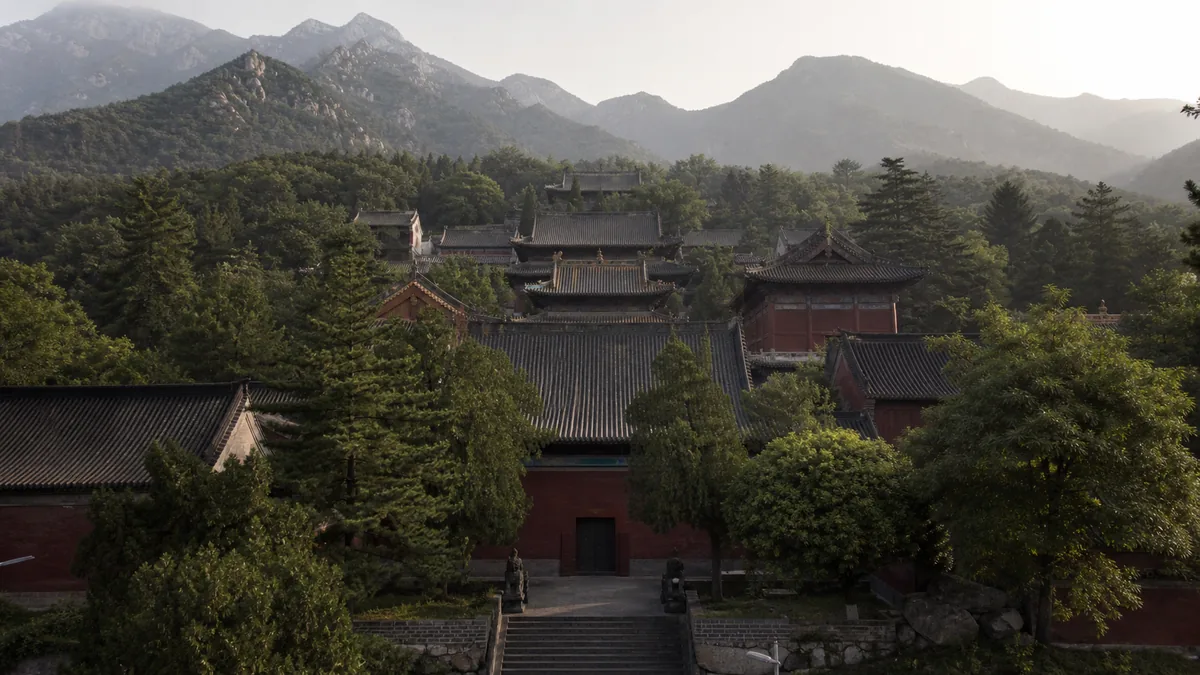
5A View location, maps and nearby scenic areasStand outside the main gate of Shaolin Temple and look past its roofline. The wooded wall behind it is Wuru Peak, part of the Shaoshi side of Mount Song. Incense may drift from the courtyards, while amplified applause or the thud of a demonstration carries from a separate performance venue. Those sounds belong to one famous destination, but not to one activity.
The useful first lesson is separation. A working monastery, a burial ground, ticketed martial-arts presentations and an exposed mountain trail have different histories, behaviours and physical demands. The distinction shows how many communities have made “Shaolin” mean something.
Choose the visit before you start walking: give the monastery and Pagoda Forest an unhurried core visit; add a martial-arts demonstration only if its current schedule fits; treat the Shaoshi–Sanhuangzhai mountain route as a separate hike, not as scenery automatically included behind the temple.
One scenic name contains four different experiences
Mount Song, or Songshan (roughly pronounced “soong-shahn”), is not a single summit. It is traditionally described through the Taishi and Shaoshi mountain groups and their many peaks. Junji Peak, on Taishi, is commonly called the main peak at about 1,492 metres; higher figures sometimes refer to another ridge or a different definition of the range’s highest point. Shaolin Temple sits on the Shaoshi side, so a Shaolin visit is not automatically an ascent of Junji.
The visitor corridor normally leads first through modern service and performance areas, then to the monastery’s controlled entrance. The Pagoda Forest lies farther west, reached by continuing beyond the main temple complex. Mountain transport and trails begin beyond or near this western sector, but their operation changes with maintenance, weather and crowd management.
This spatial order matters. The building where performers demonstrate staff, fist and acrobatics is not a prayer hall. The Pagoda Forest is not a decorative garden. A cableway ride does not deliver every visitor to a gentle summit promenade: upper routes still contain stairs, irregular rock and exposed walkways.
Use the Mount Song 5A profile as a map anchor, then read the entrance board before committing to a long route. The label joins the parts; your legs negotiate the distance.
Read the monastery as a living north–south axis
Shaolin Temple was founded in 495 CE under the Northern Wei, traditionally for the Indian monk Batuo—also rendered Fotuo or Buddhabhadra. That foundation date belongs to the institution, not to every timber column now visible. Fire, war, rebuilding and repair have repeatedly changed the complex. The great twentieth-century fire of 1928 destroyed major halls; much that visitors enter today reflects later restoration alongside surviving historic fabric, inscriptions and layout.
Pass through the mountain gate and slow down. Successive courtyards follow a generally north–south axis through halls for guardian figures, worship, teaching and memories of abbots. Roof height, forecourts and thresholds create a rhythm of compression and release; ancient trees and stelae interrupt the symmetry.
The temple remains an active religious institution. Monks do not exist merely as proof of an old martial legend, and a rebuilt hall can still hold present-day ritual meaning. Leave space around people bowing or offering incense. Follow signs on photography, keep voices low inside halls, and never turn an altar platform into a portrait set.
Generations of monks, donors, craftspeople, cooks and conservators sustained this place. Continuity lies not in an untouched fifth-century building, but in a religious community repeatedly repairing a vulnerable material home.
Bodhidharma belongs to tradition—and to a larger history
Temple tradition closely associates Bodhidharma, an early Buddhist teacher probably active in China around the fifth or sixth century, with Shaolin. The best-known story says he meditated facing a cave wall for nine years on nearby Wuru Peak. The cave and memorial sites give that narrative a physical address.
Yet the evidence needs layers. Early accounts of Bodhidharma are limited and differ about his origins and travels. The detailed Shaolin cave narrative appears in later tradition, and Chan Buddhism did not spring fully formed from a single conversation or nine-year retreat. It developed through communities, texts, teachers and institutional memory over centuries. Calling Shaolin “the birthplace of Chan” expresses an important religious tradition, not a modern archaeological proof of one precise founding moment.
A later Chan formulation says, “Point directly to the human mind; see one’s nature and become Buddha.” It summarizes an emphasis on awakening that is not confined to book learning. It should not be mistaken for a verbatim slogan carved by Bodhidharma at Shaolin. The story’s turn is the important part: a foreign teacher remembered for wordless wall-gazing became a central ancestor in a Chinese Buddhist lineage; that lineage later travelled and diversified across East Asia.
The modern echo appears in the language of Chan and martial practice as one, and in Zen traditions familiar overseas. Zen is the Japanese reading of 禪, but Shaolin is not a Chinese version of a Japanese Zen monastery. Treat the cave as a place where tradition gathers while keeping the historical question open.
Shaolin martial arts grew through history, not one miracle
The strongest early evidence for Shaolin monks in armed action is not a flying-kick legend but a stone inscription. In 621, during warfare at the end of the Sui dynasty, a group connected with the monastery supported Li Shimin, then Prince of Qin, against the forces of Wang Shichong. Later records and a Tang-period stele preserve the monastery’s service and rewards. Popular retellings compress this into “thirteen staff-wielding monks saved the Tang emperor,” although Li Shimin was not yet emperor and the encounter was more complicated than a rescue scene.
That difference reveals how reputation grows. The monastery had estates to defend and political choices to make. Martial skills developed within changing military, religious and local contexts. By the Ming period, Shaolin staff methods had attracted wider notice, but “Shaolin kung fu” never meant one frozen syllabus passed unchanged from 495.
The phrase “All martial arts under heaven come from Shaolin” is cultural acclaim, not a testable genealogy of every Chinese fighting art. Novels, opera, the influential 1982 film Shaolin Temple and international schools helped make the monastery a global emblem. Dengfeng’s large academies belong to that contemporary economy.
Watch a demonstration for timing, conditioning and stagecraft, but do not confuse it with a spontaneous monastic ritual. Performers may be students or professional teams, and programmes, venues and ticket conditions change. Applaud the skill without using costume as proof that every person on stage is an ordained monk.
The Pagoda Forest is a cemetery written in masonry
Continue west of the monastery and the vertical rhythm changes. Instead of one large hall, many compact towers rise among cypresses. This is the Pagoda Forest, a burial and memorial landscape for eminent monks. “Pagoda” here does not mean a viewing tower. Many structures mark cremated remains or commemorate an abbot’s religious standing and lineage.
UNESCO nomination records described 241 ancient pagodas dating from 689 to 1820, with modern examples continuing the tradition. Visitor sources often round the total to “about 250” or use higher figures when nearby pagodas and later structures are counted. “More than 240 surviving historic tomb pagodas” is the most useful onsite scale; the variation comes from date and boundary, not from a forest that can be counted like identical trees.
Walk the edge paths and compare square, hexagonal and circular plans; one or several storeys; dense eaves, relief carving and inscriptions. Form can reflect period, status, school and resources, but no single visual rule decodes every tower. Weathered script and replacement mortar also show conservation history.
This is sacred funerary ground. Stay on marked routes, do not lean on brickwork, climb bases or squeeze between barriers for a photograph. A quiet frame with two differently shaped pagodas usually explains the landscape better than a wide selfie that treats the monuments as props.
UNESCO protects a serial property, not the whole tourist park
In 2010, UNESCO inscribed the Historic Monuments of Dengfeng in “The Centre of Heaven and Earth.” It is a serial World Heritage property: eight groups containing eleven historic sites around Dengfeng, built and altered across many dynasties. The ensemble connects ritual gates, temples, an academy and astronomical observation with the longstanding idea that this region lay at a cosmological centre.
Within the Shaolin area, the inscribed architectural complex includes the monastery’s kernel compound, Chuzu Temple and Pagoda Forest. These are components of the wider Dengfeng property. The martial-arts performance venue, every modern visitor building, every cableway and all of Mount Song’s trails do not acquire World Heritage status merely because they share a ticketing landscape or appear in the same panorama.
Other components—Songyang Academy, Zhongyue Temple, the Dengfeng Observatory and Songyue Temple Pagoda—require separate travel. The UNESCO logic is a constellation: dispersed sites show how rulers, religious communities and scholars interpreted the “centre.”
The mountains themselves form the physical and symbolic setting. Mount Song also has a geopark identity because its exposed rocks record major chapters of geological time, but cultural World Heritage and geopark designations have different boundaries and reasons. State precisely which value you are looking at rather than using “UNESCO” as a blanket adjective.
Let energy and curiosity choose the route
A monastery-first route suits most visitors. Enter the temple early enough to read its courtyards without sprinting, then continue to the Pagoda Forest. Add a current martial-arts presentation before or after according to venue access. This makes a substantial visit even if no cableway operates and gives religious space priority over checklist collecting.
An architecture-and-memory route spends longer with stelae, restored halls and tomb pagodas. Use distant views to place the compound against Wuru Peak rather than automatically buying an upland ride.
The Shaoshi–Sanhuangzhai route is a different undertaking. Common versions use a cableway for part of the ascent and continue along cliffside plank paths, rock steps and ridge scenery; stronger walkers may plan a longer traverse between the Shaolin side and the Sanhuangzhai entrance. The two ends create a transport problem, and “downhill” still includes repeated climbs. Confirm that both gates, paths, shuttles and cableways are operating and that through-exit is allowed that day.
Do not attach a tight Zhengzhou or Luoyang departure to the end of the full traverse. Queues, heat, ice, thunderstorms and wind can change mountain operations. Carry water within current rules, use footwear with grip and turn back early enough that photography does not steal your safe descent. For another Henan encounter between Buddhist art and a physically legible landscape, continue later to the Longmen Grottoes.
Photograph relationships, and respect physical limits
At the monastery, a slightly off-axis view can hold a gate roof and wooded slope together, explaining why the site belongs here. In the Pagoda Forest, use a moderate focal length to layer towers without stepping off the path. Morning or late light may reveal brick relief and roof profiles, but haze, crowds and access are variables, not failures.
Never photograph worshippers closely without permission. Interior photography, flash, tripods and filming can be restricted by hall or ceremony; current signs take priority. At a demonstration, keep aisles clear and remember that performers are working. On the mountain, stop in a stable recess before using a phone—an exposed stair is not a tripod position.
The main corridor is easier than the high trail, but not fully accessible. Distances are long; thresholds and historic steps interrupt level movement; the Pagoda Forest has gradients and protected surfaces. Ask staff about shuttles, barrier-free approaches and toilets rather than assuming every hall is reachable.
Sanhuangzhai is not barrier-free. Even with a cableway, there can be long flights of steps, narrow passages and height exposure. Rain makes stone and timber surfaces slick; winter ice or summer storms can close sections. Visitors with vertigo, heart or joint concerns should treat the upper ride as optional, not as the price of having “really seen” Shaolin.
Return to the gate with the sounds separated
Finish where the wooded slope rises behind the temple gate. By now the sounds sort themselves: a wooden fish or bell belongs to religious time; applause belongs to a staged presentation; wind beyond the Pagoda Forest belongs to the mountain path. None has to impersonate the others.
Shaolin’s depth lies in this coexistence. A Northern Wei foundation survived rebuilding; a teacher known through sparse history and abundant tradition became a Chan ancestor; a medieval alliance grew into a martial legend. Tomb pagodas turned individual deaths into a collective skyline.
Lower the camera for one courtyard before leaving. Then, for a final photograph, step far enough from the gate to include both human architecture and the dark shoulder of Wuru Peak. That shared frame—temple below, mountain above—holds the relationship better than any isolated kick pose.
For more Henan landscapes shaped by effort and belief, compare the engineered cliffs of the Red Flag Canal or the separate canyon, reservoir and mountain areas within the Yuntai Mountain group.
Location profile
Where it is

Frequently asked questions
Are Shaolin Temple, the Pagoda Forest and Sanhuangzhai the same attraction?
They are separate parts of the wider Mount Song–Shaolin visit. The monastery is a walled religious complex; the Pagoda Forest is a burial landscape west of it; martial-arts shows normally use dedicated visitor venues; and Sanhuangzhai is a demanding mountain route. Tickets, gates, cableways and through-route arrangements can change, so check the scenic area's current map before choosing your day.
Is Shaolin Temple really the birthplace of Chan Buddhism and kung fu?
Shaolin is one of the most influential institutions in both histories, but simple origin claims need care. Temple tradition connects Bodhidharma and the beginnings of Chan with Mount Song, while historians note that Chan formed gradually and that early Bodhidharma sources are sparse. Martial practice at Shaolin has documented medieval evidence and developed through many periods rather than beginning in one dramatic event.
Can I visit Shaolin Temple and hike Sanhuangzhai in one day?
Strong walkers sometimes combine them, often using a cableway for part of the ascent or arranging transport between different gates. The mountain section still involves long stairways, exposed cliffside paths and substantial distance, and a gate or cableway closure can break a through-route. Confirm current access, weather and last transport, and keep a temple-only plan as a worthwhile alternative.
Is Mount Song suitable for visitors with limited mobility?
The main visitor corridor reaches the monastery and approaches the Pagoda Forest on paved or hardened paths, but gradients, thresholds, steps and crowds remain. Historic halls and tomb pagodas are not fully barrier-free, while Sanhuangzhai is steep and unsuitable for wheelchairs. Ask the visitor centre about current accessible routes, toilets and shuttle assistance before entering.