Shaanxi · Xi'an
Huaqing Palace: Springs, Poetry and Political Memory
Read excavated Tang bathing pools beneath Lishan, separate the romance of Xuanzong and Yang Guifei from documented history, and trace the Xi'an Incident through a layered palace landscape.
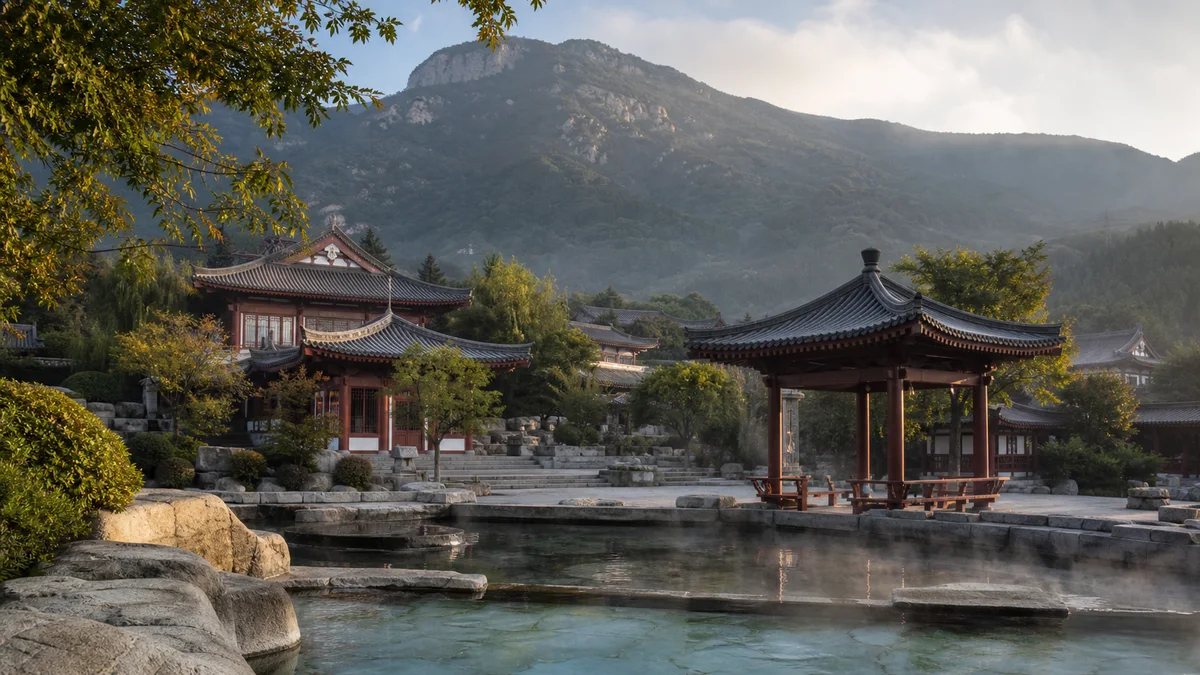
5A View location, maps and nearby scenic areasAt the Tang imperial bathing-pool ruins, lean over the railing and follow the stone edge of a basin before looking for its inlet and drain. The pool is no longer a private bath filled for a court ritual, yet the surviving outline still tells you where warm water entered, where a body might have rested and how carefully flow was controlled. Behind it, Lishan rises abruptly. Water, masonry and mountain belong in the same first view.
That visible basin is evidence, but it is not an intact room frozen in the eighth century. Roofs, screens, furnishings, attendants and much of the surrounding architecture disappeared or changed long ago. Excavation, conservation, reconstructed buildings, museum labels and modern landscaping now help visitors read fragments of several periods. Huaqing Palace is most rewarding when you keep those layers separate rather than accepting every elegant pavilion as a complete Tang original.
A clear first route: begin with the historical bath remains while your attention is fresh; continue through the palace gardens and lake-side architecture; then choose the lower Xi’an Incident rooms or the steeper Lishan locations according to time, weather and mobility. Use the current site map, because entrances, exhibitions, hillside transport and open paths can change.
Begin with the water and the excavated pools
The springs emerge along the northern foot of Lishan, where groundwater heated at depth rises through fractures. Historical writers praised their warmth and mineral character, and successive courts built around the dependable source. Exact temperature and flow figures vary by outlet, season and modern measurement, so the most important fact onsite is simpler: the spring made this a repeatedly used place, not a palace arbitrarily planted beside a mountain.
The museum area commonly identifies several excavated Tang-period bathing structures. Their conventional names include the Lotus Pool, associated in interpretation with Emperor Xuanzong; the smaller Begonia Pool, popularly called the pool of Yang Guifei; the Star Pool; a pool associated with the crown prince; and a service pool often linked with palace attendants. Names and proposed users come from a combination of archaeology, texts and later interpretation, and not every association carries the same certainty.
Compare shapes rather than collecting labels. One basin is lobed, another more compact; steps, water channels and masonry reveal different arrangements of access. The displayed stonework may include original remains, conserved material and protective or explanatory additions. Ask of each pool: which surfaces were excavated, which were repaired, and which vanished features are being supplied by the drawing on the label?
The Huaqing Pool 5A profile gives the scenic area’s position in Lintong. The archaeological pools give it scale. They show that imperial bathing was infrastructure—water capture, channels, drainage, heating expectations, privacy and service—not simply the romantic image of two famous people in mist.
A hot spring used long before one famous romance
Tradition connects Lishan’s springs with rulers as early as the Western Zhou, and later accounts associate the area with Qin and Han imperial use. Those distant origin stories are not equally recoverable in the surviving ground. What can be stated more securely is that the springs attracted repeated building campaigns and that the complex acquired different names, boundaries and architectural forms over centuries.
The Tang court transformed the site on a particularly ambitious scale. Emperor Taizong ordered a palace at the springs in the seventh century, and under Emperor Xuanzong the complex was expanded and renamed Huaqing Palace in the eighth. Xuanzong made frequent seasonal visits during the prosperous earlier part of his reign. The court did not simply move a holiday household: officials, guards, documents, supplies, horses, performers and ritual obligations travelled with the sovereign.
War and dynastic decline changed the palace. Buildings were damaged, abandoned, repaired or repurposed; later monuments occupied the same advantageous ground. Present-day halls, gates, gardens and pools therefore do not all belong to one plan or date. “Three thousand years of hot-spring history” expresses long cultural memory, not three thousand years of unchanged architecture.
Xuanzong and Yang Guifei: what a poem made unforgettable
The best-known words attached to Huaqing come from Bai Juyi’s “Song of Everlasting Sorrow”:
春寒赐浴华清池,温泉水滑洗凝脂。
In spring cold she was granted a bath at Huaqing Pool; the warm water slipped over her creamy skin.
Bai Juyi wrote the long poem in 806, roughly half a century after the crisis it describes. He was not recording a scene as an eyewitness. His verse turned the relationship between Emperor Xuanzong and Yang Yuhuan, known as Yang Guifei or the Honoured Consort Yang, into a tragedy of beauty, favour, flight, death and longing. Later theatre, painting, opera, tourism and screen adaptations enlarged that emotional world.
The Begonia Pool is therefore best read in two registers. Archaeology shows that a carefully built bathing installation existed within the Tang palace. Literary tradition links Huaqing’s warm water to Yang’s favoured place at court. But a named display pool does not verify every private scene described by poetry or modern performance. The difference does not make the story meaningless; it reveals how physical remains become anchors for cultural memory.
Yang was also more than a passive beauty in a love legend. She entered the imperial household through a complicated court process, became Xuanzong’s high-ranking consort and lived within a system where intimacy affected status and access. Her musical accomplishments and court presence mattered to her contemporaries, while later writers repeatedly remade her to express changing ideas about desire, blame and political failure.
Romance, patronage and the An Lushan catastrophe
Huaqing’s love story needs a political frame. Xuanzong’s long reign included decades remembered for strong government and cultural achievement, but its later court was marked by factional rivalry and contested patronage. Yang Guifei’s relatives, especially Yang Guozhong, gained great power. The frontier commander An Lushan also enjoyed imperial favour before launching rebellion in 755.
The An Lushan Rebellion cannot be reduced to one romance or blamed on one woman. Military structures, frontier command, fiscal pressures and court politics all mattered. Yet later narratives often used Yang as the beautiful cause of dynastic disorder, a pattern that shifts responsibility away from institutions and powerful male decision-makers.
As rebel forces approached the capital in 756, Xuanzong fled west with his entourage. At Mawei courier station, imperial guards killed Yang Guozhong and demanded Yang Guifei’s death. She died there, away from Huaqing Palace. Xuanzong continued toward Sichuan; the crown prince became Emperor Suzong; the rebellion continued for years and caused immense displacement, death and economic damage. Tang rule survived, but imperial authority and the empire’s political balance were permanently altered.
Read Bai Juyi after knowing that consequence. “Everlasting sorrow” is not only private bereavement. It stands against abandoned capitals, coerced death and a war remembered across generations. The modern stage production based on the poem can be visually powerful, but it is an artistic interpretation. Choreography, music, lighting and water effects should never be treated as documentary reconstruction.
Palaces run on water carriers, craftspeople and attendants
Imperial narratives spotlight the people who entered a bath, not those who made bathing possible. A functioning spring palace required builders to cut foundations and set masonry; hydraulic workers to capture and direct water; carpenters and tilers to raise halls; plasterers, painters and metalworkers to finish them. Others cleaned pools, prepared textiles and cosmetics, managed fuel and lamps, cooked, guarded doors, kept records and cared for horses.
The surviving service pool is a useful corrective even if its precise working arrangements remain under interpretation. Court rank shaped access to space and comfort. An emperor, a favoured consort, a prince and an attendant did not experience the spring in the same way. Luxury at the centre depended on skilled and often physically demanding work at the edges.
Modern preservation has its own labour. Archaeologists recorded foundations and channels; conservators stabilised exposed stone; historians compared poems, chronicles and plans; guides translate uncertain evidence for large audiences. Cleaners, gardeners, safety staff and water-system technicians make the present scenic area function. Reconstructed roofs and curated sightlines are not proof that a site is fake; they are evidence that interpretation is active and should be disclosed.
Pause at a drain or worn threshold instead of only photographing the prettiest pavilion. Such details move the story from imperial romance toward material systems and unequal lives. They also explain why touching stone, stepping across barriers or tossing objects into a pool damages more than a photogenic surface.
December 1936: the Xi’an Incident enters the palace
Huaqing Palace carries a second national story, separated from the Tang by more than a millennium. In late 1936, Chiang Kai-shek stayed in the Five-Room Hall while directing a campaign in the northwest. On 12 December, forces associated with Zhang Xueliang and Yang Hucheng detained him in what became known as the Xi’an Incident.
The immediate political dispute concerned Chiang’s priority of continuing military pressure against the Chinese Communists while Japan’s expansion posed a growing national threat. Zhang and Yang sought a change of policy and broader resistance to Japan. After negotiations involving Nationalist, Communist and other participants, Chiang was released later that month. The incident helped create conditions for a renewed united front against Japan, although participants disagreed over commitments and historians continue to debate agency, coercion and consequence.
At the Five-Room Hall, displays often point out damage identified with the 1936 action and reconstruct the setting of Chiang’s stay. On Lishan, a pavilion marks the rocky area where he was captured after leaving his quarters. Its name and political framing have changed over time. Treat both locations as memorial landscapes: the event is documented, but buildings have been repaired, rooms re-presented and the hillside marker constructed or reconstructed after the fact.
Neutral looking is especially valuable here. Read labels for who is speaking, when the exhibit was made and whether an object is original, restored or illustrative. Avoid turning a coercive political crisis into an adventure scene. The site matters because competing strategies toward civil conflict and foreign invasion converged here, not because a climb to a rock can reproduce what participants experienced.
Build the visit from low pools to the Lishan slope
Start with the imperial bathing-pool remains. They are the most fragile evidence and easiest to understand before palace names, poetry and staged imagery accumulate. Move slowly around the cases or railings, comparing basins and channels. Then walk into the landscaped palace core around Nine-Dragon Lake, using pavilions and views toward Lishan to reconstruct the relationship between water, residence and mountain.
Next choose between depth and height. A lower route can include the Five-Room Hall and nearby Xi’an Incident displays with fewer sustained climbs, subject to the day’s circulation. A longer route continues onto Lishan toward the incident memorial point and broader views. The mountain section can involve steep steps, uneven paving and substantial elevation gain even when a map makes the horizontal distance look short.
If your energy is limited, do not treat the slope as mandatory. Bath archaeology plus the lower political-history rooms already form a coherent visit. If you do climb, keep enough time and strength for the descent and verify whether any shuttle, cableway or linked Lishan entrance is operating; transport and combination-ticket arrangements are not permanent facts.
Huaqing sits near the Mausoleum of Qin Shi Huang, but the Terracotta Army and mausoleum landscape deserve their own concentration. Compare Huaqing’s vanished palace with the ritual and urban afterlives around the Giant Wild Goose Pagoda. The cliffs and long stairs of Mount Hua belong on a separate, weather-aware day.
Photograph layers, and plan for wet stone and changing shows
At the bath remains, photograph obliquely so an inlet, basin edge and stair can share one frame; a straight-down image often flattens the archaeology into an abstract outline. Include a label only when it clarifies which parts are excavated. Around the lake, use Lishan as the background that joins palace and geology. At the Five-Room Hall, details should serve historical understanding rather than imitation battle poses.
Photography rules can differ between archaeological interiors, exhibitions, performance areas and the mountain. Flash, tripods and commercial equipment may be restricted. Follow current signs and staff instructions, do not block narrow viewing platforms, and never cross a barrier or touch the pool fabric for a cleaner composition.
Spring water, rain and cleaning can leave stone slick. Historic thresholds, stairs, bridges and the Lishan climb create barriers even where lower plazas are accessible. Visitors who use wheelchairs or avoid steps should ask the site which bath displays, lakeside paths and incident rooms are currently step-free. Heat, humidity, winter ice and evening darkness change the effort. Shoes with reliable grip matter more than dressing for a palace photograph.
The springs remain part of Lintong’s living identity, but admission to the heritage site does not guarantee a bathing experience or access to a particular flowing outlet. Likewise, The Song of Everlasting Sorrow and other shows are programmed events, often with separate tickets and weather or seasonal dependencies. Confirm schedules, seat rules, language support, transport after the show and refund terms through current official channels.
Leave with two kinds of absence in view
Before leaving, look once more from a stone pool toward Lishan. The warm water outlasted the Tang roofs, but the basin in front of you is not the complete palace that Xuanzong or Yang Guifei knew. Poetry fills that absence with intimate feeling; archaeology limits how literally the feeling can be mapped onto stone.
The 1936 rooms create a different absence. A repaired wall and a mountain pavilion point toward a political confrontation whose arguments cannot be recovered by restoring furniture. Exhibitions provide a route through the event, but they also reflect later choices about memory.
Huaqing Palace becomes more powerful when neither gap is hidden. It is a place where geology enabled luxury, labour maintained it, literature transformed private favour into national tragedy, and a modern crisis rewrote the same landscape again. The water links those histories without making them simple. Follow its channels carefully, and the palace stops being a romance set: it becomes evidence of how China remembers power.
The LoreLens app can help identify bath ruins, reconstructed halls and Xi’an Incident locations, then keep literary interpretation separate from what survives onsite.
Location profile
Where it is

Frequently asked questions
Are Huaqing Palace and Huaqing Pool the same place?
The names commonly refer to the same Lintong attraction. Huaqing Palace emphasizes the wider imperial-palace landscape, while Huaqing Pool recalls the hot springs and historic bathing tradition. Maps, tickets and English signs may use Huaqing Palace, Huaqing Pool or Huaqing Hot Springs.
Can visitors bathe in the historic pools?
No. The excavated Tang bathing pools are archaeological remains for viewing, not public baths. Commercial hot-spring services in the wider area are separate operations; availability, water source, admission and reservation rules should be confirmed directly with the current operator.
How much time should I allow for Huaqing Palace?
A focused palace-and-bath-remains visit commonly takes two to three hours. Add more time if you intend to climb Lishan or seek out the Xi'an Incident locations on the slope. Paths, transport links, exhibitions and performance access can change, so avoid a tightly timed onward plan.
Is The Song of Everlasting Sorrow performed every night?
Do not assume so. The large outdoor production is separately ticketed and can depend on season, weather, maintenance and programming. Confirm the current date, start time, venue entrance and cancellation terms through an official sales channel before arranging transport.