Shaanxi · Xi'an
Terracotta Army: Faces of Qin Shi Huang's Afterlife
Read the expressions, armor and lost colors of the Terracotta Army, then place the three excavated pits inside Qin Shi Huang's much larger—and still unopened—mausoleum landscape.
5A View location, maps and nearby scenic areasChoose one warrior and stay with him for a moment. Notice the moustache, scarf, topknot and empty hands that once held a real weapon. The face looks unmistakably individual, yet it is probably not a portrait in the modern sense. It is one carefully varied member of an army made through an organized production system more than 2,200 years ago.
That tension—individual presence inside imperial mass—is the best way into the Terracotta Army. The ruler behind it was Qin Shi Huang (pronounced roughly “chin shir hwahng”), the king who conquered rival states and in 221 BCE declared himself China’s First Emperor. What you see here is not his tomb chamber. It is a group of military pits east of the central burial mound, built as part of a vast landscape intended to continue the structures of rule after death.
Read the site in three layers: first, notice one figure’s hair, clothing and stance; next, step back to understand the unit around him; finally, remember that every visible rank belongs to a much larger necropolis whose central chamber remains closed.
Three pits are only one district of the mausoleum
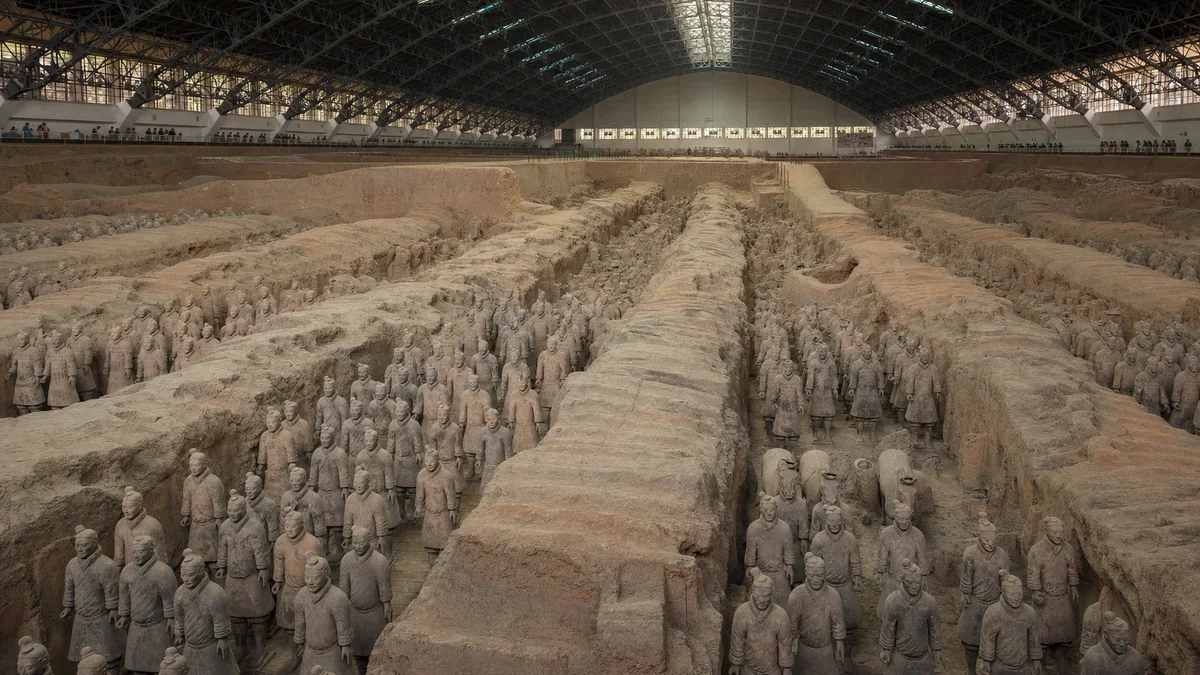
The museum’s great roofed halls protect Pits 1, 2 and 3, where terracotta soldiers, horses, chariots and weapons were placed in underground timber-lined corridors. These pits sit roughly 1.5 kilometres east of the main burial mound. They are the most famous discoveries, but not the whole Mausoleum of the First Qin Emperor.
Across the wider archaeological zone, researchers have identified ritual structures, pits with bronze birds and stone armor, stable remains, administrative spaces and satellite burials. The commonly cited area of roughly 56 square kilometres describes the mausoleum landscape—not one chamber or the visitor area—and its boundaries may be refined as research continues.
The mound to the west marks the core burial zone. Its inner chamber has not been opened, and no visitor can look inside it. That distinction matters because popular images often blend three different things: real photographs of excavated warriors, artists’ reconstructions of the underground palace described in ancient texts, and digital fantasies of rooms no modern person has seen.
Think of the complex less as a sealed treasure chamber and more as a royal capital translated into a funerary landscape. Officials, entertainers, animals and vehicles found elsewhere suggest a planned world with many functions. Like the royal necropolises of ancient Egypt, it projected power beyond death, though the Qin political and ritual setting was its own.
Counting an army without pretending every number is final
Pit 1, the largest, is approximately 230 metres long and 62 metres wide. Its corridors contain the remains of close-packed infantry and chariots. Based on excavated figures, fragments and the formation continuing beneath unexcavated ground, the pit is commonly estimated to have held more than 6,000 clay soldiers and horses. Only a portion stand restored in the ranks visitors photograph.
Across the three principal pits, “more than 8,000 soldiers” is a widely repeated estimate. It should not be mistaken for a final census of complete statues. Published totals may combine exposed figures, restored figures, fragmentary remains and projections from formations still underground. Horses, chariots and other objects may be counted separately. Archaeology is still changing the inventory.
The figures are broadly life-size, though pose, headgear and rank affect height. Compare visitors on the rail with the columns below, then trace how many warriors occupied one corridor.
Upright warriors often stand around 1.8 metres or more, while kneeling archers are naturally lower. These are approximate comparisons, not a single regulation height for every figure; the variation itself helps express role and status.
The pits were not discovered as a standing parade. Roofs burned or collapsed, earth pressed down, organic equipment decayed and most figures broke. Today’s ranks are therefore also a record of excavation and reconstruction. In Pit 1, a partly assembled torso reveals the patient work behind the spectacle.
From King Zheng to the First Emperor
Born in 259 BCE, the future emperor became king of Qin as a boy in 246 BCE; ancient accounts place the mausoleum’s beginning early in his reign. After Qin defeated six major rivals, King Zheng adopted the title Qin Shi Huangdi—First August Emperor of Qin—in 221 BCE.
The unification did more than redraw a map. Qin government promoted standardized forms of writing, weights, measures and currency, connected roads and administrative systems, and imposed law through a highly centralized state. Some measures built on earlier regional practices rather than appearing from nothing, but their empire-wide enforcement changed how people, orders and goods moved.
That coordinating power also demanded extraordinary labor. Campaigns, frontier works, palaces and the mausoleum drew on taxes, conscription, penal labor and skilled production. The army is technically brilliant because the state mobilized knowledge and materials at scale; it also shows how many lives an emperor’s vision could command.
Qin Shi Huang died while travelling in 210 BCE; conflict followed, and the dynasty collapsed within years. Fire and destruction in the pits are clear, but not every burn layer can be assigned to a named attacker. “Qin” nevertheless became the starting point for histories of unified imperial China. Xi’an City Wall and Beilin offers a later chapter in how written authority and urban defense changed.
How workshops made thousands of distinct presences
Walk along Pit 1 and compare ears, beards, cheeks and hair arrangements. The variations are real, but the romantic claim that every face must reproduce a specific soldier is not demonstrated. Archaeological study points instead to a sophisticated workshop system: bodies and body parts were formed using repeatable techniques, assembled, adjusted and finished by hand. Controlled production created a coherent army without making every figure identical.
Clay was built into hollow bodies; heads, arms and other elements could be formed separately, joined, refined and fired. Inscriptions and workshop marks help researchers trace groups of makers or production units, though one mark cannot identify who completed every stage.
Rank and function appear through posture and equipment. Armored infantry differ from lighter-clothed archers. Charioteers position their hands for reins that have disappeared. Cavalry figures stand beside clay horses. Headgear, armor panels and the cut of robes guide the eye through a military hierarchy even when the original wooden shafts, bows, crossbow components and chariots have decayed.
Bronze weapons survived better than their organic fittings, showing that the figures were once equipped rather than displayed as bare sculptures. One older explanation credited their preservation to Qin “chrome-plating.” Current research instead links some chromium to nearby lacquer and emphasizes soil conditions. Archaeology improves by changing an attractive story when analysis requires it.
The army was once bright, and excavation could erase it
The word “terracotta” encourages us to imagine an earth-brown army. Originally, the figures carried vivid painted surfaces. Traces reveal colors including reds, greens, blues, purples, whites and blacks applied over preparatory layers, including an organic lacquer. Armor, robes, faces and small details would have separated units and bodies far more sharply than the clay color does now.
Painters did not merely tint a few faces. Color articulated armor plates, layered garments and skin, giving the military formation a visual rhythm now largely absent.
Burial preserved pigment in a damp, stable environment. Excavation changed it within minutes: exposed lacquer dried, curled and could carry pigment away. The museum’s apparent monochrome reflects both ancient damage and the cost of bringing fragile material into air.
This loss explains why many warriors remain buried. Conservators document context, control humidity and test ways to keep paint attached. Until treatment improves, restraint may preserve more than excavation.
Where current displays allow, look for a patch near a collar or sleeve. These were not matching brown statues but a painted formation whose full visual effect cannot be restored.
What Sima Qian wrote—and what the mound has not proved
About a century after the First Emperor’s death, the historian Sima Qian compiled the Records of the Grand Historian. Describing the central tomb, he wrote that workers “made the hundred rivers, the Yellow River, the Yangtze and the seas with mercury, moved by mechanism.” The passage also mentions palace-like buildings, precious objects and defensive crossbows.
The story behind the quotation is imperial order extended underground: landscape became mercury, the heavens appeared above, and mechanisms guarded continuing authority. The twentieth-century discovery of the eastern pits proved an extraordinary funerary program existed, giving the old text new force.
But this is an ancient account, not a view inside. Surveys have reported elevated mercury concentrations in soil around the mound, an intriguing clue. Soil chemistry does not reveal the chamber’s layout, confirm flowing rivers or prove every detail. The mound remains unopened.
The modern echo is conservation policy. Remote sensing, geophysics and limited sampling can ask questions without destroying context. After seeing exposed colors vanish, waiting for safer tools is not failure; it is responsible archaeology.
The workers belong in the story, not outside the pits
Sima Qian wrote that more than 700,000 people were brought into the mausoleum project. That is an ancient literary-historical figure, not a surviving payroll and not a number archaeology can simply verify. It conveys how later Chinese historians understood the undertaking’s enormity, while modern interpretation must distinguish that claim from a measured workforce.
The physical evidence nevertheless makes vast coordination undeniable. Clay had to be sourced and prepared; heavy figures formed, dried, fired, painted and moved; bronze components cast and finished; timber roofs erected; soil rammed into partitions; food, tools and fuel supplied. Skilled potters, metalworkers, painters, carpenters and supervisors worked within systems that also used conscripted and penal labor.
Marks on objects sometimes connect work to production teams or supervisors. They make organization visible, but rarely recover a complete personal identity or tell us whether a named maker was free, conscripted or punished.
Workshop marks add human scale, but this is not a comfortable story of proud artisans alone. Burials associated with laboring populations have been excavated nearby. Individual lives are rarely recoverable, so avoid invented biographies; imperial immortality depended on vulnerable, mostly unnamed people.
Later tradition admired Qin unification and condemned harsh rule. Above the army, recognize logistical genius without treating coercion as a footnote: the immortal emperor at the center depended on workers who received no monumental armies.
Walk Pit 1, then Pit 3, then Pit 2
For a first visit, use Pit 1 → Pit 3 → Pit 2. Begin with Pit 1’s vanguard and long columns, then continue toward fragments and restored figures. The first railing becomes congested, so move farther along before stopping.
Next, use compact Pit 3 to change scale. Its arrangement, chariot and small group of figures have led archaeologists to interpret it as a command component, although “headquarters” remains an interpretation rather than a sign discovered on the wall. Because the pit is smaller, positions and sightlines can be easier to read.
Finish with Pit 2, where archers, cavalry and chariot units suggest a varied force. Close displays depend on the current exhibition. This order moves from spectacle to organization to military variety; reverse it to save Pit 1 for last, but do not treat Pits 2 and 3 as smaller copies.
The museum and broader park can involve separate walks or transfers. Shuttles, routes and accessible services may change. If time or mobility is limited, prioritize the three pits and main exhibitions, and confirm the current map and ticket coverage.
Real-name advance booking is common, and international visitors may need the passport used to reserve. Check current rules, use consistent details and carry the original. Allow generous travel time from central Xi’an. Huaqing Pool can fit the same direction; the Giant Wild Goose Pagoda deserves separate time for Tang Buddhist Xi’an.
Photograph the evidence, then leave one face uncollected
Pit 1’s first panorama attracts the thickest crowd. Walk farther along and use people, roof trusses or excavation bays to show scale. A moderate telephoto isolates a formation; stabilize against your body, never a historic surface or barrier.
Flash, tripods, commercial equipment and photography in individual displays may be restricted. Follow current signs and staff instructions. Never reach over a rail, touch a fragment or obstruct a narrow viewing point while waiting for an empty frame. These pits are active archaeological and conservation spaces, not reconstructed film sets.
The halls require long walks and standing. Ramps, lifts or wheelchairs may be available, but arrangements change; ask about step-free routes before booking. Outdoor sections add uneven surfaces, heat, cold and limited shade. Wear suitable shoes and carry water where permitted.
Remember that this is a mausoleum. Do not climb, intrude on human remains or turn burial into a prop. Clay, paint, bronze, labor and imperial ambition matter because they survive in layers archaeologists can still read.
Before leaving, choose another face without photographing it immediately. Little color or equipment survives, yet a mouth or eyebrow retains character. At first the army may look like proof that one emperor commanded eternity. At the end it is more moving: thousands of broken, reassembled presences around a center we have chosen not to open.
The LoreLens app can help identify figures and objects in the galleries, then connect what you see to the Qin workshops, empire and continuing work of conservation.
Location profile
Where it is

Frequently asked questions
Is the Terracotta Army the same thing as Qin Shi Huang's tomb?
No. The three famous Terracotta Army pits lie east of the burial mound and form only one part of a much larger mausoleum complex. The central tomb chamber beneath the mound has not been opened or archaeologically excavated, so visitors see the pits, conservation areas and selected finds—not the emperor's burial chamber.
How much time should I allow for the Terracotta Army?
A focused visit to Pits 1, 3 and 2 plus the main exhibitions commonly takes two to four hours, with additional time needed for entry checks, crowds and movement between areas. Add more if you plan to visit the wider mausoleum park. Routes, transfers and open galleries can change, so confirm the current site map before arrival.
Do international visitors need to reserve and bring a passport?
The museum commonly uses dated or timed real-name ticketing, and an international visitor may need the passport used for the booking. Sales channels and identity-check procedures can change. Check the museum's official instructions, enter names and document numbers consistently, and carry the original matching document.
Can visitors enter Qin Shi Huang's burial chamber?
No. The chamber under the main mound remains unopened. Accounts of palaces, traps and mercury rivers come chiefly from an ancient written source, while non-invasive research has produced clues rather than an interior view. Treat reconstructions as interpretation, not footage or proof of an excavated chamber.