Shaanxi · Xi'an
Xi'an City Wall and Beilin: Brick, Stone and Memory
Walk one measured section of Xi'an's 13.7-kilometre Ming wall, then read Beilin's stone classics, calligraphy and displaced tomb reliefs without mistaking restoration or replicas for untouched originals.
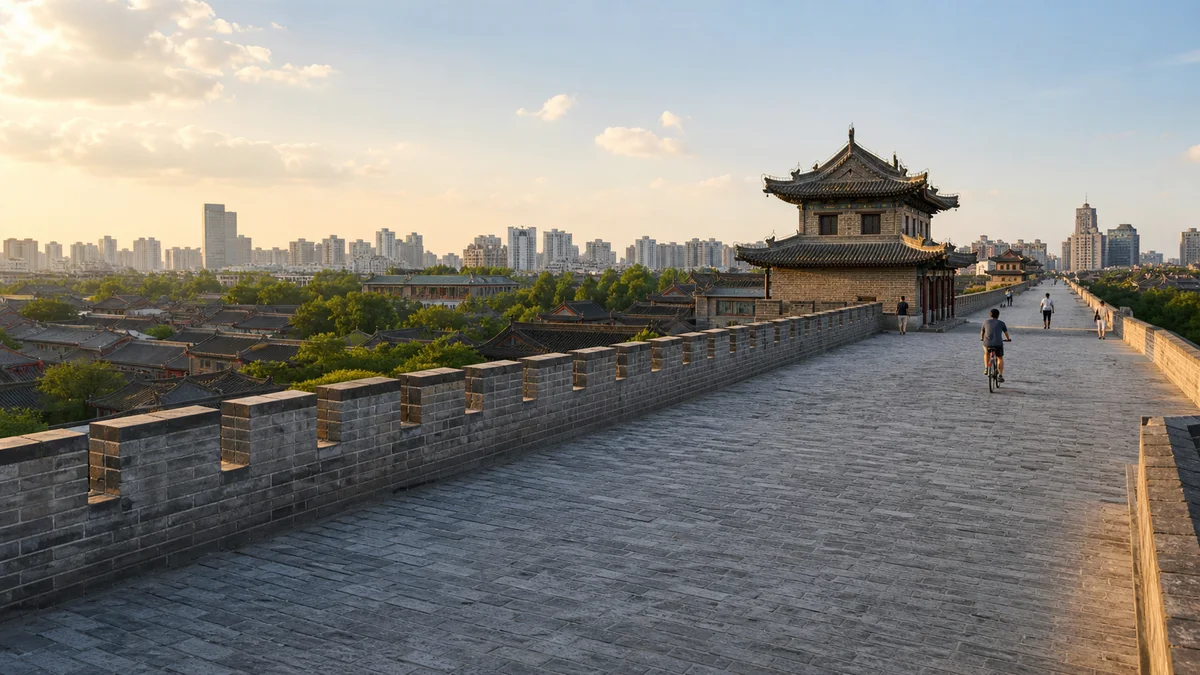
5A View location, maps and nearby scenic areasWalk to the outer edge of Xi’an City Wall and look down through a crenel. Traffic bends around the masonry; inside, streets run toward the Bell Tower; on top, the rampart feels broad enough to be an elevated road. Now place one hand behind your back rather than on the parapet and look at the surface beneath your feet. Old brick, replacement brick, drainage work and repaired joints occupy the same line.
That mixture is the right opening to this scenic area. The wall and Beilin Museum—Beilin is pronounced roughly “bay-leen” and means “Forest of Stelae”—preserve two different technologies of authority. One controlled bodies through gates, height and patrol. The other stabilized words by cutting them into stone. Neither survives as an untouched object. Both have been moved, repaired, copied and reinterpreted as Xi’an grew around them.
A useful first route: walk or ride one south-wall section, descend near an operating gate, pass through the calligraphy quarter around Shuyuanmen, then give Beilin unhurried museum time. A complete circuit and a complete reading of the stelae are both false goals for one visit.
Measure the wall as a line, not a trophy
The present wall forms a near-rectangular circuit of about 13.7 kilometres around the Ming-era city. It is roughly 12 metres high, while width varies by location and measurement. More revealing than a stack of dimensions is what the broad top allowed: soldiers, messengers, equipment and supplies could move behind the parapets without descending into streets.
This is not a miniature Great Wall. The Great Wall is a vast, discontinuous frontier system; Xi’an’s fortification is an urban enclosure, closer to an elevated defensive belt around a governed city. Its gates had to admit daily movement while remaining vulnerable points that could be watched and closed.
Choose a short stretch and use repetition as a scale. Count the interval between projecting rampart positions, compare the city inside and outside, and watch a gate tower remain distant longer than expected. The Xi’an City Wall and Beilin 5A profile gives the map location, but one well-read kilometre can explain more than a hurried 13.7.
Construction of the core Ming wall took place in the 1370s, early in the dynasty founded by the Hongwu Emperor. Builders used the foundations, materials and urban inheritance of earlier fortified settlements rather than drawing on empty ground. The wall enclosed a city far smaller than the immense Sui-Tang capital of Chang’an.
That difference corrects a common map error. The surviving circuit is not the complete boundary of Tang Chang’an. The Daming Palace archaeological site lies north of it, while the Giant Wild Goose Pagoda stands to the south. Those locations make sense once the Ming enclosure is understood as one later layer within a much larger urban history.
The early Ming work relied heavily on rammed earth. Brick facing and other strengthening occurred through later campaigns, including major work in the sixteenth century. Drains, parapets, towers and surfaces were repaired again under subsequent governments. What looks like a single grey rectangle is a construction biography lasting centuries.
Gates turned a rectangle into a controlled city
The four principal gates expressed auspicious order: Yongning in the south, Anyuan in the north, Changle in the east and Anding in the west. Their names invoked lasting peace and stability. Modern Xi’an has additional openings, so every passage through the wall should not be mistaken for a surviving Ming gate.
At a major gate, separate the components. A gate tower marked and supervised entry. An arrow tower provided a defended face. Between defensive structures, a barbican, or wengcheng, created an enclosed court. If attackers breached one door, they could be trapped under fire before reaching city streets. Moats, bridges, corner towers, battlements and projecting platforms extended that layered defence.
Architecture alone did not protect a city. Gates needed guards, schedules, signals, maintenance and intelligence. A warped door, blocked drain or undisciplined watch could undo imposing masonry. Look for sightlines rather than imagining constant battle: who could see an approaching road, where movement narrowed, and how a messenger might pass along the top?
The gates also anchored streets. Routes from the cardinal entrances pulled movement toward the inner city and, in the later plan, toward the Bell Tower area. The wall therefore organized commerce and orientation as well as defence. Today’s traffic still negotiates that inherited geometry.
A continuous silhouette contains modern repair
Xi’an’s wall is often celebrated as one of China’s best-preserved large urban walls. “Best preserved” must not become “unchanged.” Warfare, neglect, road building, new gates, structural failure and redevelopment altered the circuit. Towers and wall sections have been repaired or reconstructed, while modern conservation created the walkable continuity visitors value.
Read differences rather than hunting for a pure original brick. Colour, edge sharpness, mortar and bond can reveal separate campaigns, although visual judgement alone cannot date them reliably. A clean surface may be responsible drainage work; an old-looking brick may have been reset. Conservation records and site labels carry more authority than patina.
The people behind continuity extend far beyond emperors. Labourers tamped earth, kiln workers fired bricks, masons built drains, carpenters framed towers and gatekeepers managed passage. Residents lived against, through and around the barrier. Modern engineers, archaeologists and maintenance crews decide how to stabilize the wall while it absorbs rain, vibration and heavy visitation.
Restoration is not evidence of failure. It is the reason a vulnerable earthen-and-brick system remains legible. The honest question is not “Is every piece original?” but “Which material, form and urban relationship has each intervention preserved?”
Beilin began as a rescue operation in stone
Near the south wall, Beilin grew from a different preservation problem. In 1087, during the Northern Song, officials established the collection at its present institutional ancestor in order to safeguard important inscribed stones, especially the Tang Kaicheng Stone Classics, after earlier upheaval and relocation threatened them.
The museum occupies a historic Confucian temple setting expanded through later collecting. Courtyards and exhibition halls now hold stelae, epitaphs, carved images and other works from the Han period onward. “Forest” describes density, not a single moment of creation. Stones entered the collection at different dates and for different reasons.
A stele is both text and object. Read the characters, but also inspect the top, base, broken edges, tool marks and weathering. A formal essay may assert state values; an epitaph may reconstruct one household; a Buddhist or Daoist inscription may record devotion; a multilingual or cross-cultural monument may complicate any picture of an isolated China.
The present label is part of the encounter. It should tell you date, origin, material and whether the object is original, transferred, repaired or reproduced. A famous text can exist as an original slab, a later recut version, a rubbing, a printed copy and a digital image without those forms becoming interchangeable.
The Kaicheng Classics made learning public and fixed
The Kaicheng Stone Classics were carved in ninth-century Tang Chang’an for the imperial academy. They presented an authorized corpus of Confucian classics in hundreds of thousands of characters. Stone reduced some errors introduced by hand-copying and gave students a reference, although no inscription could end interpretation or political debate.
Among the most familiar lines is the opening of the Analects: “To learn and practise at due times—is that not a pleasure?” The Chinese wording, “學而時習之,不亦說乎,” links learning to repeated practice. Its story fits the medium. Court scholars sought a stable text; stonecutters converted brush-written models into grooves; later officials moved and protected the slabs; generations of readers copied the words again.
The modern echo is unusually strong. The sentence is still learned in schools, quoted in speeches and written in calligraphy practice. Yet most people now meet it through print or a screen. Standing beside stone restores the labour hidden by a font: every character required layout, carving and checking, and one error was much harder to correct than a digital typo.
Do not treat the classics as neutral data storage. Selecting an authorized text was an act of state education and cultural power. The slabs preserved learning while also declaring which learning deserved monumental permanence.
Calligraphy travelled through paper shadows
Beilin is also a history of handwriting made durable. Stelae preserve scripts and styles associated with celebrated calligraphers, but the carved line passes through several hands: the writer or model, the person who laid out the text, and the artisan who cut it. Stone is evidence of calligraphy and of skilled translation from ink gesture to chisel.
Rubbings allowed those carved lines to travel. Dampened paper was worked carefully into recesses and inked across the raised surface, producing pale characters against a dark ground. A rubbing could circulate a monument’s text and style far from Xi’an, becoming a study model for collectors and calligraphers across East Asia.
That usefulness came with cost. Repeated rubbing, poor technique, moisture and pigment can abrade stone. Museums therefore control access, and a rubbing sold today may be a recent authorized impression or a reproduction—not an antique pulled directly from a famous stele. Do not touch or trace inscriptions to feel closer to the past.
Shuyuanmen’s contemporary brush shops and signboards provide the modern echo. Calligraphy remains a practiced art, a school subject, a market and part of urban visual identity. Compare a shop’s copybook with a museum label: one invites repetition; the other asks you to preserve the source.
The Six Steeds reveal movement and loss
The Six Steeds of Zhaoling are limestone reliefs depicting warhorses associated with Emperor Taizong’s campaigns. They originated at his seventh-century mausoleum complex, not at Beilin. Their low-relief bodies, injuries and attendants make imperial history depend on animal effort and human care rather than on a ruler alone.
Today, four original reliefs are held in Xi’an, while two originals are in the Penn Museum in Philadelphia. Displays or publications may use casts or replacements to restore the visual group of six. Read labels closely: “the Six Steeds” can name the historical ensemble even when all six original stones are not in one room.
Their separation belongs to the modern history of collecting, removal and cultural property. It should not be softened into a travel anecdote, nor should a replica be dismissed as useless. A cast can teach composition and show what is absent; it cannot carry the original stone’s tool marks, damage and custody history.
Compare this case with the Mausoleum of the First Qin Emperor, where excavated figures are displayed within a managed archaeological landscape. Zhaoling’s horses show a different afterlife: a tomb monument broken into museum objects across institutions and countries.
Pair one wall section with one museum sequence
For a balanced half day, begin at Yongning Gate—pronounced roughly “yong-ning”—if its current entrance suits your route. Walk or cycle a south-wall section and look back at the gate complex from increasing distance. If a suitable exit is operating near the southeast, descend toward Shuyuanmen and Beilin; otherwise return through the gate you entered.
Reverse the order in hot weather or when museum attention matters most. Start at Beilin while your eyes are fresh, take a break, then reach the wall later for longer views and possible evening light. Museum hours, wall gates and ticket boundaries are separate operational systems, so verify both.
A bicycle makes the broad rampart tangible but is not automatically the best choice. Rentals, return points, age or height rules, weather suspensions and closing times can change. Joints, slopes, wind and pedestrians interrupt speed. Ride defensively and choose a short out-and-back if the full 13.7 kilometres would turn the museum into an afterthought.
Inside Beilin, use a sequence rather than a checklist: Kaicheng Classics first for state learning, calligraphy galleries for changing script, then the Six Steeds for movement and loss. Stop at a few stones long enough to read their labels; thousands of quick glances do not equal a forest understood.
Photograph and move without wearing the sites down
On the wall, use a corner or gate tower to show changes in direction. A long lens compresses repeating battlements; a wider frame can place a cyclist or cleaner against the rampart’s width. Night lighting and gate performances may be impressive, but schedules, access and visibility change. Follow current restrictions on tripods, drones and event areas.
At Beilin, photograph obliquely when raking light reveals shallow characters, provided photography is allowed. Avoid flash, barriers and leaning over another visitor. Never touch stone, place paper against it or rub a finger through a carved stroke. Reflections on protective glass are a conservation trade-off, not an invitation to find an unguarded angle.
Accessibility varies sharply. Wall-top routes require reaching a high rampart; some major gates may offer lifts or accessible approaches, while towers and other gates retain steep stairs and thresholds. Long exposed sections have little shade. Confirm current lift operation, accessible entrances and exit choices before committing to a one-way distance.
Beilin has stone steps, thresholds and sometimes dense indoor circulation; ask staff about step-free routes and lifts in current exhibition buildings. Heat, rain, winter wind and slick surfaces affect both sites. Rest before fatigue turns a historic edge into a fall risk.
Read the boundary, then read what crossed it
At the end, look from the wall toward the city and imagine a gate opening. People, taxes, orders and goods crossed that boundary under supervision. Then remember the paper rubbings that carried Beilin’s words far beyond any gate. Brick regulated movement; inscribed stone generated another kind of movement.
Neither system stayed fixed. The wall endured through alteration because people kept rebuilding a useful boundary. The stelae endured through relocation, copying and museum care because readers kept finding new value in old marks. Authenticity here is not the absence of change; it is the ability to see what changed, what moved, and who made survival possible.
Continue to the Giant Wild Goose Pagoda for translation across languages, Daming Palace for the larger footprint of Tang power, or the Mausoleum of the First Qin Emperor for a different negotiation between buried evidence, conservation and mass visitation.
Location profile
Where it is

Frequently asked questions
Is Xi'an City Wall an untouched Ming structure?
No. The present circuit was laid out in the 1370s on the foundations and urban inheritance of earlier cities, then faced, repaired, altered and partly reconstructed over later centuries. Its near-continuous line is historically important, but individual bricks, towers, gates and surfaces do not all date from one building campaign.
Should I cycle the entire Xi'an City Wall?
Only if the full circuit is your main experience and current rental, weather and gate arrangements suit you. The wall is about 13.7 kilometres around, with exposed surfaces, slopes and busy sections. A shorter walk or ride from a major gate often leaves more attention and time for Beilin.
What is most important to see at Beilin Museum?
Begin with the Kaicheng Stone Classics and the museum's chronological calligraphy sequence, then see the Zhaoling Six Steeds display carefully. Four original reliefs are in Xi'an; two originals are at the Penn Museum in Philadelphia, so use labels to distinguish original stone, repaired fragments and replacements or casts.
Can visitors make rubbings or touch the stelae?
Do not touch, trace or make an unsupervised rubbing from historic stone. Repeated pressure, moisture and pigment can damage carved surfaces. Follow museum photography rules and use authorized demonstrations, modern impressions or reproductions if you want to understand the rubbing process.
Sources and further reading
Background references for the history and place names in this guide. Opening hours, ticketing and access change often — always confirm with official local information before travelling.