Shaanxi · Xi'an
Giant Wild Goose Pagoda: Brick, Text and Tang Chang'an
Read the seven-storey pagoda from its inward-sloping brick walls to Xuanzang's translation project, then separate the historic Daci'en Temple from Tang Paradise's modern vision of the Tang.
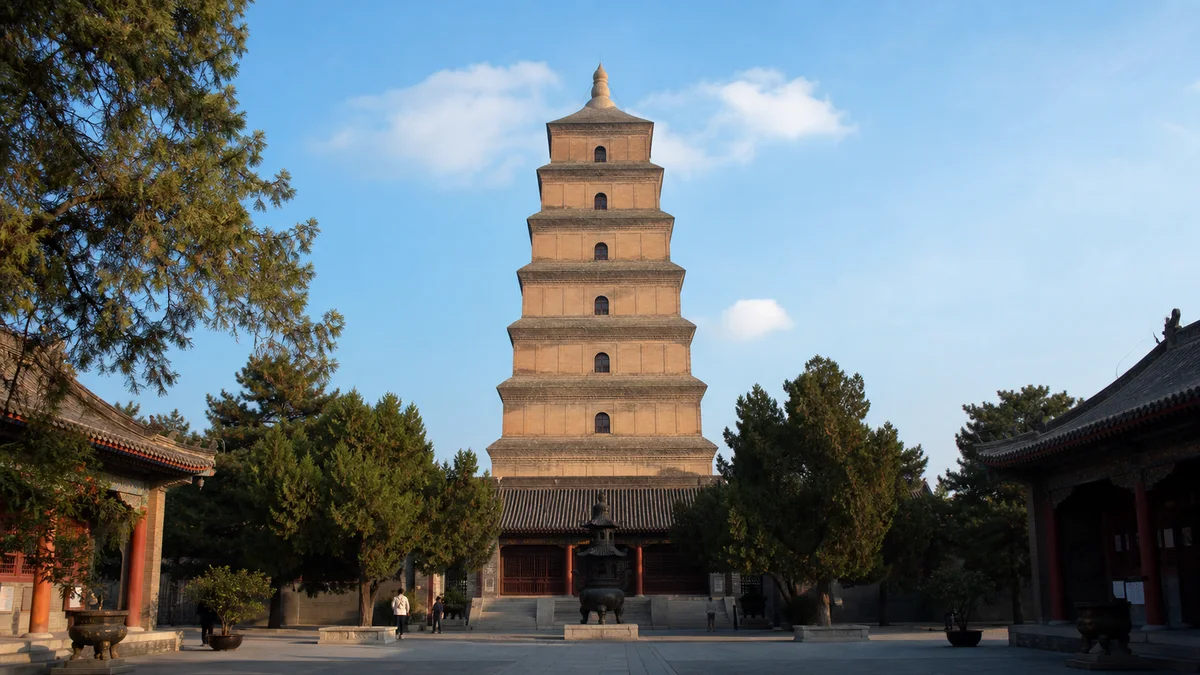
5A View location, maps and nearby scenic areasStand near a corner of the Giant Wild Goose Pagoda and look up along one brick edge. The wall leans subtly inward, storey by storey, while each square level narrows above the one below. Arched openings interrupt the masonry, and restrained brick details recall timber architecture. The result is both massive and carefully tapered.
Now turn south. The tower belongs to the north-south courtyards of Daci’en Temple, not to surrounding plazas or brightly lit palace roofs farther away. Nearby are a living Buddhist temple, a pagoda founded in 652, modern civic squares and Tang Paradise, a theme park imagining the dynasty at full colour. They share a Tang vocabulary, but not the same kind of historical evidence.
Use four layers as your map: read the temple axis; circle the pagoda before deciding whether to climb; treat the squares as modern city space; then enter Tang Paradise for a contemporary performance of Tang culture. Do not flatten them into one “ancient attraction.”
The taper begins before you climb
The present pagoda is a square, seven-storey brick tower about 64 metres high. Measurements differ slightly according to how the base and finial are counted. More useful on site: each tier reduces the plan and the walls have a slight inward batter, clearest where two faces converge at a corner.
This pavilion-style pagoda has an interior rather than a solid mound. Brick surfaces imitate wooden divisions, but masonry mass carries the structure. When climbing is available, openings shift the view from temple roofs to the modern city; the ascent is steep, enclosed and stair-only.
Walk around the base before queuing. Compare brick tone, joints and repairs; notice how the upper levels become progressively lighter. On the south side, stone tablets associated with imperial texts honouring Xuanzang’s translation work are set into the tower. Their calligraphy is traditionally connected with Tang master Chu Suiliang. The pagoda embodied not only height, but also the authority of texts.
The Giant Wild Goose Pagoda 5A profile supplies a map anchor. On site, understanding begins inside the temple precinct that gave the tower a purpose.
A 652 storehouse that kept changing
Daci’en Temple was established in 648. Crown Prince Li Zhi, later Emperor Gaozong, sponsored it in memory of his mother, Empress Wende. The monastery also gained a scholarly and religious role in the Tang capital.
In 652, Xuanzang supervised an early pagoda to hold scriptures and sacred images brought from his travels. Sources describe a five-storey tower, not today’s seven-level silhouette. Enlargement, collapse, earthquake damage and repair—including work under Wu Zetian and later dynasties—connect the original tower to the present form.
“Tang pagoda” identifies origin and cultural identity, not an untouched object frozen in 652. Visible fabric includes later interventions, and the temple halls likewise embody repair and reconstruction. Continuity lies in site, form, use and memory as well as ancient material.
In 2014, the pagoda joined UNESCO’s transnational World Heritage property, Silk Roads: the Routes Network of Chang’an–Tianshan Corridor. The designation does not cover every Tang-themed neighbour. It places the pagoda in a network of capitals, trading settlements, passes and religious monuments through which people, objects and ideas travelled.
Xuanzang returned to make books, not legends
Xuanzang left Tang China because Buddhist texts and teachings available to him contained contradictions he wanted to resolve. He crossed Central Asia, studied in South Asia—including at Nalanda—and returned to Chang’an in 645 with manuscripts and religious images. His lasting achievement came after arrival.
At imperially supported translation centres associated with Daci’en Temple, Xuanzang and collaborators turned Sanskrit writings into Chinese. The work required oral explanation, comparison of variant manuscripts, technical vocabulary, drafting, polishing and verification. The Chinese texts were disciplined collective work, even when Xuanzang’s name stood at their centre.
The historical monk later inspired Tang Sanzang in the sixteenth-century novel Journey to the West, written roughly nine centuries after Xuanzang. Monkey King, Pigsy and magical ordeals belong to literature, not eyewitness history. The documented story had another consequence: manuscripts crossed languages, and carefully chosen terms entered East Asian intellectual life.
The large Xuanzang statue south of the temple is modern, not a Tang sculpture. With the pagoda behind it, the traveller faces outward while the tower marks where travel became study and transmission.
Translation made Chang’an a meeting place
Tang Chang’an, centred in what is now Xi’an, was an imperial capital connected to routes reaching across Central and South Asia. Envoys, merchants, monks and resident communities brought languages, commodities, music and religions into the city. Calling it “cosmopolitan” is useful only if we remember the work behind the word: border rules, imperial patronage, unequal access and patient interpretation made exchange possible.
Xuanzang did not work alone. Monks versed in different textual traditions debated meaning; scribes recorded language; editors sought readable Chinese; proofreaders compared drafts; artisans produced paper, ink, bindings, images and the architecture that stored them. Court sponsorship gave the project resources and prestige, while Buddhist communities gave the translated works ritual and teaching lives.
Translation was never a mechanical exchange of matching words. Concepts formed in Indian philosophical traditions had to be made intelligible within Chinese syntax and existing Buddhist vocabulary. Decisions made in Chang’an travelled onward through copies and commentaries to Korea and Japan. A visitor reading a Buddhist term in Japanese or Korean today may be encountering an East Asian textual world shaped in part by Tang translators.
This is why the tower’s brick mass and the south-face inscriptions belong to one story. Masonry protected a textual inheritance; calligraphy gave imperial language a durable public surface. The most important movement here is not only upward through seven levels, but outward through a network of readers.
Read Daci’en Temple as a working axis
Enter the temple with the behaviour you would bring to an active religious place. The present precinct is organized through gates, courtyards and halls on a north-south line, with bell and drum architecture and spaces for worship, teaching and monastic life. Exact room access can change, but the sequence remains legible: a threshold narrows attention, a courtyard opens it, and a hall gathers it around an image or altar.
Do not rush straight to the pagoda. At each court, compare the roof brackets, ridge ornaments, incense vessels and worn paths. Notice where visitors pass and where worshippers pause. A hall rebuilt or repaired in modern times can still support living ritual; historical age is not the only measure of religious significance.
The precinct also directs attention to people whom a monument-centred account can hide. Monks explained doctrine and maintained observance. Translators and scribes laboured over language. Brickmakers, masons, carpenters and calligraphers turned sponsorship into material form. Later craftspeople kept correcting cracks, replacing weathered surfaces and stabilizing a tall masonry structure in an earthquake-prone region. Today’s conservators and temple staff continue that chain.
If incense is burning, leave space around people bowing or making offerings. Do not pose in front of an altar, photograph worshippers closely without consent, touch images or use a Buddha hall as a shortcut. The best way to recognize that this is more than a historic enclosure is to let religious practice set the pace for a few minutes.
One district, two very different kinds of “Tang”
The pagoda rises near Qujiang, a district associated with scenic water, gardens, elite outings and literary gatherings in the Tang capital. The historic Qujiang landscape changed greatly as dynasties, hydrology and the modern city changed. Its memory now supports a large cultural district, but memory, archaeology and reconstruction should not be treated as synonyms.
Tang Paradise, or Datang Furong Garden, is a modern cultural theme park opened in 2005. Its lake, bridges, painted pavilions, monumental halls, lighting and performance spaces present a contemporary vision of Tang prosperity. Major structures such as the park’s palace-like towers are modern creations, not surviving Tang royal buildings. The park can be skilled theatre and enjoyable public culture without becoming an ancient palace through repetition.
That difference creates a better visit, not a poorer one. At Daci’en Temple, ask how a seventh-century religious institution accumulated later fabric while preserving continuity of place and use. At Tang Paradise, ask what twenty-first-century China chooses to enlarge: court ceremony, costume, music, abundance and a polished water landscape. One offers layered material evidence and living worship; the other offers designed immersion.
The plazas around the pagoda form a third category. The large fountain square to the north, Xuanzang square to the south and the pedestrian entertainment spaces beyond are modern urban projects. They frame the old tower, manage crowds and turn its outline into a civic icon. Their value lies in present-day city life, not in pretending that their paving or lighting comes from the Tang.
Let your main question choose the route
For a history-first route, enter Daci’en Temple, read the courtyards slowly, circle the pagoda and climb only if access, mobility and queues make sense. Then leave by the south side to view Xuanzang’s statue and the tower on one line. This route gives the translation story priority and works even if you skip the park.
For an architecture route, begin outside at a corner where the taper is visible, compare all four brick faces, then move through the temple to see how the tower terminates its axis. Add the north square for a distant frontal view. The change of distance explains more than collecting every nearby attraction.
For a family or performance route, give Tang Paradise its own block of time. A lake circuit, staged show and evening lighting can consume more energy than the map suggests. It has controlled entrances and programming separate from the temple; do not assume a temple or scenic-area ticket includes park admission or a reserved performance.
Trying to combine temple opening, tower access, a fountain, a full park circuit, dinner and a headline show in one rigid sequence makes the day vulnerable to a single schedule change. A substantial half day suits the temple, tower and squares. Add the park as a separate afternoon or evening chapter, and confirm current admission, last entry and show booking through each official operator.
Light, water and performances are conditional
The pagoda changes character after dark. Illumination separates its stacked silhouette from the city, and the north square can become a broad viewing room. Tang Paradise uses reflected light, costume, projection and performance to make its modern architecture feel theatrical. These are legitimate contemporary experiences, but none is automatic.
Fountain sessions can move or be cancelled for maintenance, weather, crowd management or special events. Park productions can rotate by season, use separate tickets or change venue. Temple and pagoda visiting hours may end before the surrounding district reaches its brightest point. Check dated official notices rather than relying on a video whose caption does not say when it was filmed.
If you dislike dense crowds, choose either the active evening atmosphere or a quieter architectural reading; obtaining both at the same moment is unlikely. Keep a meeting point saved in Chinese, especially when barriers redirect pedestrian flow. After a show, allow for queues and busy transport rather than attaching a narrow departure connection.
Night also sharpens the distinction among sites. The old tower is illuminated as inherited fabric. The squares turn it into a city emblem. The park creates a ticketed historical fantasy. Seeing all three in one field of movement can reveal how modern Xi’an lives with the Tang rather than simply “preserves” it.
Photograph the taper without losing your manners
For the tower’s structure, photograph from a corner rather than directly in front. Two visible faces show the inward slope, and a person near the base gives scale. A moderate telephoto view from a square compresses the seven tiers; a wider view from within a temple court explains the axis. Light, haze and crowd density vary, so treat a clear sunset or fountain reflection as a possibility rather than an entitlement.
Inside the temple, follow current signs for photography, flash, tripods and restricted halls. Keep cameras below shoulder height when a service is in progress, never step between a worshipper and an altar, and ask before making a close portrait. In Tang Paradise, performers are working: use designated viewing areas and do not obstruct an aisle for a symmetrical frame.
The pagoda climb is the main accessibility divide. It involves steep, narrow stairs and no visitor lift; upper levels may also feel confined. Temple routes include stone steps and thresholds, although staff may identify alternative access to some courts. The surrounding squares and much of the modern park use broader paved routes, but distances, bridges, temporary barriers and crowd controls still matter. Visitors using wheelchairs or with limited stamina should confirm current barrier-free entrances, accessible toilets and companion procedures before arrival.
Comfort is part of historical attention. Xi’an heat, winter wind, rain-slick stone and long evening waits can empty a visit of meaning. Pace the day, carry permitted water, and leave enough energy to look up once more without a screen.
Leave with two kinds of reconstruction in view
Return to a corner of the pagoda at the end. The brick edge now holds a seventh-century textual foundation, centuries of damage and repair, a city icon, and a park rebuilding an imagined Tang in light and sound.
The poet Du Fu once climbed the Cien Temple pagoda and wrote, in an eighth-century poem, “The lofty marker straddles the vault of sky; fierce winds never cease.” The poem turns from height to unease and a searching view below. Its modern echo is available whenever upper access is open: the city seen through an arch is no longer Tang Chang’an, but the tower still makes a visitor measure distance, ambition and change.
Daci’en Temple does not need Tang Paradise to look ancient, and Tang Paradise does not need to claim ancient fabric to be culturally revealing. Between them lies a question that Xi’an keeps answering in brick, translation, conservation and spectacle: how should a living city carry a past too large to fit inside one monument?
Continue to the Xi’an City Wall and Beilin to compare urban defence with the survival of carved texts, to Daming Palace for the archaeological footprint of Tang state power, or to Famen Temple for another Buddhist site where devotion, relic history and modern presentation meet.
Location profile
Where it is

Frequently asked questions
Are the Giant Wild Goose Pagoda and Tang Paradise one historical site?
No. The pagoda stands within Daci'en Temple, a Buddhist institution founded in the Tang dynasty, and the present seven-storey tower preserves a long history of rebuilding and repair. Tang Paradise is a modern cultural theme park, opened in 2005, whose lake, Tang-style buildings and performances interpret the dynasty rather than survive from it.
Can visitors climb the Giant Wild Goose Pagoda?
Climbing is sometimes offered with separate access controls, but opening, capacity and ticket arrangements can change. The interior route uses steep historic stairs and has no visitor lift, so confirm current conditions at Daci'en Temple and do not make the climb essential to a tightly timed visit.
Is Xuanzang's journey the same story as Journey to the West?
No. Xuanzang was a documented seventh-century monk who travelled to South and Central Asia, returned with Buddhist texts and led major translations in Chang'an. The sixteenth-century novel Journey to the West transformed his memory into fantasy; the Monkey King, Pigsy and most famous adventures belong to literature, not Xuanzang's historical itinerary.
How much time should I allow for the pagoda and Tang Paradise?
A history-focused visit to Daci'en Temple, the pagoda exterior and nearby squares can fill a substantial half day. Tang Paradise deserves additional time, especially if you want its lake circuit or an evening performance. Admissions, show times, fountain schedules and last entry change, so check both operators separately.