Shaanxi · Baoji
Famen Temple: Relics, Archaeology and Living Faith
Move from the historic temple and True Relic Pagoda to Tang reliquaries and the modern Namaste Dagoba, separating archaeological evidence from devotional identity while respecting a living Buddhist site.
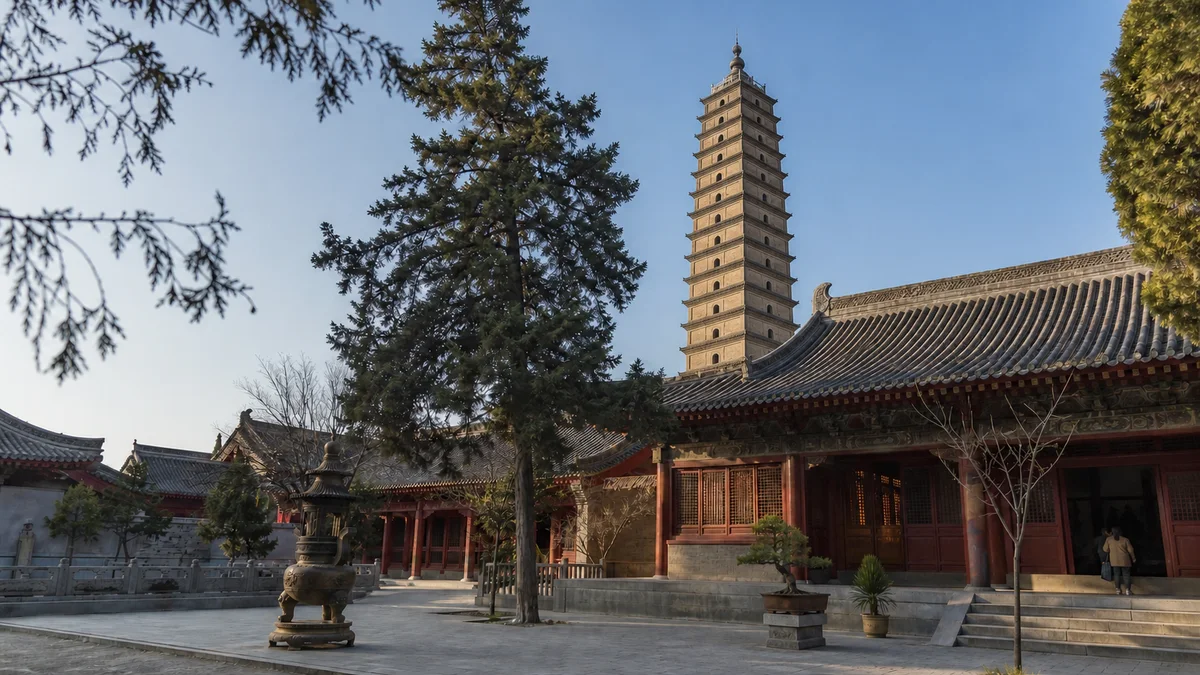
5A View location, maps and nearby scenic areasApproach the True Relic Pagoda through the historic temple axis and look down before looking up. Beneath this rebuilt tower lies the Tang underground crypt that changed the modern understanding of Famen Temple. The pagoda is visible architecture; the most consequential evidence came from a sealed space below it.
The scene is already layered. Monastic halls sustain worship, the present pagoda reconstructs a tower lost in the twentieth century, museum cases protect Tang objects, and a long modern ceremonial avenue leads to the monumental Namaste Dagoba. Together they form today’s Buddhist cultural scenic area, but they do not belong to one date or one architectural project.
Read the site in three parts: begin with the historic monastery and True Relic Pagoda; use the crypt and treasure displays to understand Tang evidence; then decide whether the scale and symbolism of the modern axis and Namaste Dagoba add to your visit. Current galleries, relic-veneration arrangements and internal transport can change that order.
One scenic area contains a monastery, an archaeological site and a modern monument
The historic Famen Temple precinct is a living Buddhist monastery organised around gates, halls, courtyards and the pagoda. Its buildings have been repeatedly repaired or rebuilt. A structure that looks traditionally proportioned may be modern fabric serving an older religious location and ritual sequence.
The present True Relic Pagoda was reconstructed in the late 1980s after the earlier Ming-period brick tower partially collapsed in 1981. It marks the place of the underground crypt but is not the Tang pagoda seen by imperial envoys. Protective design, reconstruction and religious use now meet above ancient foundations.
The Namaste Dagoba, opened in the twenty-first century, belongs to a different scale and visual language. Its enormous folded-hands form, broad plazas and ceremonial avenue were created for a modern cultural and pilgrimage landscape. It should neither be dismissed as irrelevant nor confused with excavated Tang architecture.
The Famen Temple 5A profile locates the wider complex in Fufeng County, Baoji. Onsite maps may divide temple, museum, performance or modern monument zones differently. Identify your entrance before assuming the historic monastery is just beyond the first plaza.
A collapsed tower led to the 1987 underground-palace discovery
The 1981 failure of the brick pagoda made conservation and rebuilding urgent. As work proceeded, archaeologists investigated the base. In 1987, they identified and opened a sealed Tang-period underground complex, often translated as the “underground palace” or crypt.
The discovery was not a treasure chest pulled from an empty hole. Archaeologists recorded an entrance, passage, chambers, platforms and the positions of reliquaries and offerings. Inscriptions and an inventory stele helped connect objects with Tang imperial donations and the final sealing of the crypt. Context—where one object sat inside another and where the set stood—is as important as precious material.
Four finger-like relic objects were found within nested containers. Temple tradition distinguishes one as the true-body relic and the others as “shadow bones,” devotional substitutes or protectors. Archaeology can document their material, placement, containers and inscriptions. It cannot scientifically prove that a particular bone came from the body of the historical Shakyamuni Buddha.
That boundary allows two kinds of truth to remain visible. For worshippers, the relic’s identity rests in transmitted Buddhist faith and ritual recognition. For archaeological study, the crypt securely demonstrates that late Tang rulers invested extraordinary resources in a relic cult at Famen Temple.
Tang emperors turned relic veneration into state theatre
Famen Temple had a history before the Tang, though distant founding dates in temple tradition are harder to match to surviving fabric. Under the Tang, its relic became deeply entangled with imperial authority. Emperors sent officials and monks to open the crypt, escort the relic and receive it in the capitals during major ceremonies.
In 819, Emperor Xianzong ordered another reception. The official and writer Han Yu opposed the ritual in his Memorial on the Buddha’s Bone:
今闻陛下令群僧迎佛骨于凤翔,御楼以观,舁入大内。
Now I hear that Your Majesty has ordered monks to receive the Buddha bone at Fengxiang, watched it from the imperial tower, and had it carried into the palace.
Han Yu was a hostile critic, not a neutral observer. Yet his protest confirms how public and politically charged the procession appeared. He argued from a Confucian and anti-Buddhist position; Emperor Xianzong reacted angrily, and Han Yu was spared a harsher punishment but exiled to distant Chaozhou.
The episode reveals consequences on several levels. Relic veneration could display piety, legitimacy and the ruler’s power to mobilise crowds and wealth. It could also provoke officials who saw lavish Buddhist ritual as foreign, fiscally harmful or contrary to proper government. Modern processions and announced veneration days echo the relic’s public force, though their institutions and audiences are not Tang replicas.
Suppression, revival and the final Tang sealing
Imperial patronage did not protect Buddhism permanently. During Emperor Wuzong’s 845 suppression of Buddhism, monasteries across the empire lost property, images and clerical communities; monks and nuns were forced back into lay status. Famen Temple’s history belongs within that violence rather than a smooth story of continuous royal favour.
Buddhist institutions revived after Wuzong’s death. In 873, Emperor Yizong welcomed the Famen relic in an elaborate court ceremony. He died soon afterward, and under Emperor Xizong the relic and offerings were returned. In 874, the crypt was sealed for what became its last Tang deposition.
That date matters. The objects survived underground not because the whole monastery remained untouched, but because a specific ritual assemblage was closed, forgotten and eventually buried beneath later buildings. Above ground, dynastic change, war, fire and repeated pagoda rebuilding transformed the site.
The Ming brick pagoda that later marked the crypt was itself a replacement, and its twentieth-century collapse set the archaeological discovery in motion. “Preservation” here is a chain of loss, rebuilding, concealment, rediscovery and conservation—not an unbroken architectural original.
The crypt inventory turns treasure into a ritual system
Gold and silver vessels, nested reliquaries, glassware, ceramics, silk and courtly tea utensils made the 1987 discovery spectacular. Their value lies not only in rarity or workmanship. The inventory and placement show how objects performed devotion, protected relics and translated imperial rank into material offerings.
Look for nesting. A sacred object could sit within several containers, each adding protection and meaning. Materials, inscriptions and decorative programmes connected Buddhist imagery with workshops serving elite patrons. Some glass and luxury forms also point to long-distance exchange, although an object’s style should not be turned into an unsupported claim about one precise route or maker.
The tea set is especially useful. Preparing and offering tea required specialised vessels and court procedure; it joins everyday consumption to ritual refinement. Silk records textile skill, donor status and fragile organic material that rarely survives. The inventory stele acts almost like a controlled list, helping archaeologists compare excavated position with named offerings.
Museum displays may rotate objects or use replicas to protect sensitive originals. A famous reliquary shown in a photograph may not be in the same gallery when you arrive. Read the label for material, date, provenance and display status rather than treating every glittering object as an original from the crypt.
Sacred identity and archaeological evidence require different language
In Buddhist practice, a relic is not merely a specimen. It can focus memory, merit-making, vows and the felt presence of the Buddha’s teaching. Bowing, circumambulation, offerings and quiet attention are meaningful actions for worshippers, not performances staged for tourism.
A traditional verse summarises an ethical frame larger than the object itself:
诸恶莫作,众善奉行,自净其意,是诸佛教。
Do no evil; cultivate all that is good; purify one’s mind—this is the teaching of the Buddhas.
The verse helps prevent the visit from becoming a hunt for a miraculous bone. The relic is revered within a moral and ritual tradition. A visitor need not make the same faith claim to understand why identity cannot be settled by a display case alone.
Use precise phrasing: “revered in temple tradition as a finger relic of Shakyamuni Buddha” respects the community and evidence. “Scientifically proven remains of the Buddha” exceeds what archaeology establishes. Conversely, calling the relic “just a bone” dismisses the living religious meaning that explains centuries of care.
Monks, craftspeople and excavators share the site’s history
Tang ceremonies required more than emperors. Monks maintained liturgy and relic knowledge; officials organised escorts and inventories; donors supplied wealth; guards controlled access. Miners and builders cut the crypt, while metalworkers, stone carvers, glass and ceramic makers, textile workers and calligraphers produced the ritual assemblage.
Work continued after sealing. Generations of monastics maintained halls and worship under changing political conditions. Local builders repaired roofs and pagodas; pilgrims, farmers and market networks supported the temple economy. Survival was social, not the automatic property of sacred objects.
The 1987 excavation added archaeologists, conservators, photographers, epigraphers and materials specialists. They faced a compressed deposit where silk, metal, stone and bone required different treatment. Recording before removal preserved relationships that no later exhibition can recreate.
Today monks and lay worshippers still use parts of the precinct while museum staff and scenic-area workers serve large crowds. Their priorities can differ. A tour group wants a clear view; a devotee wants time to bow; a conservator needs low light. Good visitor behaviour makes room for all three.
Choose the historical core before the monumental modern axis
Begin in the historic monastery. Follow the gates and halls toward the True Relic Pagoda, watching how worshippers use incense areas and thresholds. Then visit the crypt interpretation and treasure museum while the relationship between pagoda and underground deposit is clear.
Only afterward decide how much of the modern ceremonial avenue and Namaste Dagoba to add. The distance across the wider scenic area can be substantial, especially in sun or wind. A shuttle or sightseeing vehicle may save energy, but routes, tickets, stops and last departures can change. Do not assume a vehicle returns to the entrance you used.
For a three-hour visit, prioritise monastery, pagoda context and one strong museum sequence. For a longer pilgrimage-and-architecture day, add the modern axis and allow time for worship. If a relic veneration, ceremony or performance matters, confirm its date, location, admission arrangement and photography rules through official information.
Famen Temple pairs naturally with other Shaanxi histories but not in one rushed circuit. Qianling Mausoleum shows Tang royal power through landscape and burial; the Giant Wild Goose Pagoda connects Buddhism to translation and urban life. Mount Taibai requires a separate, weather-aware mountain plan.
Photograph with restraint and plan for thresholds, distance and sun
In the old precinct, frame the True Relic Pagoda through successive gates to show ritual approach, but do not block worshippers. Side light can reveal roof brackets and repaired brickwork. In the museum, an object photographed with its label is more useful than a reflection-filled close-up whose identity is unclear.
Never photograph a restricted reliquary, ceremony or worshipper against instructions. Flash, tripods and commercial equipment may be prohibited, and rules can tighten during relic veneration. Ask before making a close portrait, step around people bowing and keep phones silent in prayer halls.
The modern avenue is broad and exposed. Summer heat, winter wind and limited shade can turn scale into fatigue. Historic halls add steps, stone thresholds and uneven paving; museum lifts or ramps may not connect every route. Visitors with mobility needs should confirm the closest drop-off, step-free entrance, lift status, wheelchair availability and accessible toilets for each zone.
Allow more return time than the map suggests, wear shoes with grip and carry water where permitted. Ceremonies, gallery closures, crowds and security checks can redirect movement without notice.
Before leaving, look from the rebuilt pagoda toward the modern dagoba. Between them lies no single, intact “ancient Famen Temple,” but a series of choices: Tang rulers made relic devotion public; critics resisted; suppression dismantled institutions; monks and donors rebuilt; a sealed crypt preserved evidence; archaeologists made it legible; believers continue to give it sacred meaning. The site asks neither blind belief nor casual disbelief. It asks you to know which claim belongs to faith, which to material evidence, and why both have consequences.
The LoreLens app can distinguish the historic monastery, reconstructed pagoda, archaeological displays and modern Namaste Dagoba as you move through the complex.
Location profile
Where it is

Frequently asked questions
Has science proved that Famen Temple's finger relic belonged to the historical Buddha?
No scientific test can establish that individual identity. The designation as a finger-bone relic of Shakyamuni Buddha belongs to Buddhist belief, temple tradition and the Tang reliquary record. Visitors can respect that sacred identity while distinguishing it from what archaeology can demonstrate about the crypt, containers and date of deposition.
Are the True Relic Pagoda and Namaste Dagoba the same building?
No. The True Relic Pagoda stands in the historic temple precinct above the Tang crypt and is a late-20th-century reconstruction after the earlier brick pagoda collapsed. The monumental Namaste Dagoba and its long ceremonial axis are modern additions to the wider cultural scenic area.
How much time should I allow for Famen Temple?
Allow at least three to four hours for the historic monastery, pagoda area and museum displays. Walking the full modern axis and visiting the Namaste Dagoba can extend the visit toward a full day. Entrances, gallery access, shuttles and ceremonies change, so check the current map before committing to every zone.
Can visitors see the revered relic every day?
Do not assume so. Public veneration or display may be limited to announced dates, religious occasions or specific operating arrangements, and the viewing format can change. Confirm current information through the temple or scenic area's official channel, and regard access as participation in a sacred observance rather than a guaranteed exhibit.