Shaanxi · Xianyang
Qianling Mausoleum: Two Rulers beneath Liangshan
Walk the stone avenue between Liangshan and Qianling's paired steles, then separate the unexcavated joint tomb of Gaozong and Wu Zetian from the satellite tombs whose murals reveal Tang court life.
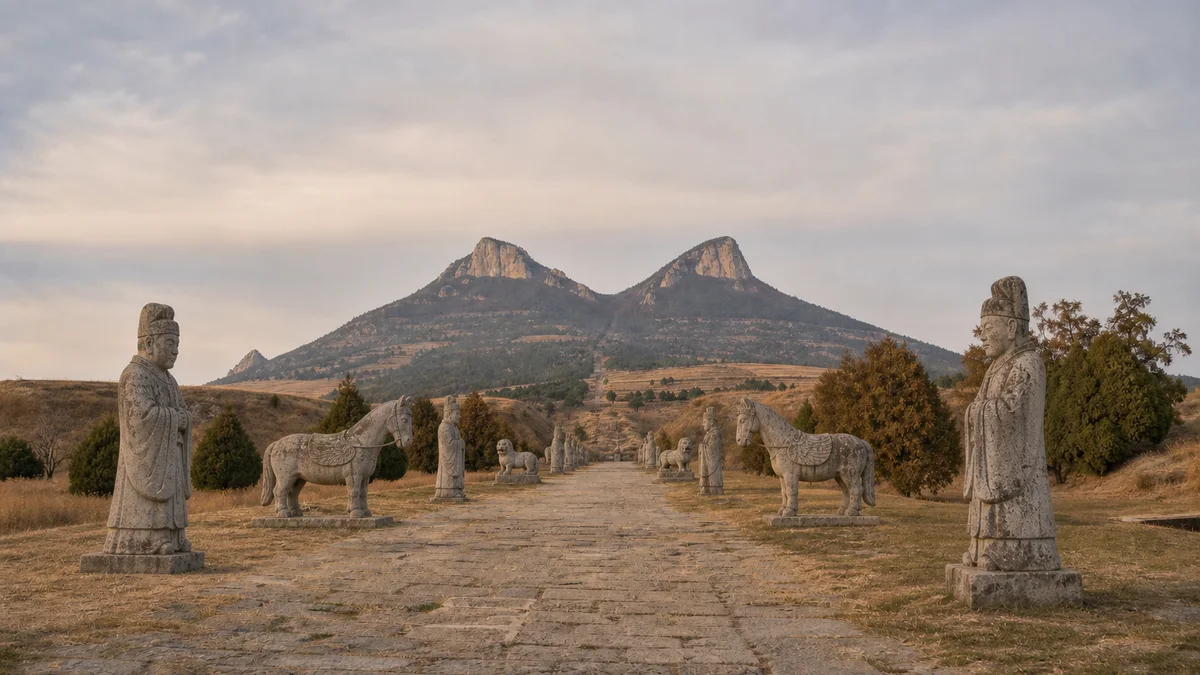
5A View location, maps and nearby scenic areasStand at the lower end of the stone avenue and let Liangshan rise behind it. The mountain is not scenery placed beyond Qianling’s tomb mound; it is the burial monument itself. Ahead, the Sima Dao, or Spirit Way, advances between stone animals, officials and foreign or regional figures. Near the upper ceremonial zone, a text-filled monument to Emperor Gaozong faces the famous stele originally left without an imperial inscription for Wu Zetian.
Qianling (roughly “chyen-ling”) is the joint mausoleum of two Tang rulers: Emperor Gaozong, born Li Zhi, and Wu Zetian, his empress who later took the title of emperor in her own right. The core chamber cut into Liangshan has not been scientifically excavated. Everything you can responsibly say about the interior must begin with that limit.
Read the site from outside inward: first let the mountain establish scale; then use the Spirit Way figures to reconstruct court order; compare the two great steles; finally visit satellite-tomb displays as separate evidence. Do not let objects from an excavated prince’s or princess’s tomb become imaginary proof of the sealed main chamber.
The mountain became the mausoleum
Emperor Gaozong died in 683. Construction and preparation at Qianling followed, and he was interred here in 684. Wu Zetian continued to dominate government, first as empress dowager and eventually as emperor of her Zhou dynasty. After her death in 705, Tang rule had been restored; in 706 she was buried with Gaozong at Qianling.
The sequence makes the joint burial politically significant. It reunited Wu with the Tang emperor whose dynasty she had interrupted, while her own reign could not simply be erased. Qianling is therefore not merely a royal couple’s romantic resting place. It is a material settlement among marriage, dynastic legitimacy, succession and a reign conducted under a different dynastic name.
Tang builders used the principle yin shan wei ling—“using the mountain as the mausoleum.” Rather than piling one enormous artificial mound over a ground-level chamber, they cut or organized the burial within a natural mountain mass and extended an architectural precinct across the slopes. Liangshan’s main northern height and southern hills gave the approach a monumental profile before a visitor reached any stone statue.
That phrase does not mean the mountain required little work. Roads, gates, walls, drainage, timber structures, stone carving and a sealed underground passage demanded planning and labor. Archaeological survey and surviving remains indicate a large gated landscape modeled through imperial ideas of capital and palace order. Published dimensions vary because they may measure an inner precinct, outer landscape, wall line or modern scenic area.
The Spirit Way turns court rank into landscape
The southern approach, commonly called the Sima Dao, is a processional road rather than a decorative sculpture garden. Pairs and groups of carved pillars, winged horses, ostrich-like birds, saddled horses, military figures and civil officials organize movement toward the mountain. Their sequence transforms court protocol into distance.
Look at how the scale changes. Animals introduce power and reach; armored guardians control the approach; officials make government visible. The carvings have weathered, shifted and been repaired, so the avenue is not a perfectly untouched Tang parade. Missing details, later bases and modern paths are part of its preservation history.
The ostrich forms are especially useful evidence of Tang connections beyond central China. They evoke rare animals known through diplomacy and exchange, but a carving does not document one specific embassy by itself. Likewise, clothing and stance can suggest office or origin without giving every statue an individual identity.
The full imperial precinct once included gates and walled divisions extending well beyond today’s most photographed line. Walking only the first statues can make Qianling seem compact. Looking back down the axis reveals the intended scale: the mountain, route and southern landscape work as one composition.
The “foreign envoys” do not all have secure names
Near the ceremonial approach stands a group commonly counted as 61 stone figures, often called foreign envoys, tributary rulers or regional leaders. Some bases once carried identifying inscriptions, and scholarship has connected several figures with polities and offices known to the Tang court. Yet weathering, damage, incomplete texts and changing historical terminology make a complete name list uncertain.
The word “foreign” also needs care. Tang political geography included neighboring kingdoms, steppe powers, allied or subordinate leaders and frontier regions whose relationship to the court cannot be reduced to modern national borders. The statues express how the Tang wished to stage centrality and diplomatic reach; they are not a neutral census of ethnicity.
Many figures lack heads. Explanations have included weathering, earthquakes, warfare, deliberate vandalism, iconoclasm or theft. Local stories offer additional causes, sometimes linking destruction to fear or resentment surrounding the statues. Unless a particular break has diagnostic evidence, no single event should be presented as the answer for every missing head.
Their damaged state still communicates. A row of bodies facing the imperial mountain shows a political claim; absent faces remind us how much identity is lost when inscription and sculpture separate. Photograph the group as evidence of an ordered court image, not as proof that every person represented has been securely identified.
One stele speaks; the other became a field of later voices
West of the approach stands the Shusheng Ji Bei, the “Stele Recording the Sage’s Deeds,” honoring Gaozong. Its long formal text is associated with Wu Zetian’s presentation of his achievements and Tang imperial memory. The monument demonstrates how rule was normally made legible: name virtues, narrate deeds and set an authorized evaluation in stone.
Across from it, Wu Zetian’s Wordless Stele originally lacked that kind of official biographical inscription on its main surface. It is not literally empty today. Visitors in later dynasties carved poems, records and comments onto it, turning the blank imperial statement into a layered archive of reception.
Why was it left wordless? Popular explanations say Wu believed her achievements exceeded language, wanted later generations to judge, could not have merit and fault reconciled, or fell victim to political compromise after the Tang restoration. Another possibility is that an intended text was never completed. These are later interpretations. No surviving contemporary instruction settles the reason.
Compare the two stones rather than asking only for a mystery solution. Gaozong’s stele represents controlled dynastic narrative; Wu’s monument exposes the instability of judgment. Its later inscriptions show that silence does not end interpretation. It invites other people to write.
Wu Zetian was neither only heroine nor only monster
Wu Zetian rose from the imperial court to become Gaozong’s empress, exercised increasing authority during his illnesses, ruled as empress dowager after his death and in 690 declared herself emperor of a new Zhou dynasty. She remains the only woman in Chinese history to have formally taken the imperial title in this way.
Her government recruited and promoted officials through an expanding examination culture, strengthened channels by which talent outside the narrowest hereditary elite could enter service, patronized Buddhism and managed an ambitious state. It also used informers and secret-police mechanisms, punished opponents, carried out purges and operated within violent court and succession politics. Frontier warfare and state extraction affected people far from the capital.
Centuries later, the historian Sima Guang, no admirer of her usurpation, wrote that “government issued from herself; she was discerning and decisive, and the able men of the age competed to serve her.” The wider judgment also criticized her harsh use of punishment and reward. That tension is the point: administrative ability and political violence belonged to the same reign.
The story turns at her death. A coup in 705 removed her from power, Tang dynastic rule resumed, and burial with Gaozong followed. The joint tomb did not erase the Zhou interlude; it placed the controversial ruler back inside Tang genealogy. The modern echo continues in novels, television, gender history and public debate, often with the Wordless Stele used as a symbol of judgment. That symbol is powerful, but it is still not proof that Wu personally designed the blank surface for that exact modern message.
To place her court in space, Daming Palace reconstructs the scale of Tang government and ceremony, while the Giant Wild Goose Pagoda shows the Buddhist networks and translation culture that also shaped the dynasty.
Satellite tombs are evidence—but not from the main chamber
Qianling’s wider complex includes tombs of imperial relatives and high-status figures. Excavated examples associated with Princess Yongtai, Prince Yide and Crown Prince Zhanghuai have yielded murals, pottery figures, architectural information and burial objects that illuminate elite Tang life.
Murals of palace women, attendants, polo, envoys, buildings and processions are among the most memorable finds. Some originals or associated objects are conserved and displayed in museums; some tomb passages or exhibition spaces may be accessible depending on current operations. Low light, conservation needs and rotation can change what a visitor sees.
These finds are invaluable comparisons, but their labels matter. A mural excavated from Princess Yongtai’s tomb did not come from Gaozong and Wu Zetian’s sealed chamber. A pottery guardian from a satellite burial does not establish the main tomb’s inventory. Museum display design can bring them into one story without making their archaeological contexts identical.
Likewise, claims about precise treasure totals, anti-theft traps or a completely untouched interior cannot be confirmed without excavation. Historical accounts, remote investigation and the absence or presence of known looting traces can inform probability, but they do not provide a camera view inside Liangshan.
Craftspeople built the silence; conservators now protect it
An imperial mountain tomb mobilized quarry workers, stone carvers, earthworkers, carpenters, metalworkers, painters, transport teams, officials and guards. “Using the mountain” transferred labor into cutting, sealing, roads and monumental approaches; it did not remove labor from the story.
The stone figures preserve workshop decisions in armor edges, animal muscles and repeated poses. Satellite-tomb murals preserve painters’ lines, pigment preparation and spatial conventions. Most individual makers remain unnamed, while the rulers they served dominate inscriptions. Look for hands in the work even when history does not supply biographies.
Guardianship continued after burial through local communities, officials and later heritage workers, though protection was never uninterrupted. Weather, vegetation, visitor pressure, past digging and modern pollution all affect stone and underground environments. Archaeologists document the precinct; conservators stabilize murals and sculpture; staff manage access around vulnerable surfaces.
Leaving the main chamber closed can be an active conservation decision, not a failure of curiosity. Excavation is irreversible. Until specialists can justify opening, stabilizing and housing whatever environment lies within, non-invasive study and protection may preserve more evidence for future questions.
Walk the axis first, then choose one satellite tomb
Begin at the lower Spirit Way and move slowly through the stone sequence. Pause at the envoy group, then compare the Shusheng and Wordless steles. Only after understanding the axis should you continue toward currently permitted mausoleum viewpoints. The core entrance and chamber are not part of an ordinary interior tour.
The route is long, exposed and often sunny. Stone paving, slopes and steps can be tiring; wind around Liangshan may feel strong even when the plain is warm. Carry water where permitted, sun protection and a wind layer, and avoid treating the long open axis as a quick stop between buses.
If time remains, choose a satellite tomb or museum according to current opening and your interest in murals or objects. Trying to collect every separate site can replace looking with transport. Ticket combinations, internal vehicles, tomb access and exhibition rotations change, so verify them at the official entrance.
Some main-axis surfaces may be broad and paved, but curb changes, distance, steps and satellite tomb passages create barriers. Visitors needing step-free travel should ask about the complete accessible route, available transport, toilets and which viewing areas are open—not simply whether the main plaza is flat.
Photograph the court in stone and remember it is a cemetery
Morning or late light can cast long shadows from stone figures and reveal shallow carving; overcast conditions reduce contrast on weathered faces and inscriptions. Use the line of statues to lead toward Liangshan, then turn around for the reverse perspective that shows how the court faced the mountain.
Do not climb figures, rub inscriptions, sit on sacred bases or move beyond barriers for symmetry. Drones, tripods, flash and photography inside mural displays may be restricted. Murals are especially light-sensitive; follow staff instructions and never assume “no flash” means every other form of photography is allowed.
Keep voices low near active memorial or burial areas. Avoid jokes about bodies, treasure hunting or traps, and do not treat headless statues as comic props. Qianling is an archaeological landscape and a cemetery before it is a film location.
At the end, stand between the two steles again. One carries an authorized account; the other accumulated words because it began without one. Behind both, Liangshan keeps the rulers’ chamber outside direct view. The lack of excavation is not a blank to fill with fantasy.
Qianling’s strongest lesson is that evidence has locations. A mountain can hold a sealed joint tomb; a satellite grave can reveal painted court life; a damaged envoy can preserve political choreography; a blank stele can attract centuries of argument. Respecting those boundaries does not make the story smaller. It lets two rulers, their workers and their later judges remain as complicated as the stones themselves.
The LoreLens app can help identify Qianling’s stone figures, steles and route, then distinguish Tang evidence from later interpretation and satellite-tomb finds.
Location profile
Where it is

Frequently asked questions
Who is buried in Qianling Mausoleum?
Qianling is the joint imperial mausoleum of Tang Emperor Gaozong, Li Zhi, and Wu Zetian, who was his empress and later ruled in her own name as emperor. Gaozong was interred in 684; after Wu Zetian died in 705 and Tang rule was restored, she was buried with him in 706.
Has Qianling's main burial chamber been opened?
No scientific excavation has opened the core chamber inside Liangshan. Surveys and study can reveal features of the precinct, but claims that the interior is certainly intact, contains a precise quantity of treasure or has proven anti-theft mechanisms go beyond direct evidence. Visitors see the processional landscape and satellite finds, not the main chamber.
Why is Wu Zetian's monument called the Wordless Stele?
Its main imperial face was originally left without a formal biographical inscription, although later visitors carved texts on it. Explanations include letting history judge her, claiming her achievements exceeded words, political compromise after the Tang restoration or an unfinished inscription. No surviving contemporary statement establishes one definitive reason.
How much time should I allow for Qianling?
Several hours normally allow the main Spirit Way, stone figures, paired steles and permitted mausoleum viewpoints. Add more for museums or open satellite tombs, which may use separate tickets and schedules. Distances, stairs, heat and wind slow the route, so confirm current access and avoid attaching a tightly timed departure.
Sources and further reading
Background references for the history and place names in this guide. Opening hours, ticketing and access change often — always confirm with official local information before travelling.