Jiangsu · Zhenjiang
Zhenjiang's Three Hills: One Swallowed by a Temple, One Still an Island, One a Balcony for a Poet
Three low hills strung along a few kilometres of the lower Yangtze at Zhenjiang, sharing one 5A listing. One of them stopped being an island in the nineteenth century, one never did, and the third holds an iron pagoda with four of its seven storeys left and a relic chamber nobody knew about until 1960.
5A View location, maps and nearby scenic areasZhenjiang has three hills on the river, they are numbered together as one 5A scenic area, and the single most useful thing to know before you visit is how differently the Yangtze has treated each of them.
Jinshan was an island. It is not one now. The river silted around it in the nineteenth century and left it stranded in a city park, with the water it used to stand in a few hundred metres away.
Jiaoshan is still an island. You take a boat, and the crossing is short enough that people underestimate what it means: everything on Jiaoshan has spent its life surrounded by moving water, including the most famous piece of carved stone in the lower Yangtze, which the water took.
Beigushan was never an island, was never meant to be beautiful, and is the reason the other two are in a set. It is a defensive spur — fifty-five metres, three peaks, cliffs on three sides — and it exists in Chinese memory as a place people stood to look north at territory they had lost.
One ticket, three completely different arguments.
The temple that ate its hill
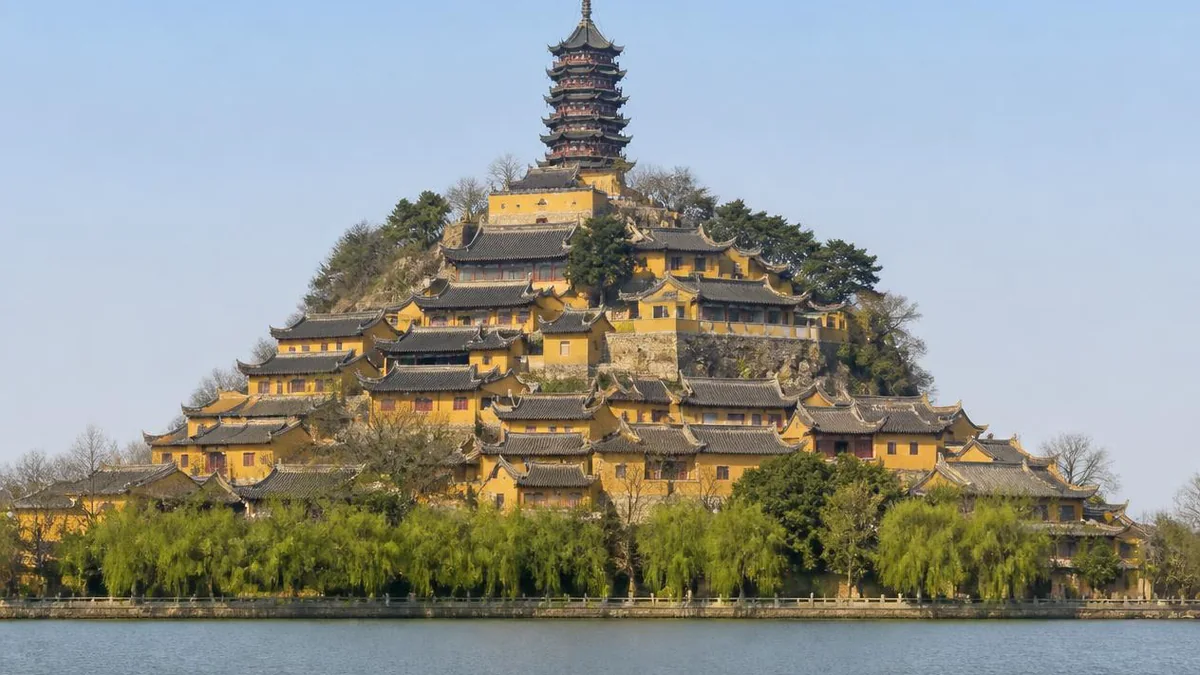
Walk up to Jinshan and you will notice you cannot see the hill. Its slope is entirely covered in halls: yellow-plastered walls, grey tiled eaves, stacked in tiers up the incline so the mountain and the monastery read as one enormous stepped building with a pagoda on top.
Chinese guides describe this in a four-character pair that is worth carrying with you all day, because it is the actual difference between two of the three hills. Jinshan is the temple wrapping the hill. Jiaoshan is the hill hiding the temple — on Jiaoshan the trees close over the buildings and you can walk past Dinghui Temple without registering it.
The monastery here was founded in the Eastern Jin, in the fourth century, under the name Zexin. It has been renamed repeatedly by people with the authority to rename things: Longyou in the Northern Song Tianxi era, then, in the autumn of 1687, Jiangtian Chan Temple — River-and-Sky — by the Kangxi emperor, who climbed it, looked at the view, and named the temple after what he saw. That is still the name on the gate.
Riding a donkey up Jinshan
The interesting thing about Jinshan is the thing that is missing.
For most of its recorded life this was a rock in the middle of the Yangtze, and the whole point of it was that you arrived by water. Then the river moved. Silt built up on the south side, the channel shifted, and at some point the island became a hill on the bank.
The date is disputed, and the disagreement is on the record rather than folkloric. One line of sources puts the joining in the Daoguang reign, 1821 to 1850. Another puts it at the end of the Guangxu reign, around 1903. The two are usually presented as competing claims; they are more likely two ends of one slow process, with the Daoguang decades as the beginning of the welding and the last years of the Qing as its completion.
What survives from the transition is a phrase: riding a donkey up Jinshan. It was a late-Qing and early-Republican pleasure, and it only makes sense in a narrow window of history — after there was ground to ride across, while the memory of arriving by boat was fresh enough to make riding funny.
The pagoda is from 1900, and it is named after an empress
The pagoda on the summit is the thing you photograph, and it is much newer than it looks.
There were pagodas on this hill from the Qi and Liang dynasties. In the closing years of the Northern Song, the chancellor Zeng Bu built two of them here in a memorial rite for his mother, one on each half of the hill, named Jianci and Jianshou. Both had collapsed by the early Ming.
The tower standing now is the result of a fundraising campaign. The earlier pagoda burned in the Xianfeng-era wars; in 1894 the abbot Yinru petitioned Beijing and was authorised to raise money for a rebuild; he spent five years begging door to door across the north and south, secured the backing of Liu Kunyi, the governor-general of Liangjiang, and collected 29,600 taels of silver. The pagoda was completed in 1900.
The completion coincided with the sixtieth birthday of the Empress Dowager Cixi, and the tower was named Cishou — ci from her name, shou for longevity. It is octagonal, seven storeys, brick and timber, about thirty metres, with an internal stair and a gallery at every level. You are climbing a Boxer-year building dedicated to an imperial birthday, on a hill that had lost its river.
The flood that never happened
Jinshan’s global fame rests on an event that did not occur.
Water Floods Jinshan is the climactic episode of the Legend of the White Snake: a snake spirit in the form of a woman, the mortal man she marries, and the monk Fahai, abbot of this temple, who separates them and is answered with a flood. The story took its familiar shape in late-Ming and Qing fiction and drama and is now one of the four great folk tales of China. It has been opera, film, television and, repeatedly, a reason to come here.
Fahai, as the story’s antagonist, has no documented career on this hill. There is an older and separate tradition about a monk here — usually named Pei the ascetic and said to be a son of the Tang official Pei Xiu — who dug up gold on the site, reported it to the throne, and thereby got the hill its name, Gold Mountain. That account comes down in later sources, and the honest label for it is tradition.
Which leaves a genuinely odd situation, and it is the most modern thing about Jinshan: a working monastery whose worldwide recognition comes from a piece of fiction in which its own abbot is the villain, and which has decided not to fight it.
Su Shi’s line, and Kangxi’s four characters
Two pieces of writing are attached to this hill and they belong to different registers.
In 1071, on his way to a posting in Hangzhou, Su Shi stopped here and wrote Visiting Jinshan Temple. Its opening couplet is the reason the poem is still quoted: the river outside his family’s door in Sichuan is where this water begins, and his career as an official has done nothing but carry him along it to the sea. It is a homesickness poem disguised as a geography lesson, written by a man who could see the whole length of his own life in a body of water.
The other piece is four characters — a single view of river and sky — written by the Kangxi emperor and now carved on a stele in the pavilion at the summit. The pavilion was rebuilt in 1685 and again in 1871, and it was Zeng Guofan, as governor-general, who had the emperor’s four characters cut in stone and placed inside. The pavilion is known by that phrase as often as by its own name.
One hill, one poet who used it to think about mortality, one emperor who used it to caption a view.
The island named after a man who said no three times
Jiaoshan is a wooded lump of rock in the river, historically nicknamed Floating Jade, and it is named after somebody who spent his life refusing to be important.
Jiao Guang was an Eastern Han hermit. The tradition holds that he was summoned to office three times by the throne and declined three times, and stayed on this island instead. There is a cave on the hill called Three Summonses for exactly that. It is a very Chinese kind of fame: the mountain carries the name of a man whose entire recorded achievement was not going.
Dinghui Temple sits under the trees. Its founding is placed in the Xingping years of the Eastern Han, in the mid-190s, as a small hermitage, and it took its present name from the Kangxi emperor in 1703. On this island you have to look for it, which is the whole point of the pairing with Jinshan.
The stone the river took
The reason serious visitors come to Jiaoshan is a damaged rock.
The Yihe Ming — Eulogy on Burying a Crane — is an inscription carved on the west crag of this island, dated 514, the thirteenth year of the Liang Tianjian reign. Its text is a small thing: a household mourns a pet crane. Its calligraphy is not. Huang Tingjian called it the ancestor of large characters and wrote that no large characters surpass it, and that verdict made a modest memorial into one of the foundational objects of Chinese calligraphic history.
Then the crag fell into the Yangtze. For centuries the text was readable only in winter, when the water dropped far enough to expose it. In 1713 five fragments were chiselled off and brought ashore. In 2010 a publicised and expensive salvage operation lifted some seven tonnes of stone from the river bed looking for the rest.
The surrounding collection grew around it. A pavilion for the inscription was built here in 1048 by Qian Yanyuan, enlarged in the Ming, and reduced by war to almost nothing by 1949; the Zhenjiang municipal government rebuilt it on the old site in 1962 by collecting carved stones from the surrounding countryside, with repairs in 1988, an expansion in 2002 and another upgrade in 2020. The stele forest now holds over five hundred stones across roughly seven thousand square metres, with four hundred-odd on display — Tang material, Song inscriptions including work by Mi Fu, a Ming carving of Mi Fu’s copy of the Lanting Preface — and it was listed as a national key protected site on 13 January 1988.
The five fragments stand alone in the central hall. If you want to read the argument in English, the standard study is Lei Xue’s Eulogy for Burying a Crane and the Art of Chinese Calligraphy, which is largely about how a broken stone gets promoted into a canon.
Four storeys of seven, and what was under them
Beigushan’s best object is an iron pagoda that is missing most of itself.
It was built in 825 by Li Deyu, the Tang statesman, and is still sometimes called the Duke of Wei’s pagoda after him. In 1078 it was moved to its present position. It has been destroyed and rebuilt repeatedly. It was seven storeys; the top three came down at the end of the nineteenth century; four remain, and they are not all the same age — the base and the two lowest storeys are Song fabric, the third and fourth are Ming.
In 1960, during repairs, the municipal heritage committee found something nobody had recorded: a relic chamber beneath it, holding a rectangular stone casket. Out of it came more than seven hundred Buddhist relic grains, eleven of them interred in a gold coffin inside a silver outer coffin, and those eleven are the ones later scholarship attributes to the Buddha himself.
That is the sequence worth holding: a ninth-century tower, moved in the eleventh, half-collapsed in the nineteenth, opened by accident in the twentieth.
Where Xin Qiji stood
The tower behind Ganlu Temple is called Duojing Lou now and Beigu Lou in the older texts, and it is the literary centre of the three hills.
In the spring of 1204, Xin Qiji was transferred to be prefect of Zhenjiang — a river-defence post looking across at Yangzhou. Han Tuozhou was pushing for a campaign against the Jin; Xin Qiji wanted the lost north back and did not want it attempted unprepared, and he spent the posting recruiting, making uniforms and running intelligence. In the autumn he climbed this hill and wrote Yong Yu Le: Meditation on the Past at Beigu Pavilion, Jingkou. Some sources place the poem in 1205 instead; the internal evidence favours 1204, because the poem’s forty-three years counts from his crossing to the south in 1161, and 1161 plus forty-three is 1204.
The poem praises Sun Quan, who built a power base at this river mouth, and Liu Yu, who marched north from here, and then turns and uses a fourth-century disaster to argue against a badly prepared war. It ends with the poet comparing himself to the aged general Lian Po — still able, not being used. He was right about the campaign and he was removed on the eve of it for improper appointments. The Ming critic Yang Shen later called this the finest of all his lyrics.
The second poem, Nan Xiang Zi, was written on the same hill and opens by asking where one might look for the homeland — and answering that the view from Beigu tower is full of it.
What the wedding stone is doing there
The rest of Beigushan is a monument to a novel.
Ganlu Temple is dated to 265, in the Wu-era Ganlu reign, and tradition says sweet dew fell as it was built, hence the name. It sits on the summit in a formation Chinese sources call the temple crowning the hill. And it is known, above everything else, as the place where Liu Bei married Sun Quan’s sister — an episode from Romance of the Three Kingdoms, a fourteenth-century novel, describing third-century people, in a temple founded after they died.
The hill has furnished the story anyway: a sword-testing stone, an ambush corridor, a tower renamed the bride’s dressing room. On the wall east of the temple is a stone cut with six characters — the first river-and-mountain view in the world — which tradition attributes to Emperor Wu of Liang. The original is long gone. What you see descends through a Southern Song calligrapher, Wu Ju, who rewrote the six characters, and a Qing official, Cheng Kangzhuang, who copied Wu’s version onto stone during the Kangxi reign. Three men, one phrase, and the earliest of them unverifiable.
That is not a debunking. It is how the hill actually works. The novel is four hundred years younger than the temple, the calligraphy is a copy of a rewrite of a legend, and both have been part of what people came here for so long that they are now the site’s genuine history — just not the history they claim to be.
Standing at Duojing Lou
From the tower you can see west to Jinshan and east to Jiaoshan, and the three hills are described in the old texts as holding the river between them like the horns of an animal.
Hold the three of them apart for a moment. On Jinshan the river left, and a monastery is still there wrapping a hill that no longer needs defending, famous for a flood in a story. On Jiaoshan the river stayed, and took the one object everybody came to see, and left five pieces of it in a hall. On Beigushan the river never mattered as scenery at all — this was a place to stand and count what was on the other side.
Xin Qiji stood roughly here in the autumn of 1204 and asked where a man should look to find his own country. The water in front of you is the answer he was given.
The LoreLens app can identify pagodas, temple halls and carved steles at all three hills and explain what each of them was for.
Location profile
Where it is

Frequently asked questions
Is Jinshan still an island?
No, and the date it stopped being one is genuinely disputed. Jinshan sat in the channel of the Yangtze for most of its recorded history; you reached it by boat, and the phrase that survives from the last stage of the process — riding a donkey up Jinshan — describes doing it on land. Chinese sources give two dates and they are usually presented as rivals. One puts the joining in the Daoguang reign, 1821 to 1850. The other puts it at the end of the Guangxu reign, around 1903. They are probably describing two ends of the same slow event: silt began welding the hill to the south bank in the Daoguang decades, and the last water closed some seventy years later. Treat any single date you are given on site as a simplification of a process, not a fact about a year.
Did the White Snake really flood Jinshan Temple, and was Fahai a real monk?
The flood is fiction. Water Floods Jinshan is an episode in the Legend of the White Snake, a story that reached its familiar form in late-Ming and Qing vernacular fiction and drama, and the monk Fahai is its antagonist, not a figure with a documented career here. There is a separate, older tradition about a monk at this hill — usually named as Pei the ascetic, said to be a son of the Tang official Pei Xiu — who is credited with digging up gold on the site, which is offered as the reason the hill is called Gold Mountain. That account is transmitted in later sources rather than contemporary ones and should be labelled tradition. What is not in doubt is that the temple has spent four centuries being famous for a story about itself that never happened, and that it now sells tickets to people who came for it.
Can I see the original Yihe Ming at Jiaoshan?
You can see what is left of it, which is five fragments. The inscription was carved on the west crag of Jiaoshan and is dated 514, the thirteenth year of the Liang Tianjian reign. The rock later fell into the Yangtze, and for centuries the text was legible only in winter when the water dropped. Five pieces were chiselled out and brought ashore in 1713; they are the centrepiece of the stele forest today, displayed together in the main hall. A publicised salvage operation in 2010 raised some seven tonnes of stone from the river bed in search of more. Huang Tingjian called the piece the ancestor of large-character calligraphy, and that judgement, more than the text itself, is why people come to look at a damaged rock.
Did Liu Bei really get married at Ganlu Temple?
No. The wedding of Liu Bei and Sun Quan's sister at Ganlu Temple on Beigushan is an episode from Romance of the Three Kingdoms, the fourteenth-century novel, not from the third-century record. The temple's own founding date, given as 265, is later than the events the novel places in it. Beigushan has leaned into the story for centuries — there is a sword-testing stone, an ambush corridor, a dressing-table tower — and the naming of those features is part of the site's history even though the wedding is not. The hill has a much better documented literary claim a hundred metres away, at the tower where Xin Qiji wrote two of the most quoted poems in the language.