Jiangsu · Nanjing
Nanjing Confucius Temple: The Examination Hall Underneath
Most visitors come for the lanterns, the snack stalls and the river. The reason this is a shopping street at all is that in 1918 the largest civil-service examination compound in imperial China was cut through with a road and sold off as commercial lots, six parts to Jiangsu and four to Anhui.
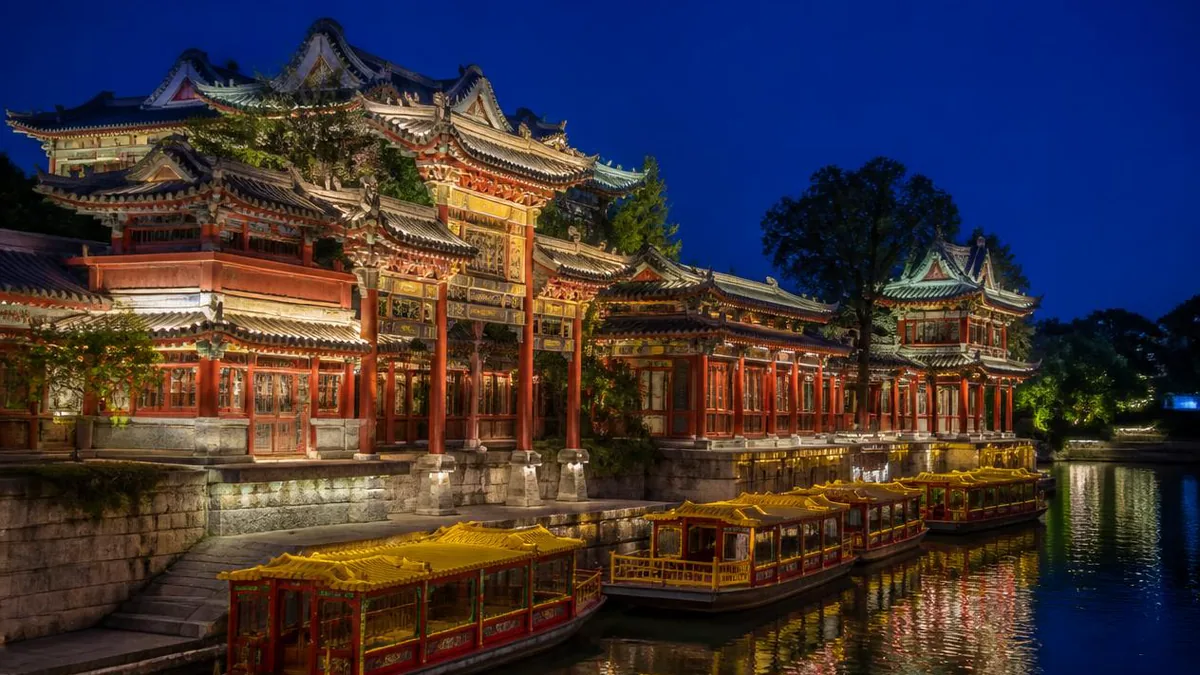
5A View location, maps and nearby scenic areasAlmost everyone who comes to the Confucius Temple district in Nanjing photographs the same three things: the floodlit hall roofs, the boats on the Qinhuai, and a plate of something fried. Almost nobody notices what the district is built on.
Across a lane from the temple, on a site running back to what is now Jiankang Road, stood the Jiangnan Examination Hall — by the late Qing the largest civil-service examination compound in the empire, with more than twenty thousand individual cells. It is not that the exam hall was near the shopping street. The shopping street is the exam hall. In 1918 a road was driven through the site and the land sold in lots, and the commercial district you are walking through inherited that plan.
A temple that borrows a river for its pool
The temple was founded in 1034, on the site of an Eastern Jin academy, and it began life under the name of the shrine to Confucius as Exalted King of Culture. It was burned in the wars of the twelfth century and rebuilt in the Shaoxing period as the prefectural school of Jiankang, with an examination ground attached — school and examination hall arrived together, and they have stood side by side ever since.
The names then track the dynasties: the Jiqing circuit school under the Yuan; the Imperial Academy and then the Yingtian prefectural school in the early Ming; the county schools of Jiangning and Shangyuan under the Qing. Only in 1866 was it renamed Fuzi Miao — Master Confucius Temple — to distinguish it from the Confucian hall of the Jiangning prefectural school, which had moved elsewhere.
One design decision is worth standing still for. A Confucian temple normally has a panchi, a semicircular ritual pool, dug in front of it. This one does not dig a pool. It uses the Qinhuai River itself as its pool, which is why the temple faces water and why the whole district organises itself along a bank rather than around a courtyard. The screen wall on the far side of the river, about 110 metres long and 10 high, dates from 1575, and the carved stone balustrade on the north bank from 1514.
What you are actually looking at
Be clear about this, because the lighting encourages the opposite conclusion.
The temple burned in the Taiping war of the 1850s. It was rebuilt and enlarged in the Tongzhi period under Zeng Guofan and Li Hongzhang after the recapture of Nanjing. It was heavily damaged by fire again when Japanese forces took the city in 1937. Rebuilding of the present complex was decided by the Nanjing and Qinhuai district governments in 1984.
So the Lingxing Gate, the Dacheng Gate, the Dacheng Hall, the Mingde Hall and the Zunjing Pavilion on the axis are, as fabric, a 1980s and later reconstruction on documented foundations. That is not a scandal — this temple has been rebuilt at least four times in a thousand years, and rebuilding is what Chinese temple complexes do. But it means the correct sentence is “this is where the temple has stood since 1034,” not “this is a Song building.”
The 1514 balustrade and the 1575 screen wall are the exceptions, and the Mingyuan Lou next door, of 1534, is another.
The real weight is across the lane
Examinations in Nanjing are older than the compound. A prefectural examination hall was built here in 1168 under the Southern Song, and a local gazetteer of 1261 records it with a hundred and ten rooms, “facing the Qinhuai, adjoining the Qingxi.” Its exact site is unknown.
The Ming made Nanjing the capital and began triennial provincial examinations in 1370. When the capital moved to Beijing in the early fifteenth century Nanjing remained the secondary capital, and the compound here held the provincial examination for the Southern Metropolitan Region for the rest of the dynasty.
When it settled on its present site is genuinely disputed, and the dispute is instructive. Late Qing writings say the Yongle emperor confiscated the houses of disgraced officials — including a shrine to the son of Qin Hui — and converted them into an examination ground. But a stele of 1457 by the Nanjing Imperial Academy libationer Wu Jie, still on site, says the site was fixed in the Jingtai period, and lists the four earlier locations the examinations had occupied since the beginning of the dynasty. A prefect is recorded asking around and being told that “on the sunny bank of the Qinhuai there is open ground, the confiscated house of a soldier.” Two accounts, one of them a contemporary inscription; they have not been reconciled.
Twenty thousand cells, counted era by era
This is the number everyone gets wrong, so take it as a ladder rather than a fact.
- Jingtai period, mid-fifteenth century: rather more than 3,000 cells, around a central Zhigong Hall.
- Wanli period: over 8,000.
- Kangxi period: over 13,000. By now the compound serves Jiangsu and Anhui jointly, which is where the name Jiangnan comes from, and the two provinces share the costs.
- 1873, after the post-Taiping rebuilding: 20,644.
Late Qing records add more than a thousand rooms for examiners, invigilators, proctors and staff, plus kitchens, stores, guardhouses, ponds, bridges and gardens. Measured on a modern map, the compound at its height covered roughly 120,000 to 130,000 square metres — east to Yaojia Lane, west to Gongyuan West Street, south to the Qinhuai, north to Jiankang Road. Walk those four boundaries and you have walked the exam hall.
The thorn enclosure, and the tower that watched it
Two details tell you what kind of place this was.
First, the walls. The compound was ringed by two concentric walls covered in brambles, to stop candidates passing cribs in or out. The nickname that stuck was jiwei — the thorn enclosure. An examination hall was, physically, a place designed to keep people in a fixed spot and prevent communication.
Second, the tower. Mingyuan Lou, built in 1534, is a four-storey structure and the tallest thing in the compound. It is not a landmark; it is a surveillance platform, positioned so that officials could look down the rows of cells. It is also, along with the stelae, almost the only Ming-Qing fabric of the compound left standing.
The compound had three gates in sequence: an outer gate, a ceremonial gate, and finally the Dragon Gate, which carried a couplet by the playwright Li Yu about a place where fish become dragons and phoenixes take flight. The metaphor is not decoration. The examination system was the mechanism by which the empire converted study into office, and this compound was the largest single machine for doing it.
What came out of it, and what stopped in 1905
One statistic carries the point better than any description. Across the Qing dynasty, examinations were held 112 times. Candidates who passed the provincial examination in this compound and then took first place in the palace examination number 58 — 49 from Jiangsu, 9 from Anhui — which is given as 51.78 per cent of all the top graduates in the dynasty. Half the empire’s zhuangyuan came up through this one yard.
The names on the site’s roll include the painter Tang Yin, the painter and calligrapher Zheng Banqiao, the novelist Wu Jingzi, the statesman Weng Tonghe, Li Hongzhang, and the late-Qing industrialist Zhang Jian.
Then it ended, quickly. The last provincial examination here was held in 1903. In 1905 the Qing court abolished the examination system altogether and the compound was left without a purpose overnight.
How an examination hall becomes a shopping street
This is the part the district does not explain, and it explains the district.
Because Jiangsu and Anhui had shared the costs, they now shared the carcass, and they argued about it for a decade. The buildings decayed while the two provincial governments failed repeatedly to agree. In 1917 they signed a ten-clause settlement: keep the Mingyuan Lou and a few structures for commemoration; sell everything else — land and appurtenances — and split the proceeds six to Jiangsu, four to Anhui.
In 1918 a disposal office was set up, a road was built through the middle of the site, and the rest was turned into commercial premises. The Mingyuan Lou, the Hengjian Hall and a handful of cells were kept. That is the moment the district’s modern street plan was set.
What followed was a century of occupation by whoever needed the space: the Nanjing municipal government from 1927; the judicial organs of the Japanese-sponsored Wang Jingwei administration from 1940; the municipal government again after 1945; and from 1949 a public security hospital that became the Nanjing Municipal Hospital of Traditional Chinese Medicine. The Mingyuan Lou served as the hospital’s front gate into the 1980s.
Recovery came slowly. An exhibition hall on examination history opened in 1989. The Imperial Examination Museum, built into the site with most of its volume below ground, opened on 28 January 2017. The hospital moved out at the end of 2018 and most of its plot went into the museum’s second phase; the old Feihong Bridge, which had been a working footpath inside the hospital, was taken out of circulation and preserved in place.
The man who lived on this bank and wrote the book about it
If you want one person to hold this district together, it is Wu Jingzi (1701–1754).
He came from Quanjiao in Anhui and from an examination dynasty — his great-grandfather placed third in the palace examination, two great-uncles were metropolitan graduates. He took the lowest degree at eighteen, and never got any further. He inherited a large fortune, spent it, was written up locally as a cautionary tale for other people’s sons, and in 1733 moved to Nanjing, to a water pavilion by the Qinhuai near Baiban Bridge. He called himself the Qinhuai sojourner.
In 1736 he was recommended for a special imperial examination for distinguished scholars and declined on grounds of illness. He spent the rest of his life poor, walking the city walls at night with friends to keep warm, selling writing for rice, and spending nearly twenty years on The Scholars — the classic satire of exactly the system whose largest physical plant stood a few hundred metres from his door. He finished it at forty-nine and died in Yangzhou in 1754.
He is not the only writer the compound produced by proximity. Kong Shangren, a sixty-fourth-generation descendant of Confucius, came to Nanjing in the late 1680s on river-dredging work, walked the Qinhuai, the Ming palace and the Ming tomb, and interviewed survivors of the fallen Southern Ming. The manuscript of The Peach Blossom Fan was finished in 1699.
Ten li of Qinhuai: boats, lanterns, two essays with one title
The stretch of the inner Qinhuai known as the Ten Li of Qinhuai is about 9.6 li, that is 4.8 kilometres. It was a dense residential and commercial quarter under the Six Dynasties, declined after the Sui conquest, and revived under the Ming and Qing into the pleasure and business district that the literature records.
The literature is unusually good. Zhang Dai, writing at the end of the Ming, describes the river houses as rented at extraordinary prices and never empty, with painted boats and pipes and drums going back and forth, terraces railed in vermilion, bamboo blinds and gauze curtains, and jasmine on the wind at night. Yu Huai’s Miscellaneous Records of Banqiao, from the Kangxi period, describes the lantern boats as unmatched anywhere.
The lanterns are still the annual event. The Qinhuai lantern fair runs from around New Year’s Eve to the eighteenth of the first lunar month and went onto China’s first national intangible cultural heritage list in 2006. It has a long institutional history: ten nights of lanterns decreed under the Ming founder, ten thousand floating lamps on the river in 1372, revival under Zeng Guofan after 1865, suppression as a feudal relic during the Cultural Revolution, and re-establishment as an annual municipal event from 1985.
And in 1923 two friends took a boat here and each wrote an essay with the same title, The Qinhuai River in the Sound of Oars and the Shadow of Lamps: Zhu Ziqing and Yu Pingbo. Zhu’s version made his name — Zhou Zuoren called it a model of vernacular prose — and it is still widely read in Japan as well as China. It is not a celebration. Much of its power comes from his awkwardness at being approached by singing girls on the water, and his inability to decide what he owes them.
Wuyi Lane, Meixiang Lou, and the rest of the bank
On the south bank is Wuyi Lane, garrison ground of the Eastern Wu in the third century and then, under the Eastern Jin, the address of the great aristocratic clans; Wang Dao and Xie An both lived here, and a memorial hall to them stands on the lane. The reason everyone knows the name is a four-line poem by Liu Yuxi of the Tang:
Wild flowers by the Vermilion Sparrow Bridge; / slanting evening sun at the mouth of Wuyi Lane. / The swallows that nested in the halls of Wang and Xie / now fly into the houses of ordinary people.
The other thing this bank is famous for needs stating plainly rather than either advertised or hidden. The Ming founder established an official pleasure quarter on the Qinhuai, known as the Old Quarter, directly across the water from the examination hall. That adjacency — twenty thousand candidates on one bank, a licensed entertainment district on the other — is the actual structure of the place, and both the fiction and the tourism grew out of it.
The women of that quarter are not only a marketing category. The best documented is Li Xiangjun (1624–1654), whose house on the river is now a small museum: daughter of a disgraced official, raised in the trade, attached to the Fushe writer Hou Fangyu, and recorded as having refused a bribe of a trousseau arranged to buy her partner’s political loyalty. She has two independent sources — Hou’s own biography of her, written in 1654, and Kong Shangren’s play, which made her a national figure. The grouping “the eight beauties of Qinhuai” that you will see on menus and shopfronts is later and looser: it was fixed in that form by a compilation of 1892, and three of the eight had little real connection to this river.
A few minutes west is Zhan Yuan, begun in the Ming as part of the Wei Guogong mansion granted to Xu Da, renamed by the Qianlong emperor, used as a palace garden by the Taiping leadership in the 1850s, and restored in the 1960s by the architectural historian Liu Dunzhen — his last work. It now holds the Taiping Heavenly Kingdom History Museum. It is quiet, and ten minutes from the loudest street in Nanjing.
Stand on Wende Bridge at night, with the lamps on the water and the crowd behind you, and hold two facts at once. This bank was licensed pleasure. That bank, behind the shopfronts, was twenty thousand sealed cells under a watchtower. The street exists because the cells were sold.
The LoreLens app can identify temple architecture, stelae and examination-hall structures along the Qinhuai and explain what each of them was for.
Location profile
Where it is

Frequently asked questions
How many examination cells did the Jiangnan Examination Hall have?
It depends entirely on which century you mean, and the single number you see on signboards flattens a two-hundred-year expansion. The compound as fixed in the Jingtai period of the mid-fifteenth century is recorded with rather more than 3,000 cells. By the Wanli period, at the turn of the seventeenth century, the count is given as over 8,000. Under Kangxi it is over 13,000. The figure people usually quote, **20,644**, belongs to a specific year: 1873, after the rebuilding that followed the Taiping war. Late Qing records add more than a thousand rooms for examiners, invigilators and staff on top of the cells. So the honest phrasing is that the hall grew from three thousand cells to more than twenty thousand across four centuries, and 20,644 is its documented maximum rather than its normal size. Roughly forty cells have been reconstructed on the site for visitors.
Is anything at the Confucius Temple actually old?
Some things, but far less than the setting implies. The temple was founded in 1034, and it was destroyed and rebuilt repeatedly — burned in the Taiping war of the 1850s, rebuilt in the 1860s, then severely damaged by fire in 1937. The complex you walk through today is substantially a reconstruction begun after the municipal government decided to rebuild it in 1984. Two genuinely old elements are usually pointed out: the carved stone balustrade on the north bank of the river, dated to 1514, which is described as the best-preserved old fabric on the site, and the long screen wall on the south bank, dated to 1575, about 110 metres long and 10 metres high. Next door, the Mingyuan Lou tower of 1534 and about twenty stone stelae of the Ming, Qing and Republican periods are what physically survives of the examination hall.
What is worth seeing here beyond the street and the food?
Three things, all separately ticketed and all easy to walk past. The Imperial Examination Museum sits on the examination hall site with most of its volume below ground, so from the outside it reads as a sunken court rather than a building; the Mingyuan Lou and the reconstructed cells are part of the same precinct. Zhan Yuan, a few minutes west, is the oldest surviving private garden in Nanjing, begun in the Ming under the Xu family, later a Taiping palace garden, restored in the 1960s under the architectural historian Liu Dunzhen as his last major work, and now also home to the Taiping Heavenly Kingdom History Museum. And Wuyi Lane on the south bank, with the memorial hall to the Eastern Jin statesmen Wang Dao and Xie An, is the site behind one of the most quoted poems in the language. Opening hours, ticketing and night access change; confirm on the day.
When are the lanterns, and how crowded does it get?
The Qinhuai lantern fair runs from around Chinese New Year's Eve to roughly the eighteenth day of the first lunar month, with the Lantern Festival itself as the peak; it was placed on China's first national list of intangible cultural heritage in 2006. Reported attendance gives a sense of scale: over three million visitors across the 2006 edition, about 450,000 on Lantern Festival day alone that year, and a reported single-day record above 600,000 in 2017. Outside the festival, the district is busiest after dark, when the buildings are floodlit and the tour boats run. Dates, boat schedules, ticketed viewing areas and crowd-control measures are set year by year — check the current announcements rather than any published figure, including these.
Sources and further reading
Background references for the history and place names in this guide. Opening hours, ticketing and access change often — always confirm with official local information before travelling.