Shanghai
Yu Garden: Three Places That Share One Name
Most people who say they have seen Yu Garden have not been inside it. The Ming private garden, the free bazaar wrapped around it and the Taoist temple next door are three institutions with three gates, and the confusion has four centuries of paperwork behind it.
Stand on the Nine-turn Bridge on a Saturday and watch what people photograph. Almost none of it is Yu Garden.
The bridge is not in the garden. The teahouse it leads to is not in the garden. The shopping lanes with the upturned eaves are not in the garden. The temple with the incense smoke is not in the garden either. The garden is behind a wall, through a gate, and it costs money to enter, and a large share of the crowd outside will go home believing they have seen it.
This is the single most useful thing to know about the place, and it is not a tourist’s failure of attention. Three institutions have been tangled here for four hundred years, and for part of the twentieth century they were literally being run by the same office.
Three gates, three owners, one name
Start by separating them, because everything else follows.
The garden. A walled classical garden of about two hectares, built in the Ming dynasty, listed by the State Council as a national key protected cultural relic in 1982. It has one entrance, one ticket window, and roughly forty named features inside. This is Yu Garden in the strict sense.
The bazaar. The lanes of shops, jewellers and restaurants around it, usually called Yuyuan Bazaar or the Yuyuan Tourist Mart. Free to walk, commercial throughout, and operated by a listed company on the Shanghai Stock Exchange whose predecessor was among the first commercial joint-stock enterprises in the country to list. Its largest shareholder has been the Fosun group since 2002, which moved it from state to private control.
The temple. The City God Temple at 249 Fangbang Middle Road, a working Taoist temple of the Zhengyi school, founded in 1403 by converting an existing shrine to the Han general Huo Guang. Its own gate, its own admission, its own clergy.
Now the part that explains the confusion. Religious activity at the temple was stopped in April 1966, and for the next quarter-century its halls and courtyards were used as commercial space by a department-store wholesale unit and by the bazaar operator. The property was formally returned to the Shanghai Taoist Association in 1990; the bazaar company handed over the use rights to the main hall, the Yuanchen Hall, the Wealth God Hall and the rest on 28 November 1994; worship resumed on 31 January 1995.
So within living memory, the temple was the shop. Visitors are not confused because they are careless. They are confused because the boundary was erased and then redrawn.
A son, a father, and eighteen years of interruption
The garden begins with a piece of demonstrative filial piety and a failed exam.
Pan Yunduan (1526–1601) came from a family at the top of the local gentry; his father Pan En rose to Left Censor-in-Chief, the senior post in the Censorate. In 1559, the thirty-eighth year of the Jiajing reign, having passed the provincial examination but not yet the metropolitan one, Pan Yunduan began laying out a garden on vegetable plots west of the family compound. The stated purpose was comfort for his father in old age, and the name follows from it: yu here is read as a cognate of the word meaning to please or gladden, specifically to gladden an aged parent.
Then he passed the metropolitan examination in 1562, took office, and left. His career ran through the Ministry of Justice, the Ministry of Works, the Ministry of Rites, and provincial posts in Shandong and finally Sichuan, where he reached Right Provincial Administration Commissioner in 1575. He was demoted in a personnel review two years later and went home.
The finish date is genuinely disputed. English-language accounts say the Sichuan posting delayed construction for nearly twenty years and put completion at 1577. Chinese accounts more often say the garden was completed only after his retirement, with the Leshou Hall finished last, and place that later in the Wanli reign. The honest form is a range with a cause: begun 1559, interrupted by office, finished around 1577 or after, and never built in one continuous push.
What is not disputed is the scale. The layout and the rockeries were the work of Zhang Nanyang, one of the great Ming rockery designers, and the garden covered more than seventy mu, some three times its present footprint. Contemporaries called it the finest garden in the southeast.
A garden that was also a theatre
The received image of a Chinese scholar’s garden is a private retreat for contemplation. Pan’s own diary contradicts it, and the diary survives.
The Yuhua Hall Diary is Pan Yunduan’s record of his later years. Of his entries from 1586 to 1601, nearly three quarters concern public performances held in the garden, with the Leshou Hall as the main stage. He had kept a Kunqu opera troupe in the household since the year construction began, and the phrase used of that period is that there was no day without a banquet and no day without a play.
That reframes the whole site. This was not a hermitage. It was a machine for hosting, and the events staged in it shaped the social texture of a town that was still a county seat rather than a metropolis.
It also explains the ending. The garden’s running costs helped ruin the Pan family. The place that was built to display a lineage’s standing outlived the lineage by four hundred years, and then became a shopping district — which, read one way, is the same instinct with different tenants.
From private garden to public property, by way of bankruptcy
The descent takes a century and a half and it is worth following, because it is why almost nothing you see is original fabric.
The garden passed to Zhang Zhaolin, the husband of Pan Yunduan’s granddaughter, and then through a succession of owners. In the Qing, part of it was briefly converted by local gentry into the Academy of Purity and Harmony, intended to honour a serving prefect with a longevity tablet; the prefect was dismissed before the work was done and it stopped there. By then the garden landscape had already gone.
Two purchases put it back into public use. In 1709, local gentry bought about two mu of land east of the City God Temple and built a temple garden, the Ling Yuan or East Garden — the Inner Garden of today. In 1760, a group of merchants bought the old Yu Garden site and rebuilt it over the following twenty-four years; this became the temple’s West Garden, opened to the general public in 1780.
From the Jiaqing and Daoguang reigns onward the halls filled with trade guilds. One hall after another became the office of a particular industry’s association, with teahouses and taverns among them. The garden was, for most of the nineteenth century, a business district with rockeries in it.
Four occupations in eighteen years
Then the wars arrived, and they arrived four times.
1842. After the Battle of Wusong in the First Opium War, British troops entered the walled city on 19 June and quartered in the City God Temple for five days. Accounts of the garden add that the Huxinting served as a British command post.
1853–1855. Liu Lichuan launched the Small Swords Society uprising by seizing the moment of an official sacrificial ceremony at the temple, and used the West Garden — today’s Yu Garden — as his headquarters. The occupation lasted about eighteen months.
1855. When the rising collapsed, Qing troops took the city back with street fighting and were then garrisoned in the garden, damaging it again. By the time they had finished, the original structures were reportedly almost all destroyed.
1860. With the Taiping armies moving east toward Shanghai, the Qing authorities invited foreign forces to help defend the city, and British and French troops camped in the garden. When they withdrew, the temple and its West Garden were in ruins.
Subscription drives rebuilt the temple in 1865 and again in 1868. The garden got no such campaign. It was damaged again during the Japanese occupation in 1942.
Dianchun Hall is the room with hard evidence
Most halls here carry attributions that soften under examination. Dianchun Hall does not.
It was built in 1820, the first year of the Daoguang reign, and it served as the base of the Small Swords Society from September 1853 to February 1855. That is a specific building, a specific organisation and a specific date range, and it is the reason the hall is singled out on every plan of the garden.
Keep the qualifier in view all the same. What survives is the identification, not an untouched interior. The garden was wrecked twice within seven years of the Small Swords leaving it, and what stands today came out of a twentieth-century rebuilding programme. The hall is authentic as a location and as a name; treat the furnishings as reconstruction.
The rock you cannot date and the rockery you can
Two stone set-pieces anchor the garden, and they sit at opposite ends of the evidence scale.
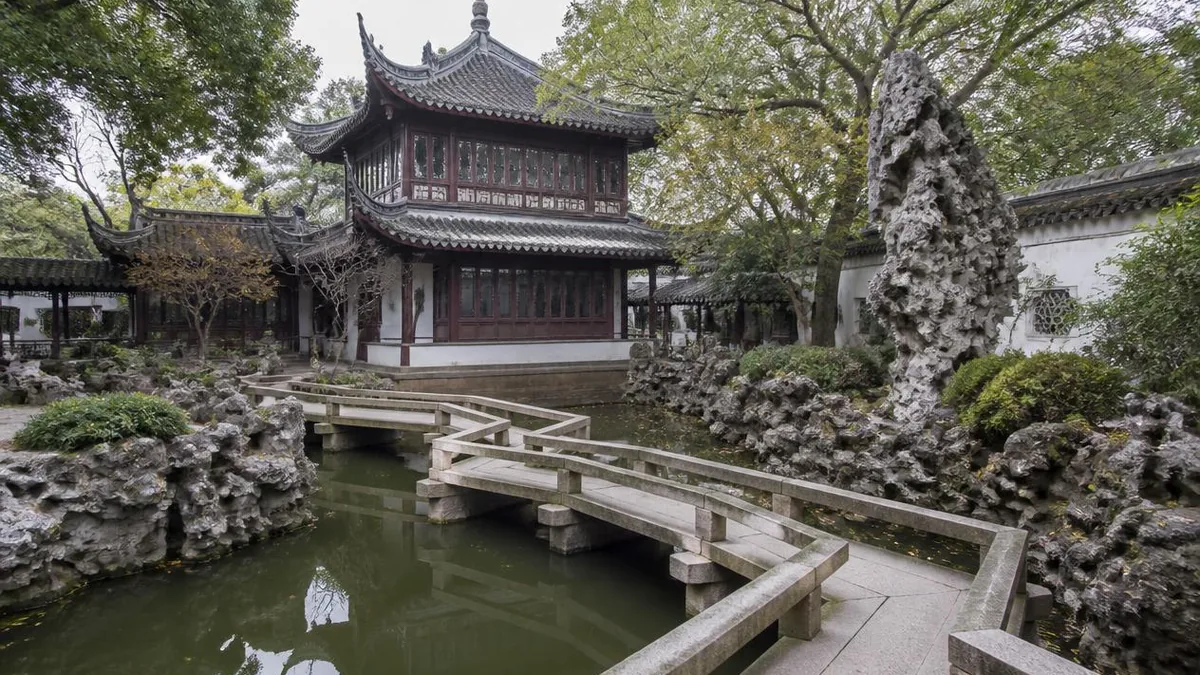
The Grand Rockery is the one that holds up. Built of huangshi, the yellowish sedimentary stone favoured in Ming rockwork, it is attributed to Zhang Nanyang and described as the oldest and largest surviving huangshi rockery in Jiangnan. Its height is given as 12 metres in English sources and about 14 metres in Chinese ones, which is the sort of gap that comes from measuring to different bases. Walk the ravines and caves rather than photographing the outline; the point of the form is the route through it.
The Exquisite Jade Rock is the famous one and the shakier one. It is a porous limestone boulder about 3.3 metres tall and roughly five tonnes, counted among the three famous stones of Jiangnan. The story attached to it is that it was cut for Emperor Huizong’s imperial garden at Bianjing as part of the huashigang, the notorious convoys of flowers and rocks shipped north in the early twelfth century, and that the barge carrying it sank, leaving it to be recovered from the Huangpu River much later. No contemporary record supports this. It is a good story fastened to a genuinely extraordinary object, and the object does not need it.
Elsewhere, the courtyard at the Wanhua Chamber holds a ginkgo about four hundred years old, there are Yuan-dynasty iron lions, and the Inner Garden’s Nine Dragon Pool takes its name from four carved dragon heads whose reflections complete the count.
1956 to 1961, and what “restored” means here
The guild associations moved out after 1949, and repair work ran from 1956 to 1961, with rockery restoration by Han Liangshun, known as Rockery Han, appointed by the municipal government.
Two details from that campaign matter for how you read the place. The Inner Garden, historically the separate East Garden of 1709 and measuring a little over two mu, was joined to the main garden during the works, so a boundary that stood for two and a half centuries is now invisible. And the old opera stage in the Inner Garden is not native to it: it was moved in from a bankers’ guild hall in Zhabei.
The administrative sequence is clean. Municipal protected unit in 1959, opened to the public in 1961, national key protected cultural relic in 1982.
So say it plainly. What you walk through is a mid-twentieth-century reassembly of a Ming plan, using genuine Ming and Qing material, some of it relocated, on roughly a third of the original ground. That is not a debunking. It is the difference between visiting a Ming garden and visiting the recovery of one, and the second is the more interesting visit.
The bridge, the teahouse and the queue
Outside the wall, three things draw more people than anything inside it.
The Nine-turn Bridge zigzags across the pond in front of the garden entrance. The Huxinting at its centre has a longer history than its appearance suggests. Pan Yunduan built a pavilion on the spot in the Jiajing era; in 1784, cloth merchants pooled funds to raise a hexagonal pavilion on the old foundation as a meeting hall for their trade, and erected a stele whose text survives. It became a teahouse in 1855 under one name, changed hands and names again in the late Qing, and acquired its present outline in 1924 when a rectangular water pavilion was added. It was renamed a workers’ tearoom during the Cultural Revolution, refitted in 1983, closed for repair in October 2023 and reopened on 10 July 2025.
It is routinely called Shanghai’s oldest surviving teahouse. Notice that the competing dates measure different things: 1784 is when the building went up, 1855 is when it started selling tea. Both are quoted as its founding.
The Nanxiang steamed-bun shop by the bridge opened in 1900 as Changxing Lou, founded by the brother-in-law of a Jiading proprietor whose original shop dated to the Tongzhi reign. The queue is not a recent invention. The shop is now part of the same listed group that runs the bazaar, which is a tidy illustration of how thoroughly the commercial layer has absorbed the historical one.
Walking it so the three layers stay separate
Take them in the order in which they made sense to the people who built them.
The temple first: it is why the quarter exists at all, and the garden’s whole modern history runs through it. Then the garden, where the sequence to hold in mind is Pan’s private world, the guild offices, the four occupations, and the 1950s reassembly — four uses of one enclosure, in that order. Then the bazaar, which you will enjoy more once you have stopped mistaking it for the thing it surrounds.
Practicalities are simple and unstable. Yuyuan Garden station on metro Lines 10 and 14 puts you at the edge of the block. The bazaar is free; the garden and the temple each take a ticket. Prices, opening hours, whether a combined ticket exists and which halls are accessible all change, so confirm on the day rather than trusting a figure printed anywhere, including here.
One last thing to carry through the gate. Pan Yunduan built this to please his father and it helped bankrupt his family; the merchants who rebuilt it in 1760 opened it to the public; the guilds turned it into offices; four armies took turns in it; and a restoration crew put it back in the 1950s. The crowd in the lanes outside is not a modern insult to a quiet Ming retreat. It is the latest owner in a long list, and by no means the loudest.
The LoreLens app can identify the halls, rockeries and inscribed stones inside Yu Garden and explain who built each one and who took it away.
Location profile
Where it is

Frequently asked questions
Is Yu Garden free? I walked around for an hour and never bought a ticket.
Then you were in the bazaar, not the garden. Three things share the name and only one of them is the Ming garden. The Yuyuan Bazaar, the pedestrian blocks of shops and restaurants, is free and open street; it is run by a listed company, Shanghai Yuyuan Tourist Mart, whose largest shareholder has been the Fosun group since 2002. The garden itself is a walled two-hectare classical garden with its own gate and its own ticket, protected at national level since 1982. The City God Temple on Fangbang Middle Road is a working Taoist temple of the Zhengyi school with a separate admission. The mix-up is not carelessness: until the 1990s the temple halls were literally being used as shop and warehouse space by the bazaar operator and a department-store wholesale unit, and the use rights were not handed back until 28 November 1994. Ticket prices, hours and any combined ticket change, so confirm on the day.
When was Yu Garden built, and by whom?
Pan Yunduan (1526–1601) built it for his father Pan En, who had risen to Left Censor-in-Chief. Work began in 1559, the thirty-eighth year of the Jiajing reign, on vegetable plots west of the family compound, with Zhang Nanyang designing the layout and the rockeries. The finish date is where accounts split. English-language sources generally say Pan's posting as an official in Sichuan stalled the project for nearly twenty years and put completion at 1577; Chinese accounts more often say the garden was only finished after he retired and came home, with the Leshou Hall completed last, and some place that late in the Wanli reign. Give it as 1559 to roughly 1577, and note that construction was interrupted rather than continuous. The name comes from yu, glossed as a cognate of the word for pleasing or gladdening, in the sense of gladdening an aged parent.
Is the Exquisite Jade Rock really an imperial stone from the Song dynasty?
That is the story on every signboard and it has no contemporary record behind it. The rock is real and it is remarkable: a porous limestone boulder about 3.3 metres tall and roughly five tonnes, counted as one of the three famous stones of Jiangnan. The claim attached to it is that it was quarried for Emperor Huizong's imperial garden at Bianjing as part of the huashigang, the flower-and-rock convoys that shipped exotic stones north in the early twelfth century, and that the boat carrying it sank, leaving it to be salvaged from the Huangpu River generations later. Treat that as folklore fastened to a genuine object. Nothing about the stone in front of you depends on it being true.
How long do I need, and in what order should I do it?
Half a day covers all three layers without hurrying. A practical order is temple first, garden second, bazaar last, because the temple is the reason the whole quarter exists and the garden reads better once you know it spent a century as the temple's West Garden. Allow roughly an hour to ninety minutes inside the garden itself. The Nine-turn Bridge and the Huxinting teahouse sit outside the garden wall and can be seen without a garden ticket; the teahouse closed for repairs in October 2023 and reopened on 10 July 2025. The queue at the Nanxiang steamed-bun shop by the bridge is genuinely long and has been a fixture for generations rather than a recent social-media phenomenon. The nearest metro is Yuyuan Garden station on Lines 10 and 14. Opening hours, ticket prices and which halls are accessible all change, so check at the gate rather than trusting an itinerary written earlier.
Sources and further reading
Background references for the history and place names in this guide. Opening hours, ticketing and access change often — always confirm with official local information before travelling.