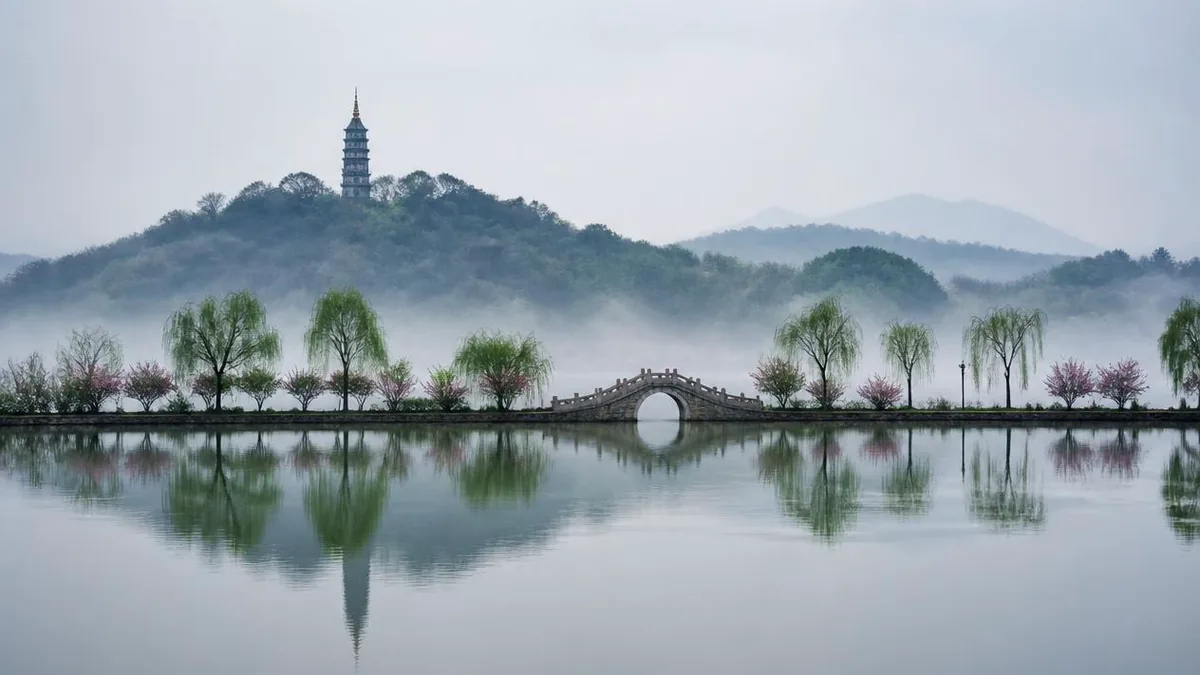
Zhejiang · Hangzhou
West Lake: The Lake That Was Designed, Then Redesigned
Hangzhou's West Lake is not what geology left behind. It is a silting bay that a thousand years of governors, dredging corps and committees decided to keep open—which is exactly why UNESCO listed it as a cultural landscape rather than a natural one.
5A View location, maps and nearby scenic areasMost famous lakes are what geology left behind. West Lake is mostly what a thousand years of officials, dredging corps and public votes decided to keep.
That is not a debunking. It is the reason the lake is on the World Heritage list at all, under a category most visitors never notice.
A bay that closed behind itself
Two thousand years ago this was part of the Qiantang estuary. Sandspits building out from the hills on either side—Wu Hill to the south, Baoshi Hill to the north—grew toward each other, met, and sealed off an inner body of water somewhere around the Qin and Han periods.
That is the standard account, and it has been argued over for a century. In 1920 the meteorologist Zhu Kezhen described the lake as a small bay on the left bank of the Qiantang that silting closed into a lagoon, and estimated from sedimentation rates that it formed roughly 12,000 years ago. In 1924 the geologist Zhang Hongzhao added tidal action as the force that both built the bar and kept the water surface alive.
Drilling since 1950 complicated it. Core samples from the lake’s islands and the lakeside park were read as evidence of a violent Late Jurassic eruption, leaving volcanic rock under much of the lake floor and a horseshoe-shaped collapse depression. A 1979 microfossil study proposed three stages instead: lagoon, bay, lagoon again, sealed as the Qiantang sandbar matured.
Zhu Kezhen’s other observation is the one that matters here. Streams off three sides of hills carry sediment in continuously. Without repeated dredging, he wrote, West Lake would long since have filled in.
The maintenance record is the history
Read the chronology as an infrastructure ledger and the lake stops being scenery.
781: the prefect Li Bi sank six wells near Qiantang and Yongjin gates and piped lake water into the city through buried tile and bamboo conduits. The lake’s first job was drinking water.
822: Bai Juyi, arriving as prefect, enlarged the stone culvert, dredged, and built a dam and sluice to raise storage for irrigating farmland between Qiantang and Yanguan. He then had the Record of the Qiantang Lake Sluice carved on stone, spelling out how the water was to be released and the works protected. A governor writing the operating manual into rock is a good sign the lake was understood as a machine.
927: the Wuyue king Qian Liu established a standing corps of a thousand men to cut weed and clear springs—permanent maintenance rather than emergency repair.
Then 1090 (Su Shi), 1503–1508 (Yang Mengying), 1727 (Li Wei, at a cost given as 42,742 taels of silver), 1800 (Ruan Yuan, whose spoil became the islet Ruan Gong Dun), 1864 (a standing West Lake Dredging Bureau). Between interventions the lake shrank: about 10.8 square kilometres in the Tang, nearly double today’s, and 7.54 in the Yongzheng years.
The causeway that Bai Juyi did not build
The Bai Causeway is named after Bai Juyi. He did not build it.
The embankment you walk—from Broken Bridge, past Jindai Bridge, to the Autumn Moon terrace, about two li—was known in the Tang as Baisha Di, the white sand embankment, after the sand once laid along it, and later as Gushan Road and Shijin Tang. Bai’s own dyke, the Bai Gong Di, stood outside Qiantang Gate in the area of today’s Baisha Road, and no longer exists.
The name was transferred by a public that wanted the poet commemorated on a causeway it could still stand on, and the transfer is old enough to have become the truth.
What is genuinely Bai’s is subtler. The earliest surviving appearance of the name West Lake is in two of his poems; before that the lake was Wulin Water, or Qiantang Lake, or a dozen other names.
Su Shi, 200,000 workers, and a poem written seventeen years early
Su Shi came to Hangzhou twice. The first time, from late 1071 to 1074, he was a deputy prefect, and the quatrain everyone quotes belongs to that posting—conventionally dated 1073, some seventeen years before he touched the lake with a shovel:
The shimmering water, in clear weather, is at its finest; the hills in blurred rain are marvellous too. If you would liken West Lake to Xizi, light powder or heavy rouge—always right.
Xizi is Xi Shi, the semi-legendary beauty of Yue. The couplet is why the lake’s alternative name is Xizi Hu, and why every later description of it is stuck with a woman’s face as its metaphor.
He returned in 1089 as prefect, and found that neglect since the Wuyue period had let weed cover roughly half the surface. His 1090 memorial Petition to Open West Lake is, as far as the record goes, the first official document to use the name West Lake, and its argument is blunt: Hangzhou has West Lake as a person has eyes and brows—it cannot be dispensed with.
That April he put 200,000 labourers on it. The dredged weed and silt were piled into a causeway across the water, about 2.8 kilometres (2.797 by modern survey), with six arched bridges—Yingbo, Suolan, Wangshan, Yadi, Dongpu, Kuahong. The lake was cut into east and west halves and the north and south hills were finally joined by land.
One divergence worth flagging: some accounts date the dredging to 1089. That is his arrival year; the petition and the works are 1090. The design also travelled—the West Causeway of Kunming Lake at Beijing’s Summer Palace, with its six differently shaped bridges, is a deliberate imitation.
Yang Mengying’s invoice, and the lake’s worst year
The Ming episode is the one that shows what dredging cost politically.
Yang Mengying was appointed prefect in 1503 and pushed a restoration through against furious resistance from wealthy families farming the silted margins, backed by the touring censor Che Liang. The Record of Sightseeing at West Lake itemises it: 152 days, 6.7 million man-days, 23,607 taels of silver, 3,481 mu of encroached fields and ponds demolished. The verdict in the same source: from this point West Lake was restored to what it had been in the Tang and Song. The spoil widened the Su Causeway and built a new bank along the western inner lake, later named Yang Gong Di. As that margin silted up again the causeway merged into the shore, which is why it now reads as a road rather than a dyke.
Then the modern low point. In 1949 the lake’s average depth was 0.55 metres and its storage barely three million cubic metres; the bottom was matted with weed and large boats could only follow cut channels. Mechanised dredging ran from 1951 to 1954, a second national dredging began in 1976, and the shoreline revetment was rebuilt to a total length of 29,800 metres, the largest such work in the lake’s history.
Today’s figures—about 6.39 square kilometres, average depth 2.27 metres, roughly 14.29 million cubic metres of water, 3.2 kilometres north to south, 2.8 east to west, nearly 15 kilometres around—are the output of that programme, not a natural baseline.
The Ten Scenes are a naming system, not a list
The Ten Scenes of West Lake feel eternal. They are a fashion in art criticism that hardened into infrastructure.
The set originated in the Southern Song, and originated as titles—largely in the naming of landscape paintings of the lake, and in the titles of later Southern Song poems. They are recorded in Zhu Mu’s Fangyu Shenglan and Wu Zimu’s Mengliang Lu, but were not agreed at the time.
Then the list kept being replaced. The Yuan had its own ten—Misty Willows at the Six Bridges, Nine Li of Cloudy Pines, the Night Market at the North Gate—several outside the lake basin entirely. In 1699 the Kangxi emperor toured the ten, renamed three, and wrote the names out; local officials carved his characters on stelae and built pavilions over them. That is the decisive step: scenes that had existed only in books acquired fixed positions on the ground, and floating viewpoints like Two Peaks Piercing the Clouds got an official place to stand. The Yongzheng years produced eighteen scenes with almost no overlap; Qianlong added a poem to the back of each stele, and separately assembled twenty-four.
The practice never stopped. In 1985, after an eight-month public vote involving more than 50,000 people, a New Ten Scenes was announced. In 2007 a third round drew some 338,600 votes over nine months and produced ten more, including Lingyin’s Chan Traces—which is how the temple next door formally re-entered the lake’s canon. In 2013 the classic Ten Scenes were listed collectively as national key protected cultural relics, as a cultural landscape.
Ten centuries, at least six official lists. Naming this lake is part of maintaining it.
Three small towers and a banknote
Xiaoyingzhou, the island behind the Three Pools Mirroring the Moon, is the lake’s largest at about 60,000 square metres, and entirely artificial.
The three stone pagodas came first, and they were not ornaments. When Su Shi dredged in 1090 he set towers in the water as boundary markers, under a regulation that the area inside them could not be encroached for water-caltrop ponds. They were zoning posts. Su’s towers were destroyed under the Yuan; the present three are usually dated to 1621, though one account holds that the Tianqi-era towers were lost in the early Qing and today’s are Kangxi-era work. Each stands about 2.5 metres, 2 above water: a base, a hollow spherical body pierced by five round openings, a canopy, a small hexagonal pavilion and a gourd finial.
The island around them was built later. In 1607 Qiantang magistrate Nie Xintang raised a ring embankment outside the release pond; from 1611 magistrate Yang Wanli extended it, finishing about 1620, producing the grid that gives the lake-within-a-lake effect.
They are fragile: on the night of 29 July 2013 a tour boat knocked the southernmost pagoda into the water, and divers recovered the parts for reassembly before dawn.
And the banknote. The scene is on the reverse of the 1 yuan note of the fifth series, issued in 2004. Look closely and it is a composite: Baochu Pagoda and Broken Bridge have been moved into the frame. There is no vantage point from which that photograph could be taken.
What you climb at Leifeng is not the old pagoda
The original was a Wuyue royal work: begun around 972 under Qian Chu and completed in 977, built to enshrine a relic of the Buddha’s hair, and originally called the Imperial Consort’s Pagoda. Thirteen storeys were planned; money ran out at seven.
It was damaged in the Xuanhe wars, rebuilt over twenty years in the Southern Song at five storeys, then burned in the Jiajing reign when pirates besieging Hangzhou set it alight on suspicion that troops were hidden inside. The timber galleries went; the brick core survived, scorched reddish, and that gaunt red stump is the “Leifeng in sunset glow” of the classic scene.
Then it was quarried by its admirers. Its bricks were believed to ward off evil, bring sons and protect silkworms, and townspeople prised them out for decades until, on 25 September 1924, the shell collapsed. Lu Xun wrote two essays reading the fall as the overdue end of an old moral order.
Rebuilding was decided in 1999. Excavation in 2000–2001 exposed the base, the surviving lowest storey and the underground chamber, opened on 11 March 2001: an iron reliquary casket, a gilt silver Ashoka-style pagoda, and 3,428 coins spanning the Western Han to 960.
The new tower was completed on 25 October 2002. Designed at Tsinghua University, it is five storeys in Southern Song proportions but a steel frame, with columns, brackets and tiles in copper, total height 71.679 metres. Of that, the bottom 9.7 metres is a protective canopy on 24 inclined steel columns, clear-spanning about 48 metres so the excavated ruins sit undisturbed beneath it, with lifts inside.
The honest description is a viewing tower built as the roof of an archaeological site. Knowing that improves the visit rather than spoiling it.
The White Snake is younger than the pagoda it haunts
The legend that gives Leifeng and Broken Bridge their charge is a folk story with a traceable, and fairly late, literary history.
An early relative is The Three Pagodas of West Lake in the Ming collection Qingpingshantang Huaben: a young man of Lin’an, a white-robed woman who proves to be a white snake, and a Daoist who raises three pagodas in the lake to pin down three demons. The first fully formed version is Feng Menglong’s late-Ming The White Maiden Locked for Eternity in the Leifeng Pagoda. The framework most people know was assembled in Fang Chengpei’s 34-act Leifeng Pagoda of 1771, presented to Qianlong on a southern tour. Xiaoqing was a green fish before she was a green snake; Xu Xian was Xu Xuan.
Broken Bridge, where the lovers meet, is real, at the eastern end of the Bai Causeway, rebuilt in 1921. Its name has nothing to do with the story: after snow, the sunlit arch clears while the approaches stay white, so from Baoshi Hill the span appears to break. Locals file it under the lake’s three contradictions: the Long Bridge is not long, Solitary Hill is not solitary, the Broken Bridge is not broken.
Hedge the cycle accordingly. It is a magnificent piece of collective authorship, not a record of anything.
Why the listing says “cultural landscape”
Hangzhou announced its bid in 1999. On 24 June 2011, at the 35th session of the World Heritage Committee in Paris, the West Lake Cultural Landscape of Hangzhou was inscribed under criteria (ii), (iii) and (vi), with a property of 3,322.88 hectares and a buffer zone of 7,270.31. The inscribed area takes in the Ten Scenes and the monuments around them—Baochu Pagoda, the Leifeng ruins, the Liuhe Pagoda, Jingci Temple, Lingyin Temple and the Feilai Feng carvings, Yue Fei’s tomb, the Wenlan Pavilion, the Qiantang Gate site, the Xiling Seal Society, Longjing. It was Zhejiang’s first world cultural heritage site.
The category is the point. A cultural landscape is by definition the combined work of nature and man. Everything above—the dredging corps, the causeways of spoil, the boundary pagodas, the stelae that told people where to stand, the votes of 1985 and 2007—is not a footnote to the scenery. It is the nomination.
Recent chapters continue it. In 2002 the south-line project pulled down 2.25 kilometres of fencing and 65,700 square metres of buildings and opened four lakeside parks free around the clock; West Lake became China’s first 5A scenic area without an entrance ticket, and is still among very few. From late 2002 the “West Lake moves west” scheme restored around 70 hectares of water at Maojiabu and Wuguitan; the water surface is described as going from 5.6 to 6.5 square kilometres, close to its extent three centuries ago. That figure and the 6.39 quoted for the lake proper measure different things, which is worth remembering before repeating either.
Stand on the Su Causeway at dusk and the composition looks inevitable. It is not. Every element in the frame—the bank under your feet, the pagoda on the southern hill, the three small towers offshore, the very fact that there is water rather than farmland—was somebody’s decision, and most of those decisions had to be made again.
The LoreLens app can identify the causeways, bridges, pagodas and stelae around West Lake and explain what each one was actually built to do.
Location profile
Where it is

Frequently asked questions
Did Bai Juyi build the Bai Causeway?
Almost certainly not, and Hangzhou's own signage is fairly honest about it. The causeway you walk, from Broken Bridge past Jindai Bridge to the Autumn Moon terrace, was called Baisha Di, the white sand embankment, in the Tang, and Gushan Road or Shijin Tang in the Song and Ming; the name refers to the white sand once laid on it. Bai Juyi, prefect of Hangzhou from 822, did build an embankment with a stone sluice, but outside Qiantang Gate, in the area of today's Baisha Road, and that structure—the Bai Gong Di—no longer exists. Later generations transferred the poet's name onto the surviving causeway. What is genuinely his: the earliest surviving use of the name West Lake appears in two of his poems, and his Record of the Qiantang Lake Sluice set out in writing how the water was to be stored, released and protected.
Is the Leifeng Pagoda you can climb an ancient pagoda?
No, and this is worth knowing before you buy a ticket. The original was begun around 972 under the Wuyue king Qian Chu and finished in 977. Its timber galleries burned in the Ming, leaving a scorched brick core, and after decades of townspeople prising out bricks—believed to ward off evil, bring sons and help silkworms—the shell collapsed on 25 September 1924. What stands today was completed on 25 October 2002: a five-storey steel-framed structure with copper columns, brackets and tiles, designed at Tsinghua University, total height about 71.7 metres. Its lowest 9.7 metres are a protective canopy carried on inclined steel columns, spanning the excavated ruins. You are climbing a museum roof with a viewing deck on it. The excavated remains underneath, and the relics from the 2001 opening of the underground chamber, are the genuinely old part.
Do you need a ticket for West Lake?
The lake itself, no. After the 2002 south-line integration project removed fencing and made four lakeside parks free around the clock, West Lake became China's first 5A-rated scenic area without an entrance ticket, and it remains one of very few. What still charges is individual attractions inside the landscape—Leifeng Pagoda, the boat out to the Three Pools island, Lingyin and the Feilai Feng carvings next door, and some gardens and museums—each with its own gate, hours and pricing. Boat services in particular depend on weather and water conditions. Treat any price you read online, including here, as indicative and confirm at the gate on the day.
How long do I need, and which Ten Scenes are worth the walk?
A full day covers the lake on foot and by bike; two days lets you add the hills. A workable first day is the Su Causeway end to end, about 2.8 kilometres with six bridges, then the Bai Causeway and Solitary Hill, which are shorter and better for a slow walk. Add a boat to Xiaoyingzhou for the three stone pagodas if the water is calm. The classic Ten Scenes date from Southern Song painting titles and were fixed to physical viewpoints only after the Kangxi emperor inscribed them in 1699, so several are seasonal or time-of-day effects—Broken Bridge wants snow, Leifeng wants sunset, Nanping wants the evening bell. The 1985 New Ten Scenes and the 2007 third set push you into the hills and are much quieter; Lingyin's Chan traces, added in 2007, is the natural bridge to the Feilai Feng carvings.
Sources and further reading
Background references for the history and place names in this guide. Opening hours, ticketing and access change often — always confirm with official local information before travelling.