Zhejiang · Zhoushan
Putuoshan: The Buddhist Mountain You Can Only Reach by Boat
Twelve and a half square kilometres of island, the only one of China's four sacred Buddhist mountains that sits in the sea, and a founding legend about a Japanese monk whose ship would not leave. Every part of this place is shaped by the crossing.
5A View location, maps and nearby scenic areasThere is no bridge. Whatever else you arrange, the last leg of a trip to Putuoshan is a boat, and it has been that way as long as anyone has been coming here.
That single fact explains more than any of the temple signboards do. Putuoshan is a small island in the Zhoushan archipelago off the Zhejiang coast, the bodhimaṇḍa of Guanyin, and the only one of China’s four sacred Buddhist mountains that stands in the sea. The other three are inland: Wutai in Shanxi for Manjushri, Emei in Sichuan for Samantabhadra, Jiuhua in Anhui for Kṣitigarbha.
Guanyin is also the bodhisattva whose canonical job description includes rescuing people from shipwreck. Hold those two facts together and the island stops looking like a coincidence.
Twelve and a half square kilometres, a hundred nautical miles out
The scale is the first surprise. The whole island covers about 12.5 square kilometres, of which roughly 11.85 is dry land and the rest intertidal. Its high point, Foding Shan, reaches only about 300 metres—one source gives 297—and the summit itself is a closed military radar installation, so the walk stops at the temple below it.
Position matters more than size. Putuoshan lies roughly 100 nautical miles east of the mouth of Hangzhou Bay, where the coastal lanes toward Japan and Korea ran. Its registered population is about 4,840—a number that tells you nothing about how many people stand in front of Puji Temple on a spring morning.
The island was not always Buddhist. From the Western Han to the Song it was Meicen Shan, after a Daoist recluse said to have withdrawn here. The Buddhist name arrived later, and it arrived from India by way of a book.
What the Lotus Sutra actually promises sailors
The relevant text is chapter 25 of the Lotus Sutra, the Universal Gate chapter, in Kumārajīva’s translation. Among the perils it lists, alongside fire and flood and swords and chains, is this: merchants who put out into the great sea after gold, silver, lapis, coral, amber and pearls; a black wind blows their vessel off course and casts them onto the land of the rakshasas; if even one person aboard calls the name of Guanyin, all of them are released. The chapter’s closing epithet is the operative one—Guanyin is the Giver of Fearlessness.
That is not incidental doctrine on a shipping route. It is a functional promise made to exactly the people who used these waters.
The name followed the same logic. Potalaka—rendered into Chinese as Putuoluojia and shortened to Putuo—is the mountain the Avataṃsaka Sūtra names as Guanyin’s abode; the original is generally placed in what is now Tirunelveli district in Tamil Nadu. In the Song, visitors decided this island matched the description—luminous, clean, full of small white flowers—and renamed it after the Indian one. Lhasa’s Potala Palace takes its name from the same word.
The founding legend is a foreign story, and it is late
Egaku—written in Chinese as Huie or Hui’e—was a Japanese monk of the early Heian period. His birth and death years are unknown, but his career is documented in fragments across both countries. Sent to Tang China on the instructions of Empress Tachibana no Kachiko, he reached Mount Wutai in 841 carrying her gifts and looking for a teacher willing to sail east; he was behind the invitation that brought the Chan monk Yikong to Japan; he had Bai Juyi’s collected works transcribed at Suzhou in 844 and carried the copy home, where that textual line survives as an important witness to the anthology. In 854 he returned to Wutai and obtained a Guanyin image.
The famous part comes next. In 858, sailing for home, his ship could not clear these waters—wind, then fog that turned him back, then iron lotuses rising around the hull. He set the image ashore, concluded that the bodhisattva was unwilling to leave, and a local man surnamed Zhang gave over his house to hold it. Hence the shrine’s name: the temple of the Guanyin Who Would Not Go.
Three caveats. The earliest surviving accounts are the Fozu Tongji, a Chinese chronicle of the thirteenth century, and the Genkō Shakusho, a Japanese one of the fourteenth—four hundred years later; a related early text describes a painted image, not a sculpture. Several Chinese-language summaries call Egaku a Rinzai monk, which does not survive contact with the chronology. And the same sources record a foreign monk burning a finger in offering at Chaoyin Cave here in 847, eleven years earlier—so even the priority claim inside the local tradition is not tidy.
None of that makes the legend worthless. It makes it interesting: the origin story of China’s Guanyin island is, from the very first telling, a story about a foreigner who could not get home.
Three great temples, and the dates on them are mostly Qing
Visitors routinely leave believing they walked through Tang and Song architecture. They did not.
Puji Temple, the Front Temple, descends directly from the ninth-century shrine, and its name changed with the dynasties: Baotuo Guanyin Temple in the Song, Huguo Yongshou Putuo Chan Temple in the Wanli era, and finally Puji after the Kangxi emperor bestowed a plaque reading puji qunling. But the layout you walk, across some 37,000 square metres, is a campaign of 1731 to 1734—nine halls, twelve pavilions, sixteen chambers and four galleries. Its Yuantong Hall holds the Vairocana Guanyin surrounded by the thirty-two responsive manifestations that are this island’s particular iconography.
Fayu Temple, the Rear Temple, was founded in 1580 as a hermitage called Haichao’an. Kangxi granted the plaque reading tianhua fayu, from which its present name comes, and paid for the expansion; today it climbs the slope in six ranks of halls, some 245 rooms across roughly 47,600 square metres.
Huiji Temple, near the top of Foding Shan, is the youngest. English sources date its foundation as a temple to 1793; Chinese ones credit a monk named Yuanhui with an earlier Ming hermitage and put its rise to major status much later, when a monk named Dehua obtained a printed Buddhist canon in 1907. Its main buildings run along a horizontal axis rather than a central one—unusual in Chinese temple architecture, and a straightforward response to the ridge.
The genuinely old object is not a hall. It is the Duobao Pagoda southeast of Puji, built around 1333 to 1334 from Lake Tai limestone under the abbot Fuzhong with funding from Yuan princes—hence its other name, the Prince’s Pagoda. It is the oldest surviving structure on the island; its relief buddhas were chiselled off during the Cultural Revolution. With the Yangzhi Guanyin stele behind Fayu—an image after a design attributed to Yan Liben, recut in the Ming—and the nine-dragon coffered ceiling in Fayu’s Guanyin hall, it makes up the island’s three treasures. A widely repeated tradition holds that hall’s timber came from the dismantled Ming palace at Nanjing; I could not confirm that from a source I can open.
Two caves, and a prohibition carved in stone
This section needs care, because it concerns people who died here.
Chaoyin Cave is a sea cave in soft rock on the southeast shore, where the swell drives in and booms. You look down into it from above; you cannot enter. The three characters of its name on the cliff were written by the Kangxi emperor, who granted the plaque in 1699. Fanyin Cave, below Qingu Shan on the east coast, is larger and steeper, its floor a jumble of collapsed rock. Both are places where pilgrims have long come hoping to see Guanyin manifest.
That hope had a dark edge. The record begins with a foreign monk burning a finger in offering at Chaoyin Cave in the ninth century, an act with precedent in Buddhist devotional literature. Devotees imitated it, and the imitation extended to giving up the body altogether at the cave mouth. The monastic community and the civil authorities prohibited it, and the stone tablet warning against the practice still stands.
The wider East Asian context makes this legible rather than lurid. In Japan the same scriptural geography produced fudaraku tokai—setting out by sea toward Potalaka—attested in 57 recorded cases, the earliest at Kumano in 868 and the last at Cape Ashizuri in 1909, with almost half falling in the sixteenth century. Departures were timed to the winds of the eleventh month and to the eighteenth day, Guanyin’s day of affinity. Putuoshan’s stele and Japan’s departure boats are two ends of one idea: that the bodhisattva’s mountain lies across water.
The stele is the honest monument here. An institution looked at what devotion was doing to the devout and told them to stop.
The statue on the headland is younger than most visitors
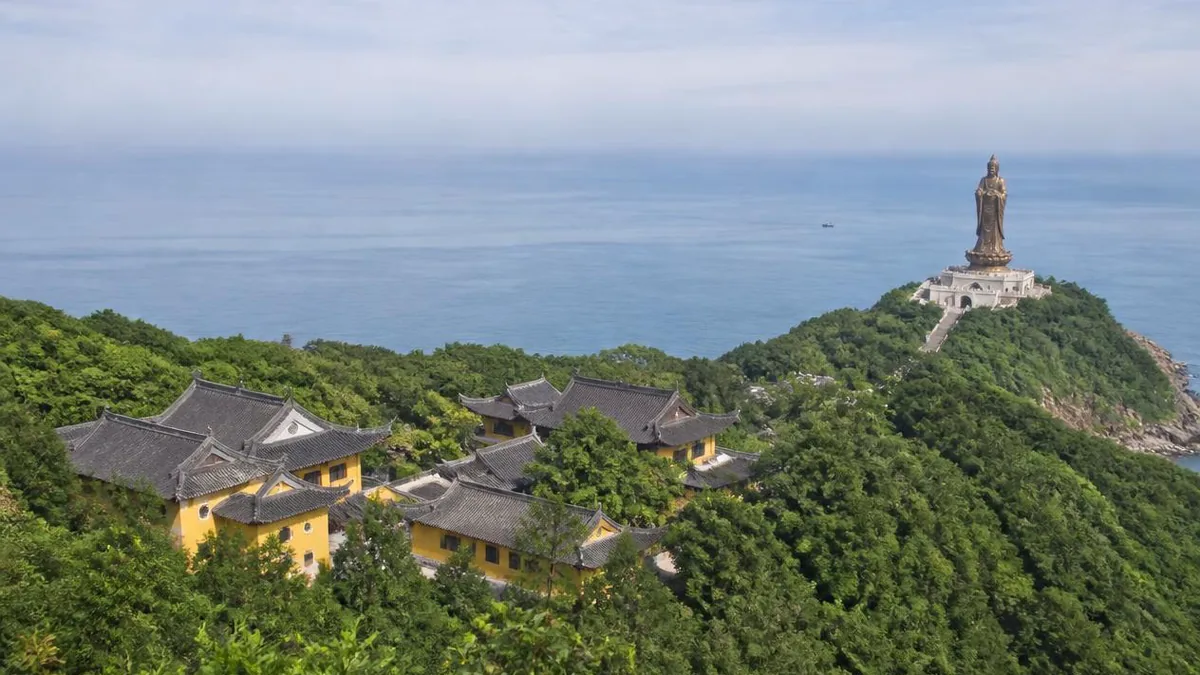
The South Sea Guanyin on the headland is the image on every poster of this island. It is also contemporary.
The figure stands 33 metres and weighs upwards of 70 tonnes in bronze, paid for by donations from Chinese communities at home and abroad, and it was consecrated on 30 October 1997. It is described as the largest bronze Guanyin in the world—a superlative worth attributing rather than asserting. The impetus came from the abbot Miaoshan, and the traditional account has him seeing the bodhisattva standing at the water’s edge in October 1994 and resolving to build what he saw: a devotional narrative attached to a modern commission, told by the community that commissioned it.
What is not in question is the dating. If you want something on this island that a Song pilgrim would have seen, walk to the Duobao Pagoda instead.
The twentieth century broke this place, and one biography carries the repair
Almost nothing here is continuous, and one man’s life explains why.
Miaoshan (1909–2000), born Wu Jingting in Rugao, Jiangsu, ordained in 1932, became abbot of Gaomin Temple in Yangzhou in 1941 and crossed to Putuoshan in 1944. He was acting abbot of Fayu Temple by 1952. In 1960 he was sent down from the island with a hundred other monks to a temple at Yuyao. He came back in 1979, was acclaimed acting abbot of the whole mountain, and was formally installed in 1989.
What he came back to had been stripped. During the Cultural Revolution the temples were badly damaged, images destroyed, monks returned to lay life. Huiji Temple lost more than 700 square metres of meditation hall and had troops quartered in it; the garrison moved out in October 1979, and reconstruction by the island’s Buddhist association began in 1980. The translator Qian Chunqi wrote of an island lying in the sea covered in wounds, its monks scattered and its halls swept bare.
Miaoshan’s later record is the counterweight: the bronze Guanyin, a Buddhist academy, a research institute, a hospital, a fresh edition of the island’s gazetteer. What looks like unbroken tradition is a restoration begun within living memory, carried out by the same people who had been sent away.
Luojia Shan, and the saying about an incomplete pilgrimage
About 4.7 kilometres off the southeast shore lies a second, much smaller island: Luojia Shan, only 0.36 square kilometres with a high point of 99.3 metres, seen from Putuoshan as a reclining figure on its back.
In the Tang and Song the two were spoken of as one place—Putuo-Luojia Shan, after the Indian Potalaka—and only later split in two, the compound name shortened for daily use. The old saying survives the split: if you have not been to Luojia, you have not finished Putuo.
Four hermitages, a finely carved stone pagoda above the landing, two halls beyond the ridge, and at the far end a lighthouse built by the British in the late nineteenth century—Chinese sources give both 1883 and 1898, so take the decade rather than the year. When the ribbonfish were running, the massed lanterns of the fishing fleet and the lighthouse beam together made one of the island’s classical twelve views.
Practicalities are unforgiving in a useful way. The crossing takes around twenty minutes, the boat waits a fixed period before returning, almost everything worth seeing is over the ridge and up steps, and there is no food, no lodging and essentially no commerce.
A 5A scenic area with a working monastery inside it
Putuoshan holds China’s top 5A tourism rating and is simultaneously an active religious site with monks in residence, and the friction between those identities is visible from the moment you land.
The mechanics: a landing charge for the whole island is collected in a hall as you come off the ferry; each of the three temples takes a small separate admission; the statue takes another; the shuttles are not included and charge per ride; the cable car and the Luojia Shan boat are separate again. Around Puji Temple there is a night market selling souvenirs and raw seafood, and the island has a beer named after it. The morning liturgy at Puji runs in the small hours and is crowded—if you are not there for the ceremony, come later.
None of this is hypocrisy, and none of it is new; pilgrimage sites have always had economies attached. But arrive with the right expectation. There are on the order of eighty temples and hermitages here, of which perhaps three are famous. The other seventy-odd are where the quiet is.
One last resident. West of Huiji Temple stands the last wild specimen of Carpinus putoensis anywhere in the world—an island endemic, over two centuries old, nationally protected since 1999 and classed as critically endangered. A tree that exists in exactly one place, because the sea kept it there.
Getting there, and the three days the island fills
The two everyday crossings are short. From Wugongzhi wharf on Zhujiajian—the island immediately south, which also holds Zhoushan Putuoshan Airport and a bus terminal—the fast ferry is reported at about twelve minutes; from the Banshengdong wharf at Shenjiamen, about fifteen. Both run frequently, and you need identification to buy a ticket. From Shanghai there is an overnight sailing from Wusong and a fast ferry from Xiaoyangshan; Ningbo, Hangzhou and Shanghai sell combined bus-and-ferry tickets. Private cars are not permitted on the island.
Then the calendar. Three lunar dates fill this place past comfort: the nineteenth day of the second, sixth and ninth months. The second-month date is Guanyin’s birthday; sources assign the enlightenment and the renunciation to the other two inconsistently, which is worth knowing before you argue with a sign. On those days, and on national holidays, book far ahead—a small island has a small number of beds.
Everything numerical here moves—frequencies, first and last departures, fares, shuttle routes, which halls are open when. Confirm at the terminal and at the gates.
And then take the boat. The crossing is ten or fifteen minutes now, which is precisely the point. For most of the eleven hundred years this island has been a pilgrimage destination, that stretch of water was the whole difficulty and the whole meaning—the reason a foreign monk’s ship stopped here, the reason the bodhisattva invoked was the one who saves people from black winds at sea, and the reason there is a stone tablet above Chaoyin Cave telling the faithful that they do not have to prove anything to the water.
The LoreLens app can identify temple halls, pagoda types and Guanyin iconography here, and explain the history behind them.
Location profile
Where it is

Frequently asked questions
Is the story of the Japanese monk and the statue that would not leave true?
The monk is real; the episode is a later story about him. Egaku, written in Chinese sources as Huie or Hui'e, was a Japanese cleric of the early Heian period whose dates of birth and death are unknown. His documented career is solid: he sailed to Tang China on the instructions of Empress Tachibana no Kachiko, reached Mount Wutai in 841 with gifts from her, had a copy of Bai Juyi's collected works made at Suzhou in 844 and carried it home, and was instrumental in bringing the Chan teacher Yikong to Japan. In 854 he returned to Wutai and obtained a Guanyin image. The famous part—the ship stopped by wind and by iron lotuses on the water, the image refusing to go east, the shrine built where it came ashore—is dated in the accessible sources to 858. But the earliest surviving accounts of it are the Fozu Tongji, a Chinese Buddhist chronicle of the thirteenth century, and the Genkō Shakusho, a Japanese one of the fourteenth: roughly four hundred years after the fact. Another early text records a painted image rather than a sculpture. Treat 858 as the traditional date, not an attested one.
How old are the buildings at the three main temples?
Mostly Qing, with Ming foundations and a single Yuan survivor. Puji Temple descends from the ninth-century shrine but its present layout comes from a building campaign of 1731 to 1734, under the name granted by the Kangxi emperor. Fayu Temple was founded in 1580 as a hermitage called Haichao'an and was enlarged into a great monastery under Kangxi patronage. Huiji Temple on the summit ridge began as a Ming hermitage and only became the third of the three great temples in the early twentieth century, after a monk named Dehua obtained a printed Buddhist canon in 1907. The oldest standing structure on the island is not a hall at all but the Duobao Pagoda southeast of Puji, built in the Yuan dynasty around 1333 to 1334 from Lake Tai limestone. Everything else you walk through has been rebuilt, and much of it was rebuilt after 1979.
How do you get to Putuoshan, and can you drive?
You cannot drive onto the island—private cars are not permitted, and the last leg is always a boat. The two workhorse crossings are from Wugongzhi wharf on Zhujiajian, which is the island next to Zhoushan Putuoshan Airport and has its own long-distance bus terminal, and from the Banshengdong wharf at Shenjiamen. Both are short: reported fast-ferry times are roughly twelve and fifteen minutes respectively, running at frequent intervals through the day. Longer options exist from Shanghai, including an overnight sailing from Wusong and a fast ferry from Xiaoyangshan. Identification is required to buy a ticket. Once ashore you walk or use the island shuttle network; there is a cable car up to Huiji Temple. Sailing times, first and last departures, fares and shuttle routes all change by season—confirm the day's actual schedule at the terminal rather than trusting any published table, including this one.
When is Putuoshan busiest, and what does it cost?
Three dates in the lunar calendar fill the island: the nineteenth day of the second, sixth and ninth months, the anniversaries associated with Guanyin. The second-month date is universally given as the birthday; which of the other two marks the attainment of enlightenment and which the renunciation of lay life is assigned differently by different sources, so do not be surprised by contradictory signage. On and around those days, and during national holidays, accommodation on a small island with a small housing stock should be booked well in advance. On cost, the structure matters more than the numbers: there is a landing charge for the whole island collected as you leave the ferry hall, small separate admissions at each of the three temples and at the South Sea Guanyin statue, per-ride fares on the shuttles, a return fare for the Luojia Shan boat, and a cable-car fare. Published figures date quickly. Check them on the day.
Sources and further reading
Background references for the history and place names in this guide. Opening hours, ticketing and access change often — always confirm with official local information before travelling.