Zhejiang · Hangzhou
Lingyin Temple: The Best Thing Here Is Outside the Gate
Almost everyone walks straight up to the temple. The irreplaceable thing at Lingyin is the limestone hill you pass on the way in, where five centuries of carvers left a sequence of Buddhist sculpture that ends with something almost nobody else in southern China has.
Nearly everyone here does the same thing. They come through the screen wall with its four characters promising that the Western Heaven is within reach, they follow the road, and they head for the temple.
On the way in they pass a low limestone hill with a stream at its foot. That hill is the reason to come.
Two gates, two tickets, one hillside
The practical shape of a Lingyin visit surprises people at the door, so take it first.
There are two things here, and they charge separately. The outer admission covers the Lingyin–Feilai Feng scenic area: the peak itself, its grottoes, the carvings, the Cold Spring stream, the Chuncong Pavilion, and the stone Ligong Pagoda near the entrance, which is said to hold the ashes of the temple’s founder. The temple precinct behind it charges again, traditionally with an incense ticket sold at its own window; in recent years the formal front hall has often been closed to visitors, who are funnelled through side doors past those separate ticket desks.
The upshot is worth knowing in advance: you can buy the outer ticket, spend two hours on the carvings, and leave without entering the temple at all. For anyone who came for sculpture, that is not a compromise.
Both sit inside the boundary of the West Lake World Heritage property, which lists Lingyin Temple and the Feilai Feng carvings among its constituent monuments, and Lingyin’s Chan traces were voted into the lake’s third set of Ten Scenes in 2007. None of that makes the ticketing shared. Prices, hours, entrances and booking rules change; confirm on the day rather than trusting any figure, including anything you read here.
What is carved on Feilai Feng, and how many
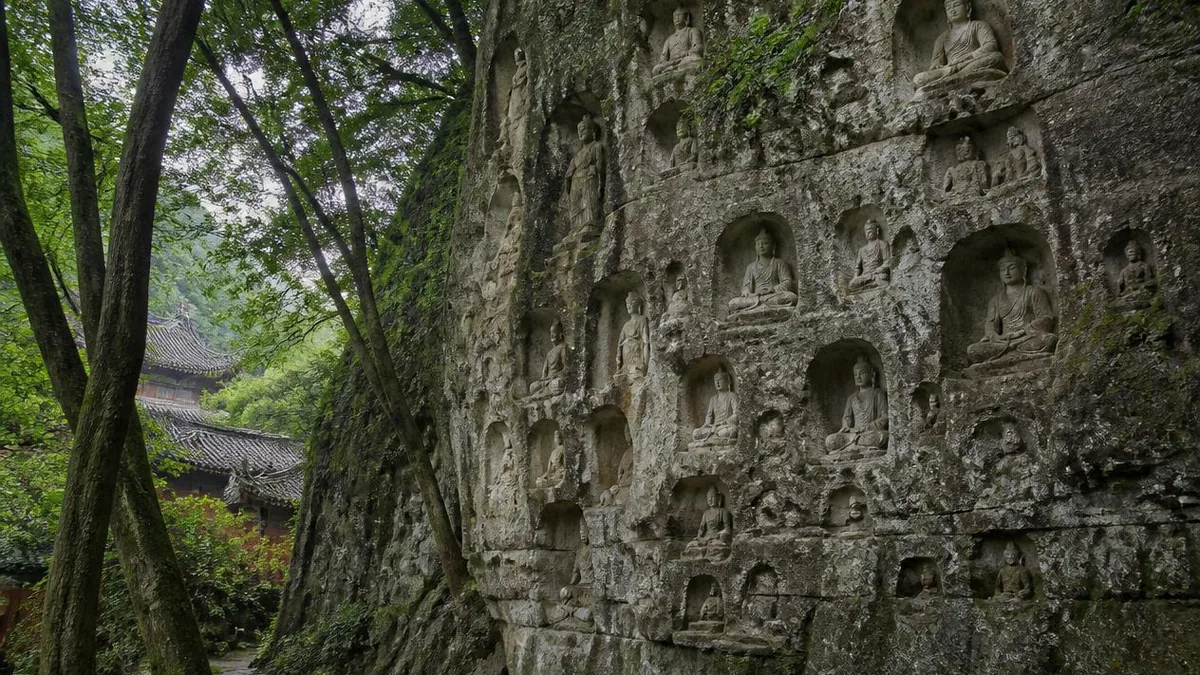
Feilai Feng—the Peak That Flew Here, also called Lingjiu, Vulture Peak—is limestone, about 168 metres high, and it looks nothing like the sandstone hills around it: pitted, fissured, hollowed into caves. That is why the legend of an imported mountain attached itself, and it is also why the rock could be carved.
The carved ground runs roughly 600 metres long and 200 metres wide, along the cliffs above the stream and inside the Qinglin, Yuru and Longhong grottoes. In the main Guanyin cave a crack runs from the ceiling to the open air, so that from one spot you see a single blade of daylight—the “thread of heaven.”
The totals do not agree, and it is better to say so than to pick one. A common Chinese figure is 345 surviving statues, produced over roughly five centuries from the Five Dynasties to the Yuan, itemised as 3 Five Dynasties figures, 232 Song and 116 Yuan in 67 niches—which sums to 351. English accounts give 153 shrines and more than 470 carvings, of which 338 are reasonably well preserved, with about 11 from the late Tang and Five Dynasties, 222 Northern Song, and roughly 96 to 100 Yuan.
What every count agrees on is the sequence and its unusual completeness: three dynasties of Buddhist sculpture on one hillside, listed for national protection in 1982. Read the hill as a stratigraphy, not a gallery.
The Wuyue layer: three figures at a cave mouth
The oldest work is small and easy to miss. On the right-hand wall at the Qinglin grotto stand three figures—Amitabha, Guanyin and Mahasthamaprapta: the Three Saints of the West, the Pure Land triad.
They belong to the Five Dynasties, when Hangzhou was the capital of the Wuyue kingdom and its rulers spent lavishly on Buddhism—temples, pagodas, sutra pillars and grottoes all around the lake. Lingyin was enlarged in the same programme, and the same patronage is the reason Leifeng Pagoda and Baochu Pagoda exist.
Pure Land is the significant part. This is devotional sculpture for people who intend to be reborn in Amitabha’s paradise, not doctrinal illustration for monks. It sets the tone for the whole hill: everything carved here was carved to be prayed to by somebody walking past.
Numbers for this layer are among the shakiest on the peak—three figures in one account, about eleven late Tang and Five Dynasties carvings in another, depending on how weathered fragments at the summit are counted.
The Song layer: a fat monk and eighteen arhats
The Song is the bulk of the hill, and it is the layer visitors actually photograph.
The famous one sits low on the cliff facing the path: Budai, the sack-carrying monk traditionally understood as a manifestation of Maitreya, sprawled and laughing with a bare belly, surrounded by the Eighteen Arhats. At about 3.6 metres high and 9.9 metres long it is the largest single composition on Feilai Feng.
It repays a second look, because it is a hinge in Chinese religious art. Maitreya, the buddha of the future, had been depicted for centuries as a slim, seated, meditative figure. The cheerful fat monk is a Chinese folk identification layered onto that scripture, and by the Song it had displaced the earlier image almost entirely. The carving is not a joke inserted into a serious sequence; it is the moment a doctrinal figure turned into a popular one.
Around it the Song carvers left a wide cast: buddhas including Vairocana, bodhisattvas, arhats, and the six patriarchs of Chan—appropriate, since Lingyin is a Chan monastery. The style is confident, rounded and legible from the path, which is exactly what donor-funded roadside sculpture should be.
The Yuan layer, and why it is rare in Jiangnan
Now the part worth crossing the country for, and the part most visitors walk past.
Around a hundred figures here are Yuan work, concentrated on the southern bank of the Cold Spring stream and on the cliffs near the Qinglin and Yuru grottoes. They are usually described as the largest surviving group of Yuan carving in China, and they do not look like the Song work above them: broader shoulders, tighter waists, elaborate crowns, ornament that reads as Himalayan rather than Jiangnan.
That is because they are Tibetan Buddhist sculpture. The Yuan court adopted the Sakya school as its imperial religion; the emperor’s preceptor was a Tibetan hierarch, and the iconography travelled with the administration. Descriptions of the Feilai Feng group note exactly this hybrid—Tang and Song formal habits carrying Tibetan and Mongolian content.
Southern China is full of Song Buddhist carving. It has very little Tibetan-style Yuan carving, for the obvious reason that the dynasty was short, resented, and southern patrons had other loyalties. A coherent programme of this size, in Hangzhou, is close to unrepeatable.
Which raises the question the signboards mostly avoid: who paid for it?
The man who commissioned it
The Yuan carvings were directed by Yang Lianzhenjia, a Tangut monk of the Sakya school, a disciple of the imperial preceptor Phagpa, and a favourite of Kublai Khan, appointed supervisor of Buddhism in the newly conquered Jiangnan in 1277.
He is one of the most detested figures in Chinese historical memory. The record accuses him of systematically robbing the tombs of the Southern Song emperors outside Shaoxing, stripping the gold, scattering the remains, and having the skull of Emperor Lizong made into a drinking vessel. The History of Ming repeats the charge; the vessel was eventually recovered under the early Ming and the bones reburied.
And he put himself on the hill. Below the largest Yuan Vaiśravaṇa carving, Yang had his own donor portrait cut into the rock, and it is still there. Ming officials tried to erase it: a Hangzhou prefect ordered the head chiselled off, and both Tian Rucheng, author of the Record of Sightseeing at West Lake, and Zhang Dai, author of Dream Recollections of West Lake, wrote that they had personally “beheaded the shaven-headed Yang.” All of them attacked the wrong figure. The donor portrait survived intact.
The late-Ming writer Yuan Hongdao set the pattern for how this is usually handled: he praised the peak and loathed the carvings on it.
You do not have to resolve that. The most art-historically valuable thing at Lingyin was commissioned by a man remembered as a desecrator, and both halves of that sentence are true.
The temple’s real age, told honestly
The banner figure is roughly seventeen centuries. The buildings are roughly one.
Tradition credits the founding to Huili, an Indian monk, who is said to have arrived and found the setting so strange that spirits must be hidden here—hence Lingyin, the retreat of the immortals. The date is given as 326, sometimes 328. This is traditional attribution rather than documented history, and the same story supplies the peak’s name: Huili is said to have recognised the limestone hill as a spur of Vulture Peak in India and asked when it had flown over.
The Wuyue period was the high point. Accounts describe nine towers, eighteen pavilions and seventy-odd halls, with more than a thousand cells and around three thousand monks; the exact tally shifts between sources. Under the Southern Song it counted among the top Chan monasteries of the region, and it was here that the monk Puji compiled the Compendium of Five Lamps.
Then the destruction cycle. Chinese sources say the temple has been ruined and rebuilt more than ten times; English ones say no fewer than sixteen. The decisive one was recent: in 1860 Taiping forces took Hangzhou and burned the monastery, leaving only the Hall of Heavenly Kings and the arhat hall standing, with heavy losses from the library. Reconstruction of the main hall, pushed by the abbot, the monk Yekai and the industrialist-official Sheng Xuanhuai, was not substantially complete until 1910.
It nearly went again in 1966, when Red Guards who had already wrecked Yue Fei’s tomb turned toward Lingyin. Local people and students from Zhejiang University physically defended it, and protection followed on instructions from Zhou Enlai.
What is actually old inside the walls
Given all that, the honest question inside the temple is not what is beautiful but what is early. Three answers.
The Weituo figure in the Hall of Heavenly Kings, standing behind the laughing Budai and facing uphill, is a Southern Song survival—usually described as seven or eight centuries old, and as the oldest and most important statue in the temple. It came through 1860 because that hall did.
The pair of sutra pillars flanking the same hall are older still. Both are inscribed with the Uṣṇīṣa Vijaya Dhāraṇī and carved with Buddhist figures and scenes, both were erected in 969 under Wuyue, and both were moved to their present position in 1053. They are, in effect, the Five Dynasties layer of Feilai Feng relocated indoors.
And the Ligong Pagoda outside, hexagonal and seven storeys, roughly eight metres tall, standing beside a cave on the peak: a small stone reliquary said to hold Huili’s ashes, older than every hall around it.
Everything else on the axis is a reconstruction, and the temple does not particularly hide this.
The 1956 Buddha and the halls of 2002
The Mahavira Hall is genuinely impressive—33.6 metres tall, triple-eaved, with an interior that opens up about thirty metres. It is also a 1910 building.
The Buddha inside is younger. The seated Shakyamuni was carved in 1956 from camphor wood in Tang style and finished in gold leaf, and it is described as the largest wooden Buddha statue in China: about 19.6 metres for the figure, and 24.8 metres including the throne—though 24.6 also appears in print, and one account specifies sixty taels of gold. Behind it is a vast painted tableau of Sudhana’s pilgrimage to fifty-three teachers, with more than 150 figures worked in, among them the Journey to the West characters and Ji Gong.
Further up are the Hall of the Medicine Buddha with its twelve heavenly generals, and then two halls that are barely older than the tourists: the sutra tower and the Huayan Hall were built between 2000 and 2002 to restore the five-hall Chan axis. Only the front three halls belong to the Qing arrangement. A three-metre bronze of the Japanese monk Kūkai, who studied in Tang China, was placed in the bamboo between them in 2002.
The arhat hall to the west of the main courtyard is modern too, laid out as a swastika with five hundred bronze arhats, each about 1.7 metres, and a bronze canopy at the crossing that the temple describes as the tallest solid bronze structure in the world—a superlative worth treating as a claim rather than a measurement.
New is not fake. But a visitor who thinks the gold Buddha is a Tang survival has been misled by the room, not by the temple.
Ji Gong, and the peak that flew
The last thing to separate is the man from the character.
Daoji, known as Ji Gong, was real: born in Taizhou, in the Tiantai area, and conventionally dated 1148 to 1209, though 1149 appears for his birth. He took ordination at Lingyin under the master Fohai Huiyuan, ignored the monastic rules on meat and wine, and was reported to his teacher, who is supposed to have replied that the Buddhist gate is wide enough to hold one mad monk. After Huiyuan died he moved to Jingci Temple by the lake, where he died in 1209; he was buried at Hupao.
The Ji Gong everyone actually knows—the ragged fan, the healing miracles, the impossible rescues—was assembled afterwards, in storytelling, opera and finally the Qing novel The Complete Story of Ji Gong by Guo Xiaoting. Scholars have noted that several of his miracles were transferred wholesale from the biographies of earlier monks. He is honoured in temples, but more often in folk religion than in Buddhist practice, and Lingyin’s own Ji Gong Hall reflects the popular figure: a bronze about 2.3 metres and two and a half tonnes, broken fan in one hand, prayer beads in the other, one foot dipped in a wine jar, with eighteen wall paintings running some fifty metres.
The best-known local story about Feilai Feng belongs to that same folk layer—Ji Gong foreseeing that the peak would fly in and crush the village, and carrying off a bride to force everyone outdoors in time. It is retold at every gate on the hill. It has no early textual standing, and the temple’s own naming story credits Huili, not Ji Gong.
Hold the two apart and the visit gets better. Go up the stream first, in the dark under the trees, and read the hill from the bottom: Pure Land at the cave mouth, a laughing Maitreya on the cliff, and then, on the far bank, a body of Tibetan Buddhist sculpture carved in Hangzhou by order of a man whose name the city spent four centuries trying to chisel off the rock—and failing.
The LoreLens app can identify individual Feilai Feng carvings and temple statues and explain which dynasty made them and why.
Location profile
Where it is

Frequently asked questions
Why are there two tickets at Lingyin?
Because there are two things here with two different owners. The outer ticket admits you to the Lingyin–Feilai Feng scenic area: the limestone peak, the grottoes, the carvings, Cold Spring stream, Ligong Pagoda and the walks. The temple precinct behind it charges separately, traditionally with an incense ticket bought at its own window rather than at the scenic-area gate. Many visitors only discover the second charge at the temple door. The practical consequence is that you can visit the carvings without entering the temple, which for anyone interested in sculpture is not a downgrade. Prices, opening hours, which entrance is in use and whether advance booking is needed all change—check the official channels or ask at the gate on the day.
How many carvings are on Feilai Feng, and how old are they?
The counts genuinely disagree, so hold the shape rather than the number. A widely repeated Chinese figure is 345 surviving statues made over roughly five centuries, from the Five Dynasties through the Song to the Yuan, broken down as three Five Dynasties figures, 232 from the Song, and 116 in 67 Yuan niches—which adds to 351, not 345. English-language accounts describe 153 shrines and more than 470 carvings of which 338 are relatively well preserved, with about 11 from the late Tang and Five Dynasties, 222 from the Northern Song and roughly 96 to 100 from the Yuan. Everyone agrees on the sequence, the roughly 600-by-200-metre extent of the carved ground, and the national protection listing granted in 1982. Treat any single total you see on a signboard as one count among several.
What makes the Yuan carvings special?
They are Tibetan Buddhist sculpture, executed in Jiangnan, at a scale that has almost no parallel there. The Yuan court patronised the Sakya school, and the work here is usually described as the largest surviving group of Yuan-dynasty carving in China, blending Tang and Song habits with Tibetan and Mongolian iconography—wide-shouldered bodhisattvas, elaborate crowns, Vajrayana figures. Most of it is along the southern bank of the Cold Spring stream and on the cliffs near the Qinglin and Yuru grottoes. Southern China has plenty of Song Buddhist carving; a coherent Yuan Tibetan-style programme of this size is the genuinely rare item, which is why art historians make the trip and most visitors walk past it.
How old is Lingyin Temple, really?
The foundation date usually given is 326 CE, with 328 also in circulation, attributed to an Indian monk known in Chinese as Huili. That is traditional attribution, not documented fact, and it is the basis of the roughly 1,700-year figure on the marketing. The buildings are a different question. The temple has been destroyed and rebuilt many times—Chinese sources say more than ten, English ones no fewer than sixteen. Taiping forces burned it in 1860, leaving only the Hall of Heavenly Kings and the arhat hall; the present Mahavira Hall was not substantially finished until 1910. The main Buddha inside was carved in 1956, and the two rearmost halls on the axis were built between 2000 and 2002. The institution is ancient. Almost nothing you look at is.
Sources and further reading
Background references for the history and place names in this guide. Opening hours, ticketing and access change often — always confirm with official local information before travelling.