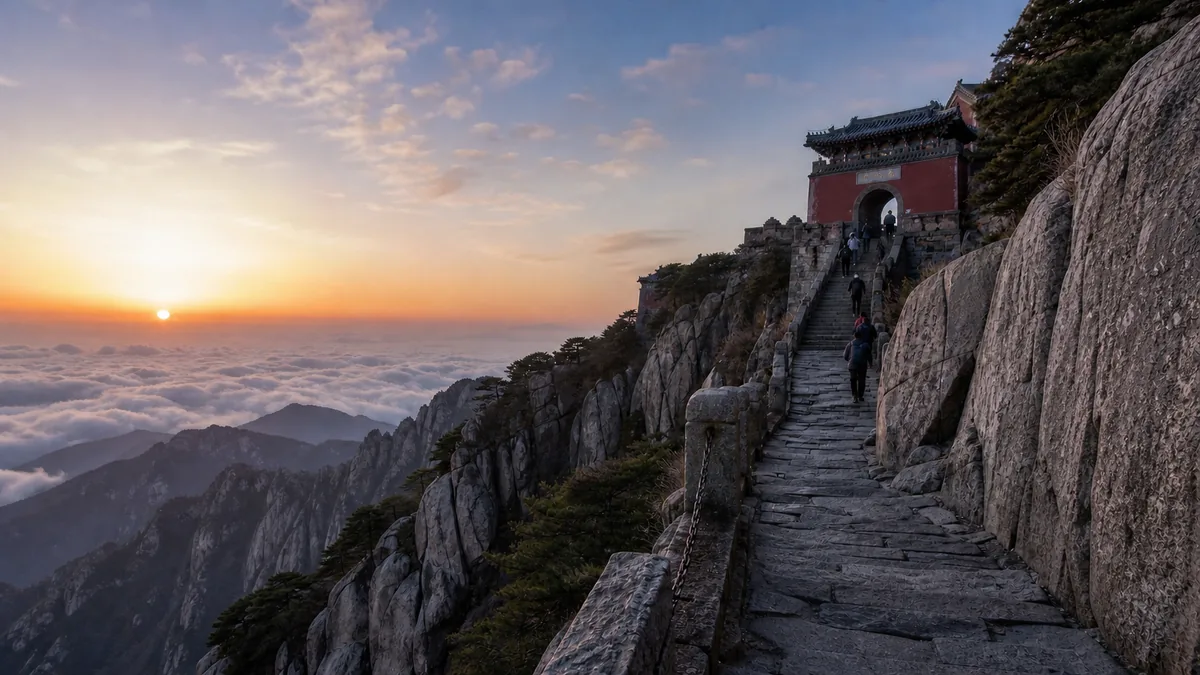
Shandong · Sacred Mountains
Mount Tai: The Mountain Emperors Climbed to Talk to Heaven
Follow China's most politically charged mountain from Dai Temple to the summit, through imperial sacrifice, cliff inscriptions, midnight climbers and the uncertain reward of sunrise.
5A View location, maps and nearby scenic areasHere is a mountain that demonstrates the difference between height and importance. Mount Tai reaches about 1,545 metres—far below the world’s great peaks—yet for more than two thousand years it was where Chinese rulers came to prove that heaven approved of their rule.
Confucius climbed it. Emperors built altars on it. Poets covered it in quotations. Tonight, hikers will again move up the dark staircase towards a sunrise that may or may not appear. The mountain’s power comes not from one view, but from all those journeys occupying the same path.
Think of Mount Tai as three sites joined vertically: Dai Temple is the ceremonial beginning, the stone stairway is an open-air archive, and the summit is the meeting place of imperial ritual and modern sunrise culture.
Why the east made Mount Tai first
China’s traditional Five Great Mountains correspond to directions: east, west, south, north and centre. Mount Tai guards the east, where the sun rises. East therefore suggested birth, renewal and the beginning of political order.
That symbolism made Mount Tai first among the Five Great Mountains, even though it is not the highest. An emperor who wished to present a renewed, harmonious realm could not choose a more legible stage: climb towards sunrise, report to heaven, then descend with cosmic approval.
The mountain also dominates the North China Plain more dramatically than its absolute elevation suggests. Approaching from the lowlands, it appears as a sudden wall rather than one peak among many. Geography reinforced symbolism.
Begin below the mountain at Dai Temple
The historical ascent does not really begin at the first steep step. It begins in Tai’an at Dai Temple, the great ritual complex dedicated to the deity of Mount Tai. Emperors prepared and conducted ceremonies here before moving upwards.
The temple’s courtyards, gates, cypresses, steles and main hall establish the political language of the climb. If the summit is an audience with heaven, Dai Temple is the palace where the paperwork and protocol begin.
Many fast itineraries skip directly to a shuttle or cable car. That saves energy but removes the opening chapter. If time allows, see the temple first and then look north towards the mountain; the route will feel designed rather than accidental.
Fengshan: the ceremony an emperor could not fake
The most famous imperial rite was fengshan, a pair of sacrifices associated with heaven and earth. In simplified form, the ruler ascended to report achievements to heaven and performed complementary rites below. It was a declaration that political rule and cosmic order agreed.
The danger was reputational. Tradition held that only an exceptional ruler presiding over peace and prosperity deserved the ceremony. Attempt it without merit and later historians could turn the climb into evidence of vanity.
Qin Shi Huang, the First Emperor, is the best-known early imperial visitor, climbing in 219 BC. Later rulers including emperors of the Han, Tang and Song dynasties used Mount Tai to frame their legitimacy. Legends say Qin Shi Huang’s procession met a storm; critics enjoyed reading the weather as heaven’s review. Whether every detail is historical matters less than the logic: on this mountain, even rain could become political commentary.
A staircase written over by history
Mount Tai is often described as an open-air museum of inscriptions. Steles and cliff calligraphy accumulated along the route as emperors, officials, monks and poets left records, poems and claims of presence. Counts vary by cataloguing method, but the landscape contains well over a thousand historic inscriptions.
Look beyond individual characters. Notice scale and placement. A small inscription beside the path speaks to walkers at eye level; a huge imperial text on a cliff tries to make authority part of the mountain itself.
Do not touch, trace or climb on carved surfaces for a photograph. Weather already works on the stone every day. The respectful visitor reads the relationship between words and rock without adding another mark.
Confucius, Du Fu and a mountain inside the language
Confucius was born in nearby Qufu, and a saying associated with him declares: “Climb Mount Tai and the world becomes small.” The statement is physical—a wider view from above—and moral: perspective changes judgment.
More than a thousand years later, the Tang poet Du Fu wrote the mountain’s most quoted promise:
One day I shall reach the highest summit,
And see all other mountains made small at a glance.
The first line matters because it says “I shall”—the poet is looking towards a climb not yet completed. Modern readers still use the couplet to express ambition before a difficult task.
Mount Tai also lives inside ordinary Chinese. “Stable as Mount Tai” means utterly dependable. “Having eyes but failing to recognise Mount Tai” means not recognising an important person or real expertise. Sima Qian’s line that death may be “weightier than Mount Tai or lighter than a feather” made the mountain a measure of moral significance.
The classic central climbing route
The traditional central or imperial route links a chain of gates and thresholds: Dai Temple and the lower ceremonial axis, Red Gate, Midway Gate to Heaven, the Eighteen Bends, South Gate to Heaven, the ridge-top street and finally Jade Emperor Peak.
The route is commonly described as roughly seven thousand stone steps. Exact counts depend on where counting begins, but the practical fact is obvious: it is a sustained stair climb, not a gentle trail.
The Eighteen Bends form the steep final test below South Gate to Heaven. Look upward and the red gate can appear suspended above the stairs. Take small steps, use handrails where available and let faster climbers pass. Racing this section leaves little attention for the calligraphy, views and change in vegetation that make the route meaningful.
Three ways to arrange the ascent
Walk the full central route if continuity matters most. You experience the same sequence of gates that gave the climb its ritual power. Start early and allow time for Dai Temple, meals and rests.
Combine road transport and walking if you want selected sections without the full elevation gain. Visitor transport normally reaches the Midway Gate to Heaven area; from there you can continue on foot towards the Eighteen Bends.
Use the cable car for the upper mountain if mobility, time or weather makes the stairway unsuitable. It typically brings visitors near South Gate to Heaven, but the summit area still involves walking, slopes and steps. Operating routes and closures respond to wind, maintenance and crowd control.
There is no morally superior method. The emperors had porters. Choose the route that lets you pay attention rather than merely survive.
The midnight climb and the uncertainty of sunrise
The modern ritual begins after dark. Students, families and couples climb with headlamps, and the lights form a moving line up the mountain. The goal is a dawn view from the summit ridge, often above cloud.
Night removes heat but adds other risks: poor depth perception, tiredness, temperature drops and limited transport options. Carry a reliable light, water, food and warm, windproof or waterproof layers. Do not depend entirely on rental coats or shops being open.
Most importantly, sunrise is weather, not a performance. Fog may hide everything. Wind can close exposed areas or transport. Check official notices and the forecast, and keep a conservative turning-back decision. A mountain associated with cosmic order does not owe every visitor a clear horizon.
A World Heritage site made of nature and memory
In 1987, UNESCO inscribed Mount Tai for both cultural and natural value. That dual status is the correct way to read it. Geology, vegetation and views cannot be separated from pilgrimage, empire, philosophy and writing.
Stay on marked routes, protect inscriptions and carry rubbish down. In crowded sunrise areas, do not climb barriers for an unobstructed photograph. The mountain’s accumulated meaning depends on millions of visitors deciding not to take a piece of it home.
When you finally reach a high point, turn away from the crowd for a moment. Look back down the route rather than only east towards the sun. Gates, stairs, temples and city align below. The achievement is not simply standing at 1,545 metres. It is understanding why so many people needed this particular height to mean so much.
The LoreLens app narrates Mount Tai as you climb—point your camera at the gates and inscriptions to hear what emperors and poets left behind.
Location profile
Where it is

Frequently asked questions
How high is Mount Tai?
Mount Tai's highest point, Jade Emperor Peak, is about 1,545 meters above sea level. Its fame comes less from extreme altitude than from its role as the eastern and foremost of China's Five Great Mountains.
How long does it take to climb Mount Tai?
Walking the classic central route commonly takes several hours and includes thousands of stone steps; pace, crowds, rest and weather make a large difference. Allow a full day if you want to include Dai Temple and read the inscriptions rather than treating the climb as a race.
Can I visit Mount Tai without climbing all the steps?
Yes. Road transport normally connects a lower visitor hub with the Midway Gate to Heaven area, and a cable car usually continues towards the South Gate to Heaven. Routes, operating hours and weather closures change, so confirm the current plan before arrival.
Is sunrise on Mount Tai guaranteed?
No. Cloud, fog, rain and wind can hide the sun even after a successful night climb. Check the forecast, carry warm and waterproof layers, and treat the changing mountain atmosphere—not only a clear sunrise—as part of the experience.
Sources and further reading
Background references for the history and place names in this guide. Opening hours, ticketing and access change often — always confirm with official local information before travelling.