Chongqing · Yangtze River
Qutang Gorge: The Landscape on the 10-Yuan Note
Start with the mountain gate on China's 10-yuan note, then follow eight kilometres of river through imperial history, two defining poems and the traces of the old cliff road.
5A View location, maps and nearby scenic areasDo not reach for your longest lens yet. Take out a Chinese 10-yuan note, turn it over, and look beyond the bow. The two mountains facing each other on the banknote form Kuimen, the stone gate your ship is about to enter.
That small act—matching a piece of money to the landscape—is the quickest way into Qutang Gorge (pronounced roughly chü-TAHNG). But take the photograph and move on too quickly, and you miss what gives these eight kilometres their depth: a city where an emperor entrusted the future of his kingdom, two poets every Chinese schoolchild knows, and the remains of a transport route cut into the cliffs.
Remember three views: Baidicheng is the historical stage, the river is the dramatic passage through Kuimen, and the Three Gorges Summit is the high panorama. Each reveals a different version of the same landscape.
Why eight kilometres make the strongest scene in the Three Gorges
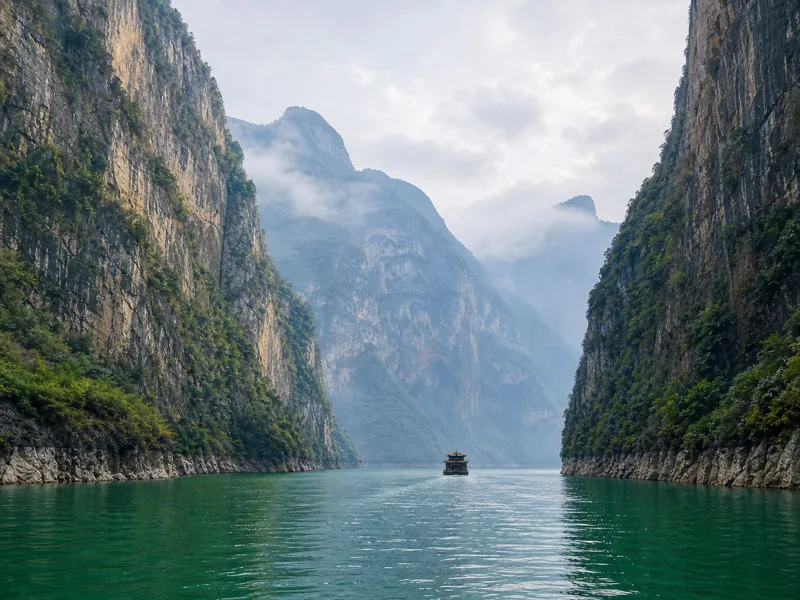
Qutang is the westernmost and shortest of the Three Gorges. It begins around Baidicheng in Fengjie, Chongqing, and runs east for roughly eight kilometres. Its power does not come from length. It comes from compression: an open stretch of the Yangtze suddenly narrows between two mountains, pulling the river, the ship and your entire field of view towards one stone doorway.
Chijia Mountain rises on the north bank of the western entrance; Baiyan Mountain faces it to the south. Together they make Kuimen, literally the “Kui Gate.” Chinese writers condensed its reputation into four characters: 夔門天下雄, “Kuimen is the most majestic pass under heaven.” The line is not simply praise for tall mountains. It captures the sense that this gate commands the whole river.
The gorge’s width varies with location and water level, and commonly cited descriptions put its narrowest reaches at around a hundred metres. The mountains tower far above the water. Rather than memorising a disputed figure, use another vessel as your scale: when a cruise ship ahead shrinks to a bright speck between the walls, the proportions become immediately legible.
How to match the 10-yuan note to the real gate
The reverse of China’s fifth-series 10-yuan banknote shows a Three Gorges scene with Kuimen as its defining form. It is an emblem, not a navigation chart. Water level, haze, direction of travel, deck height and focal length all change the perspective, so do not expect a perfect overlay from every position.
If you are travelling east from Fengjie, reach an open deck facing forward before the ship enters the gorge. First identify the two mountain masses that most resemble a doorway. Then hold the note low in the foreground. Let the printed gate and the real mountains remain visible together instead of covering one with the other; the photograph tells the story more clearly that way.
After you have the shot, put the note away and watch the approach once without a frame. The real spectacle is not the moment paper and mountain align. It is the gradual sensation that the two mountains have taken control of the Yangtze.
Baidicheng: an empire entrusted after defeat
On the heights by Qutang’s western mouth stands Baidicheng, the White Emperor City. It turns this geological drama into one of the most consequential settings in the Three Kingdoms story—China’s equivalent of an epic cycle such as the Iliad.
In 222, the Shu Han emperor Liu Bei marched against the rival state of Eastern Wu to avenge his sworn brother Guan Yu. The campaign collapsed at the Battle of Yiling, where Wu forces used fire against Liu Bei’s extended camps. He withdrew towards Baidicheng and died the following year.
Before his death, Liu Bei entrusted his young heir Liu Shan to the strategist Zhuge Liang. The Records of the Three Kingdoms preserves the extraordinary instruction: “If the heir can be assisted, assist him; if he proves incapable, you may take the state yourself.” In other words, the emperor appeared to offer his minister the throne if his son failed.
The turn in the story is Zhuge Liang’s refusal. He continued to serve Shu Han, and later generations summarised his commitment with another line: “Bend myself to the task and give everything until death.” The phrase 鞠躬盡瘁,死而後已 is still used in Chinese for devotion carried to its absolute limit. Look from Baidicheng towards Kuimen and the gorge becomes more than a defensive gate: it is the setting where a defeated ruler handed the future to someone he trusted.
Li Bai’s fast boat: freedom hidden inside a travel poem
The brightest poem associated with Baidicheng belongs to the Tang poet Li Bai, the wandering, wine-loving genius often treated as ancient China’s rock star:
At dawn I leave the White Emperor amid coloured clouds;
A thousand miles to Jiangling, returned in a single day.
The monkeys’ cries on both banks have not yet ceased;
My light boat has passed ten thousand mountains.
On the surface, Leaving Baidi in the Morning is about speed. The current carries a light boat downstream so quickly that an impossible distance seems to vanish in a day. The emotional background makes it stronger: Li Bai wrote the poem after receiving a pardon while travelling towards exile. The “light boat” therefore feels like a person suddenly relieved of a crushing weight.
Almost every Chinese reader learns these lines. “The light boat has passed ten thousand mountains” is still quoted when someone has survived a difficult period and can finally move forward. As your vessel runs with the current through Kuimen, you are not just following a literary route; you are moving through a metaphor for release that remains alive in modern Chinese.
Du Fu’s autumn: the same river, a different state of mind
A few years later, another great Tang poet, Du Fu, lived in Kuizhou, the old name for the Fengjie area. Where Li Bai found speed and release, Du Fu saw age, displacement and the turbulence of his time. In Ascending the Heights, he wrote:
Boundless, the falling leaves rustle down;
Endless, the Yangtze rolls towards us.
One line fills the mountains with falling leaves; the next sets the river moving without end. A finite human life and apparently infinite time occupy the same view. Du Fu produced several hundred poems during his Kuizhou years, one reason Fengjie is widely known as a City of Poetry.
Li Bai sees escape in this river. Du Fu sees time. That contrast is why Qutang rewards more than a quick photograph: the landscape does not dictate one emotion; it enlarges whatever a traveller brings to it.
What to watch for as the ship passes through
- Before the entrance, keep the whole gate in view. Begin with a wide composition that preserves the relationship between both mountains and the river.
- At the gate, look back towards Baidicheng. Its buildings rapidly diminish with distance, revealing how the city, the river and the pass fit together.
- Inside the gorge, study the rock. Look for strata, holes and horizontal traces along the cliff. Some are associated with old plank-road remains, though visibility depends on route, light and water level.
- Use other vessels as a scale. A cruise ship, freighter or small boat often communicates the gorge’s height and narrowness better than an empty landscape.
- Notice what a photograph cannot keep. Wind, engine noise, reflected light and the changing echo between the walls all shift once the ship is inside.
Navigation on the upper Yangtze was once punishing. Boats heading upstream relied on trackers, ropes and paths along the bank. Workers cut holes into the rock, inserted wooden beams and laid planks to create cliff-side routes. The surviving traces remind you that today’s calm deck view is a modern privilege; earlier travellers met this river with muscle and rope.
Cruise only, half a day or a full day?
A cruise passage is the essential first experience. You get the complete dramatic sequence—approach Kuimen, enter the gorge, then look back as the gate closes behind you. The ship will not pause for every detail, so reach the open deck early.
Baidicheng plus Qutang Gorge is the better choice if the Three Kingdoms and poetry matter to you. See the historical setting first, then match its position to the gate from the water or a nearby viewpoint.
Add the Three Gorges Summit if you want the large-scale geography, sunrise or cloud. The high viewpoint looks down over the river’s course, but mountain weather, visibility, road transfers and opening arrangements can all change the experience.
Baidicheng and Qutang Gorge together form a National 5A Scenic Area, the highest tier in China’s scenic-attraction system. The rating reflects a broad assessment of the attraction, visitor services and management; it does not guarantee that every path, cruise stop or ticket arrangement operates in the same way every day. Check current reservations, access, weather and docking plans with the attraction or your cruise operator.
When is the best time to see Qutang Gorge?
There is no single correct season. Clear weather reveals the structure of the mountains; light mist makes Kuimen resemble a landscape painting. Angled morning or late-afternoon light can bring out the rock layers, while midday often produces stronger contrast between bright sky and shadowed walls.
If the banknote photograph matters most, prioritise visibility and deck position over a particular month. If your plan includes stairs or a high viewpoint, put rain, heat, cold and mountain-road conditions ahead of the photograph.
Finally, lower the camera for ten seconds
Kuimen’s most affecting moment may not be when the note aligns with the mountains. It may come just after the bow passes through and you turn back to see the two sides close together again. The eight-kilometre gorge feels like a door pushed open by the Yangtze—one through which emperors, poets, boat trackers and today’s travellers have all passed.
Lower the camera for ten seconds and listen to the wind and echo. Then take one final photograph with a distant vessel for scale. Make the people small, and Kuimen will finally look as large as it feels.
Adapted from the LoreLens audio guide for Qutang Gorge. Point the LoreLens app at the gorge and hear this story narrated as you sail through.
Location profile
Where it is

Frequently asked questions
Is Qutang Gorge really the landscape on China's 10-yuan note?
Yes. The reverse of the fifth-series 10-yuan banknote depicts a Three Gorges scene dominated by Kuimen, the western gate of Qutang Gorge. Water level, weather and your position will change the perspective, so the real view will not align perfectly from every boat.
Are Baidicheng and Qutang Gorge the same attraction?
Baidicheng stands at the western entrance to Qutang Gorge, and together they form the Baidicheng–Qutang Gorge National 5A Scenic Area. A cruise shows you Kuimen and the gorge; visiting Baidicheng's buildings and exhibitions normally requires a shore or overland itinerary.
Can I experience Qutang Gorge properly from a Yangtze cruise?
A cruise gives you the essential sequence of approaching Kuimen, entering the gorge and looking back at the gate. Add Baidicheng for the Three Kingdoms history or the Three Gorges Summit for a high viewpoint. Confirm the day's stops and transfers with your cruise operator.
Where should I stand to photograph Kuimen from the boat?
Choose an open deck facing the direction of travel before the ship reaches the western entrance. Start wide enough to keep both mountains and the river in frame, then use a 10-yuan note as a foreground element without blocking the real gate.
Sources and further reading
Background references for the history and place names in this guide. Opening hours, ticketing and access change often — always confirm with official local information before travelling.