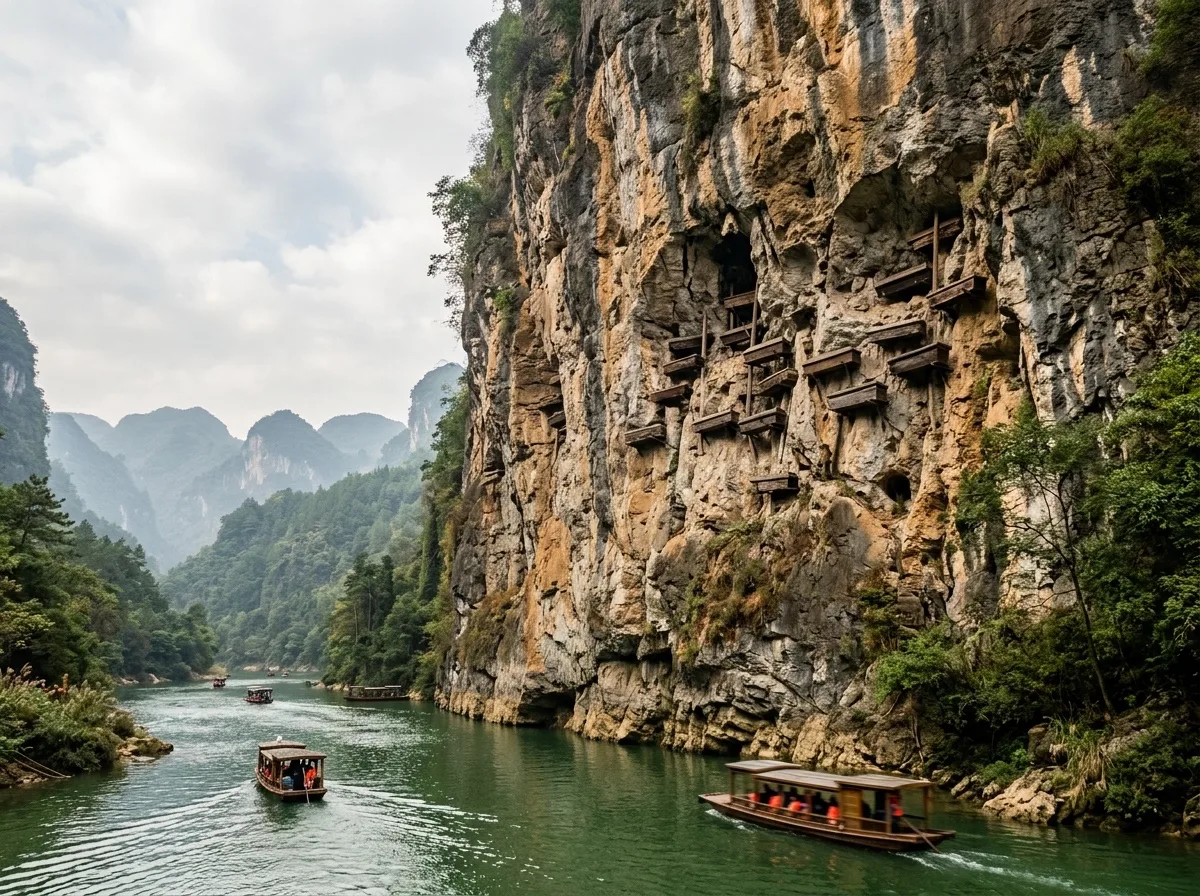
Chongqing · Yangtze River
The Hanging Coffins of the Yangtze
Find real wooden coffins high in the cliffs, meet the ancient river communities associated with them, and separate what archaeology knows from the legends below.
Look where the guide points, then keep looking. High above the water, a dark slit in the cliff slowly separates into rock, shadow and a straight piece of wood. That last shape is a coffin—a real burial placed between river and sky.
The hanging coffins of the Yangtze are easy to miss and difficult to explain. Some have remained in cliff cavities for more than two thousand years. Their distance created mystery; their survival created legends. The first task is to separate what can be observed from what remains a theory.
Use careful language: “hanging coffin” describes a broad cliff-burial tradition, not one single people, date or lifting method. Different valleys and sites have different archaeological histories.
What exactly is a hanging coffin?
The name covers several ways of placing the dead above ground: a wooden coffin set inside a natural cave, wedged into a rock crevice, laid on a ledge or supported by beams inserted into a cliff. From a boat, those distinctions often collapse into one distant horizontal shape.
Many coffins were made from substantial timber, sometimes hollowed from a single trunk. Boat-shaped forms make particular sense in river cultures, although not every coffin is literally a canoe. The wood, burial objects and placement help archaeologists distinguish an actual grave from a later structure or a suggestive natural form.
The height seen today is not always the height experienced by the people who built the burial. River levels and landscapes change. Yet many sites were unquestionably difficult to reach even in antiquity; elevation was part of the choice, not an accident.
Who placed them there?
In the Three Gorges and neighbouring river systems, hanging coffins are often associated with ancient communities described broadly as Ba and with later local groups. The Ba flourished in this region before imperial China unified, and historical sources remember them as skilled river people with a strong warrior tradition.
Popular accounts sometimes present the modern Tujia people as direct descendants of the ancient Ba. Cultural and population history is more complicated than a straight family tree, so it is safer to say that Tujia communities preserve important regional connections to the landscapes and traditions once associated with Ba culture.
Avoid the fantasy of a vanished “mystery race.” These burials belonged to real communities with families, tools, beliefs and knowledge of the cliffs. The mystery lies in incomplete evidence, not in a people being unknowable.
Why put the dead so high?
No surviving instruction manual gives one universal reason. Archaeologists and historians usually discuss several motives that may have overlapped.
Belief is one: height could place the dead closer to heaven, ancestral spirits or a sacred landscape. Filial devotion is another: a difficult burial visibly demonstrated the labour a family and community were willing to give. A traditional phrase often quoted in this context suggests that the higher the burial, the greater the devotion.
There was also protection. A high crevice discouraged animals, flooding and casual grave robbers. Some excavated coffins retained objects such as weapons, textiles or personal goods, although the contents vary widely by site.
These explanations are not mutually exclusive. A burial can express cosmology, family honour and practical security at the same time.
The engineering question: how did they do it?
A loaded timber coffin may weigh hundreds of kilograms. Moving one across steep terrain is difficult; placing it partway up a cliff is a collective engineering project.
One leading method is lowering from above. Workers could carry the coffin to the clifftop, secure it with braided ropes, lower it while people guided the load and manoeuvre it into a cave or crevice. Rope technology does not need to be modern to be strong, but the anchors, coordination and risk would have been formidable.
Another proposal uses timber scaffolding. Rows of holes found in some cliffs may once have held beams supporting temporary platforms or ramps. The structure could be dismantled or decay, leaving only sockets in the rock.
Different sites may have used different solutions, including natural slopes or access from inside caves. The attractive idea that ancient water simply reached the coffins does not fit many elevations and reconstructed river levels. The honest answer is not “nobody knows anything,” but “several workable methods remain, and the evidence is site-specific.”
What archaeology can—and cannot—tell us
Timber species, tool marks, human remains and burial goods provide more reliable clues than a distant photograph. They can indicate date ranges, craft practices, diet, status and exchange. They rarely preserve the words spoken at the funeral or the exact meaning a family attached to height.
Some cliff burials have been disturbed by weather, looting, development or changing water conditions. Others remain inaccessible. That makes each surviving coffin both an archaeological source and a human grave.
When a guide supplies a precise age or ethnic identity for one object far above the boat, understand the difference between a regional story and a laboratory result. The story may orient you, but certainty belongs to evidence from the specific site.
When a tomb became a bellows or a military book
For centuries, people below the cliffs could see the shapes but could not reach them. Imagination filled the distance.
In Bellows Gorge, objects in the rock were said to be the bellows of Lu Ban, China’s legendary master carpenter—the equivalent of attributing an impossible structure to Daedalus. Elsewhere, shapes on a ledge were identified as secret military books and a precious sword left by the strategist Zhuge Liang for a worthy successor.
These legends are not failed archaeology. They show how communities made inaccessible objects meaningful. The modern identification—a high ancient burial constructed without cranes—may be stranger than the supernatural explanation.
How to spot a hanging coffin from the boat
This is one place where a long lens or binoculars genuinely help. The wood may be nearly the same colour as the cliff, and distance removes depth. Do not search randomly across the entire mountain wall.
Use this sequence:
- Listen for the guide to say xuan guan, the Mandarin words for hanging coffin.
- Find the larger cave, crevice or pale ledge first.
- Look for a straight horizontal edge that differs from natural layers.
- Use binoculars before zooming a phone; digital zoom can enlarge blur rather than detail.
- Once found, lower the lens briefly and keep the grave in its wider river landscape.
The Lesser Three Gorges on the Daning River is one of the most common excursion routes associated with visible cliff burials. Routes and visibility change with operations, light and water, so no guide can guarantee the same view on every departure.
Photograph a grave, not a curiosity
The distance can make the coffin feel like an abstract puzzle. It is not. It held a person whose family undertook extraordinary work to place them in a chosen landscape.
Photographing from a public boat is different from approaching, touching or disturbing a burial. Do not treat inaccessible graves as targets to reach, and do not encourage unauthorised climbing or collection. Archaeological protection matters precisely because so much context disappears once an object is moved.
A useful photograph includes enough cliff and river to explain the decision. The coffin should look small. Its scale against the rock communicates the labour more honestly than an extreme crop.
Between water and sky
After you finally identify one, wait before taking the next photograph. Imagine carrying timber, rope and a human body through this terrain, then trusting a whole community to hold the load steady.
The lifting method may never be known for every coffin. The intention is clearer: the family did not want this person to vanish into ordinary ground. They chose a place between water and sky, and two thousand years later travellers still look up.
Adapted from the LoreLens audio guide for the Yangtze hanging coffins. The LoreLens app tells the archaeological story as your boat passes below the cliffs.
Frequently asked questions
Are the Yangtze hanging coffins real coffins?
Yes. Cliff cavities and ledges in the Three Gorges region preserve ancient wooden coffins and cliff-burial remains. Individual sites differ in date and cultural attribution, so not every distant object identified in a tour story is necessarily the same type of burial.
How old are the hanging coffins?
Many hanging-coffin traditions in southwest China date back more than two thousand years, but the dates vary by river valley and site. Archaeologists use timber, burial objects and regional context rather than assigning every coffin one single age.
How were coffins lifted onto the cliffs?
No single method explains every site. Leading proposals include lowering coffins from the clifftop with ropes and raising them on timber scaffolds fitted into rock holes. The work required organised labour and considerable risk; simple high-water explanations do not fit many locations.
Where can travellers see hanging coffins near the Three Gorges?
The Daning River's Lesser Three Gorges is one of the most commonly visited viewing areas, often from a smaller excursion boat. Visibility depends on route, water level, light and current access, so listen for the guide's cue and carry binoculars or a long lens.
Sources and further reading
Background references for the history and place names in this guide. Opening hours, ticketing and access change often — always confirm with official local information before travelling.