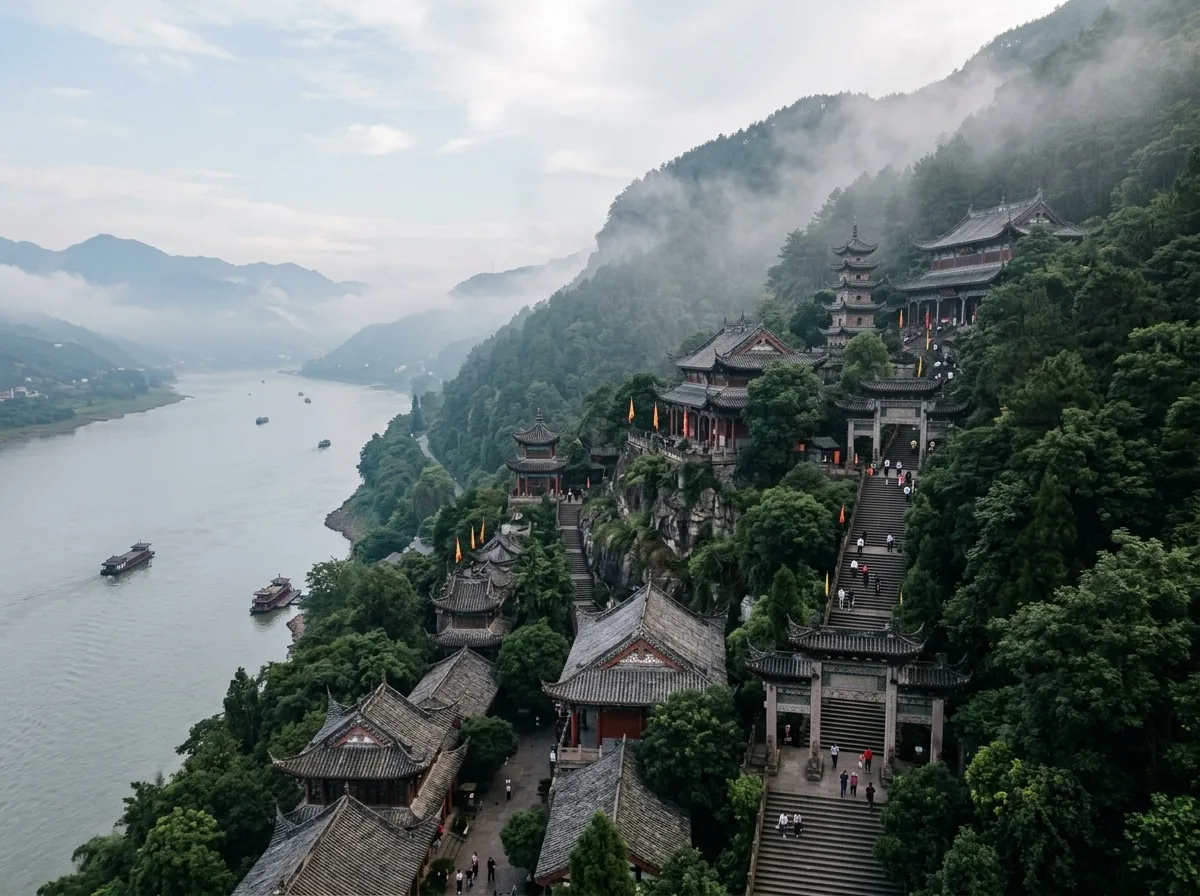
Chongqing · Yangtze River
Fengdu Ghost City: Visit the Afterlife, Come Back Alive
Walk the Chinese afterlife as a complete journey—from the Bridge of Helplessness and the Gate of Ghosts to the last look home and the final court of judgment.
Congratulations: you are about to visit the afterlife and come back alive. The mountain ahead is Fengdu Ghost City (pronounced roughly fung-DOO), and Chinese storytellers have spent nearly two thousand years turning it into the capital of the dead.
This is not a haunted house with one jump scare after another. It is a walk-through model of how a human life is judged: a bridge tests your character, a border gate checks your papers, a road asks whether you can let go of the living world, and a final palace delivers the verdict. The monsters are dramatic, but the question beneath them is simple: how should you live before death arrives?
Read the mountain as a journey, not a collection of statues. Each stop moves the imagined soul from arrival and inspection to judgment, consequence and, eventually, another chance at life.
How an immortals’ mountain became the capital of the dead
The best-known origin story begins in the Han dynasty, around the time of the Roman Empire. Two seekers of immortality, Yin Changsheng and Wang Fangping, were said to have practised here and attained transcendence. Later storytellers placed their surnames together—Yin and Wang. Heard another way, Yin-wang suggested a king of the underworld.
The pun is memorable, but it is folklore, not a proven etymology. Fengdu’s reputation grew over centuries through several traditions: Taoist ideas of immortals and cosmic officials, Buddhist ideas of karma and rebirth, local worship, temples, inscriptions and popular literature. The result is more interesting than a single origin. Fengdu became a shared stage on which generations imagined what justice after death ought to look like.
The mountain itself is commonly called Mingshan, “Famous Mountain.” A line associated with the Song-dynasty writer Su Shi praises Pingdu as an ancient famous mountain under heaven. The name helps explain Fengdu’s double identity: it is both a scenic hill above the Yangtze and a moral world built in temples and stories.
Hell, but with paperwork
If Dante’s Inferno imagines hell as circles of punishment, Fengdu often feels like something more familiar to anyone who has visited an office: a government. Judges keep records. Constables escort souls. Passes are inspected. Evidence is reviewed. Sentences match offences.
Scenic-area descriptions commonly cite more than a thousand figures across the mountain. Together they form a supernatural administration of arrest, trial, punishment and rebirth. The dead are not simply thrown into chaos; they are processed. Even the underworld, Chinese imagination insists, should have rules.
That is also the crucial difference from the idea of eternal damnation. In the moral universe represented here, punishment is a stage, not necessarily the final destination. A soul faces the consequences of its actions, then moves towards rebirth. The system is frightening, but it leaves room for procedure, proportion and hope.
First checkpoint: Naihe Bridge
The Naihe Bridge, often translated as the Bridge of Helplessness, is the first famous test. The surviving stone bridges are associated with early Ming construction, although the precise dating and the rituals told to visitors vary by source.
Folklore says a good person crosses safely while a wrongdoer loses balance and falls towards waiting demons. Visitors are often invited to cross in a prescribed number of steps or choose between bridges linked with fortune, health or moral testing. Treat those rules as participatory folklore rather than a universal religious command; follow the instructions posted on site.
The name has travelled far beyond Fengdu. Naihe means something like “what can be done?” and survives in the everyday phrase wu ke nai he—“there is no help for it.” A bridge in the imagined afterlife became a word used in Chinese offices, families and Monday-morning complaints.
Ghost Gate: the border crossing of the underworld
Beyond the bridge comes Guimenguan, the Gate of Ghosts. In folklore, a newly dead soul cannot pass without a road permit, a paper document stamped by underworld officials. Historical and replica permits associated with Fengdu make one of the site’s funniest serious points: death itself requires paperwork.
On the approach, grotesque figures represent human weaknesses—the drunkard, gambler, miser, coward and many more. Modern Chinese still calls people “ghosts” in exactly this way: a drunkard is an “alcohol ghost,” a timid person a “small-gutted ghost,” and an affectionate quick-witted child a “clever ghost.” The figures are not portraits of strange dead beings. They are caricatures of the living.
Temple guardians known as Heng and Ha extend the joke. One snorts, the other exhales; in the Ming novel Investiture of the Gods, those sounds become supernatural weapons. Their names still describe a pair who works in perfect coordination. Once you recognise them, you begin spotting the same guardians at temple gates across China.
Yellow Springs Road: do not look back
The next symbolic stretch is Huangquan Road, the Road to the Yellow Springs. “Yellow Springs” is one of the oldest Chinese names for the realm of the dead, probably drawing on the image of yellowish groundwater deep below the earth. Thousands of years later, “to go to the Yellow Springs” still means to die.
The rule in the story is simple: walk forward and do not turn around. A soul that keeps looking back cannot release the world it has left. Whether or not you play along, the idea gives the path its emotional weight. The afterlife journey is not only about fear of punishment; it is also about the difficulty of saying goodbye.
The last look home—and Fengdu’s lost town
At the Homeward-Gazing Terrace, tradition grants the soul one mercy before judgment: a last view of home, family and the life it can no longer re-enter. It may be the most humane invention in Fengdu’s entire bureaucracy.
The view has acquired a modern layer. When the Three Gorges reservoir rose, old parts of Fengdu by the river were submerged and residents rebuilt across the Yangtze on higher ground. From the mountain, today’s city and the reservoir turn the ancient metaphor into recent memory: living families also had to look back at a home they could not return to.
Do not force the comparison into a neat ghost story. Resettlement was a real, complicated human experience. The terrace matters because it lets legend and lived history meet in one view—both concerned with departure, memory and the work of beginning again.
Tianzi Palace: judgment, punishment and another chance
Near the culmination of the route stands Tianzi Palace, the court of the ruler of the underworld. Judges, Black and White Impermanence, Ox-Head and Horse-Face and scenes of punishment populate the moral universe around it. These figures remain familiar in Chinese opera, film, games and festivals.
Displays associated with the Eighteen Hells match punishments to offences. The purpose is not gore for its own sake. Like medieval church images or Dante’s moral architecture, the spectacle teaches that actions have consequences. The phrase “the eighteenth level of hell” still means rock bottom in everyday Chinese.
The final message is less bleak than the statues suggest. This is a court and a prison, not an endless void. There is judgment, a sentence and then the possibility of rebirth. The mountain frightens visitors in order to return them to ordinary life with a practical instruction: be kinder while you still can.
How to visit without missing the point
Allow for an uphill route, stairs and pauses at individual halls. A cruise excursion may move quickly, while an independent visit gives you more time to read the sequence. Cable-car operations, entrances and open halls can change; check the current site information rather than building a plan around an old timetable.
Photograph the statues, but do not reduce the site to comic horror. Avoid blocking worship, follow signs inside halls and ask before photographing where restrictions apply. The best images show the relationship between path, gate, temple and river—not only the most frightening face.
When you reach a high viewpoint, turn towards the Yangtze. Fengdu makes the most sense when the theatrical underworld remains visibly attached to a real town, a real river and real human departures.
Leave the ghosts on the mountain
Locals like to say, “Walk through the Ghost City and live to ninety-nine.” The promise is playful, but it carries the same lesson as the whole route. You do not come here to become fascinated with death. You rehearse the journey so that the value of being alive becomes harder to ignore.
At the last gate, lower the camera for a moment. The court is imaginary; your choices are not. Then walk back down the mountain and leave the ghosts to their paperwork.
Adapted from the LoreLens audio guides for Fengdu Ghost City. The LoreLens app narrates the bridge, gate, road, terrace and court as you climb.
Location profile
Where it is

Frequently asked questions
Is Fengdu Ghost City a haunted house or a religious site?
It is a historic temple landscape shaped by Taoist, Buddhist and popular beliefs about death, judgment and rebirth—not a modern haunted attraction. The theatrical statues teach moral lessons, and visitors should treat active halls and images with the same respect as other religious sites.
Why is Fengdu called the Ghost City?
The best-known legend links two Han-era seekers of immortality, Yin Changsheng and Wang Fangping. Later storytellers combined their surnames as Yin-Wang, which sounded like a ruler of the underworld. The explanation is traditional folklore rather than settled history.
What is the usual route through Fengdu Ghost City?
The story is commonly understood as a soul's route: Naihe Bridge, the Gate of Ghosts, Yellow Springs Road, the Homeward-Gazing Terrace and Tianzi Palace. Actual access and sequence can change, so follow the site's signs and allow extra time for stairs.
Can I visit Fengdu Ghost City from a Yangtze cruise?
Many cruise itineraries use Fengdu as a shore excursion, but stops, transfer methods and available time vary by ship and water conditions. Confirm the current program with your operator rather than assuming every cruise includes it.
Sources and further reading
Background references for the history and place names in this guide. Opening hours, ticketing and access change often — always confirm with official local information before travelling.