Beijing · Great Wall
Juyongguan: The Great Wall's Front Door to Beijing
Read the Great Wall as a valley-wide defence system, trace the Mongol and Ming struggle for Beijing's northern door, and stop at a six-script Buddhist monument.
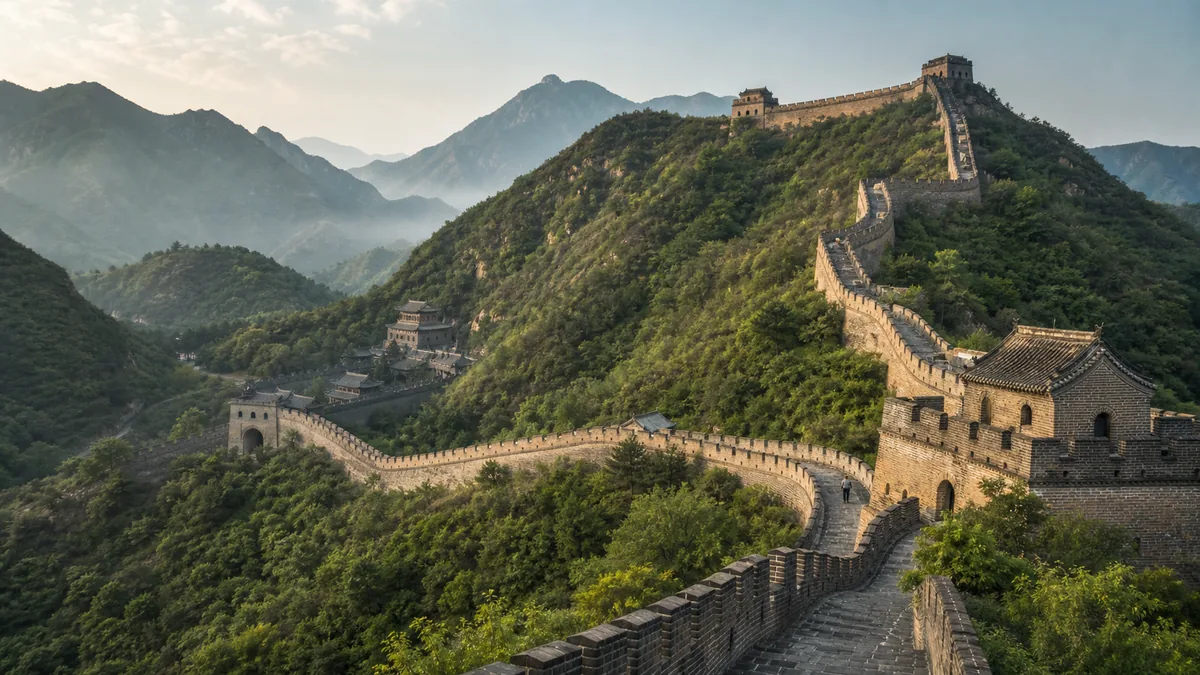
Before climbing, stand on the valley floor and turn slowly through a full circle. At Juyongguan, the Great Wall is not simply a line on a ridge. It climbs both sides of a narrow mountain corridor and closes around the valley. The pass itself is the weapon.
For much of Chinese history, armies approaching Beijing from the northern steppe faced this geography. Control the corridor and the capital had a door; lose it and the road south opened. Juyongguan therefore makes the Great Wall easier to understand as a system of terrain, gates, walls, towers, troops and supply—not a single endless barrier.
Read three layers separately: the valley explains the strategy, the Ming walls show the mature defence system, and the Yuan Cloud Platform preserves the pass’s multilingual religious world.
Geography before masonry
The Juyong corridor runs between steep mountains northwest of Beijing. Long before the surviving brick walls, states used the narrow passage as a checkpoint between the North China Plain and routes towards the steppe.
Walls work best when terrain has already reduced an army’s choices. A force in an open plain can spread, manoeuvre and bypass. In a confined valley, movement compresses; gates, watchtowers and defenders can concentrate at the decisive point.
That is why the wall here rises around the valley rather than only crossing one distant skyline. Look down from a tower and trace roads, water, slopes and gate locations. The defensive logic becomes visible without needing to imagine one continuous wall stretching across all China.
The name and the labourers behind the legend
A popular origin story connects the name Juyong to the First Emperor, Qin Shi Huang. Conscript labourers—yong—were made to dwell—ju—in the valley while building early frontier works. The name is then read as “the place where labourers lived.”
The explanation is traditional rather than a settled linguistic proof, but it keeps an important truth in view: walls are not built by emperors’ commands alone. They require quarrying, transport, food, barracks and immense human labour.
The Great Wall is often photographed without workers. At Juyongguan, the enclosing terrain helps you imagine the logistical community that had to live inside the pass to maintain it.
When the strongest door still failed
The useful history of a fortress includes the moments it did not work. During the Mongol campaigns of the early 13th century, Juyongguan stood on the road towards the Jin capital at Zhongdu, near modern Beijing. Accounts describe Mongol forces using manoeuvre, feigned movement and alternate approaches rather than relying only on a frontal assault; details differ across retellings.
The strategic lesson is more reliable than one dramatic anecdote: a fixed wall can delay and channel an enemy, but intelligence, leadership, morale and control of surrounding routes decide whether it holds.
When the Ming dynasty replaced Mongol rule in 1368, the founding general Xu Da was associated with rebuilding and strengthening the pass. The system developed walls, towers, gates, military spaces, temples and stores. Having driven Mongol power north, the Ming invested in preventing the route from opening again.
What to look for in the Ming defence system
As you climb, distinguish the parts. Battlements shield defenders. Crenels permit observation and shooting. Watchtowers provide elevated positions, shelter and communication. Gates manage daily movement but also become the point requiring the heaviest protection.
The wall follows terrain rather than a ruler-straight plan. Steeper ground can reduce the need for massive artificial obstacles, while saddles and approaches receive more construction. Repairs from different periods may also use different brick, stone and mortar.
Do not assume every visible section is exactly as it stood in one Ming year. Like most accessible Great Wall sites, Juyongguan includes historic fabric, later repairs and modern visitor infrastructure. Its value lies in the system and setting, not in pretending time stopped.
The Cloud Platform and six scripts in one arch
Near the valley floor stands the Cloud Platform, a white-marble gateway completed in the Yuan dynasty in 1345, before the surrounding Ming walls took their mature form. Buddhist structures once stood above it; the platform and carved arch survive.
Inside are Buddhist texts and images in six scripts: Sanskrit, Tibetan, Mongolian, Uyghur, Tangut and Chinese. The list is a map of the Mongol empire’s human world—different languages and religious communities passing beneath one political order.
Tangut had already lost its state, yet its script remained meaningful enough to carve. Today those inscriptions are especially valuable for scholarship. Look at the direction, shape and density of each script before trying to photograph everything. The monument is not a decorative alphabet sampler; it records translation, patronage and empire.
Use soft side light if available and avoid touching the reliefs. Hands, rubbing and repeated contact can damage details that survived for nearly seven centuries.
A military pass that became a landscape painting
Juyongguan also entered the traditional list of Beijing’s celebrated views as “Layered Greenery at Juyong.” Ridges, pines and the pass overlap until walls and mountains become one composition.
The phrase reveals a double life. The same valley that concentrated armies also attracted emperors, officials and poets as scenery. Peace did not erase the military architecture; it turned the architecture into part of a landscape tradition.
Spring greenery, summer haze, autumn colour and winter snow each redraw the wall. Weather can also make stone slippery and exposed towers windy, so beauty and risk change together.
Choose a route before you start climbing
A useful visit has three possible scales.
Lower pass and Cloud Platform: best when time or mobility is limited. Focus on the valley geometry, gates and multilingual monument rather than treating height as the only achievement.
One side of the wall: climb towards selected towers, then return according to the marked route. This gives the classic elevated view without committing to the full enclosure.
A substantial circuit: allow three to four hours or more, depending on open sections, pace and conditions. The stairs are steep and irregular, and repeated descent can be as tiring as ascent.
Check the current map at the entrance. One-way controls, closed towers and maintenance can change the practical circuit. Save enough energy for the return; the pass does not flatten because the best photograph is behind you.
Juyongguan or Badaling?
Juyongguan lies closer to central Beijing than Badaling and is often—but not always—less crowded. Its signature is the enclosed valley, steep ring of walls and Cloud Platform. Badaling offers a different, more famous ridge-line experience and more extensive visitor transport.
There is no universal winner. Choose Juyongguan if the pass itself, military geography and Yuan inscriptions interest you. Choose according to real transport time, accessibility and weather rather than an online promise of “no crowds.” Holidays can make any major Great Wall site busy.
Climb safely and photograph the system
Wear shoes with grip. Stone and restored brick can be slick in rain, snow or frost; summer sections have little shade. Carry water, protect against sun and wind, and do not climb closed parapets for a cleaner frame.
For photographs, include the curve of the wall and the valley floor. A tight tower portrait could belong anywhere. A wider image showing gates below, walls climbing both ridges and roads threading the pass explains why Juyongguan mattered.
At one tower, stop and look north. A Ming sentry did not see “the Great Wall” as a world-famous icon. He saw weather, smoke, roads and the possibility of movement in the valley. For a moment, use the wall as an instrument for watching rather than a background for posing.
The door was never only stone
On the way down, look again at the Cloud Platform and the road passing through the centre. Armies, pilgrims, merchants, officials and modern visitors all needed this valley to remain a route, even while rulers tried to make it a barrier.
That contradiction is Juyongguan’s real story. Beijing’s front door had to close against an army and open for a civilisation. Stone helped, but the decisions made at the door always mattered more.
The LoreLens app narrates Juyongguan as you climb—point your camera at the Cloud Platform to hear six scripts explained in one story.
Location profile
Where it is

Frequently asked questions
How far is Juyongguan from central Beijing?
Juyongguan is roughly 60 kilometers northwest of central Beijing in the mountain corridor leading towards Badaling. Road time varies greatly with traffic, so plan by current transport conditions rather than distance alone.
Is Juyongguan the same as Badaling Great Wall?
No. They are separate sites in the same strategic corridor. Juyongguan encloses a valley and contains the Yuan-dynasty Cloud Platform; Badaling is farther north and generally better known. Choose by route, transport and the type of landscape you want.
How long does it take to walk Juyongguan?
A short visit to the lower pass and Cloud Platform can take a couple of hours, while a substantial circuit may take three to four hours or more. Steep, irregular stairs, heat, ice and crowds make pace highly variable.
What is special about the Cloud Platform?
The white-marble Cloud Platform was completed under the Yuan dynasty in the 14th century. Its arch carries Buddhist texts and imagery in Sanskrit, Tibetan, Mongolian, Uyghur, Tangut and Chinese, preserving a rare multilingual record of the Mongol empire.
Sources and further reading
Background references for the history and place names in this guide. Opening hours, ticketing and access change often — always confirm with official local information before travelling.