Chongqing · City
Liziba: The Train That Runs Through an Apartment Building
See Chongqing's monorail enter a 19-storey residential tower, understand why the station and building were designed together, and frame the classic view safely.
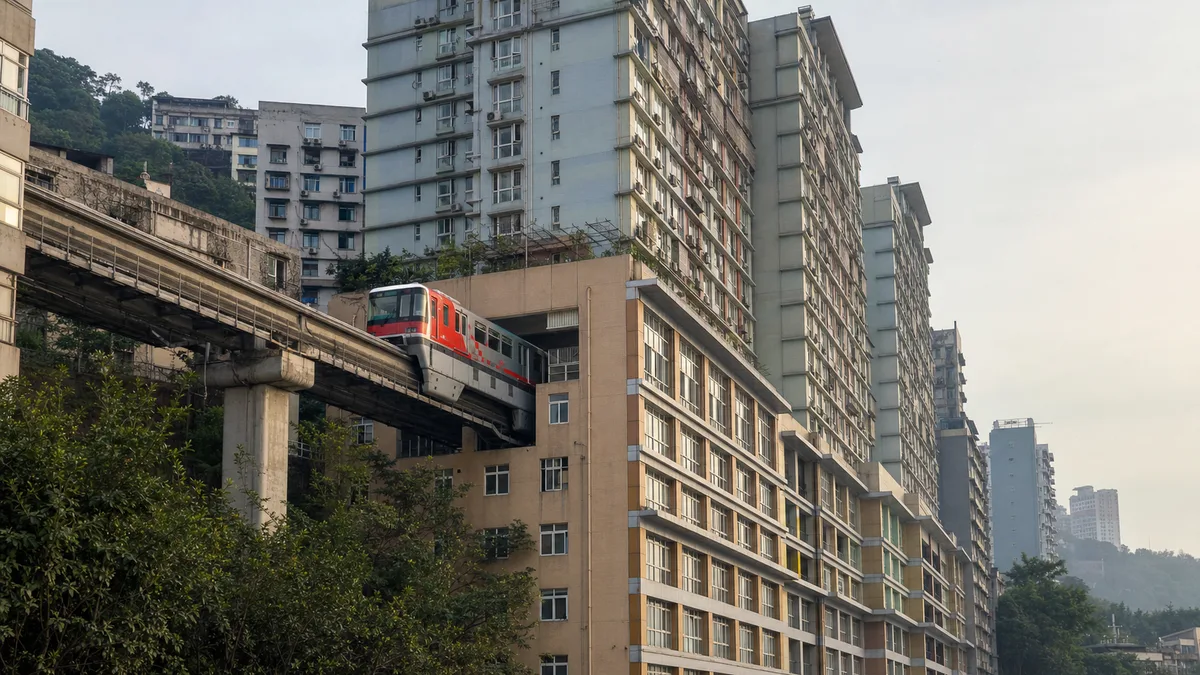
At first, wait without looking at your screen. Listen for the soft mechanical rise, then watch a full-sized train enter the middle of a residential tower and disappear. A few seconds later it emerges from the other side as if this were the most ordinary commute in the world.
This is Liziba (roughly lee-dzuh-BAH), one of Chongqing’s defining urban scenes. Line 2 passes through a station occupying the middle floors of a 19-storey building. The image looks improvised; the engineering was not.
The key fact: nobody drilled a railway through an existing apartment block. The station and building were coordinated from the beginning, with the rail-supporting structure separated from the residential structure.
What is actually inside the building?
The train enters Liziba Station, commonly described as occupying the sixth to eighth floors of the tower. Passengers are not travelling through someone’s living room. They arrive at a proper station zone with platforms, circulation space and equipment, while residential floors continue above and below.
The supporting systems are designed as independent structures so that railway loads and vibration are not simply transferred into the homes. The train is also a rubber-tyred straddle-beam monorail, not a conventional steel-wheel metro. Rubber tyres help it grip curves and gradients while reducing the sharp wheel-on-rail sound associated with ordinary trains.
Online retellings often attach a precise gap or a household-appliance noise comparison to the building. Treat those as popular shorthand unless you are reading an engineering source. The reliable point is more important: structural separation, vibration control and the monorail system allow a station and housing to share one envelope.
Why Chongqing chose a monorail
The answer is visible around you. Chongqing is built where mountains meet the Yangtze and Jialing rivers. Flat corridors are scarce; streets bend, climb and stack. A rail system here must negotiate steep gradients, tight curves and dense neighbourhoods without demanding a broad strip of level land.
A straddle-beam monorail suits those constraints. The narrow guideway can weave along slopes and between buildings more flexibly than many conventional rail alignments. Liziba is the famous frame, but the more revealing experience is to ride Line 2 and feel how often the track curves with the terrain.
The train-through-building solution was therefore not a stunt added for tourism. It was a compact agreement between transport, housing and topography: if neither mountain nor city block can move, infrastructure must learn to share space.
The “8D city” in one photograph
Chongqing is nicknamed an “8D city” because ordinary ideas of ground level fail here. An entrance labelled the first floor may open to one street while a much higher floor opens directly onto another road on the hillside. Bridges cross above roads that already cross buildings; a map looks two-dimensional, but the journey is not.
Liziba compresses that logic into a single image. The train is not violating the city. It is obeying it. Where flat cities separate rail, road and residence into parallel zones, Chongqing layers them vertically.
This is also why first-time visitors should use landmarks and station exits, not only a straight-line map. Two points may appear close while a cliff, elevated road or large height difference sits between them.
Watch the whole sequence, not only the entrance
From the public viewing area, identify three parts of the scene before filming: the guideway approaching along the slope, the opening in the building and the section where the train reappears. Watch one train without the camera so you understand its timing.
Then follow the sequence:
- Approach: keep enough of the track in frame to show where the train comes from.
- Entry: hold the shot steady as the leading car reaches the building.
- Disappearance: resist the urge to pan away; the empty opening is part of the illusion.
- Exit: if your position allows, include the train emerging on the far side.
- Afterward: keep recording for a moment so the clip does not end abruptly.
Services are frequent, but intervals change with time of day. If the first attempt is shaky, wait for another train rather than stepping into the road or blocking pedestrians.
How to film the classic Liziba shot
Video explains the place better than a single still. Use a normal or moderately wide lens and stand far enough back to include the building’s full height. If you crop too tightly around the station opening, it looks like any covered platform; the residential floors above and below create the surprise.
For a still photograph, add scale: people at the viewing area, the slope, or several floors of windows. For the playful “catch the train in your hand” pose, set the composition before the train comes and let your subject stay still. Do not chase the alignment through a crowd.
The designated viewing space exists because visitors once stopped in unsafe places. Stay behind barriers, keep stairs and access lanes clear, and never step into traffic for a cleaner angle. A viral clip is not worth becoming part of the transport problem the site was built to solve.
Ride the scene after watching it
Once you have seen the exterior, enter Liziba Station and ride Line 2 for a few stops. From the carriage, the famous building becomes only one moment in a longer piece of city engineering. The elevated track follows the hillside and opens towards the Jialing River, with towers rising at several apparent ground levels.
Riding the line also corrects the most common misunderstanding: Liziba is not a miniature tourist railway. It is part of Chongqing’s daily public-transport network. Commuters use the same platform while visitors below wait for the perfect ten-second clip.
Avoid the busiest commuting periods if your schedule is flexible, keep luggage compact and let passengers leave before boarding. The most respectful way to experience the attraction is to remember that it is working infrastructure first.
The wartime city beneath the viral city
A short walk from the station area leads towards the Liziba wartime heritage park, where surviving buildings recall the period when Chongqing served as China’s wartime capital during the Second World War. The city endured repeated aerial bombing, and shelters were cut into the same steep geology that later challenged metro engineers.
The connection should not be forced into a neat slogan, but it adds depth. Liziba’s viral image is about adapting to a difficult landscape; the nearby heritage is about a city adapting under far harsher pressure. Check current access and exhibition hours before making the park the fixed centre of your itinerary.
For a wider explanation of Chongqing’s layers, continue to Eling Park if time and weather allow. A high viewpoint over the rivers and skyline shows why the rail line could never behave as it would on a flat grid.
When to go and what changes the photograph
Soft morning or late-afternoon light usually gives the tower more depth than hard midday contrast. Rain and mist can make the scene distinctly Chongqing, but they also make paving slippery and reduce visibility. At night the city atmosphere changes, while a fast-moving train becomes harder for a phone camera to freeze.
Crowd levels matter more than any “secret” angle. Arrive with patience, frame from the public area and accept that people are part of a living station. The best Liziba image does not erase the city around the train; it explains why the train belongs there.
The building is not the trick—the city is
After one final train passes, lower the phone and look at the slope, roads and towers around the opening. The engineering achievement is not simply that a train crosses a building. It is that a dense neighbourhood, a railway and a mountain were persuaded to coexist.
The train disappears for only a few seconds. Chongqing’s real illusion is making that disappearance feel completely normal.
Adapted from the LoreLens audio guide for Liziba. Point the LoreLens app at the station and hear why Chongqing built transport in three dimensions.
Location profile
Where it is

Frequently asked questions
Does the Liziba monorail really run through an apartment building?
Yes. Chongqing Rail Transit Line 2 enters Liziba Station within the middle floors of a 19-storey residential tower. The station and building were planned together; the rail-supporting structure is separated from the residential structure rather than being cut through an existing home.
Do people actually live in the Liziba building?
Yes, residential floors remain above and below the station zone. Structural separation and a rubber-tyred straddle-beam monorail help control vibration and noise, although the experience inside private homes is not part of the public visit.
Where is the best place to see the train enter the building?
Use the purpose-built public viewing area below and opposite the station rather than stopping on the road. Signs and pedestrian routing can change, so follow the marked path from Liziba Station and keep emergency and walking routes clear.
How much time should I allow at Liziba?
Allow roughly an hour to watch several trains, film from more than one position and ride Line 2 for the river view. Add more time if you plan to visit the nearby wartime heritage area or continue uphill to Eling Park.
Sources and further reading
Background references for the history and place names in this guide. Opening hours, ticketing and access change often — always confirm with official local information before travelling.