Beijing · Haidian
Summer Palace: Read Beijing's Imperial Landscape
Follow Kunming Lake from the painted Long Corridor to Longevity Hill, and discover how an imperial retreat became a record of beauty, destruction, contested rebuilding and public memory.
5A View location, maps and nearby scenic areasStep through the East Palace Gate and resist the urge to photograph the first roof. Walk until Kunming Lake appears between trees, then compare the long horizontal waterline with Longevity Hill rising behind it. The lake seems natural and the hill inevitable. Both were shaped, edited and framed to make that impression.
That first view is the key to the Summer Palace, or Yiheyuan (yee-huh ywen). It is not simply a palace beside a lake. It is a designed landscape in which water, architecture, paths and borrowed views tell you when to pause, climb, turn and look back.
Orient yourself before exploring. The East Palace Gate and administrative courts lie to the east. Kunming Lake fills most of the southern and western ground. Longevity Hill rises along its north shore; the Long Corridor follows the water below it. If energy is limited, keep to the lake edge. If you want the commanding view, save strength for the hill.
A lake and hill that organise the whole garden
The Summer Palace covers about 2.9 square kilometres, and water occupies roughly three quarters of it. Those figures matter because the garden is read across distance. A pavilion that looks isolated from one bank may be the point that completes a view from another.
Kunming Lake, Kunming Hu (koon-ming hoo), was enlarged from earlier bodies of water. Earth removed during that work contributed to the reshaping of Longevity Hill, known in Chinese as Wanshou Shan (wahn-show shahn). The result is a landscape made from excavation and placement rather than a collection of buildings dropped onto untouched nature.
Look for three kinds of line. The lake supplies a broad horizontal plane. Causeways, bridges and corridors draw routes across it. The central group on Longevity Hill pulls the eye upward toward the Tower of Buddhist Incense. Chinese garden design often creates harmony through such relationships, although it would be too neat to assign one fixed symbolic meaning to every stone or angle.
On the Summer Palace 5A profile, the map shows the boundary. On the ground, scale is more persuasive: a destination visible across the water can still be a long walk away.
From the Garden of Clear Ripples to Yiheyuan
In 1750, the Qianlong emperor began developing the site as Qingyiyuan, the Garden of Clear Ripples. Qianlong was the sixth emperor of the Qing dynasty, the Manchu-led house that ruled China from 1644 to 1912. The project joined an existing tradition of imperial gardens northwest of Beijing, while using the lake and hill to create a particularly coherent composition.
The garden was not protected by its beauty. In 1860, during the Second Opium War, Anglo-French forces destroyed major buildings here as they looted and burned the nearby imperial garden complex now called the Old Summer Palace. The two places are often confused, but their surviving landscapes are very different.
Reconstruction in the late nineteenth century brought the renamed Yiheyuan, usually translated as the Garden of Nurtured Harmony or Summer Palace, into close association with Empress Dowager Cixi. In 1900, foreign troops damaged the garden again during the Boxer crisis. Repairs followed. Its present appearance therefore combines Qing design, multiple episodes of rebuilding, twentieth-century conservation and continuing maintenance.
In 1998, UNESCO inscribed the Summer Palace as a World Heritage Site, emphasising the achievement of Chinese landscape-garden design. World Heritage status does not freeze it at one date. Restoration decisions, visitor pressure and the life of an urban park continue to shape what you see.
Qianlong’s view was also an argument about culture
Qianlong did more than commission attractive scenery. His court collected paintings and texts, sponsored scholarship, staged imperial ritual and used architecture to express a claim to cultured rule. The Summer Palace belongs to that political world even when it feels far from government.
The lake’s expanded form and its causeways invite comparisons with the celebrated West Lake landscape at Hangzhou. That does not make this a simple copy. Imperial gardens assembled references from places, paintings and literary memory, then reworked them for a northern climate and courtly programme. A visitor who recognised the allusion also recognised the emperor’s ability to gather distant landscapes into his domain.
That achievement depended on far more people than the ruler whose reign supplied the date. Engineers managed water and earth. Masons, carpenters, tile makers, painters and gardeners converted plans into surfaces. Boat crews, attendants, guards and cleaners made the retreat operate. Their names are far less visible than the imperial inscriptions, but their labour is present in every graded bank and repainted beam.
When you see a “natural” turn in the path, ask who moved the soil, aligned the view and maintained the water. The garden becomes more impressive, not less, when design is understood as work.
Cixi, reconstruction and the naval-funds story
Empress Dowager Cixi, pronounced roughly tsuh-shee, was one of late Qing China’s most powerful political figures. She entered the court as a consort, became mother of the Tongzhi emperor and exercised authority through successive reigns. The restored Summer Palace became closely identified with her residence, ceremonies and leisure.
A familiar story says Cixi simply took “all the navy’s money” to rebuild the palace, leaving China defenceless. It is memorable because it turns national crisis into one person’s extravagance. The documented financial history is more complicated. Reconstruction drew on funds connected in various ways to naval administration, special levies, official contributions and other state channels; scholars differ over amounts, accounting categories and the military effect. Late Qing defence also suffered from divided budgets, institutional weakness, regional interests and larger strategic failures.
None of that makes the rebuilding politically neutral. At a time of intense fiscal pressure and foreign threat, directing substantial resources toward an imperial retreat was controversial and remains ethically revealing. But replacing analysis with a single slogan hides how the Qing state actually worked.
The Marble Boat at the west end of the Long Corridor is often recruited into this morality tale. Its stone base and elaborate superstructure make a vivid image, but the building alone cannot prove a budget ledger or military counterfactual. Photograph it as evidence of late Qing taste; treat claims about exactly what it “cost China” as interpretation requiring sources.
The Long Corridor is a moving picture gallery
The Long Corridor, or Changlang (chahng-lahng), runs for nearly 730 metres along the north shore of Kunming Lake. From outside, it is a coloured ribbon between water and hill. From inside, its repeating columns turn walking into a sequence of framed scenes.
Painted beams contain landscapes, flowers, birds, figures and episodes drawn from literature and history. Restoration and repainting have occurred over time, so avoid treating every surface as an untouched eighteenth-century original. It is also safer to admire the abundance than to repeat an unverified exact count of paintings.
Try walking one section slowly. Look up at a panel, then out between the columns. The painted landscape and the actual lake alternate like pages. This is practical architecture too: the roof provides shade and some shelter, while the corridor connects residence, religious buildings, docks and viewpoints.
Crowds can turn it into a narrow channel. Step aside before stopping, keep doorways clear and avoid touching painted surfaces. The best detail photograph often comes from a slight diagonal, where red columns create depth and a slice of lake keeps the corridor connected to its setting.
Climbing from court life to the Buddhist axis
The buildings on Longevity Hill are not merely a scenic skyline. The central ascent passes through the Hall of Dispelling Clouds toward the Tower of Buddhist Incense, a many-sided structure that dominates the lake view. The route joins imperial celebration, religious patronage and theatrical display.
Buddhist names and images deserve more than decorative treatment. Qing emperors supported multiple religious traditions for personal, dynastic and diplomatic reasons. Specific buildings changed through destruction and reconstruction, so the complex should not be read as a perfectly preserved ritual programme from 1750. It remains, however, a powerful example of sacred vocabulary integrated into an imperial garden.
The climb involves long stairs and can be strenuous in heat, rain or winter conditions. Interior access, additional tickets and one-way controls may change. If the upper route is open and suitable for you, pause on the way rather than treating the summit as the only reward: columns repeatedly reveal new portions of lake and city.
If stairs are a poor choice, remain near the shore and look upward. The full vertical composition is often clearer from below, and the garden’s meaning does not depend on conquering its highest point.
Choose a route that matches your energy
A useful first visit begins at the East Palace Gate, crosses the court area, reaches the north shore, follows a substantial section of the Long Corridor and decides at Longevity Hill whether to climb. Continue west toward the Marble Boat if time and legs allow. This route introduces government, residence, garden and religious axis in an intelligible order.
For a gentler route, prioritise the lakefront and corridor. Surfaces are still sometimes uneven, thresholds remain, and the site is very large, but avoiding the hill removes the greatest concentration of stairs. Ask staff about current step-free entrances, accessible toilets and assistance; do not assume every historic interior has barrier-free access.
For a landscape-focused day, include a causeway or the southern and western lake edge. These quieter stretches reveal how islands, bridges and distant buildings hold the composition together. They also add considerable distance, so consult the official map before committing.
Boats can shorten or transform a route, but they are not guaranteed transport. Services depend on season, weather, water, maintenance and queues. Confirm the day’s landings before buying a ticket, and keep enough time and energy to finish by land.
Photograph relationships, not just landmarks
For the classic lake-and-hill view, include open water beneath the Tower of Buddhist Incense. A passing boat, willow or balustrade provides scale. Morning and late-day light can be attractive, but haze, cloud and operating hours are never guaranteed; a grey sky can still reveal the garden’s layered silhouettes.
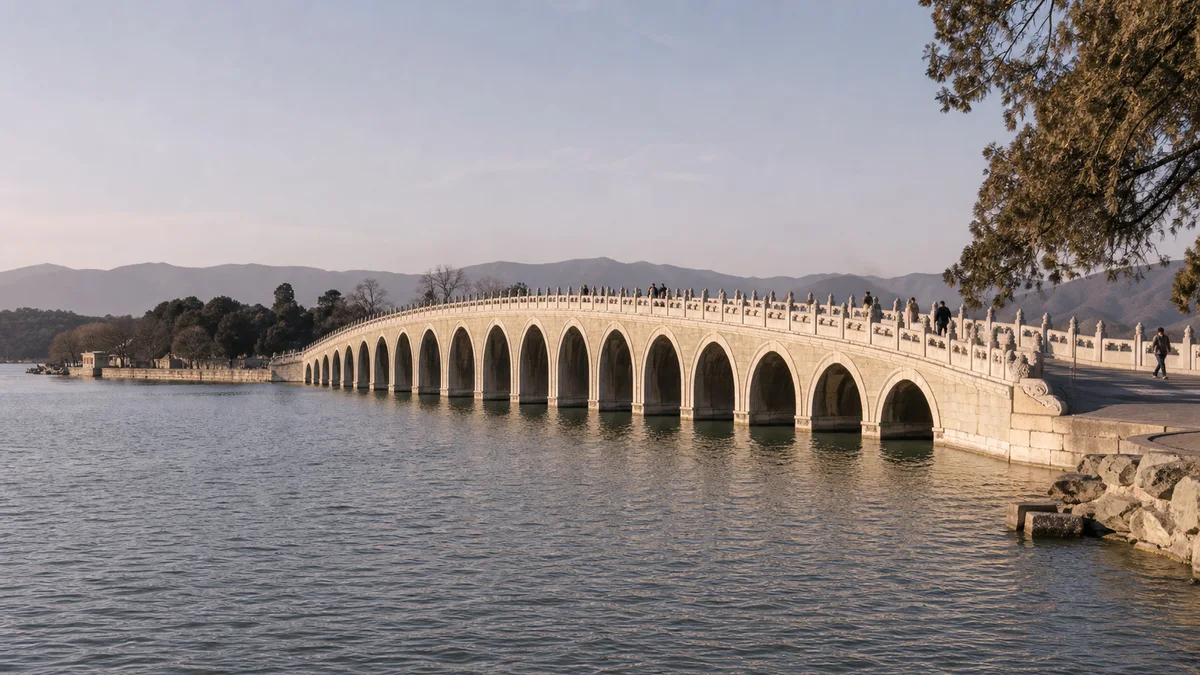
The Seventeen-Arch Bridge is strongest when photographed as a connection between shore and island, not as an isolated object. Seasonal sunlight effects attract attention online, but weather, access and crowds determine what is actually visible. Do not block the bridge while waiting for a precise alignment.
Inside covered spaces, check current photography notices and avoid flash where prohibited. Tripods may obstruct narrow routes. Drones should not be assumed legal or welcome. Historic masonry becomes slippery in rain and snow; stay behind barriers, especially near water and steep steps.
Be considerate of residents who use the grounds for walking and of visitors engaged in quiet appreciation or religious gestures. A palace garden may be a World Heritage monument, but it is also shared public space.
Return to the water with a changed eye
By the time you come back to Kunming Lake, its calm surface should look less innocent. It reflects a celebrated work of garden design, but also war damage, repeated repair, court politics, disputed spending and generations of largely unnamed labour.
That complexity distinguishes the Summer Palace from the more ruined Old Summer Palace and from the ceremonial density of the Forbidden City. It also helps explain the quieter transition from imperial court to aristocratic residence at Prince Gong’s Mansion.
Stand where hill and tower reappear in the lake. The composition still performs exactly as a garden should: it slows your steps and arranges your attention. Yet what now fills the frame is not one emperor’s timeless harmony. It is a landscape repeatedly broken, argued over, rebuilt and opened to people who were never meant to enter it.
LoreLens App can identify the buildings around Kunming Lake and turn their names into connected stories as you walk.
Location profile
Where it is

Frequently asked questions
How much time should I allow for the Summer Palace?
Allow at least half a day for the East Palace Gate, Long Corridor and a substantial stretch of Kunming Lake. A longer visit makes room for Longevity Hill or the west side without rushing. The grounds cover about 2.9 square kilometres, so choose priorities rather than trying to walk every shore and garden.
Are the Summer Palace and Old Summer Palace the same place?
No. The Summer Palace, or Yiheyuan, is the largely restored lake-and-hill garden described here. The Old Summer Palace, or Yuanmingyuan, is a separate and much more ruinous garden complex several kilometres away. They need separate tickets and are best treated as different visits.
Can I take a boat on Kunming Lake or climb the Tower of Buddhist Incense?
Boats commonly operate in suitable seasons, and the hillside buildings can often be visited, but weather, ice, wind, maintenance, crowd control and ticketing can change access. Check the official notice on the day and keep a shore-based route as a complete alternative.
What should international visitors confirm before going?
Confirm current opening times, reservation and identification requirements through the official Summer Palace channels. Carry the original passport used for any booking. Entrances, separately ticketed interiors and photography rules can change, so do not rely on an old itinerary or screenshot.
Sources and further reading
Background references for the history and place names in this guide. Opening hours, ticketing and access change often — always confirm with official local information before travelling.