Beijing · Haidian
Old Summer Palace: Read the Ruins Beyond the Marble
Begin with the map, not the famous stone façades: Yuanmingyuan was a vast three-garden world of lakes, timber halls and imperial government before looting, fire and decades of further loss.
5A View location, maps and nearby scenic areasBefore following signs to the famous broken columns, stop at the first full plan of the park. Put one finger on the Western Mansions, then look at how much land surrounds them. That small gesture corrects the most persistent misunderstanding about the Old Summer Palace.
The site known in Chinese as Yuanmingyuan (ywen-ming-ywen) was not a European palace made of marble. It was a vast system of three imperial gardens, built mainly in timber around lakes, islands, courtyards and artificial hills. The stone ruins are real and important, but they are a surviving fragment—not the shape of the whole.
Choose your evidence before your route. For garden scale and court life, begin with the Jiuzhou area. For water and long views, choose Fuhai. For the most visible remains of looting and destruction, go to the Western Mansions. Connecting all three requires substantial walking and should not be treated as a quick loop.
One name, three gardens
“Old Summer Palace” is a convenient English label, but the historic complex comprised Yuanmingyuan, Changchunyuan and Qichunyuan. Qichunyuan was also known in its later history as Wanchunyuan. Together they occupied roughly 3.5 square kilometres, an area larger than the nearby Summer Palace.
Yuanmingyuan formed the original core. Its waterways, residential compounds and celebrated scenes developed over generations. Changchun Garden extended the complex eastward and included the Western Mansions in its northeast corner. Qichun Garden lay mainly to the south, combining areas that had their own development histories before they were absorbed into the imperial whole.
The boundaries are hard to feel once lawns, roads and modern planting replace walls and timber rooms. That is why the map matters. Check which garden you are standing in, find the nearest body of water, and notice how far the Western Mansions sit from the rest. On the Old Summer Palace 5A profile, the locator is only the beginning; inside the gates, a detailed site plan is essential.
A garden where emperors also governed
Construction and expansion continued from the early eighteenth century into the early nineteenth. The Kangxi emperor gave an early garden here to his son Yinzhen, who later became the Yongzheng emperor. Yongzheng expanded the estate after taking the throne; Qianlong and later Qing emperors continued to add landscapes and buildings.
Calling Yuanmingyuan a “summer residence” can make it sound like a long holiday. In reality, Qing emperors lived here for extended periods, received officials, read memorials and conducted government. The Forbidden City remained the dynasty’s central ceremonial palace, but power did not stay inside its red walls every day of the year.
The garden joined political work to a carefully ordered environment. Administrative courts stood near intimate residences; lakeside halls offered retreat without removing the emperor from decision-making. A painted view might suggest cultivated ease, while beyond the screen secretaries, guards, eunuchs, servants and messengers kept the state moving.
This dual role helps explain the shock of 1860. The target was not merely an ornamental park or one ruler’s private collection. It was an active imperial residence, an archive of courtly objects and a place where the Qing state represented itself.
Landscapes, collections and the people who made them
Yuanmingyuan gathered many kinds of place into one compound. Some areas referred to famous southern scenery; others evoked fields, villages, temples or scholarly retreats. Such scenes did not simply reproduce China in miniature. They recombined remembered landscapes and artistic conventions for an imperial audience.
The palaces also held paintings, books, clocks, ceramics, textiles, religious objects and diplomatic gifts. Surviving inventories, eyewitness accounts and dispersed objects indicate extraordinary richness, but no single modern list can reconstruct everything once present. Claims about an exact total or value should be treated cautiously.
The emperor supplied patronage, not every pair of hands. Designers, hydraulic specialists, gardeners, carpenters, painters, stoneworkers and labourers shaped the site. Court women, princes, officials, eunuchs and servants inhabited it. Boat crews maintained movement across water; storekeepers and guards managed objects and provisions.
Remembering these people changes the ruins. A low foundation is not only an outline of imperial taste. It marks rooms that had to be heated, repaired, cleaned, guarded and crossed in all weather. Loss affected cultural collections and political symbolism, but it also erased much of the physical record of everyday work.
What happened in 1860
In 1860, during the Second Opium War, Anglo-French forces entered Beijing after a military campaign driven by demands for expanded diplomatic and commercial access. Troops looted Yuanmingyuan, removing or destroying objects on a large scale. Major buildings were then burned. The violence occurred within an imperial war, not an accidental urban fire.
British high commissioner Lord Elgin ordered the burning after members of an Anglo-French delegation and their escort had been imprisoned and some tortured and killed by Qing authorities. That sequence explains the stated act of retaliation; it does not make the collective destruction of a vast cultural site inevitable or ethically neutral. French and British participation in looting, and the precise sequence of fires across the complex, are documented through accounts that do not always describe every location identically.
Timber construction made the halls highly vulnerable. Roofs, columns, partitions, paintings and furnishings could burn or be carried away, while water systems, platforms and some masonry remained. The event devastated the complex, but “it vanished in one night” is an image, not a complete archaeological description.
When looking at a foundation, separate three propositions: the complex was extensively looted in 1860; major architecture was deliberately burned; the exact condition of every feature visible today was also shaped by what happened afterward.
The destruction did not stop when the fires went out
Some buildings and landscape features survived 1860. Over later decades, however, the weakened estate passed through further political turmoil, military occupation and inadequate protection. Materials were removed and reused. Stone, timber and decorative elements entered other construction, markets and private hands.
The Boxer crisis of 1900 and the foreign occupation of Beijing brought another period of damage and disorder. In the following republican and warlord eras, organised and opportunistic dismantling continued in different forms. Residents living through poverty and upheaval also used land and accessible material; their actions should not be flattened into the same category as an invading army’s state-backed destruction.
Waterways silted, buildings collapsed, farmland and settlements altered parts of the former garden, and decades of neglect changed the archaeological record. This longer history explains why the site today is not simply a burnt shell left untouched since 1860.
Modern conservation has had to choose what to excavate, stabilise, landscape or interpret. Full reconstruction may produce an attractive image while erasing evidence and implying certainty where records are incomplete. Leaving ruins visible can preserve testimony, but ruins also need maintenance and explanation. The park you see is already the result of such choices.
The Western Mansions are the exception, not the model
The Western Mansions, or Xiyang Lou (shee-yahng loh), were developed mainly in the mid-eighteenth century in a small part of Changchun Garden. European Jesuits at the Qing court, including Giuseppe Castiglione and Michel Benoist, participated in design, while Chinese artisans and labourers translated plans into local materials and construction.
Baroque-inspired façades, formal gardens, fountains and waterworks made the ensemble unusual. It was nevertheless a courtly hybrid created in Beijing, not a European transplant built without Chinese knowledge. Its visual vocabulary sat within a much larger garden dominated by Chinese timber architecture and landscape design.
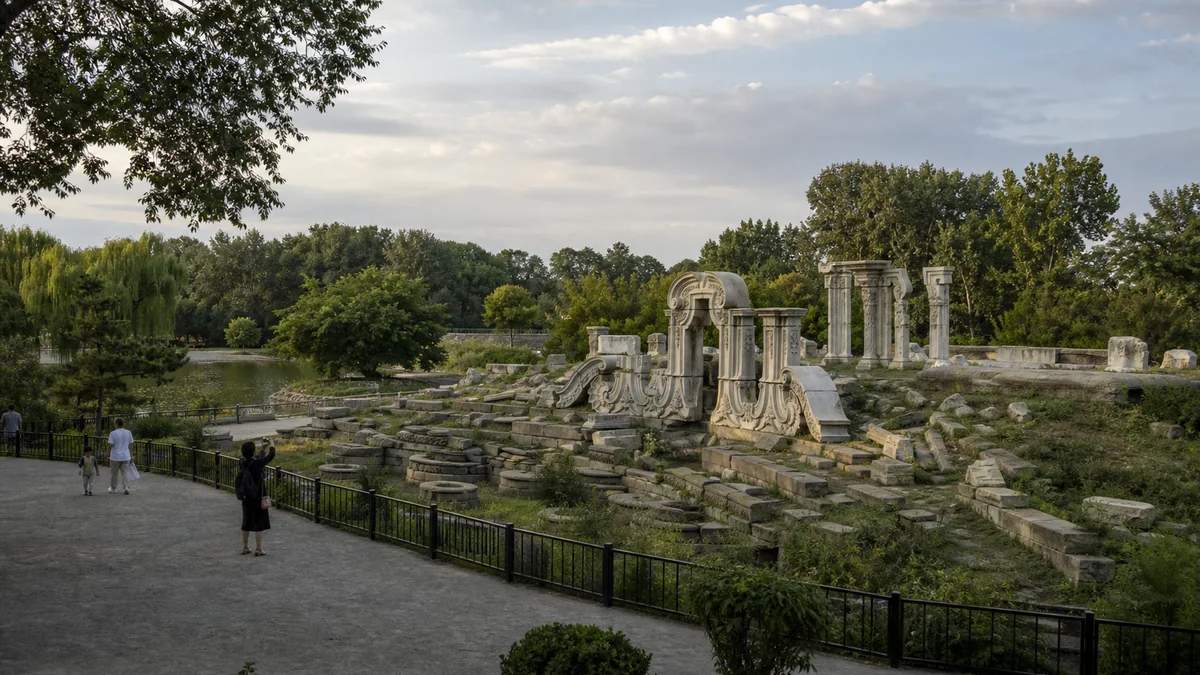
Stone components survived more visibly than the surrounding wooden halls. Photographs of the Dashuifa fountain remains and Haiyantang therefore became shorthand for all Yuanmingyuan. The image is powerful precisely because broken masonry resembles the familiar visual language of classical ruins.
Keep the proportions in mind: the Western Mansions occupy only a small corner of one of three gardens. If they become your only stop, you will understand the history of destruction better than the world that was destroyed.
Dispersed objects and the politics of memory
Objects taken from Yuanmingyuan travelled through soldiers, dealers, auctions, collections and museums. Some can be linked to the 1860 looting with strong documentation; other provenances are incomplete or involve later removals. It is responsible to distinguish a verified route from an assumed one.
Bronze animal heads associated with the Haiyantang fountain have become especially prominent in debates about return. Their fame has drawn attention to cultural loss, private collecting and restitution. It can also narrow an immense collection to a small group of marketable objects. Books, paintings, textiles, ceramics, architectural pieces and ordinary records deserve attention even when they do not command auction headlines.
In China, Yuanmingyuan became a major site of national memory: evidence of imperial violence and Qing weakness, a warning about cultural vulnerability, and a focus for demands concerning displaced heritage. Those meanings are understandable and historically grounded. The site need not, however, be reduced to hatred of present-day people or to a single patriotic slogan.
Look closely at labels in exhibitions. Good interpretation should tell you what an object is, what is known about its removal and where uncertainty remains. Memory becomes stronger when it can survive precise questions.
Pick one route, then let the map expand
For a first historical route, begin by orienting yourself within the three gardens and focus on the Jiuzhou area. Foundations and restored landscape cues help outline the imperial core. It is a route for reading absence: platform edges, changes in ground level and the relation between rooms and water matter more than a single photogenic ruin.
For a water-and-scale route, choose Fuhai, the large lake. Walking part of its shore reveals why boats, islands and causeways were essential to movement through the garden. Current water levels, path closures and seasonal conditions can change what is accessible.
For a destruction-and-collections route, prioritise the Western Mansions. Give the stone remains time, but use the map before and after so their small share of the whole stays visible. Exhibitions may provide models or recovered fragments; specific galleries and displays can change.
Park transport may operate on some routes, but stops, hours and ticketing are not guaranteed. Confirm current arrangements at the entrance. Carry the identification used for any reservation, check the latest gate and admission rules, and do not assume that every named zone is included in one ticket or open that day.
How to see and photograph an absence
At the foundations, lower your viewpoint. A line of stone bases can reveal a vanished row of columns; a step can show where interior floor became courtyard. Include a person at a respectful distance to give scale, but do not climb onto protected masonry for a dramatic pose.
At the Western Mansions, take one close image of tool marks or carved stone and one wide image showing the remains within modern vegetation. The pair says more than a tight shot designed to make the whole garden look like European ruins. At Fuhai, photograph the relationship among water, island and bank rather than searching for a vanished building in every frame.
Paths are long and surfaces around ruins can be uneven. Heat, rain, snow and winter ice change the difficulty. Visitors who need step-free access should confirm suitable gates, routes, toilets and transport with the park; not every archaeological area is equally accessible.
Treat loose stone and foundation lines as evidence, not props. Observe barriers, current photography notices and any restrictions around exhibitions. Quiet attention is appropriate here—not because the park is a tomb, but because cultural violence and loss are not a stage set.
Leave with a larger picture than the columns
Return to the map before leaving. The Western Mansions should now shrink back to their proper size, while the invisible timber halls, lakeside rooms, working courts and garden paths expand around them in your imagination.
The nearby Summer Palace shows what repeated rebuilding can make visible. The Forbidden City preserves a far denser architectural record of Qing ceremony and rule. The Beijing Olympic Green offers a modern contrast: another vast state landscape, built for global display and later adapted to public life.
Yuanmingyuan asks for a different kind of looking. Do not use the ruins to pretend the lost garden can be fully recovered, and do not let the lost garden disappear behind its most photogenic stones. Hold both scales at once: the fragment in front of you, and the much larger world it can no longer show.
LoreLens App can identify surviving structures and help place each fragment back within the three-garden plan as you walk.
Location profile
Where it is

Frequently asked questions
How much time should I allow for the Old Summer Palace?
Allow at least half a day and choose one main zone: the Jiuzhou area, Fuhai lake or the Western Mansions. The three-garden complex covers roughly 3.5 square kilometres, so trying to connect every famous point on foot can turn a historical visit into a race. A longer visit is useful if you want both the central waterways and the stone ruins.
Is the Old Summer Palace the same as the Summer Palace?
No. The Old Summer Palace, or Yuanmingyuan, is a large archaeological and memorial park made up of three former imperial gardens. The Summer Palace, or Yiheyuan, is a separate, extensively restored lake-and-hill garden several kilometres away. They have different entrances and tickets and reward different ways of looking.
Was the whole Old Summer Palace destroyed in a single fire in 1860?
Anglo-French forces looted the complex in 1860 and major buildings were burned, but not every trace disappeared in one night. Surviving structures and materials suffered further damage during later conflict, occupation, dismantling, reuse and long neglect. Today's ruins are the result of this longer sequence.
Are the Western Mansions the main part of Yuanmingyuan?
No. The European-style Western Mansions occupy a small area in the northeast of Changchun Garden. Their stone remains became the site's best-known image because they survived visibly, while the much larger Chinese timber garden architecture largely vanished. Visit them as one chapter, not as a model of the entire complex.