Beijing · Chaoyang
Beijing Olympic Green: From Games to Everyday City
Stand between the Bird's Nest and Water Cube, then follow Beijing's northern axis to see how 2008 spectacle, 2022 reuse and ordinary urban life now share one vast public landscape.
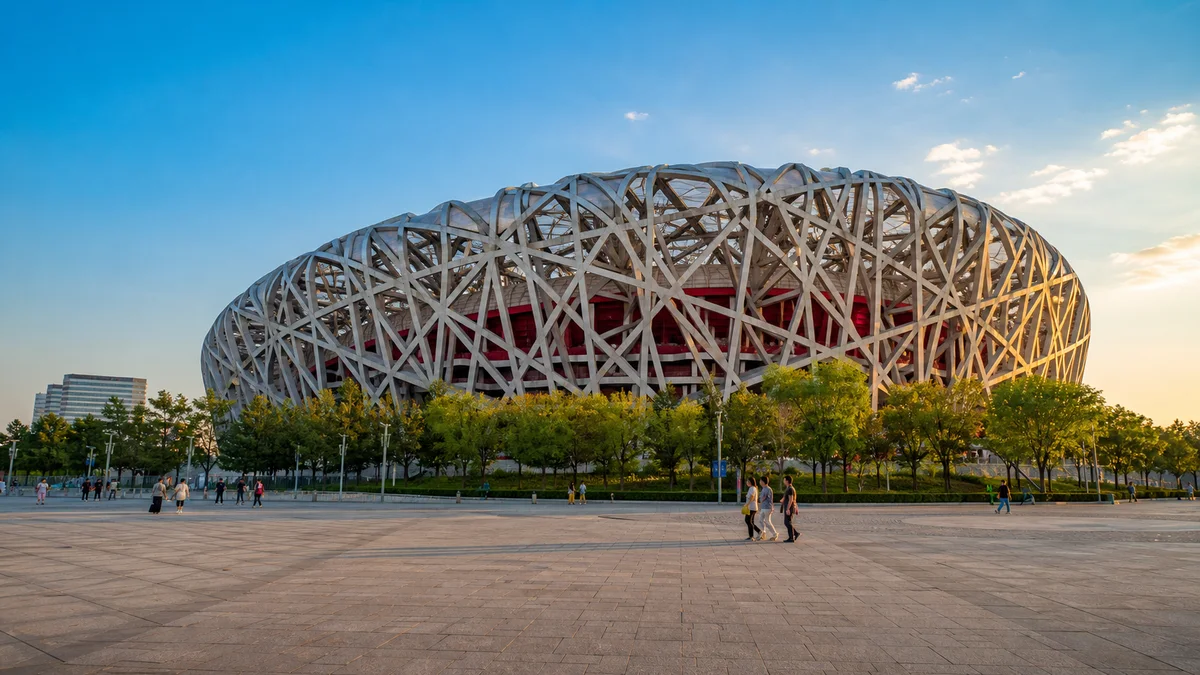
5A View location, maps and nearby scenic areasStand in the broad plaza between the National Stadium and National Aquatics Center and compare their skins. The stadium’s red bowl appears wrapped in a restless lattice of grey steel; across the open ground, blue translucent cells make the aquatic center look light enough to float. Beijing quickly gave them simpler names: the Bird’s Nest and the Water Cube.
That contrast became one of the defining images of the 2008 Beijing Summer Olympics. It is not the end of the story. Look around now and the ceremonial foreground has become a city surface: families walk, runners cross the axis, event barriers appear and disappear, and visitors continue north toward towers and parkland. Some venues returned for the 2022 Winter Olympics. Others host sport, exhibitions and performances, or are experienced mainly from outside.
Read the precinct in three distances: first compare the Bird’s Nest and Water Cube across the core plaza; next follow the central axis and notice how the venues form a district; finally decide whether to continue north to the Olympic Tower area or the forest park. The long distances are part of the design.
Olympic Green is a district, not one attraction
The Olympic Green occupies a broad north-south landscape in Beijing’s Chaoyang District. Its best-known core includes the National Stadium, National Aquatics Center and National Indoor Stadium. Public plazas, roads, transport infrastructure, the Olympic Tower area and a large forest park extend the experience far beyond a single pair of buildings.
This matters because a 5A scenic-area name can sound like one fenced park. In practice, the precinct contains different operators and different kinds of space. A plaza may be freely accessible while a venue interior requires a separate ticket. A sports event can redirect pedestrians or introduce security zones. The forest park has its own entrances and operating arrangements. The Olympic Green 5A profile gives the destination’s mapped location, but it should not be read as one universal admission boundary.
Use the central axis as orientation. The Bird’s Nest and Water Cube form the core architectural encounter. From there, landmarks to the north may look close across flat ground but require substantial walking. Decide before starting whether your priority is architecture, an interior visit, an elevated view or green space.
Why the 2008 Games changed this part of Beijing
The 2008 Games were presented as a global introduction to a rapidly changing China. Beijing needed competition venues, athlete and media facilities, transport capacity, public space and a ceremonial setting large enough to carry that message. Olympic Green became the principal stage.
Its placement along the northern continuation of Beijing’s historic central axis connected a new international event district to an older language of urban order. The comparison is suggestive rather than literal. The Forbidden City used gates and courtyards to regulate approach to an emperor; the Olympic Green used open scale, broadcast views and dispersed venues to receive mass audiences.
The opening ceremony in the National Stadium turned the architecture into a television image seen around the world. Yet a host city is made by more than a ceremony. Construction workers, engineers, performers, volunteers, transport staff, security teams and nearby residents all experienced the transformation differently.
Large-event development brought infrastructure and public landscapes that continued after 2008, but it also concentrated investment, accelerated redevelopment and temporarily placed everyday city life under exceptional schedules and controls. An honest legacy is not simply “successful” or “wasteful.” It asks which spaces remained useful, who can use them and how a district built for a few weeks performs over decades.
The Bird’s Nest is the work of a collaboration
The National Stadium is often introduced as the creation of Swiss architects Herzog & de Meuron. They were central designers, but the stadium was a collaboration with Chinese architectural partners and engineering teams. The artist Ai Weiwei served as an artistic consultant during the design process. Reducing this network to one famous name hides how a building of this scale is actually made.
From the plaza, separate two visual systems. Inside is a red seating bowl shaped for spectators and events. Around it, large steel members cross in an apparently irregular lattice. The pattern earned the “Bird’s Nest” nickname, yet the steel is not applied decoration: structure, circulation and enclosure were developed together.
Walk along the perimeter and watch openings change. From one angle the members form a dense woven surface; from another, stairs and internal volumes become visible between them. The building refuses a single postcard front. Its identity comes from walking around it.
The stadium hosted athletics and major ceremonies in 2008. In 2022 it returned for the Winter Olympic opening and closing ceremonies rather than being rebuilt as an entirely new showpiece. Today access can range from exterior viewing to sightseeing routes, exhibitions, concerts or sporting events. Event conversions, ticketing and security determine which version a visitor encounters.
The Water Cube became the Ice Cube without erasing itself
Across the plaza, the National Aquatics Center offers a deliberate material contrast. Its pale blue envelope is made from inflated ETFE cushions arranged through a geometric system inspired by the way bubbles can divide space. The cells look random, but their varied shapes emerge from a designed structural pattern.
The building was also produced by an international and Chinese design-and-engineering consortium, not a lone author. Architecture, structure, environmental systems and specialist fabrication had to work together to create the lightweight enclosure and the controlled interior required for Olympic swimming.
In 2008, the venue hosted swimming, diving and synchronized swimming events. For the 2022 Winter Games, part of the interior was converted for curling, giving rise to the name Ice Cube. A removable or adaptable competition surface allowed a summer-sport venue to support winter ice rather than being discarded after one Olympics.
That conversion is more important than the clever nickname. It demonstrates a practical form of legacy: design a way for a highly specialized building to change use. The venue has also supported public recreation and visitor experiences at different times, but exact pools, exhibitions and access zones depend on current operations. Confirm what “Water Cube visit” includes before buying.
2022 made Beijing a dual Olympic city
When Beijing hosted the 2022 Winter Olympics, it became the first city to host both the Summer and Winter Olympic Games. The title is memorable, but the more useful onsite question is how much of 2008 could be reused.
The Bird’s Nest returned for ceremonies. The Water Cube became the Ice Cube for curling. The National Indoor Stadium, another major venue in the precinct, was adapted for ice hockey. Other 2022 competitions took place in different Beijing zones and in mountain clusters outside the city, so Olympic Green should not be mistaken for the entire Winter Games geography.
Reuse did not mean that nothing new was built or that conversion had no cost. Ice-making, temporary installations, technical upgrades and changed circulation all required work. Still, reusing prominent venues avoided treating them only as monuments to a completed event.
Look for traces of both identities rather than choosing one year. The blue building can be aquatic and icy; the stadium can be a summer athletics icon and a winter ceremony stage. Beijing’s “dual Olympic city” claim becomes meaningful when buildings hold more than one institutional memory.
A spectacle was made by people, then inherited by a city
Broadcast images tend to credit a host city as if it were one person. On the ground, Olympic Green was produced by many kinds of labor. Construction crews assembled immense quantities of steel and concrete. Engineers tested structures and environmental systems. Performers rehearsed, volunteers guided visitors, cleaners reset public areas and transport workers moved crowds on schedules few ordinary days require.
Residents experienced the event at different distances. Some gained new transit, parks and services; others encountered construction, security perimeters or changes to familiar neighborhoods. Individual outcomes varied, and a short visit cannot turn them into one verdict.
The long-term test arrived after the athletes left. Could a ceremonial plaza accept ordinary walking? Could specialized venues pay for maintenance through sport, tourism, exhibitions and performances? Could the northern landscape function as urban nature rather than an event backdrop?
The answer remains mixed and active. Event calendars still create intense peaks. On quieter days, the same scale accommodates exercise, family outings and informal public life. Legacy is not a fixed label awarded in 2008 or 2022; it is the repeated work of operating expensive places without freezing them as empty symbols.
From monumental plaza to everyday movement
Watch what people do rather than only what buildings mean. Runners use the long flat routes. Families stop at open sightlines. Visitors frame photos while workers prepare the next exhibition or match. Farther north, the forest park changes the sensory register from steel, paving and controlled facades to water, vegetation and longer recreational paths.
This coexistence is the precinct’s strongest modern echo. The 2008 design sought images legible to a television audience; daily users turn those images into routes, meeting places and habits. A stadium stays urban when citizens can place it inside an ordinary week.
Not every space is equally public at every moment. Temporary barriers may protect an event setup. Bag checks can appear. A plaza route may close. Forest park gates and facilities follow their own conditions. Read fences as evidence of current use, not proof that the whole Olympic Green is permanently open or closed.
For another example of large infrastructure becoming a daily civic landscape, the Beijing Grand Canal offers a useful comparison: its waterside parks, museums and transport history create a very different kind of public realm in the eastern city.
Choose a compact loop or a long northward route
For a compact architecture visit, begin on the southern side of the core, compare the Bird’s Nest and Water Cube exteriors, cross the central space and include the National Indoor Stadium if current circulation permits. This is the best choice when you have limited time or a ticketed interior to anchor the day.
For an architecture-and-view route, continue north along the axis toward the Olympic Tower area. A tower visit, if offered, may require separate admission, identity checks, security and suitable weather. Confirm current access rather than assuming an observation deck is included with the scenic area.
For an urban-landscape route, keep going into the Olympic Forest Park or start the green portion separately. The precinct is long enough that combining detailed venue interiors with a substantial park walk can consume most of a day. A map that looks simple can conceal tiring paved distance.
Public transport is commonly the most practical way to reach the area, but station entrances, event controls and last-service times can change. On major event days, the nearest route may not be the easiest. Check live transport information and the exact gate named on your venue ticket.
Enter, photograph and move through the precinct responsibly
An exterior walk and an interior visit are different products. Venue sightseeing can close for rehearsals, matches, concerts, maintenance or private events. Security may limit bags, food, tripods or professional equipment, and identity documents may be checked. International visitors should carry the passport linked to any real-name ticket and verify current instructions with the venue.
For photographs, use the open ground between the Bird’s Nest and Water Cube to build contrast into one frame. A moderate telephoto lens compresses steel and blue cells; a wide lens emphasizes the human scale of the plaza. Close to the stadium, let diagonal steel members lead through the image. At the aquatic center, look for reflections after rain without stepping into controlled water features.
Architectural lighting can transform both buildings after dark, but switching times, brightness and event displays are operational decisions. Fountains and projections may be seasonal or event-specific. Plan a night view only after checking current notices, and keep a worthwhile daytime route as the base plan.
The main plazas are broad, but broad does not mean effortless. Distances are long, summer surfaces can be hot, winter wind is exposed and event detours can add walking. Visitors with limited mobility should confirm step-free station exits, venue entrances, lift availability and wheelchair services for the exact destination—not simply for “Olympic Green.”
The real legacy appears after the broadcast ends
Return to the first comparison. The Bird’s Nest still looks heavy, angular and open; the Water Cube still looks light, cellular and sealed. In 2008 their difference made a global image. In 2022 their ability to change role made another argument: a venue can carry new functions without losing its recognizable form.
Now add what television aerials often removed—the worker closing a barrier, the child cycling across a plaza, the runner heading north, the concert audience waiting for security and the trees maturing beyond the stadiums. These ordinary figures do not diminish Olympic architecture. They reveal whether it belongs to a city.
Beijing’s Olympic Green is most interesting neither as a preserved 2008 stage nor as proof that every mega-event solves its own legacy. It is an ongoing negotiation between spectacle, maintenance, controlled access and public use. Walk far enough north and the two famous buildings shrink behind you. That change of scale is the place’s most honest conclusion.
The LoreLens app can identify the Bird’s Nest, Water Cube and other venues on site, then connect their structures to the people and events that reshaped them.
Location profile
Where it is

Frequently asked questions
Is Beijing Olympic Green the same place as the Bird's Nest?
No. The Bird's Nest is the National Stadium within a much larger Olympic precinct. The Olympic Green also includes the National Aquatics Center, National Indoor Stadium, public plazas, the Olympic Tower area and the forest park to the north. These spaces do not all share one ticket or one operating schedule.
Can visitors go inside the Bird's Nest and Water Cube?
Both venues may offer sightseeing entry, exhibitions, sports sessions or ticketed events, but access changes with event schedules, maintenance and security. Check each venue's official notice for the date of your visit; an open plaza does not guarantee that an interior tour is available.
How much time should I allow for the Olympic Green?
A focused exterior walk around the Bird's Nest, Water Cube and central plaza can fill several hours. Adding an interior, the Olympic Tower area or the forest park can turn it into a half- or full-day outing. Distances are substantial, so choose a zone rather than assuming every landmark fits into one short walk.
Are the Olympic Green lights and fountains on every night?
Architectural lighting and fountain programs may operate on selected evenings, seasons or event schedules, but timing, brightness and access can change. Weather, maintenance, energy policy and security can all affect them. Treat illuminated views as a possibility and confirm current local notices.