Beijing · Dongcheng
Temple of Heaven: Reading Beijing's Architecture of the Sky
Walk from a white-marble altar to the blue-roofed Hall of Prayer for Good Harvests and discover how emperors, craftsmen and today's park-goers have each given meaning to Beijing's great ritual landscape.
5A View location, maps and nearby scenic areasStand on the centre stone of the Circular Mound Altar and turn slowly. There is no roof above you, no idol in front of you and almost nothing to interrupt the sky. The emptiness is the point.
This is the Temple of Heaven, or Tiāntán (roughly “tyen-tahn”), but “temple” can be misleading. The complex was built for emperors of the Ming and Qing dynasties to address Heaven through carefully ordered state rituals. Architecture directed the emperor’s movement, controlled who could come close and made an invisible relationship visible through stone, timber, colour, music and open air.
Read the axis from south to north: begin at the Circular Mound, pass the Imperial Vault of Heaven, follow the raised Danbi Bridge and finish beneath the blue roofs of the Hall of Prayer for Good Harvests. You are moving from an altar open to the cosmos towards an enclosed wooden image of it.
First understand the park, then the monuments
The heritage site and its surrounding park cover roughly 2.7 square kilometres. Two sets of walls enclose a long north-south landscape containing far more than the three buildings that dominate photographs. Groves of old cypress, gates, service compounds, animal-preparation areas and halls for music once supported the ceremonies.
The outer plan is not a perfect diagram, but its northern edge is rounded while the south is more angular. Visitors often connect this with tiān yuán dì fāng—“Heaven round, Earth square.” This belongs to a changing body of cosmological thought, not a modern scientific claim, and not every curve has one uncontested meaning. Here, round altars, square precincts and sky-blue tile clearly form a ritual vocabulary.
The most useful distinction is between the two main ceremonial zones. In the south, the Circular Mound Altar hosted the winter-solstice sacrifice to Heaven. In the north, the Hall of Prayer for Good Harvests was associated with prayers for the year’s crops. The Imperial Vault of Heaven between them stored sacred tablets used in the southern ceremonies.
For a map and coordinates, open the Temple of Heaven 5A scenic-area profile. The park, paid heritage compounds and individual halls may have different current access rules.
A landscape measured in circles, squares and nines
At the Circular Mound, count before you photograph. The altar rises in three round terraces of pale stone. Around the central stone, paving slabs and balustrades are arranged in multiples of nine, a number strongly associated with imperial authority and the highest single digit in traditional numerology. The pattern is clearest under your feet rather than from a distant postcard view.
The symbolism was cumulative, not decorative trivia. The emperor, offerings, burners, musicians and officials occupied assigned positions beneath the open sky. Widening rings placed the central human body inside a larger measured order.
North of the altar, the round Imperial Vault of Heaven echoes the larger prayer hall. The contrast matters: the great southern sacrifice happened outdoors, while the tablets connected with it were protected in this enclosed building.
Continue onto the Danbi Bridge, a broad raised processional way nearly 360 metres long. It gently rises towards the north, so the final hall seems to approach the sky as you walk. Its English nickname “bridge” sounds odd because there is no dramatic river below. Think instead of an elevated sacred road separating the imperial procession from service routes and ordinary ground.
The blue hall is a timber cosmos
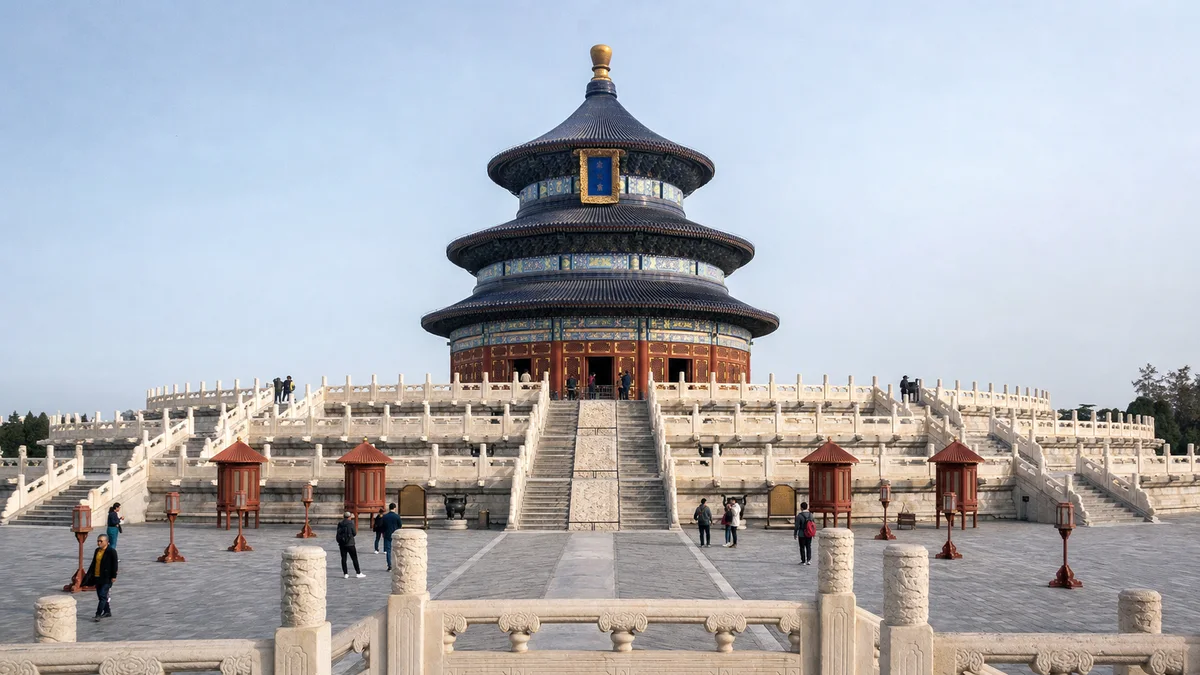
The Hall of Prayer for Good Harvests is the image most visitors recognise: three blue-tiled roofs stacked above a round red structure, set on three white-marble terraces. The building is about 38 metres high and roughly 32 metres across, large enough to dominate the courtyard but balanced enough to appear almost weightless from the southern gate.
Look past the silhouette. Timber columns and bracket sets carry the roof through fitted joinery rather than a Western-style stone load-bearing wall. The claim that it was made “without a single nail” oversimplifies a sophisticated structural frame.
Column groups are commonly read through calendars and seasons: four central columns for the seasons and an outer group for months. Explanations of further correspondences vary, and today’s decoration contains layers of rebuilding. Treat the numbers as inherited ritual interpretation, not a code with one provable answer.
Blue glazed tiles evoke Heaven; red walls and columns speak an imperial architectural language; pale marble terraces make a luminous base. Their relationship changes against Beijing’s grey winter sky and green summer trees.
Built by one dynasty, remade by several generations
Construction began under the Ming Yongle Emperor between 1406 and 1420, during the transformation of Beijing that produced the Forbidden City. Palace and altar answered different needs: government and dynastic life inside the palace; communication with Heaven in this southern precinct.
The site did not emerge complete in one campaign. Sixteenth-century reforms under the Jiajing Emperor separated sacrifices to Heaven and Earth more clearly and helped establish the southern circular altar. Qing emperors later repaired and refined the complex. Its apparent unity is a conversation across reigns.
Lightning destroyed the Hall of Prayer in 1889. Craftsmen rebuilt it in the following years using its inherited timber form. Continuity here lies not in every piece of wood surviving from 1420, but in persistent design knowledge, meaning and skill.
Imperial ceremony ended with the Qing dynasty. Yuan Shikai briefly borrowed its legitimacy for a politically charged sacrifice in 1914, but could not restore the system. The grounds became a public park in 1918; UNESCO listed them as World Heritage in 1998.
The emperor came here to limit himself
Imperial ritual displayed power and obligation. The Son of Heaven was a mediator whose conduct and ceremonies were linked, in the political imagination, with harmony and successful harvests. Flood, drought or famine could turn ritual language into a language of responsibility.
Before major ceremonies, the emperor stayed in the Hall of Abstinence. “Fasting” could mean avoiding meat, alcohol, entertainment and certain contacts, bathing and concentrating on the rite. Even the ruler was subject to rules.
At the altar, offerings, incense, music and movement made order audible and visible. Specialists kept texts and sequences; attendants prepared vessels, fires and sacrificial animals; guards controlled access. One man at the centre depended on a large institution.
This is also where the site’s hierarchy should remain visible. Most residents of Beijing never witnessed the central ceremony. Farmers across the empire supplied the material reality behind a “good harvest,” yet the state represented their wellbeing through an exclusive imperial performance. The beauty of the plan and the inequality of access are not opposing stories—they are two parts of the same system.
Listen for the workers behind the silence
Geometry can hide labour. Quarry workers cut marble; carpenters joined huge timbers; kiln workers fired blue tiles; painters renewed colour; gardeners maintained groves; musicians rehearsed; cooks and animal handlers prepared offerings. After the 1889 fire, another generation raised the prayer hall again.
Their names rarely lead the visitor narrative because imperial records foreground rulers and rites. At a bracket cluster or curved balustrade, ask how many trained hands made repetition appear effortless.
The nearby Divine Music Administration trained performers and managed ritual music. Bells, stone chimes, voices and movement marked stages in the rite. Access can vary, but its position on the map keeps the central halls from becoming isolated sculptures.
Old cypresses shaped procession, shade and enclosure. Do not touch ancient trunks, step onto protected roots or turn quiet service courts into shortcuts.
An imperial enclosure became Beijing’s morning room
Arrive early and a second Temple of Heaven appears. Along the Long Corridor, residents may practise tàijíquán (tai chi), sing, play shuttlecock, write temporary calligraphy with water or crowd around chess games. The mix changes, but its social energy matters as much as the monuments.
This is not a colourful extra pasted onto an ancient site. A landscape once organised around one sovereign’s rare passage is now remade by ordinary bodies moving, talking and resting.
Ask before taking close portraits: a chorus is not automatically a tourist performance, and a chess circle is not an invitation to push in a camera.
Compare the Beijing Olympic Green: both use monumental axes and now host recreation, though one grew from imperial cosmology and the other from a global sporting event.
Choose a route that preserves the argument
For a first visit, the south-to-north route makes the architecture easiest to understand:
- Start at the Circular Mound and walk its three terraces slowly.
- Continue to the Imperial Vault and test the courtyard’s acoustics only if conditions allow.
- Follow the Danbi Bridge north, noticing its gradual rise and side routes.
- Finish at the Hall of Prayer for Good Harvests, then explore the Long Corridor and cypress park.
Allow about three hours for this mostly level axis and its marble steps. Surrounding paths still reveal the sequence to travellers avoiding stairs, but confirm current ramps and barriers. Stone can be slick after rain, the altar has little shade, and summer heat makes distances feel longer.
The east entrance is commonly convenient but starts near the northern half. Decide whether to go south first and retrace the axis, or accept a reverse narrative that reveals the climax before its approach.
Secondary compounds reward extra time, but opening can change. Check official park information for hours, tickets, documents, reservations and last entry; an old blog may no longer describe the current procedure.
Test the acoustics without turning them into a stunt
The Echo Wall surrounding the Imperial Vault is famous because sound can travel along its smooth curved surface. Two people standing near the wall at separated points may hear each other more clearly than expected. Nearby, the so-called Three Echo Stones are associated with repeated reflections towards the vault.
Conditions matter: voices, wind, barriers, surfaces and precise positions can overwhelm the effect. Management may keep visitors away from the masonry. Do not slap the wall, shout repeatedly or monopolise a spot.
More important than “getting” perfect echoes is noticing how architecture shapes attention. Even if the experiment fails, look along the curve and imagine information moving through stone.
Photograph relationships, not just the postcard
The classic Hall of Prayer view is from the south, where terraces and stairs build towards blue roofs. A person at the edge shows scale; a moderate lens often preserves proportions better than an extreme wide angle.
Then turn sideways: frame blue tile through cypress, compare worn stone with renewed paint, or show today’s visitors on Danbi Bridge. At the Circular Mound, a low view opens paving rings towards the sky.
Morning and late light can soften red and blue, but weather and entry time are never guaranteed. Drones and professional equipment may be restricted. Do not climb balustrades, stand on protected stones or block the route: the best photograph explains how bodies, buildings and sky relate.
Leave by looking up once more
If you began at the Circular Mound, the open sky first seemed like an absence. By the time you reach the Hall of Prayer, it has become an architectural material—translated into round plans, blue tile, measured numbers, music, procession and the discipline imposed on an emperor.
The park also refuses to remain an imperial diagram. Carpenters rebuilt what lightning destroyed; gardeners and conservators keep it standing; morning singers turn ceremonial groves into a neighbourhood room.
Step away from the central staircase and look at the roof between the trees. The Temple of Heaven does not prove that earth and sky fitted a perfect order. It shows how urgently people tried to create one—and how later generations learned to live inside its beautiful frame.
Continue the story of Beijing’s designed landscapes at the Summer Palace, where hill, lake and court life organise space in a very different way.
LoreLens App can help you recognise the altar, vault and prayer hall on site, then hear how ritual architecture turned the sky into a political landscape.
Location profile
Where it is

Frequently asked questions
What is the Temple of Heaven, and was it an ordinary temple?
It was the principal Ming and Qing imperial ritual complex for sacrifices to Heaven and prayers for good harvests. It was not an ordinary temple centred on a single devotional image: its altars, halls and processional route supported state ceremonies in which the emperor acted as the Son of Heaven.
How much time should I allow for the Temple of Heaven?
Allow about three hours for the main south-to-north ritual axis at an unhurried pace, and longer if you want to explore the Hall of Abstinence, Divine Music Administration or the everyday life of the surrounding park. Entrance arrangements and access to secondary compounds can change, so confirm the current ticket and opening rules.
Which entrance gives the clearest first visit?
Entering from the south normally gives the most legible ceremonial sequence: Circular Mound Altar, Imperial Vault of Heaven, Danbi Bridge and Hall of Prayer for Good Harvests. The east entrance can be convenient, but it places you near the northern half, so use a map to avoid missing the southern altar.
Does the Echo Wall always produce an echo?
The circular wall can carry sound along its smooth masonry, and nearby stones are associated with other acoustic effects. Results depend on crowd noise, where people stand, restoration barriers and current management. Treat it as an architectural experiment, keep your voice considerate and do not expect a guaranteed performance.