Beijing · Shichahai
Prince Gong's Mansion: Read Power Through a Qing Home
Walk from formal courtyards to a private garden and watch one Beijing mansion change meaning under Heshen, Prince Qing and Prince Gong—through favour, confiscation, diplomacy and legend.
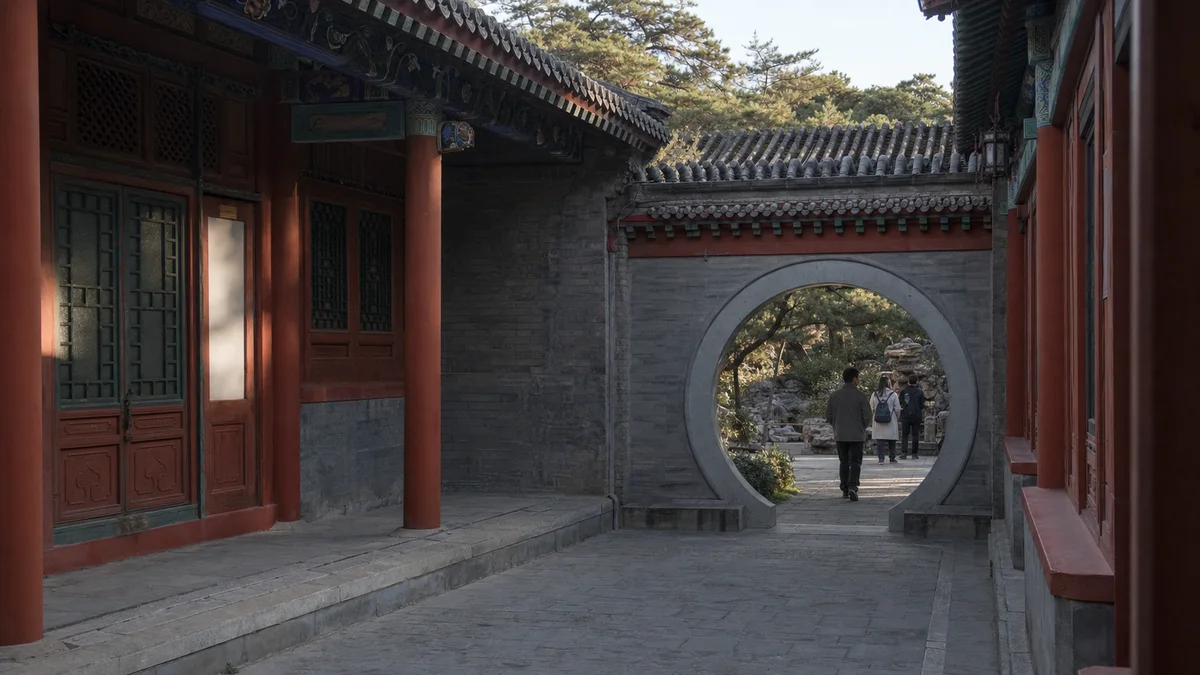
5A View location, maps and nearby scenic areasStand in the first formal courtyard and take three steps sideways. The straight view through the central doors disappears almost at once, replaced by walls, screens and a side passage. That small shift tells you how a Qing elite residence controlled movement: rank determined who used the centre, who waited, and who entered by another route.
This is Prince Gong’s Mansion, or Gong Wang Fu (gong wahng foo). The name remembers one nineteenth-century owner, but the buildings carry several lives. Read them in sequence and the site becomes more than a luxurious house: it is a diagram of court favour, confiscation, princely status, foreign crisis and modern preservation.
Follow the social order of the site. Begin in the residence to the south, keep track of the central and side courtyards, cross the long Rear-cover Building, then enter the garden to the north. Moving in that order makes the transition from public rank to private display much easier to see.
A sixty-thousand-square-metre house in two halves
The residence and garden together cover roughly 60,000 square metres in the Shichahai area. That is large for an urban mansion, yet its scale feels very different from the Forbidden City or Summer Palace. Here, power is compressed into narrow courtyards, thresholds and rooms rather than expressed across a palace city or lake.
The southern half is the fu, the formal residence. Successive courtyards are arranged along north-south routes, with the central line carrying the strongest ceremonial weight. The northern half is the garden, later known as Cuijin Yuan, where rocks, water, pavilions and planted views loosen the rigid geometry without abandoning status.
Between them stretches the Rear-cover Building, or houzhao lou (hoh-jaow loh). It forms a long architectural boundary: residence in front, garden behind. Passing through or around it feels like leaving the visible duties of rank for a more private world, although servants and storage made that privacy possible.
Use the Prince Gong’s Mansion 5A profile to locate the site. Once inside, a plan with the three main routes is more useful than a list of named halls.
Architecture made hierarchy visible
Qing architecture communicated status through layout, scale, roof treatment, gate form and access. A princely mansion had privileges unavailable to an ordinary household, but it still stood below the emperor’s palace. The distinctions were not decoration added after construction; they were a spatial version of the political order.
On the central route, gates and halls prepare formal reception. Side routes supported family life, study, service and movement that did not belong in the most ceremonial view. Screens prevent an outsider from seeing too deeply at once. Raised thresholds slow the body and mark transition, while courtyards separate groups who lived only a few metres apart.
Avoid reading every surviving room as if it preserved one fixed function from one owner’s lifetime. The mansion changed hands, underwent repair and served institutional uses in the twentieth century. Exhibitions and modern circulation also alter how visitors move. The grammar of hierarchy survives more clearly than a complete inventory of furniture.
Watch other visitors for a minute. Crowds instinctively choose the central opening, even when a side passage is faster. The architecture is still directing behaviour long after the Qing ranks that created it have disappeared.
How Heshen turned imperial favour into power
Heshen, pronounced approximately huh-shen, came from a Manchu military-banner family and entered imperial service as a young man. Accounts of his early career emphasise his appearance, linguistic ability and administrative talent, but no single personal quality explains what followed. The decisive factor was the confidence of the Qianlong emperor.
Qianlong promoted Heshen rapidly. He accumulated senior posts and influence across finance, personnel, security and court business. The emperor’s favoured daughter married Heshen’s son, linking official advancement to the imperial family itself. Access brought information; information brought the ability to shape appointments, gifts and decisions; each success increased the cost of opposing him.
This is the useful causal chain. Heshen was not powerful simply because he was clever or corrupt. He operated inside a court where one ageing emperor’s confidence could protect a favourite across overlapping offices. Officials seeking decisions had incentives to cultivate the man closest to the ruler.
The mansion made that position tangible. Its location, scale and refined detail announced proximity to the throne. Yet a residence granted or tolerated by favour was also vulnerable to a change at the top.
1799: protection ended, and the house changed hands
In 1796, Qianlong formally abdicated so that his reign would not exceed that of his grandfather Kangxi. He remained the dominant political figure as retired emperor, while his son ruled as the Jiaqing emperor. As long as Qianlong lived, Heshen’s protection largely held.
Qianlong died in 1799. Within days, Jiaqing moved against Heshen. He was arrested, charged with a long list of abuses, stripped of office and ordered to die. His property was confiscated. The speed of the fall reveals how much his power had depended on personal access rather than an independent base that could survive its patron.
Confiscation records and contemporary accusations leave little doubt that Heshen accumulated extraordinary wealth through abuse of office. What they do not support cleanly is every viral claim that his fortune equalled an exact number of years of Qing revenue. Inventories counted land, businesses, jewellery, cash, buildings and objects in inconsistent ways; later retellings amplified numbers. “History’s most corrupt official” is a memorable label, not a measurable world ranking.
Look at the courtyards as assets as well as architecture. In 1799, control over these rooms, land and stores could be reassigned because elite property remained embedded in imperial power.
One mansion, several owners
After Heshen’s downfall, the property was divided and redistributed. The residence became associated with Yonglin, Prince Qing, a younger brother of the Jiaqing emperor. This middle chapter matters: the house did not jump directly from a condemned official to the man whose title it carries today.
In 1851, the Xianfeng emperor granted the mansion to his half-brother Yixin, Prince Gong. From then on, Yixin and his descendants shaped the place for decades, and “Prince Gong’s Mansion” became its enduring name.
Each transfer changed the meaning of the same walls. Under Heshen they spoke of an official’s exceptional favour. Under Prince Qing they became a legitimate imperial prince’s residence. Under Prince Gong they belonged to a statesman confronting the Qing dynasty’s foreign and domestic crises.
The twentieth century added more layers as parts of the complex passed through educational and institutional use before major conservation and public opening. That history helped preserve some fabric and altered other areas. A heritage site is never simply the last private owner walking out and the modern visitor walking in.
Prince Gong and a state forced to negotiate
Yixin, pronounced roughly yee-sheen, was the sixth son of the Daoguang emperor and a half-brother of the Xianfeng emperor. His title, Prince Gong, did not make him sovereign, but his royal status and ability placed him near the centre of late Qing government.
When Anglo-French forces reached Beijing in 1860 and Xianfeng fled, Yixin remained to negotiate. The resulting Convention of Beijing confirmed deeply unequal concessions under military pressure. Negotiation prevented further immediate uncertainty in the capital, but it also tied Yixin’s career to the painful reality that the Qing had to deal with foreign states through new institutions.
He became a leading figure in the Zongli Yamen, the office created to manage foreign affairs, and supported parts of the Self-Strengthening effort to acquire modern military and technical capacity. He also participated in the 1861 political settlement that elevated the empress dowagers, including Cixi, as regents. Cooperation later mixed with rivalry and periods of dismissal.
This career gives the mansion its deeper modern echo. A residence designed to express stable hereditary rank belonged to a prince working inside a state whose old diplomatic assumptions no longer held.
The Rear-cover Building is more than a backdrop
Many visitors notice the Rear-cover Building because it runs unusually far across the north edge of the residence. Its repeated doors and windows create a strong photographic rhythm, but the building’s importance is spatial rather than numerical. Avoid relying on unverified room counts as the main fact.
The structure provided extensive usable space for storage and household functions while creating a firm screen between mansion and garden. Different window patterns are often interpreted as clues to the rooms behind them; some popular explanations are plausible, others have grown more precise through tourism storytelling than surviving evidence allows.
Stand at an angle rather than directly in front. One end recedes and the building begins to look like an internal wall with inhabited depth. Then turn around: the formal courtyards are behind you, while garden rocks and pavilions wait beyond.
That threshold also makes hidden labour visible. Fine objects, clothing, food and seasonal equipment required storage, record-keeping and carrying. Elite privacy depended on a large household whose circulation architecture tried to keep discreet.
The garden speaks in bats, rocks and disputed blessings
The garden relaxes the residence’s straight lines. Paths bend around artificial hills, pavilions interrupt the view and water reflects spaces that cannot be seen from the main axis. This is not freedom from hierarchy so much as a different performance of cultivation and private taste.
Look for bat motifs. In Chinese, bat is fu and blessing or good fortune is also pronounced fu, though written with a different character. The visual pun appears widely in Chinese decorative arts; it was not invented for this mansion. Bats may be stylised into borders, carving or pond shapes so that auspicious meaning surrounds daily life.
The garden’s famous Fu stele bears a large character meaning blessing. Its calligraphy is traditionally attributed to the Kangxi emperor. Stories connect it with prayers for the health of Empress Dowager Xiaozhuang, Heshen’s secret possession of it and hidden layers of longevity or many blessings within the brushwork. The documented provenance and details of these stories are not equally secure, and the promotional title “the finest fu under heaven” is not an objective historical rank.
Appreciate the calligraphy and the cultural desire to materialise blessing. Do not expect touch to guarantee health or wealth, and do not rub protected stone. Access to the grotto or viewing position can change with conservation and crowd management.
A route for crowded courtyards
On a first visit, stay with the residence-to-garden sequence. Use the central route to establish formal hierarchy, sample one side courtyard for contrast, then examine the Rear-cover Building before entering the garden. This is more coherent than rushing to the Fu stele and backtracking through dense passages.
The site is compact enough to look easy on a map, but narrow gates create bottlenecks. Reservation, identification and entry-slot rules can change; confirm current requirements through official channels and carry the passport or document used for booking. Specific halls, exhibitions, theatre events and garden paths may close or require separate arrangements.
Historic thresholds, uneven stone and steps limit barrier-free movement. Ask staff about the current accessible route and toilets rather than assuming the full historic circuit can be completed without obstacles. Benches and quieter corners are more common in the garden than along the busiest residence axis.
Check photography signs before entering rooms or exhibitions. Avoid flash where prohibited, keep tripods out of narrow passages and do not block a doorway while waiting for an empty frame. If the opera house hosts an event, admission and photography conditions may differ from normal daytime access.
Leave through a house that outlived its labels
At the end, look back from the garden toward the long rear building. The mansion’s sequence now runs in reverse: private retreat, household boundary, formal courts, city. No single owner can fill that whole view.
Heshen’s fall shows the danger of power resting on one patron. Yonglin’s tenure shows confiscated property returning to the imperial family. Prince Gong’s life brings foreign pressure, institutional reform and court rivalry into the courtyards. Later schools, offices, conservators and visitors gave the buildings uses their first residents could not have imagined.
Compare this compressed domestic hierarchy with the vast state ceremony of the Forbidden City, the designed imperial retreat of the Summer Palace, or the cosmic ritual order of the Temple of Heaven. Prince Gong’s Mansion is smaller, but that intimacy makes consequences legible.
Take the last threshold slowly. What survives is not a frozen portrait of “the corrupt official’s house” or a machine that dispenses good luck. It is a residence repeatedly reassigned by the same political system its courtyards were built to express.
LoreLens App can identify the halls, motifs and garden structures, then connect them to the changing owners who gave this mansion its many lives.
Location profile
Where it is

Frequently asked questions
How much time should I allow for Prince Gong's Mansion?
Allow two to three hours for the main residence, Rear-cover Building and garden without rushing. A longer half-day suits visitors who want exhibitions and architectural detail. Courtyards can become congested, so current entry slots and one-way controls may affect pace more than the site's roughly 60,000-square-metre size suggests.
Who was Heshen, and was he the richest corrupt official in history?
Heshen rose rapidly under the Qianlong emperor, accumulated offices and influence, and was arrested by the Jiaqing emperor in 1799 after Qianlong died. The confiscation record supports enormous illicit wealth, but popular claims that it equalled a precise number of years of state revenue use inconsistent inventories and later retellings. The causal story is firmer than the dramatic multiplier.
Why is it called Prince Gong's Mansion if Heshen built it?
The late-eighteenth-century residence is closely associated with Heshen, but it changed hands after his downfall. It became a residence of Yonglin, Prince Qing, and in 1851 was granted to Yixin, Prince Gong. Yixin's family occupied it for decades, and his title supplied the name used today.
Does touching the Fu stele bring good luck?
The stele's calligraphy is traditionally attributed to the Kangxi emperor, and its fu character has inspired many stories about blessing and longevity. Claims that touching it guarantees health, wealth or luck are tourism folklore, not verifiable effects. Follow current barriers and appreciate the inscription without rubbing or touching protected stone.