Jiangsu · Suzhou
Zhouzhuang: The First Water Town, and the Painting That Wasn't
An oil painting of two bridges made this the most famous water town in China. The reporter who filed that story in 1985 later found the bridge on the famous first-day cover belonged to a different town, and sat on the correction for twenty-four years.
5A View location, maps and nearby scenic areasEvery account of Zhouzhuang starts with a painting, and the painting is a better story than the one usually told.
The town sits in Kunshan, at the point where Kunshan, Wujiang and Shanghai meet, roughly 30 kilometres south-east of central Suzhou. The wider township covers about 38.96 square kilometres; the ticketed old town is about half a square kilometre of it. Water surrounds it on four sides, which is the whole reason it survived: for most of its history the only way in was by boat.
That isolation ended in the 1980s, and what ended it was an image.
A pair of bridges shaped like a key
Start with the object, because everything else attaches to it.
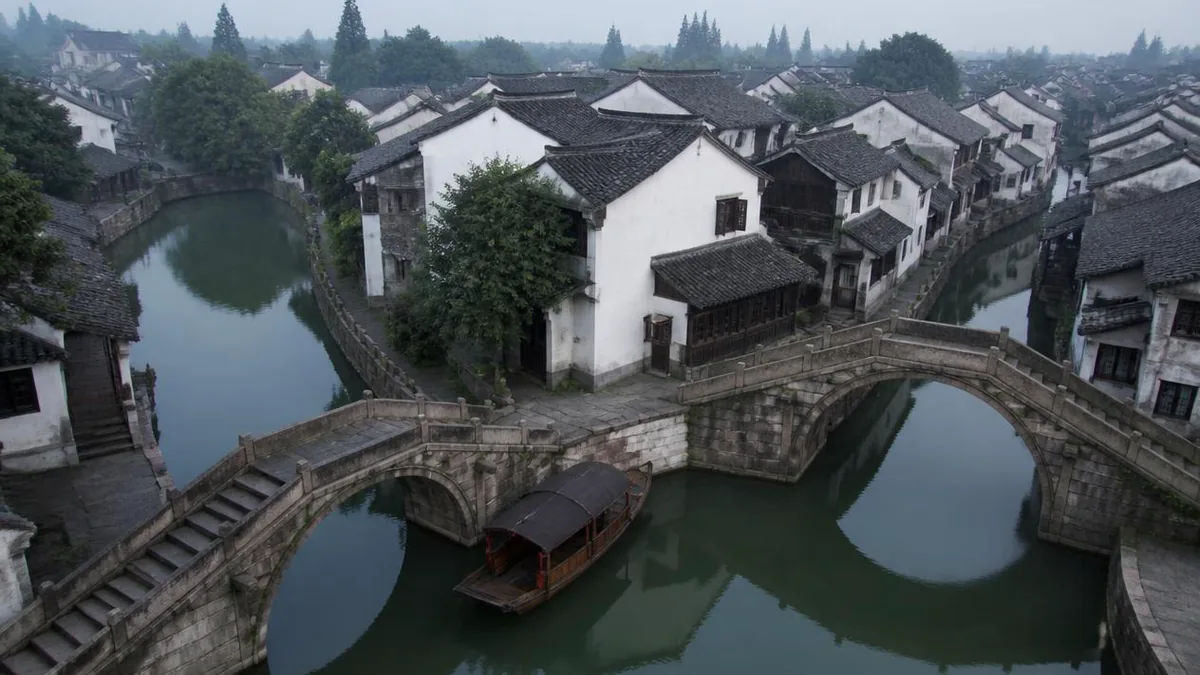
The Double Bridges are two separate bridges built in the Wanli era of the Ming, between 1573 and 1620. Shide Bridge runs east-west and is a stone arch. Yongan Bridge runs north-south and is a stone beam bridge with a square opening. They cross two channels that meet at a right angle, and they join at one end, so the pair in plan looks like an old Chinese key. Locals call it the key bridge.
The visual trick is the reflection: from the right position the arch and its image in the water close into a full circle. That is the composition that ended up on a canvas, and it is why the small hump of Shide Bridge is now the most photographed square metre in the Yangtze delta.
The painting, and a correction that waited twenty-four years
The person usually credited with finding Zhouzhuang is not the famous one. In 1978 the Suzhou painter Yang Mingyi came here to work and produced Festival in the Water Town; he is described in Chinese accounts as the first person to bring Zhouzhuang out. Wu Guanzhong and Chen Yifei followed.
Chen Yifei, born 1946 and died 2005, was by then studying in New York. In the spring of 1983 he travelled here by water, because the road from Kunshan to Jinxi and Zhouzhuang had not been built, accompanied by a local cultural-relics officer who borrowed a small steam launch for the trip. He did not sketch. He photographed, filled a shoulder bag with exposed film, and painted afterwards in the studio.
The result was Memory of My Hometown, showing the Double Bridges. Armand Hammer, chairman of Occidental Petroleum, whose New York gallery had Chen Yifei under contract for annual October shows from 1983 to 1985, bought it and presented it to Deng Xiaoping. A press photograph shows the two men in conversation with the framed painting beside them.
Two things in the standard telling do not survive checking. The first is chronology and provenance: the gift is dated to the autumn of 1984 in the Kunshan account and to 1985 elsewhere, and while the painting is often listed among the 38 works of Chen Yifei’s second Hammer show on 29 October 1984, a contemporary 1985 report placed it among the 43 works of the first show, painted from an earlier trip. Both are in print.
The second is bigger. What made the image global was a first-day cover, not a postage stamp: on 14 May 1985 Wenhui Bao reported that an adapted version of the painting had been printed on a cover issued by the World Federation of United Nations Associations, on public sale from 10 May 1985 in New York and Vienna. In November 1990 Chen Yifei brought one of these covers back to Zhouzhuang and gave it to the town head at Shen Ting, inscribing it “I love Zhouzhuang.”
The journalist who had filed the original 1985 story looked at it and realised the bridge on the cover was Nantang Bridge in Jinxi, a different Kunshan water town, then still called Chenmu. He decided a correction would hurt Zhouzhuang and said nothing for twenty-four years, publishing it only in December 2009. Chen Yifei’s own line on the question was elegant and not quite an answer: he had painted a Jiangnan bridge, and you could say it looked like a particular bridge or say it did not.
Whose manor?
The name is a piece of temple estate accounting.
In the Spring and Autumn period the area is described as the fief of Yaocheng, and the settlement was called Zhenfengli. In 1086, under the Northern Song, a devout Buddhist remembered as Zhou Digong donated 200 mu of farmland to Quanfu Temple as monastic property. Zhou’s manor — Zhouzhuang — is the donor’s name attached to the estate, and it stuck. The name Zhouzhuang was only formalised as the town’s name in the early Kangxi reign.
The fabric follows the water rather than a grid. Streets run along the channels, houses back onto them, and stone bridges do the work that intersections do elsewhere. Counts of what survives vary with the counter: around 60 carved brick gate towers and close to a hundred old courtyards is the usual figure, with the share of dwellings keeping Ming or Qing form given as anywhere from 50 to more than 60 per cent.
What happened next was policy, not art
The painting brought attention. Conservation took a professor and a spreadsheet.
Ruan Yisan, of Tongji University in Shanghai, visited in the winter of 1985 and returned in March 1986 with 45 architecture students, at his own expense, to survey the water system, the dwellings, the bridges and the customs. Out of that came Zhouzhuang’s first plan, the Overall and Conservation Plan for the Water Town of Zhouzhuang, which extended protection from Shen Ting alone to the whole old town. Ruan is the same figure known for stopping the demolition of Pingyao’s walls, and Chinese accounts of his Zhouzhuang work use the phrase “defending Zhouzhuang with his life.”
Two smaller interventions belong here. Wu Guanzhong wrote an essay, Pull Out the Thorn in the Eye, attacking a concrete flat bridge with an iron shed built on it for the convenience of freight. And in 1991 the town’s seventh party congress adopted a sixteen-character line that has governed it since: protect the old town, develop the new district, develop tourism, prosper the economy. The new district outside the gate is not an accident; it is the other half of the policy.
Zhuang Chundi, a former town head, divides what followed into three decades: 1990-2000, restoration, when Zhang Ting, Milou and a number of demolished stone bridges were put back; 2000-2010, tourism plus sewage treatment and infrastructure; and after 2010, upgrading of the residents’ quarters and evening programming. In 2003 the conservation plans for Zhouzhuang, Tongli, Luzhi, Wuzhen, Xitang and Nanxun, drawn up by Ruan’s team, won a UNESCO Asia-Pacific heritage award. Zhouzhuang has also been carried on China’s tentative World Heritage list as part of the Jiangnan water-town group, which is a queue rather than a listing.
1 April 1989
On 1 April 1989 Zhouzhuang sold its first ticket. It is routinely called the first ancient town in China to charge admission; that ranking is repeated everywhere and is best treated as a claim rather than a checked fact.
The date matters more than the ranking, because a ticket requires a gate, a gate requires a boundary, and a boundary produces an inside and an outside. Everything visitors find odd about Chinese old towns — the turnstile, the wristband, the separate evening admission, the new district that looks nothing like the postcard — descends from a decision taken here, seventeen years before Wuzhen’s Xizha zone opened and twenty-four years before Fenghuang tried and abandoned the same thing.
Present arrangements move constantly: a day ticket bundling the listed houses, a narrower evening arrangement, seasonal boat services, occasional reservation requirements. Confirm at the gate.
Shen Ting is a building from 1742
The two big houses are worth seeing and worth dating accurately, because their dates are the honest part of Zhouzhuang.
Shen Ting, on Nanshi Street, was originally Jingye Tang and later Songmao Tang. It was built in 1742, the seventh year of Qianlong, by Shen Benren, a descendant of Shen Wansan — not by Shen Wansan, who had been dead for centuries. It runs seven courtyards deep with five carved brick gate towers, more than a hundred rooms on a hundred-metre axis, over 2,000 square metres. It became a national key protected unit in the seventh batch, in 2013.
Zhang Ting, at 38 Beishi Street, is Yuyan Tang, formerly Yishun Tang. It was built by descendants of Xu Kui in the Zhengtong era, 1436 to 1449, and bought by the Zhang family in the early Qing: about seventy rooms over some 1,800 square metres. Its selling point is literal — a channel runs through the house, so the local line is that sedan chairs come in at the door and boats come in through the middle. Provincial protection came in 1995, national in 2013.
Fu’an Bridge dates to 1355, under the Yuan, and carries pavilions at its corners; the common description of it as the only surviving arch-and-tower combination among the Jiangnan water towns is a local superlative, not a survey result. Chengxu Daoist Temple was built between 1086 and 1093. Milou, once a tavern by Zhenfeng Bridge, is where the South Society poets Liu Yazi and Chen Qubing met.
Shen Wansan in two layers
The town’s biggest cultural asset is also its shakiest, so separate it.
Layer one, what circulates. Shen Wansan was the richest man in the delta at the Yuan-Ming transition. He made his money from land, then from trade running out along the waterways to the sea. He paid for a third of the new capital’s wall at Nanjing, finished early, then offered a bounty for every soldier in the imperial army. The Hongwu emperor read that as sedition, the empress talked him out of an execution, and Shen was exiled to Yunnan. He was buried in water at Yinzi Creek. He had a treasure bowl. The pork knuckle in every second shop is named after him.
Layer two, what the documents support. His family’s tomb inscriptions call him Shen Fu. Wang Xing’s epitaph for his son Shen Rong records Shen Rong dying in 1376 aged seventy-one and speaks of Shen Wansan as already dead — which places his death before the Ming was founded in 1368. The Wujiang gazetteer compiled by his in-law Mo Dan says he was already dead when Zhang Shicheng took Suzhou in 1356, and that his sons ran the grain shipments. Ming forces did not campaign in Yunnan until 1381-82, so an exile there is difficult to fit. The court scene survives chiefly in the Ming History’s life of Empress Ma, compiled under the Qing. Modern historians including Gu Cheng conclude that his exploits were inflated and may have been transferred from another man of the same clan; a separate lineage register asserts dates of 1306-1394 and thirteen concubines, which is its own kind of evidence.
So the useful sentence is short. A rich late-Yuan landowner and trader lived here. The empire-scale legend was built on top of him, in Zhouzhuang, by people with an interest in it.
Commercialisation, described as a mechanism
Zhouzhuang was criticised for commercialisation before any of its rivals, because it got there first. A 2017 Smithsonian piece called it the most famous and most commercialized ancient water town in China.
The specific mechanism is worth knowing, because it explains why the town’s response looks half-finished. One Wansan pork-knuckle shop became more than a hundred. That was bad competition and a genuine fire problem: the dish needs sustained open flame inside timber buildings. From 2001 the town ran a campaign known locally as thinning the silk and cutting the hocks, closing about half the pork shops and reining in the silk shops the same way.
Then it ran into its own foundation. Officials could close a shop on publicly operated premises. They could do nothing about a shop inside a privately owned house — and Zhouzhuang’s houses were never bought out. So the tools left were rules: no single-product monopolies, no fraud, no counterfeit goods, no trading in the street, posted prices. Notably, operators pay nothing to the town beyond national taxes.
Compare the alternatives that other towns picked. Lijiang has levied a maintenance fee since 2001 and lost its residents anyway. Fenghuang introduced a perimeter ticket in 2013 and withdrew it in 2016. Zhouzhuang chose the perimeter ticket in 1989 and kept private ownership, and both halves of that choice are still visible on the ground.
Who still lives inside
There are residents, and there are fewer every year, and the reason is not only tourism.
The people still living in the old houses are mostly older, and Chinese reporting on the town puts it plainly: they stayed because they were used to it. Young people are not queuing to move in. The guesthouses tourists enjoy are the ones that have been retrofitted with air conditioning, a flush lavatory and damp-proofing; an unmodernised timber house on a canal is unpleasant in a Jiangnan August and worse in January. Population thinning in Zhouzhuang is a housing-quality problem as much as a heritage one, and any honest account has to say so.
The town has spent thirty years adding reasons to stay longer instead: an international tourism festival run with the national tourism authority since 1996, a China Famous Towns Forum that had reached eleven editions by 2018, and an evening programme, marketed as Night Zhouzhuang, that pushes visitors past the day-trip window.
Standing on the Double Bridges
Give the bridges ten minutes, and give the crowd on them a second look.
You are standing on the spot where Chinese old-town tourism was invented. The sequence ran painting, attention, plan, ticket, boom, criticism, correction — and every water town within two hours of here repeated it, some of them with more money and better lighting. Zhouzhuang got the whole cycle first, which is why it is simultaneously the most famous of them and the one most often described as ruined.
And the founding image, the one that carried the town to New York and Vienna and back, was a composite. A painter photographed several towns in one week from a borrowed launch, put a Jiangnan bridge on canvas, and let an American oilman carry it to Beijing. Then the cover that made it famous showed somebody else’s bridge, and the man who knew kept quiet for twenty-four years so as not to spoil it.
Look at Shide Bridge anyway. It is genuinely from the Wanli era, and it is genuinely shaped like a key.
The LoreLens app can identify Ming and Qing brick gate towers, stone arch and beam bridges and Jiangnan timber-frame houses, and explain the history behind them where you are standing.
Location profile
Where it is

Frequently asked questions
Did a United Nations stamp of Zhouzhuang's Double Bridges really make the town famous?
Almost, but two details in the usual version are wrong. It was not a postage stamp: on 14 May 1985 the Shanghai paper Wenhui Bao carried a dispatch reporting that an adapted version of Chen Yifei's oil painting had been printed on a first-day cover issued by the World Federation of United Nations Associations, on sale from 10 May 1985 at the UN headquarters in New York and at UN offices in Vienna. And the picture on that cover was not the Double Bridges. In November 1990 Chen Yifei brought a cover to Zhouzhuang and presented it at Shen Ting to the town head, Zhuang Chundi. Chen Yi, the Kunshan journalist who had filed the original 1985 news item, examined it and recognised Nantang Bridge, also called Lihe Bridge, in Jinxi, another Kunshan water town then known as Chenmu. He withheld the correction for twenty-four years for fear of damaging Zhouzhuang, and finally published it in Wenhui Bao in December 2009. What is not in doubt is the painting itself and its route: Armand Hammer, chairman of Occidental Petroleum, bought Memory of My Hometown, which does show the Double Bridges, and presented it to Deng Xiaoping.
Was Shen Wansan a real person, and did he pay for a third of Nanjing's city wall?
He appears to have been real and much less spectacular than the story. The famous version is that he was the richest man in the Yangtze delta at the Yuan-Ming transition, funded a third of the new capital's wall, offered to pay a bounty to every soldier in the army, was suspected of sedition by the Hongwu emperor, was spared after the empress intervened and was exiled to Yunnan. The chronology does not hold. His family's own tomb inscriptions name him Shen Fu. An epitaph by Wang Xing for his son Shen Rong records Shen Rong dying in 1376 at the age of seventy-one and refers to Shen Wansan as already deceased, which puts his death before the Ming was founded in 1368. The Wujiang gazetteer compiled by his in-law Mo Dan states that he was already dead when Zhang Shicheng held Suzhou from 1356 and that his sons shipped the grain. Ming armies did not campaign in Yunnan until 1381-82. Historians including Gu Cheng conclude that he was a rich man of the late Yuan whose deeds were inflated, possibly absorbed from another member of the Shen clan; one lineage register gives his dates as 1306-1394 instead. The court anecdote survives mainly in the Ming History's life of Empress Ma, a Qing compilation. Treat the wall, the exile and the treasure bowl as folklore with a wealthy landowner underneath.
Is Zhouzhuang too commercialised to be worth a day?
It is heavily commercialised, and the reason is structural rather than moral. Zhouzhuang never bought out its houses, so the town can regulate trade but cannot decide who trades. A Smithsonian article in 2017 called it the most famous and most commercialized ancient water town in China. The town's own answer has been rules rather than ownership: from 2001 a campaign known locally as thinning the silk and cutting the hocks closed roughly half the Wansan pork-knuckle shops, which had grown from one to more than a hundred and were both a competitive mess and an open-flame fire risk in timber buildings; officials could act on publicly operated premises and could not act on shops inside private homes. Posted prices, no counterfeits and no trading in the street are enforced, and operators pay no charge beyond national taxes. What is worth a day is the dated fabric: two protected houses, a Yuan-dynasty bridge with towers on it, and the crowd on the Double Bridges as a piece of tourism history in itself.
How does the ticket work, and how is Zhouzhuang different from Wuzhen?
Zhouzhuang sold its first ticket on 1 April 1989 and has been a gated old town ever since; the core scenic area is small, around half a square kilometre, and the ticket bundles the listed houses inside it. There is also a separate evening arrangement covering a narrower set of houses, and in some seasons staying overnight inside affects re-entry. Prices, the list of included houses, boat services and evening hours all change, so confirm at the gate rather than trusting any published figure, including this page. The structural difference from Wuzhen is ownership. In Wuzhen's Xizha zone the operator bought the houses and the shops and moved the residents out, which is why that zone is uniform. Zhouzhuang's houses stayed in private hands, so it is messier, noisier and still lived in, mostly by older people who never left.
Sources and further reading
Background references for the history and place names in this guide. Opening hours, ticketing and access change often — always confirm with official local information before travelling.