Zhejiang · Jiaxing
Wuzhen: The Old Town That Was Bought, Emptied and Rebuilt
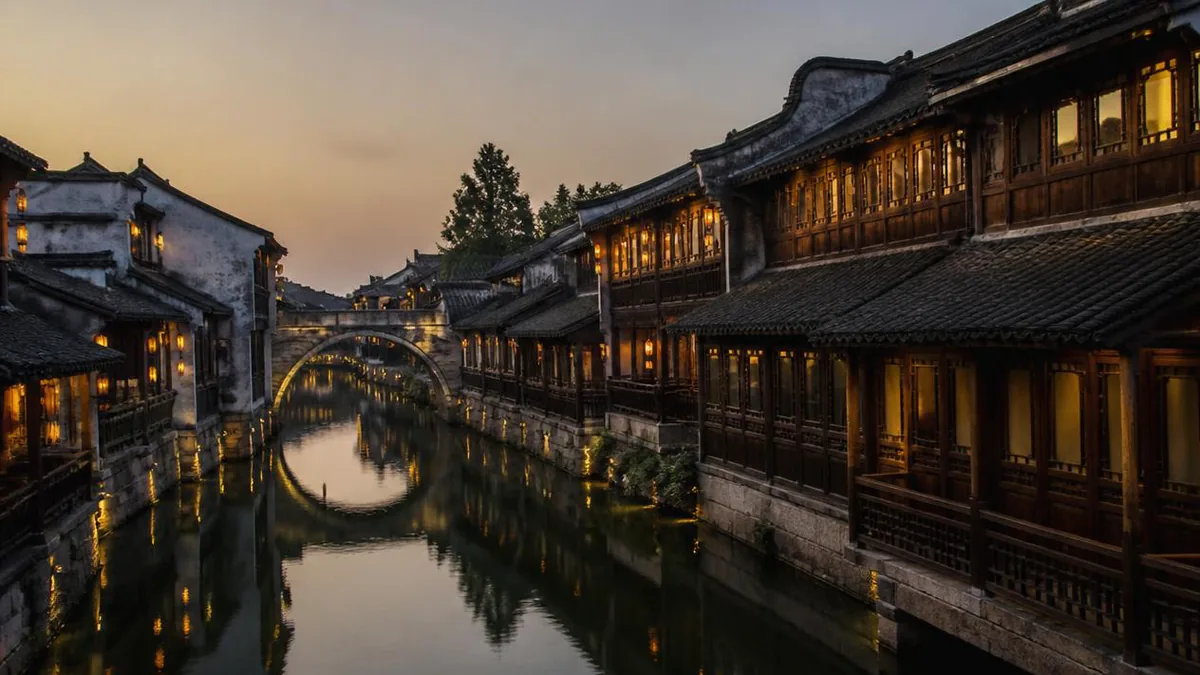
Xizha has no overhead wires, no illegal extensions and no touts because the operator bought the houses, moved the residents out and now sets the menus. The tidiness is an operating result, not a survival.
5A View location, maps and nearby scenic areasMost Chinese old towns are described in terms of what survived. Wuzhen is more accurately described in terms of what was decided, and by whom.
The town lies at the northern edge of Tongxiang, in Jiaxing prefecture, in the middle of the Hangzhou-Jiaxing-Huzhou plain. It is roughly 13 kilometres from central Tongxiang, about 80 kilometres from both Hangzhou and Suzhou, and 140 kilometres from Shanghai. The operator gives the township area as 79 square kilometres; other references say 71.19, so the number moves depending on the boundary being counted.
What does not move is the mechanism. In 1999 a fire, a planning contract and a seconded official set this place on a path that no other water town in China took, and everything visitors admire about it follows from that path.
Two towns, one market river
Wuzhen was two towns for most of its history, and the seam is still legible.
The market river divided them. West of the water was Wuzhen, administered from Wucheng county under Huzhou prefecture. East of it was Qingzhen, under Tongxiang county in Jiaxing prefecture. The operator’s own history notes that the site sat at the meeting point of two provinces, three prefectures and seven counties — a border town in the middle of the richest farmland in China. The two halves were finally merged in May 1950, and the combined settlement took the name Wuzhen.
The internal geography is a cross. Two waterways intersect and cut the town into four quarters, which locals call the east, south, west and north zha. A neolithic site in the near suburbs is dated to roughly 7,000 years ago; the town as a town is credited with about 1,300 years. Historically it produced 64 metropolitan graduates and 161 provincial graduates, which is the ordinary background hum of a delta market town.
Only two of the four quarters are open as scenic zones. Those two are the whole argument.
A fire, and the man who was sent to clean up
On New Year’s Day of 1999 a serious fire broke out in Wuzhen. The Tongxiang municipal government sent the director of its own general office, Chen Xianghong, a Wuzhen native, to resettle the people burned out of their homes. When the job was finished he was not sent back. He was transferred to Wuzhen to run old-town protection and tourism development, and the Wuzhen tourism company was set up the same year.
The starting position was poor and worth stating. Wuzhen had almost nothing listed — essentially one monument, Mao Dun’s house. Neighbouring towns including Zhouzhuang, Xitang and Nanxun already had five to ten years of tourism behind them. The town itself had spent the 1990s going backwards: state mills and silk factories restructured, workers laid off, duck sheds along the canals fouling the water, stone bridges demolished and their steps ramped over so motorcycles could cross, flagstones paved in cement, unpermitted extensions everywhere.
The planning came first. In 1998 the town commissioned Tongji University’s urban planning institute to write a conservation plan that graded the whole old town into four protection zones with a buffer of some 198 hectares. In 1999 a detailed first-phase plan followed, covering the eastern quarter.
Dongzha, 1999 to 2001: the light-touch half
Dongzha opened in January 2001 and took more than a million visitors in its first year.
What was done there is unglamorous and was genuinely new in China at the time: overhead cables buried, lavatories rebuilt, canals dredged, floodlighting installed, seven factories moved out, buildings that clashed with the townscape demolished, a coach park and visitor centre built. Chinese heritage professionals subsequently borrowed the phrase the Wuzhen model for this package, and a UN inspection group is credited with the coinage; treat that attribution as the operator’s own account of its origins.
Two deliberate omissions define Dongzha. No large hotels were built, and no night-tour product was created, explicitly in order to limit the disturbance to people who still lived there. The town also imposed a rule of one shop, one product and a flat-pricing policy across the zone, which is the ancestor of everything Xizha does now.
Commercially it worked fast: by 2004 the zone had repaid its loans and turned an after-tax profit of about 35.5 million yuan. It also exposed its own limits. Revenue was almost all ticket revenue, visitors came for one day and left, and — the sentence that matters — fragmented ownership meant management could only go so deep.
What is actually old in Dongzha
The eastern quarter is where the dated material is, so go slowly through a short list.
Mao Dun’s former residence was built in the mid-nineteenth century, about 650 square metres of Qing Jiangnan house. The writer was born here on 4 July 1896 and lived here until he left for school in the spring of 1910. It became a provincial protected unit in 1982, opened to the public in July 1985 after restoration, and was declared a national key protected unit in January 1988.
Next door is the Lizhi Academy. Its predecessor, the Fenshui Academy, burned in 1860 during fighting between Qing and Taiping forces; a local gentleman named Yan Chen rebuilt and enlarged it from 1865, finishing in 1868, and named it from a maxim about setting one’s purpose. Mao Dun studied in it as a child.
Xiuzhen Temple stands on the street of the same name, founded in 998 by a Daoist named Zhang Dongming. It decayed and was partly demolished for other uses after 1949, and was rebuilt with public money once the town became a tourist site. The signage describes this as restoration to its historical appearance, which is accurate as far as it goes and worth reading carefully. An old opera stage faces it across the water.
The Hongyuantai dye works, where indigo-printed cotton is still hung out in long blue-and-white banners, traces to the Song-Yuan period and moved to its present East Street site during the Guangxu reign. And the bridge within a bridge is a genuine piece of geometry: Tongji Bridge, running east-west, is 28.4 metres long and has been rebuilt five times; Renji Bridge, running north-south, is 22.6 metres. Each is visible through the arch of the other.
Xizha: bought, emptied, rebuilt
In 2003 the town began the second phase, a provincial key project, on the western quarter. It took four years. Xizha opened in February 2007 and was rated a national 5A scenic area in April 2010.
The physical numbers are large. The zone covers about 4.92 square kilometres over a dozen islands, holds more than 300,000 square metres of Ming and Qing buildings, has a main street of about 1.8 kilometres, close to ten thousand metres of internal waterways, 72 stone bridges, and more than 50,000 square metres of wetland at its northern end. Twenty-one categories of pipe and cable were laid underground, including direct-drinking water, fire mains and stormwater, alongside a broadband network. The operator’s claim that its canal density and bridge count are the highest of any old town in China is a marketing line without a stated method.
The decisive number is the other one. Chinese business reporting on the project states that the company spent on the order of one billion yuan buying the property rights of the shops and of the residents’ houses, and relocated the residents as a block. That is described, in the same account, as Xizha’s advantage over Dongzha: not scenery, not history — ownership. The conservation workload was reckoned at more than three times Dongzha’s, and one trade commentary puts new construction at 65 per cent of what stands in Xizha, a figure from industry writing rather than from any survey.
Why it looks the way it does
This is the causal step most travel writing skips, and without it Xizha looks like luck.
There are no overhead wires because they were buried at the start. There are no unpermitted extensions, no mismatched shopfronts and no sun-faded plastic signage because the operator owns the walls and can simply refuse. The night lighting is uniform because it was designed and wired as one system rather than accumulated bulb by bulb. There is no touting and no price gouging because the company sets the menus and the prices.
The management detail is unusually explicit. Hotels in the zone are run directly by the company. Guesthouses are run by resident hosts to company standards, with unified menus, unified pricing and weekday and weekend rate tiers; a guesthouse may serve only a limited number of dining tables at a time. Shop tenancies are vetted, with a married couple preferred and local people given priority, and quality standards run down to the level of how many eggs go into a plate of egg and tomato. Reporting on the company describes it subsidising lessees where necessary so that the one-shop-one-product rule survives commercially.
Now read the consequence, which the same reporting states directly: Xizha inverts the structure of a town. Visitors become its residents. The former residents become outsiders who come in to run its guesthouses, restaurants and shops.
That is not a scandal and it is not a triumph. It is a trade. You are buying a legible, quiet, uncluttered evening on a canal, and the price is that nobody in front of you is there for a reason unrelated to you.
Who owns it
The ownership chain is public, because the parent is listed.
China CYTS Tours Holding, traded in Shanghai, took a majority of Wuzhen Tourism Co., Ltd. and held 51 per cent until July 2013, when it bought the 15 per cent held by two IDG vehicles for 67.5 million US dollars, taking it to 66 per cent. After that transaction only two shareholders remained: CYTS and a Tongxiang municipal old-town tourism investment company. Plans to float Wuzhen Tourism separately were shelved, partly because listing a historic town requires central housing-ministry sign-off.
In October 2025, answering an investor’s question on the exchange’s interaction platform about who owns the shops, CYTS stated plainly that the operating assets of the Wuzhen scenic area are held outright by Wuzhen Tourism Co., Ltd.
The scale explains the attention. Wuzhen Tourism reported revenue of 690 million yuan in 2012, contributing roughly forty per cent of its parent’s net profit; visitor numbers passed six million in 2012 and ten million in 2017, on revenue of 1.646 billion yuan; 2018 revenue was reported at 1.908 billion with net profit of 734 million. The model also proved portable: Gubei Water Town, below the Simatai Great Wall north of Beijing, was built from nothing on the same template by CYTS, IDG, a Beijing energy group and Wuzhen Tourism itself.
Mao Dun, Mu Xin, and an asset that is not a picture
Zhouzhuang’s fame rests on a painting of two bridges. Wuzhen’s rests on two writers who actually lived here, which is a materially different kind of claim.
Mao Dun (1896-1981), born Shen Dehong, wrote The Lin Family Shop and the Rural Trilogy out of this town’s economy and became the first Minister of Culture of the People’s Republic. The literary prize named after him is the most important award for the Chinese novel; its eleventh ceremony was held in Wuzhen on 19 November 2023. Signage in Xizha’s Zhaoming Academy — named for the Liang crown prince Xiao Tong, compiler of the Wen Xuan, who is recorded studying here in 503 — calls the town the prize’s permanent home. The eighth ceremony, in 2011, was held in Beijing, so read the word permanent as an ambition with recent practice behind it.
Mu Xin (1927-2011) is the sharper case. Born in Wuzhen, imprisoned during the Cultural Revolution and later resident in New York, he came back in 1994 and wrote an essay about it that says the dialect had not changed and nothing else was any good, ending: farewell, I shall not come again. It was published in December 1998, at exactly the moment the town’s reconstruction began. Chen Xianghong brought him back in 2006, at seventy-nine. He lived in his restored family house in Dongzha until his death in December 2011, and the Mu Xin Art Museum in Xizha, designed by architects who had trained with I. M. Pei, opened in November 2015.
A town that read its most famous exile’s demolition notice and then persuaded him to move home has done something that no amount of stone-slab sourcing can fake.
A stage and a summit
Two events took Wuzhen out of the water-town category entirely, and both are worth understanding as infrastructure decisions rather than as programming.
The Wuzhen Theatre Festival opened on 9 May 2013, founded by the actor and producer Huang Lei, the director Stan Lai, the director Meng Jinghui and Chen Xianghong, and produced by Culture Wuzhen. It began with six invited productions and nineteen performances; by the seventh edition in 2019 that had reached twenty-eight productions and one hundred and forty-one performances, with a street carnival that had grown from a few hundred acts to a few thousand. From 2016 a contemporary art exhibition was added on the same logic.
The World Internet Conference followed in 2014. The State Council Information Office announced on 30 October 2014 that Wuzhen would be its permanent venue, and the first summit ran 19-21 November 2014, hosted by the Cyberspace Administration of China with the Zhejiang provincial government. From 2016 the sessions have used a purpose-built convention centre beside the town, with a main hall seating around three thousand.
Chen Xianghong’s own explanation of why it landed here is the least mystical and the most convincing: without a decade of tourism development, and without modern services fitted inside traditional fabric, a state-level international conference could not have used the place at all. Free town-wide wi-fi, installed years earlier as a hospitality feature, turned out to be the qualifying credential.
What to do with this
Take the two zones as two different objects and do not expect the same thing from them.
Go to Dongzha for the dated material and for the fact that people still live there: Mao Dun’s house and school, the dye works, the two bridges that frame each other, laundry in the canal. Go to Xizha for what an entire town looks like when one company owns it, runs it and lights it — and stay the night, because the evening is the product the whole zone was designed around. Then note what you are not seeing, which is anyone whose presence is accidental.
Wuzhen is often held up as the model other Chinese old towns should copy, and the reason it cannot easily be copied is not taste or talent. It is that somebody bought the town first. Lijiang kept its residents and lost most of them anyway; Zhouzhuang kept private ownership and cannot control its own shopfronts; Fenghuang tried a perimeter ticket and withdrew it. Wuzhen removed the variable.
Everything you will like about it, and the one thing that may unsettle you, come from the same decision.
The LoreLens app can identify Jiangnan timber-frame houses, water pavilions and stone arch bridges, and explain the history behind them where you are standing.
Location profile
Where it is

Frequently asked questions
Were Xizha's residents really moved out, and who owns the buildings now?
Yes, and the arrangement is documented rather than rumoured. Chinese business reporting on the project states that in building the second-phase Xizha zone the company spent on the order of one billion yuan buying the property rights of the shops and of residents' houses and relocated the residents as a block, which is described as Xizha's decisive advantage over the first-phase Dongzha zone, where residents stayed and ownership remained fragmented. On the corporate side, China CYTS Tours Holding, listed in Shanghai, answered an investor question on the exchange's interaction platform in October 2025 by stating that the operating assets of the Wuzhen scenic area are held outright by Wuzhen Tourism Co., Ltd. CYTS held 51 per cent of that company and raised it to 66 per cent in July 2013 by buying IDG's 15 per cent for 67.5 million US dollars; the remaining shareholder is a Tongxiang municipal investment vehicle. Former residents were not simply removed from the picture: many returned as lessees running the guesthouses, restaurants and shops under company standards. But they returned as tenants of a landlord, not as owners.
Dongzha or Xizha, and how long do I need?
They are different kinds of object and the ticket is zoned accordingly, usually as separate east and west admissions plus a combined option. Dongzha is the smaller, older-feeling one: people still live there, the workshops and the writers' houses are there, and a half day covers it. Xizha is about 4.92 square kilometres across a set of islands, with a main street of roughly 1.8 kilometres, and it is built for staying rather than walking through, so a full day plus a night inside is the intended use, and evening lighting and boats are the main draw. If you only have one day, Dongzha in the morning and Xizha from mid-afternoon into the evening is the usual compromise. Ticket zoning, evening hours, boat services and any reservation requirement all change with the season, so check the current notice at the gate rather than trusting any published figure, including this page.
Is Wuzhen fake?
It is not a forgery and it is not a survival; it is a reconstruction with real material in it, and the honest answer is to separate the layers. Genuinely old and genuinely in place: Mao Dun's family house in Dongzha, built in the mid-nineteenth century and a national key protected unit since January 1988; the Lizhi Academy next to it, rebuilt in 1865-68 after its predecessor burned in the fighting of 1860; the Hongyuantai dye works, of Song-Yuan origin, moved to its present Dongzha site under the Guangxu reign; the Tongji and Renji bridges, which frame each other. Restored or rebuilt: Xiuzhen Temple, founded in 998, dismantled and repurposed during the Mao era and rebuilt from public funds once tourism began, with signage describing it as restored to its historical appearance. Newly built inside old form: much of Xizha, where one trade account puts new construction at 65 per cent of the fabric, a figure from commentary rather than a survey. The one thing that is not in dispute is that the pretty parts were decided rather than inherited.
When are the theatre festival and the internet summit, and do they affect a visit?
Both are autumn events and both change how the town works while they run. The Wuzhen Theatre Festival began on 9 May 2013 and has since settled into October, founded by Huang Lei, Stan Lai, Meng Jinghui and Chen Xianghong and produced by Culture Wuzhen; it grew from six invited productions and nineteen performances to twenty-eight productions and one hundred and forty-one performances by the seventh edition in 2019, with a street carnival on top. The World Internet Conference has been held in Wuzhen since its first edition on 19-21 November 2014, hosted by the Cyberspace Administration of China with the Zhejiang provincial government, and the town was designated its permanent venue; since 2016 the main sessions have used a purpose-built convention centre whose main hall seats around three thousand. Summit weeks bring heavy security, identity checks and closures of parts of the town, and festival weeks bring full guesthouses and ticketed performances. Check dates before booking, in either direction depending on what you want.
Sources and further reading
Background references for the history and place names in this guide. Opening hours, ticketing and access change often — always confirm with official local information before travelling.