Hunan · Xiangxi
Fenghuang: A Garrison Rebuilt as a Photograph
A Qing military seat on the Tuo River, a novel set in a different county that everyone attributes to it, a Ming border wall renamed the Southern Great Wall in April 2000, and three years in which walking down the main street cost 148 yuan.
5A View location, maps and nearby scenic areasMost people arrive in Fenghuang with a sentence already in their heads: this is the town from Shen Congwen’s Border Town. It is the wrong sentence. Correcting it is the best possible way into the place, because almost everything here has the same shape — a real object, and a story attached to it afterwards.
That is not a complaint. The attaching is the history. A Qing garrison seat became a National Historic and Cultural City in 2001, received 570,000 visitors that year, and 6.9 million eleven years later. Something happened in between, and it was not the buildings.
Six thousand civilians and eight thousand soldiers
The town sits in a narrow valley where the Tuo River cuts through, and it was built to hold that gap rather than to enjoy it.
Its older name is Zhen’gan. Under the Yuan it was the seat of the Wuzhai chieftaincy; under the Ming and Qing it became one of the empire’s principal frontier commands. Local records describe the early Qing town as a garrison of six thousand civilians and eight thousand troops. In 1700 the garrison was raised to the rank of a zhen, one of sixty-two in the country. In 1704 the chieftaincy was abolished and a camp established on the site of today’s county town, and the Chen-Yuan circuit intendancy moved here; by 1729 the reorganised Chen-Yuan-Yong-Jing military-defence circuit administered more than twenty prefectures and counties across western Hunan from this valley.
The name Fenghuang, phoenix, arrives late. The prefecture became a county under that name in 1913. The Tuo River runs 131 kilometres in total, of which nearly 97 are inside the county — a small river in a tight gorge, which will matter later.
The novel is set in another county
Border Town was serialised in Tianjin’s Guowen Weekly from New Year’s Day 1934, ran four instalments, broke off, resumed on 12 March and finished on 23 April: eleven instalments in all. The book edition came out in Shanghai that October.
Its first paragraph names the setting. The road from Sichuan into Hunan reaches a small hill town called Chadong; there is a stream, a white pagoda, and one household — an old man, a girl, a yellow dog. Chadong is in Huayuan County, at the meeting point of Hunan, Chongqing and Guizhou. In July 2005, in a township merger, it was renamed Biancheng — Border Town. The Hunan provincial government’s website now calls Biancheng the prototype location of the novel, and there is a scenic area there with a Cuicui island and a lantern-lit night market.
So the renaming of a real town after a novel happened in 2005, and the renaming of a real wall after another wall happened in 2000. Fenghuang did not invent this habit, but it has been unusually productive at it.
Shen Congwen has two addresses here
He was born on 28 December 1902 in a southern-style courtyard house on Zhongying Street, and that house is the one national-level protected building inside the old town, listed in 2006.
The biography is harder than the tourism version. His paternal grandmother was Miao, his mother Tujia; he identified as Han for most of his life and chose Miao identity in old age. At about fifteen he left school for the local warlord Chen Qumin’s forces, worked as a clerk, read Chen’s library, and left for Beijing in 1922 with a primary-school education. He stopped writing fiction on the last day of 1948 and spent the rest of his working life on Chinese historical dress at a museum. He died on 10 May 1988.
His grave is not at the house. It is on Tingtao Hill, on the north-east flank of Nanhua Mountain east of the old town, and it is a walk. His ashes came back in 1992; half were scattered in the Tuo, half buried here. The marker is an unworked agate boulder quarried from the hill above — about 2.8 metres high, 1.9 wide, 0.9 thick, some six tonnes. The front carries a line his widow Zhang Zhaohe chose from his late essay Abstract Lyricism; the back carries a couplet sent from the United States by her sister Zhang Chonghe. Zhang Zhaohe’s own ashes were interred here on 18 May 2007. Go in the morning, before the river fills up.
The wall that was renamed in April 2000
Out in the hills west of town is a stretch of stone wall now marketed as the Southern Great Wall. The wall is real. The name is twenty-six years old.
In late April 2000, preparing the town’s application to be designated a National Historic and Cultural City, the county party committee and government invited more than ten specialists, among them Zhao Jinghui of the construction ministry and Luo Zhewen of the State Administration of Cultural Heritage, then a vice-president of the Great Wall Society. When local officials described the “Miao frontier wall,” Luo climbed it and surveyed it; by the end of the month the group had concluded it should be called the Great Wall of the South. Emergency repairs began at once — 1.78 kilometres restored at Lahao camp by May 2001 — and in 2003 the county built the world’s largest go board on it, 31.7 metres a side, for a China–Korea invitational.
The underlying structure is a Ming frontier system, generally dated to the Wanli reign and funded by a court grant of 40,000 taels of silver, with other accounts giving 1554 and a completion date of 1662; its heritage listing simply reads Ming to Qing. It ran roughly 190 kilometres, with more than 1,300 forts, watchtowers, blockhouses and gates along it, over 800 in this county alone, and a garrison of four to five thousand rising to about seven thousand. The wall itself is modest: around three metres high, two metres wide at the base, one at the top, built of stones a sixth to a tenth the size of those in the northern Great Wall.
Its purpose was also different. It did not hold off steppe cavalry. It separated Miao communities that had submitted to the court from those that had not, and after Miao forces levelled it at the end of the Ming, the Qing rebuilt it on the same line for the same reason.
What is actually protected, and where
Heritage listings are the most reliable guide to what is old here, and they point away from the river.
At national level the county has exactly two entries, both from the sixth batch in 2006. One is the Shen Congwen residence. The other is a group called the Fenghuang Ancient Castles, and it consists of four fortified sites out in the townships — Huangsiqiao, an intact walled fort whose site goes back to a Tang county seat; Shujiatang fort village; Wangpotun fort; and Lahao camp. None of them is the waterfront.
The waterfront items are protected at Hunan provincial level: the Rainbow Bridge, the city gate towers, the Xiong Xiling residence, the Confucian temple, the Heavenly King temple, the Yang and Tian ancestral halls, the Chaoyang hall, and Shen Congwen’s grave. The frontier wall is provincial too. Fenghuang went onto China’s World Heritage Tentative List on 28 March 2008 and has stayed there. Compare Lijiang, inscribed in 1997 and audited by the World Heritage Committee five times since: a listing brings scrutiny as well as status, and Fenghuang has had neither.
Stilt houses, and how much of the view is new
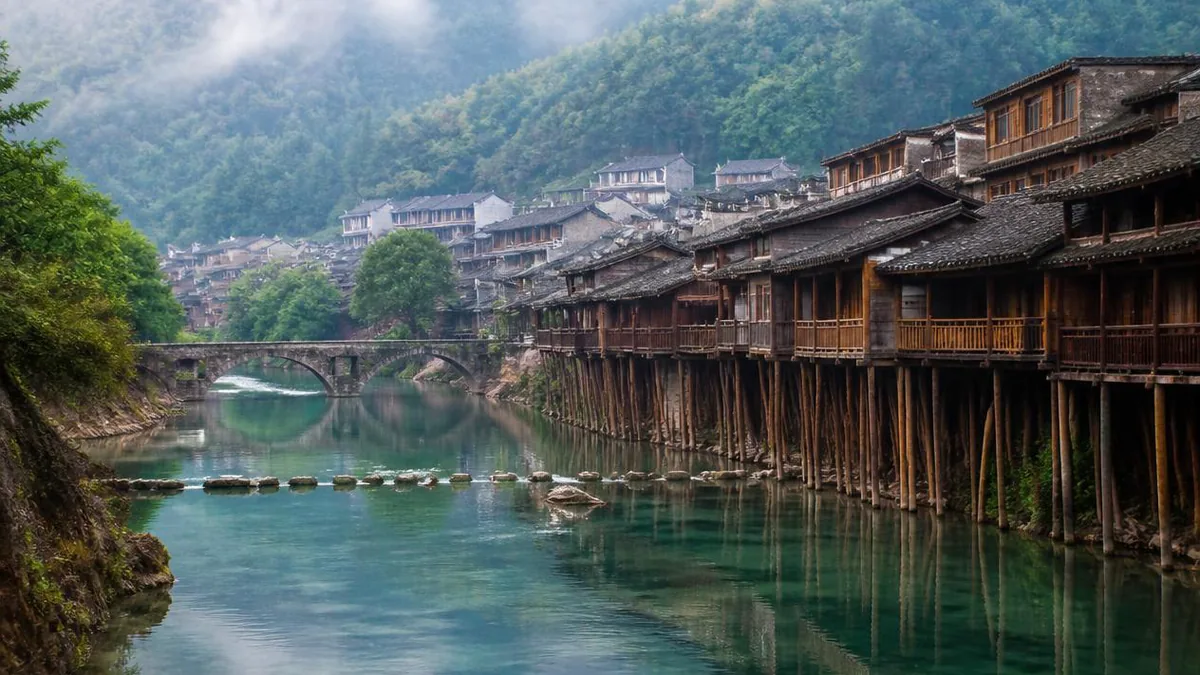
The diaojiaolou along the Tuo are the image the town sells. Structurally they are half-ganlan timber buildings: the front sits on the bank, the rear is carried on posts over the slope or the water, the upper floor is the dry living space and the space beneath is storage or livestock. Building out over the water is not romance; it is what you do when the buildable shelf between cliff and river is a few metres wide.
How much of what you photograph is original is a separate question, and the honest answer is: less than it looks. The painter Huang Yongyu, a Fenghuang native, returned in the 1980s and published an album titled The Landscape That Has Gone. A public inventory of copies and rebuilds includes: the riverside city wall, reduced to footings, built over with plain houses in the 1970s and 1980s and re-walled only after tourism began; the Rainbow Bridge, originally a timber covered bridge, stripped to a road deck and asphalted in the 1950s for cars, then given a new covered upper storey in modern materials as a pedestrian street; the Wanming Pagoda at Shawan, timber, demolished in the 1960s and rebuilt in the 1980s in modern materials; the octagonal tower, demolished in the 1960s and rebuilt in 2005 by a property developer as an estate amenity; and a south-west gate that no record and no elderly resident can place before the tourism era. The flagstone streets were relaid in red stone in 2002 and back in blue-grey stone by the mid-2010s.
The 148-yuan gate
Before 2013 the arrangement was ordinary: entering the old town was free, and a 148-yuan combined ticket covered nine ticketed attractions inside it.
From 10 April 2013 the county inverted this — “ticket to enter the attraction” became “ticket to enter the area” — merging the old town with the neighbouring Nanhua Mountain scenic area into one 148-yuan product sold by a newly formed operating company. Officials explained the price as containing three components: a town maintenance fee, a resource protection fee and a marketing fee. There were concessions: three days’ validity, extensions for long-stay guests, free re-entry within a year, lifetime free entry after three purchases.
It did not hold. Shops struck on the day it took effect and riot police stood by. On 27 March 2016 the county decided to stop perimeter ticketing from 10 April 2016, keeping tickets only for individual attractions. That is roughly the arrangement today, which is why every price in this article, and everywhere else, should be checked at the gate.
Why the bars flood
On the night of 14–15 July 2014 the county took up to 189 millimetres of rain in sixteen hours. The Tuo rose more than three metres. Riverside streets went under; water reached the second and third floors of the bar strip; the whole town lost power and water and closed to visitors, and around 120,000 people including tourists were moved. A reinforced-concrete covered bridge built by the county around 2008 collapsed and washed away on the morning of the 15th. It was the second inundation in six weeks, after floods in 2010, 2011 and 2012, and there were more in 2020.
Two explanations were given at the time and both are on the record. The Changtangang reservoir, twelve kilometres upstream and completed in 1998, was facing its largest inflow since it was built; it began releasing on 13 July when its level passed the warning mark, rain then intensified, and discharge and rainfall stacked. And the head of the county flood-control office said plainly that after commercial development, bars and inns had been built closer and closer to the bank and had changed the river’s cross-section, making the flooding worse than before. A provincial geological engineer added the obvious constraint: a long narrow gorge, a narrow channel, stilt houses on both banks.
Miao and Tujia, specifically
“Ethnic minority atmosphere” is not a description of anything. The county’s own numbers are.
At the end of 2020 Fenghuang counted 421,100 registered residents, of whom 333,300 — 79.15 per cent — were of minority nationality, and 249,000, or 59.13 per cent of the total, were Miao. The Miao are the indigenous population, settled in large blocks with smaller pockets between; the Tujia largely arrived as garrison troops and live interspersed with Han. The Han, about 27 per cent, are concentrated inside the old town — which is the point worth carrying: the walled town was the state’s town, and Miao settlement is what lies outside it. In the wider Xiangxi prefecture the split is roughly 43 per cent Tujia and 34 per cent Miao.
The living institution to look for is the ganchang, the periodic market, held on a five-day cycle. Alaying trades on the second and seventh of the lunar month and is the county’s largest; Jixin on the fifth and tenth; the Miao markets at Shanjiang on the third and eighth and at La’er Mountain on the second and seventh; Heku on the first and sixth. Traders come from three provinces. Local theatre runs to nuotang exorcism drama, which uses only percussion and no melodic accompaniment, plus the tea-lantern comedies and the spring yangxi.
Two towns, one ticket queue
Fenghuang today is a photography industry with a river running through it. The county reports more than a thousand travel-photography studios, over five thousand people directly employed and around 500 million yuan of combined annual turnover, and it published the country’s first trade standard for the sector. Visitors went from 570,000 in 2001 to 6.9 million in 2012 to 17.2 million in the first nine months of 2024. The 5A grade came in February 2024 and the plaque went up that October.
The town has been through the full modern cycle — designation, an operating company, a perimeter ticket, a public revolt, a flood partly of its own making, a national inspection list — and none of it is hidden. It is all in the county gazette, the provincial heritage register and the newspaper archive.
So use the register. Spend the morning at Tingtao Hill and the Zhongying Street house, spend an afternoon out at Huangsiqiao and Lahao camp where the genuinely old fortifications are, and if you have come for Border Town, go to Huayuan County, where the book is actually set. Then come back at dusk and enjoy the stilt houses for what they are: a rebuilt view of a real valley, which is not nothing.
The LoreLens app can identify stilt-house construction, Ming frontier fortification and Qing garrison-town layouts, and explain the history behind them on the spot.
Location profile
Where it is
Frequently asked questions
Is Fenghuang the setting of Shen Congwen's Border Town?
No, and this is the most common mistake made about the town. The novel names its own setting in its first paragraph: a small hill town called Chadong, on the road from Sichuan into Hunan. Chadong is in Huayuan County, on the border with Chongqing and Guizhou, not in Fenghuang County. In July 2005 the Hunan authorities merged Chadong with a neighbouring township and renamed the combined unit Biancheng, meaning Border Town, and the Hunan provincial government's own website describes Biancheng as the prototype location of the novel. Fenghuang is where Shen Congwen was born, on 28 December 1902, and where he is buried, and it appears throughout his non-fiction. It is not the town in the novel.
Is the Southern Great Wall really part of the Great Wall?
That depends who is asking, and the naming has a date. The structure was known locally as the Miao frontier wall. In late April 2000, preparing Fenghuang's application to be named a National Historic and Cultural City, the county invited a group of specialists including Luo Zhewen of the State Administration of Cultural Heritage, then a vice-president of the Great Wall Society; at the end of that month the group concluded that the wall should be classed as the Great Wall of the South. Restoration and promotion followed immediately. Its own heritage listing is more cautious: it is protected at Hunan provincial level under the names Ming and Qing Xiangxi border wall and Xiangxi border wall, not as Great Wall, and it is not a national-level protected unit. Its purpose also differed from the northern wall's. It divided Miao communities that had submitted to the court from those that had not.
Do I have to buy a ticket to walk into the old town?
Not at the moment, but this has changed twice and could change again, so treat any figure you read as provisional. From 10 April 2013 the county switched from ticketing individual attractions to ticketing the whole area, so that entering the old town at all required a 148-yuan combined ticket. Shops struck on the day it took effect. On 27 March 2016 the county decided to stop checking tickets at the perimeter from 10 April 2016, while keeping tickets for individual attractions such as the Shen Congwen residence, so the museum-type sites still charge. Boat rides, shows, the Southern Great Wall site and the outlying forts are separately priced. Confirm everything on the day rather than from any article, including this one.
Is Fenghuang a World Heritage Site, and what is actually protected?
It is not a World Heritage Site. It was added to China's World Heritage Tentative List on 28 March 2008, which is a nomination queue rather than a listing. It has been a National Historic and Cultural City since 2001, and the Fenghuang Ancient Town tourist area was confirmed as a national 5A scenic area in February 2024, with the plaque unveiled on 20 October 2024. At national heritage level only two things in the county are listed, both in the sixth batch of 2006: the Shen Congwen residence on Zhongying Street, and a group called the Fenghuang Ancient Castles, which is not the riverside town at all but four fortified sites out in the countryside. The photogenic riverside items, the Rainbow Bridge and the city gate towers among them, are protected at provincial level.
Sources and further reading
Background references for the history and place names in this guide. Opening hours, ticketing and access change often — always confirm with official local information before travelling.