Jiangsu · Suzhou
The Humble Administrator's Garden: A Garden Cut in Three
The name is not modesty, it is a shrug from a man who lost his job. And the garden behind it spent roughly three centuries as three separate properties in three different hands before anyone sewed it back into one.
5A View location, maps and nearby scenic areasThe English name is a mistranslation people have grown fond of. There is nothing humble about it.
The two characters at the heart of the Chinese name come from a rhapsody by the third-century writer Pan Yue, An Idle Life, in which he describes watering his vegetable plot, selling the produce, and living off it: this too is the way an inept man conducts government. The word is closer to clumsy, or useless, than to humble. When a dismissed censor named Wang Xianchen attached that phrase to five hectares of Suzhou in the early sixteenth century, he was not being modest. He was being sour, in the polished way that Ming officials were sour.
The second thing to know is that the garden did not stay one garden. For roughly three hundred years it was two, then three, separate properties with separate owners, separate walls and separate names. What you walk today is a reassembly, and the seams are still visible if you know where they are.
A name that is a shrug, not a boast
Wang Xianchen was a jinshi graduate of the Hongzhi era who served as a censor, an inspector whose job was to report on other officials. His career was the kind that goes up and down more than it goes forward: promotions, demotions, and a final posting as magistrate of Yongjia in Zhejiang. He returned to Suzhou around 1510, on his father’s death, and began building.
The founding date is usually given as 1509, the fourth year of the Zhengde reign. English-language accounts often say 1513 instead, and note that the name is first attested around 1517 and that the work ran on until roughly 1526. The range, not the point, is the honest answer. What the accounts agree on is the site: the ruins of the Dahong Temple, on ground also associated with the Tang dynasty writer Lu Guimeng.
The early garden is described as loose and unbuilt-up. Water was dredged into a broad pond, and one contemporary phrase says the flooded middle looked “like a lake.” The rest was orchard, bamboo, flower plots and about thirty-one scattered structures. It was, in other words, closer to a designed countryside than to the dense architecture visitors expect from a Suzhou garden today.
What Wen Zhengming actually recorded
The garden’s early documentation is unusually good, and it comes from one man.
Wen Zhengming, the Suzhou painter and calligrapher, was Wang’s friend. In 1533 he produced a set of thirty-one paintings, each paired with a poem, and wrote an accompanying essay, Notes on the Wang Family’s Humble Administrator’s Garden. In 1551 he made a second, smaller album of eight leaves, different views but the same poems.
Tradition goes further and credits Wen with designing the garden. That claim is much weaker than the paintings, which exist. Treat the design attribution as a Suzhou tradition and the album as evidence.
Even the album needs a caveat, and it is the single most useful thing to carry through the rest of a visit. Wen’s thirty-one views are a poet-painter’s record, not a survey. Many of the names on today’s plaques were taken back off Wen’s list in the 1950s and applied to buildings that have no connection to the Ming structures of the same name. Suzhou’s own gazetteer material says so directly of the Small Flying Rainbow covered bridge, the Small Canglang water pavilion and the Fine Fruits Pavilion: the names are Wen’s, the buildings are not.
One night at the gaming table
Wang Xianchen’s son is said to have lost the entire garden in a single night’s gambling, to a family surnamed Xu. Whether or not the night is literal, the transfer is recorded, and it set the pattern for the next three hundred years.
The Xu descendants declined. In the late 1640s the scholar-official Qian Qianyi built a wing here and installed the celebrated courtesan Liu Rushi in it. When Qing troops took Suzhou the garden was occupied by a garrison commander. In 1653 the fifth-generation Xu heir, out of options, sold it for two thousand in silver to the grand secretary Chen Zhilin.
Chen renovated it expensively. He is also recorded as having been in the capital the whole time, exiled to Liaodong five years after the purchase, and dead in exile without ever having seen a single flower in the garden he owned.
In 1662 the property was confiscated as state land and enclosed as a general’s residence, then converted into a military circuit official’s guest lodging in 1664. Through all of this, the accounts note, the garden itself was still recognisably the old garden. That was about to change.
The son-in-law who rebuilt it wrong
The garden was eventually returned to Chen Zhilin’s son, who sold it to Wang Yongning, son-in-law of Wu Sangui, the general whose defection opened the passes to the Qing and who would later rebel against them.
Wang Yongning did not restore. He rebuilt. The records describe him levelling and rearranging the artificial hills, and putting up a Spotted Bamboo Hall and a Ladies’ Hall as living quarters for Wu Sangui’s daughter, plus a nanmu-timber hall carried on more than a hundred columns, its stone column bases three or four feet across and carved with ascending dragons, with drum-shaped stools of white jade. After Wang Yongning, the accounts say, the garden no longer matched Wen Zhengming’s paintings.
The state took it back. From 1679 it housed a new circuit administration; the post was abolished in 1683. The Kangxi Emperor came through on a southern tour in 1684, and the county gazetteer compiled that same year delivered a verdict worth quoting for its flatness: in twenty years the place had changed hands repeatedly, and although it had been made grander, the old mountain-and-forest refinement was gone.
The split into three
After 1683 the estate dissolved into private housing, and the division that defines the modern garden set in.
The east had already gone. In 1631 some ten-odd mu of derelict ground on that side were bought by the vice-minister Wang Xinyi, a landscape painter who laid it out himself and finished in 1635, calling it Dwelling Upon Return to the Countryside. By the Daoguang reign his descendants still held the land, but it had reverted largely to vegetable beds and grass.
The rest split in the early Qianlong years. The centre became the Restored Garden, bought by the prefect Jiang Qi, who spent years bringing it back and filled it with books; the poets Yuan Mei, Zhao Yi and Qian Daxin came and wrote. The west became the Book Garden, built essentially new on waste ground by the Hanlin scholar Ye Shikuan.
Three gardens, three walls, three sets of deeds. The centre passed on again in 1809 to Cha Shitan, and by the end of the Jiaqing reign to Wu Jing, after whom Suzhou people called it simply the Wu Garden. A visitor in 1842 comparing it against a painting from roughly a hundred and sixty years earlier found the two barely comparable. Contemporary accounts put the Wu Garden at about one third of the old garden’s extent — which is arithmetically what it was.
A Taiping prince, then a Manchu guild hall
On 2 June 1860 the Taiping army entered Suzhou, and the central garden became the palace of the Loyal Prince, Li Xiucheng. He combined it with the Pan and Wang houses to either side; tradition places his working office in the Mountain-in-View Tower. A contemporary account notes that hundreds of craftsmen worked year-round and the job was still unfinished when the city fell.
Li Hongzhang took Suzhou in 1863 and used the Loyal Prince’s palace as his own provincial governor’s headquarters, with a medical dispensary attached. The governor’s office moved out in 1866. A visitor a year after the handover found roughly half the fittings already gone.
Then comes the change that made the garden you see. In the winter of 1871 the incoming governor Zhang Zhiwan lived in the attached residence, and being a painter, repaired the garden back into shape. On leaving for a new post he and three Manchu officials converted the property into the Banner Bureau Guild Hall in the first month of 1872, funded by three thousand in silver plus two thousand for maintenance. It was overhauled again in 1887.
That is the central garden’s real date. Water-centred, broad, open: the layout has held since then.
The west garden belongs to a merchant, and it shows
In 1877 the western portion, by then in the hands of a family surnamed Wang, was sold for 6,500 taels to Zhang Lüqian, a wealthy Wu county merchant, who renamed it the Supplementary Garden.
He found one or two battered pavilions and rebuilt comprehensively. The Thirty-Six Mandarin Ducks Hall and the Eighteen Camellias Hall are his, and so is the fan-shaped With Whom Shall I Sit Pavilion, whose two fan-shaped window openings frame the Reflection Tower on one side and the Mandarin Ducks Hall on the other, with the hilltop Bamboo Hat Pavilion appearing in a third opening to complete the fan. In 1894 he obtained a rubbing of the stone engraving of Wen Zhengming’s essay, had it re-cut, acquired portraits of Wen and Shen Zhou, and built a studio to house them.
Suzhou’s own assessment of the result is not flattering and is worth repeating. The work was expensive and ornate, and in pursuing richness it lost part of the sparse, unhurried quality the garden had been named for. One thing it bought, though, was acoustics: the Mandarin Ducks Hall has a barrel-vaulted ceiling, and Zhang and his grandson were kunqu enthusiasts who used it as a performance room.
If the western garden feels denser, glassier and more decorated than the centre, that is not your imagination. It is a late-Qing merchant’s taste, about three and a half centuries downstream of Wang Xianchen.
The eastern garden is younger than the People’s Republic
The eastern third has the shortest history and the clearest one.
By the twentieth century Wang Xinyi’s Dwelling Upon Return to the Countryside had been walled off from the centre for generations and was, by the surviving descriptions, a field with a few derelict houses, some stored coffins and one small pavilion on a mound. The puppet provincial education department later punched through the dividing wall and put up a small foreign-style house.
The rebuild came in two stages after 1949. The garden was placed under cultural-relics administration in November 1951; repairs to the central and western gardens finished in October 1952, and both opened to the public on 6 November 1952. The east stayed a nursery and staff housing. From the second half of 1959 it was rebuilt on a large scale — a new main gate, the Lotus Pavilion, the Green-Steeped Pavilion, the Sorghum Fragrance Hall — and finished in September 1960. Several structures, including the Orchid Snow Hall and the Heavenly Spring Pavilion, were moved in from elsewhere.
At that point the three parts became one property again, for the first time since the Kangxi reign. The eastern section runs to roughly 31 mu, against about 18.5 for the centre and 12.5 for the west. The largest part of the largest garden in Suzhou is the part that is younger than most of its visitors’ grandparents.
Reading the seam on the ground
Knowing the sequence changes what you look at.
The eastern section is deliberately open: grass, pine, a low ridge standing in for distant hills, a stream through bamboo. It is spacious and pleasant and stylistically unrelated to the late-Qing garden next door, because it was designed in 1959 to evoke a Ming garden nobody had seen.
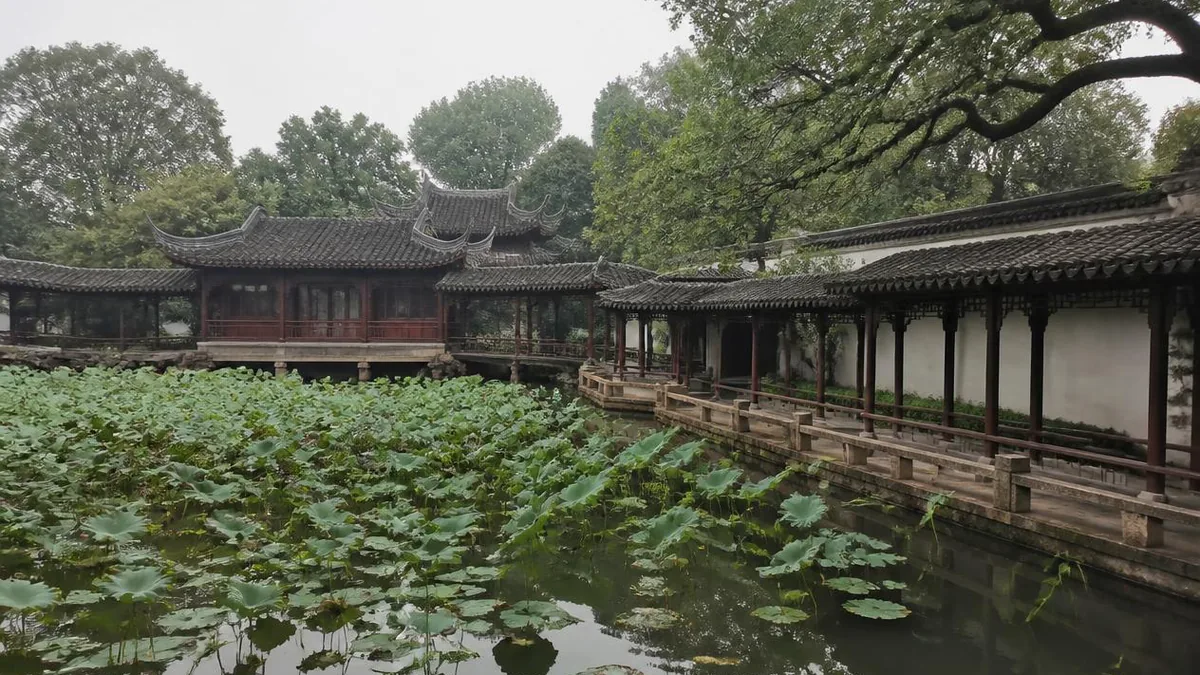
The centre is where the water does the work. The pond takes about a third of the section’s area, and the buildings are set at the edge or out over it. The Distant Fragrance Hall, a four-sided hall walled in glazed windows, faces two islands across the water, one carrying the Snow-Fragrance Cloud-Luxuriance Pavilion and one the Awaiting Frost Pavilion. West of it the Fragrant Isle, a stone boat, and the Lotus Breeze Pavilion and the Leaning on Jade Studio form a triangle around the lotus beds. The Small Flying Rainbow is the only covered bridge in the Suzhou gardens. From the Wutong and Bamboo Retreat on the eastern side you can see the North Temple Pagoda standing outside the wall — the textbook example of borrowed scenery, and the reason the garden’s eastern boundary is left visually open where a wall would be easier.
The west is the compressed one: an L-shaped pond, halls facing each other across it, an undulating waterside corridor, and reflections used as a design element rather than a bonus.
And remember the plaques. Names such as Small Flying Rainbow, Small Canglang and Leaning on Jade were reassigned from Wen Zhengming’s 1533 list in the 1950s. They are honest quotations, not survivals.
Two lists at the gate, and what they cover
Visitors regularly get tangled in Suzhou’s ratings, so it is worth separating them.
The garden was named among China’s first batch of national key protected cultural relic sites in 1961, and inscribed by UNESCO as part of the Classical Gardens of Suzhou in 1997, in the first group of four. Five more gardens were added in 2000, bringing the World Heritage total to nine.
The national 5A rating works differently. It is not issued to this garden alone; the 5A entry for Suzhou’s gardens is a bundle listing three components — this garden, Tiger Hill and the Lingering Garden. So the two lists overlap only partly. Tiger Hill is in the 5A bundle and not on the World Heritage list. The Lion Grove Garden, the Master of the Nets Garden and the Mountain Villa with Embracing Beauty are World Heritage and are rated separately, at 4A or not at all. Neither list is a ranking of quality, and neither is a ticket.
The former residence at the south of the site now holds the Suzhou Garden Museum, opened in September 1992 and described as China’s first museum devoted to gardens, with a new hall added in 2007. Everything transactional here — hours, ticket categories, timed entry, whether the museum is open, how the entrance flow is routed — has changed repeatedly and will change again. Confirm at the gate on the day.
Then find the water. It is the one thing in this garden that four hundred years of gamblers, exiles, generals, prefects, guild treasurers, merchants and municipal bureaus never managed to move.
The LoreLens app can identify garden halls, rockery types and borrowed-scenery framing devices while explaining the history behind them.
Location profile
Where it is

Frequently asked questions
How much of the garden is actually Ming dynasty?
Very little in built fabric. The founding is dated to 1509, but almost nothing standing today is from that garden. The central section, which everyone calls the finest part, survives as the Banner Bureau guild hall estate rebuilt in 1872 and repaired again in 1887. The western section is the merchant Zhang Lüqian's Supplementary Garden, bought in 1877 and rebuilt to his taste. The eastern section was constructed new between 1959 and 1960 on land that had been derelict, market gardens and a scatter of houses for most of a century. What is genuinely old is the shape of the water. The pond-and-islands layout of the centre is thought to preserve the broad structure of the early garden, and specialists such as Liu Dunzhen have dated the surviving arrangement of rock and water there to the early Qing at the earliest. Treat the pavilion names as later labels, not birth certificates.
Is the Humble Administrator's Garden a national 5A site?
Yes, but not on its own. The national 5A rating for Suzhou is issued to a bundled entry, Classical Gardens of Suzhou, which names three components: this garden, Tiger Hill and the Lingering Garden. That is a different list from the UNESCO World Heritage inscription, which covers nine gardens in two batches, four in 1997 and five more in 2000. Only two gardens sit on both lists. Tiger Hill is 5A but not World Heritage; the Master of the Nets Garden, the Mountain Villa with Embracing Beauty, the Lion Grove Garden and several others are World Heritage but are not part of the 5A bundle. This garden was in the first World Heritage batch in 1997 and was made a national key protected cultural relic site back in 1961.
What is the best order to walk it, and how long does it take?
Two to three hours is a realistic minimum for the garden alone, longer if you include the Suzhou Garden Museum in the former residence. The main entrance is on the eastern side, which means most visitors arrive through the newest part of the garden first. If you want to read the place historically rather than in the order the gate imposes, walk the eastern lawns quickly, spend most of your time on the central pond, and finish in the west. Mornings on weekdays are the least crowded. Opening hours, ticket types, timed-entry rules and whether the museum is open all vary by season and by year, so confirm at the gate on the day.
Did Cao Xueqin base the Grand View Garden in Dream of the Red Chamber on this place?
It is a popular claim and it is not settled. The version usually repeated is that Cao Xueqin lived here in his teens, around 1735, and drew on the garden for the fictional Grand View Garden in the novel. Some Chinese scholars accept the influence; others treat the residence itself as unproven and the resemblance as generic, since a large water garden with islands, covered walks and named pavilions describes a whole class of Jiangnan gardens rather than this one specifically. There is no need to decide. Read it as a strong local tradition attached to the site, in the same category as the tradition that the Taiping commander Li Xiucheng used the Mountain-in-View Tower as his office.
Sources and further reading
Background references for the history and place names in this guide. Opening hours, ticketing and access change often — always confirm with official local information before travelling.