Jiangsu · Suzhou
Hanshan Temple: Twenty-Eight Characters That Fed a Monastery
A four-line Tang poem made this ordinary Suzhou temple a landmark across East Asia. Almost nothing the poem describes has survived — including the bell — and scholars are not even sure the poem was about this temple.
Most famous buildings earn their fame by being remarkable. Hanshan Temple earned its fame by being mentioned — in four lines, twenty-eight characters in the original, written by a minor Tang poet named Zhang Ji who was passing through and could not sleep:
The moon sets, a crow cries, frost fills the sky. River maples, fishing lights, and a traveller’s uneasy sleep. Outside the walls of Gusu stands Hanshan Temple; the midnight bell reaches the passenger boat.
That is the entire foundation. No imperial patronage story, no relic, no founder of the first rank — just a poem that entered the Chinese canon, then the Japanese canon, and has carried a temple on the western edge of Suzhou for roughly twelve hundred years. The interesting part is how much of what it describes has since vanished, and how uncertain scholars are that it was ever about this place.
Twenty-eight characters, written in flight
Zhang Ji passed the imperial examinations in 753. Two years later the An Lushan rebellion broke out, the emperor fled to Sichuan, and educated men scattered south into what is now Jiangsu and Zhejiang. The poem belongs to that displacement. Dating it precisely is not possible: one common account places it in 756, while Japanese scholarship, reasoning from Zhang Ji’s career and other works, puts it around 760. Both are estimates, so give the range.
The earliest surviving text is the anthology compiled by Gao Zhongwu within living memory of the poet — and there the poem carries a different title, referring to mooring on the Song River rather than at Maple Bridge. It later entered the Three Hundred Tang Poems, which is how it reached every Chinese schoolchild.
The word to keep in mind is mooring. The city and ward gates of Tang Suzhou were shut at night for security, so travellers arriving late slept on the boat, outside the walls. The poem is not a temple visit. It is what a man heard from the water.
Nine hundred years of arguing about a midnight bell
The line about the bell provoked one of the longest-running quarrels in Chinese poetics, and it is a useful example of how literary claims get tested. The Northern Song writer Ouyang Xiu raised the objection in his Remarks on Poetry: the line is a fine line, but the third watch is not the hour for striking a bell. He was accusing Zhang Ji of inventing a detail.
The counter-arguments accumulated for centuries. Song critics collected other Tang poems describing midnight bells — from Yu Gu, Bai Juyi, Wen Tingyun, Huangfu Ran and others, across Chang’an, Suzhou, Zizhou and elsewhere — suggesting a real, geographically wide custom that had died out by Ouyang Xiu’s time. There was direct testimony too: Lu You wrote of hearing the midnight bell at Maple Bridge, and Fan Chengda’s Suzhou gazetteer records the local practice under a specific name, the fixed night bell.
Today the question is treated as settled against Ouyang Xiu. The bell was real. What is worth taking from it is the method: a claim in a poem checked against other poems, against gazetteers and against people who had been there, across five hundred years.
The larger doubt: was there a Hanshan Temple at all?
Here is the part the signboards leave out. The name Hanshan Temple cannot be found in surviving Tang documents, nor in Song ones. The earliest attestation anyone points to is a Suzhou prefectural gazetteer of the fourteenth century.
The internal chronology also refuses to line up. A Ming account of the temple’s restoration, by Yao Guangxiao, places the poet-monk Hanshan’s hermitage here in the Yuanhe era, 806 to 820 — half a century after the poem. The same account credits the founding to the Chan master Shitou Xiqian, who died in 790, which would mean the temple was founded to commemorate a man who had not yet arrived. And when Ouyang Xiu quoted the poem in the eleventh century, he gave the third line differently, placing the temple below the Gusu Terrace southwest of the city rather than outside the western wall.
From this, modern scholars including Misawa Reiji and Yang Ming have proposed a reconstruction: the name Hanshan Temple dates from the Southern Song at the earliest, the place having previously been called Miaoli Puming, Puming Chan Cloister or Maple Bridge Temple, and in Zhang Ji’s line the phrase was not a proper noun at all. It meant a temple on a cold hill, exactly as a near-contemporary, Wei Yingwu, uses the same words. On this reading, Zhang Ji moored on the Song River south of Suzhou, heard some hill temple’s bell, and later readers took the phrase as a name and attached it to the one temple whose characters matched.
This is a live scholarly position, not a debunking. The temple has held the poem for centuries and the association is now a historical fact in its own right. But the honest version is that its claim on the poem is a very old, very productive identification rather than a documented one.
Hanshan and Shide, and what they became
The temple’s name points to Hanshan — Cold Mountain — a Tang poet-monk of unknown dates, named for the cold cliff west of Shifeng county where he lived.
He is inseparable from Shide, whose name means “picked up,” because the monk Fenggan found and raised him at the Guoqing Temple on Mount Tiantai. The two worked in the temple kitchen, ate leftovers kept in a bamboo tube, lived like beggars, shouted and sang in the corridors, and roared with laughter when chased off. They were also serious about Buddhist philosophy, and Hanshan left a large body of poems.
In Chinese they became the Two Immortals of Harmony and Union, later identified as reincarnations of the bodhisattvas Manjushri and Samantabhadra. In Japan they had a remarkable career as a painting subject: versions attributed to Liang Kai, Yan Hui and Yintuoluo sit in Japanese collections, and Japanese painters returned to the pair for six centuries. Mori Ōgai wrote a short story about them.
The Hanshi Hall on the eastern side of the compound holds gilded images of the two. Whether either ever stood on this ground is, as above, unproven.
A temple that burns
Traditionally founded in the Tianjian era, 502 to 519, under Emperor Wu of Liang, as the Miaoli Puming Pagoda Cloister, the temple has one consistent feature across its history: it burns.
A seven-storey pagoda was built here around 976 by the military governor Sun Chengyou; the name changed to Puming Chan Cloister in the Jiayou era, and the monk Faqian rebuilt it in 1134. It burned in 1366 in the fighting between Zhang Shicheng and Zhu Yuanzhang, was rebuilt in 1369, burned again, was rebuilt in the Zhengtong era by the Suzhou prefect Kuang Zhong, received a great bronze bell cast by the monk Benji in the Jiajing era, and burned again in 1618, in 1711, and in 1860 in the Taiping war.
There is also a strange non-fire disaster on the record: in the Daoguang reign, more than a hundred and forty monks and lay visitors gathered for the abbot’s birthday are said to have died after eating poisonous mushrooms, and the temple’s incense was interrupted for years.
What stands today, and when it was built
The compound you walk through dates from the rebuilding at the very end of the Qing, given as 1906. Accounts differ over who drove it, naming the Jiangsu governors Chen Kuilong and Cheng Dequan; the two attributions have not been reconciled, and the work plainly spanned several years.
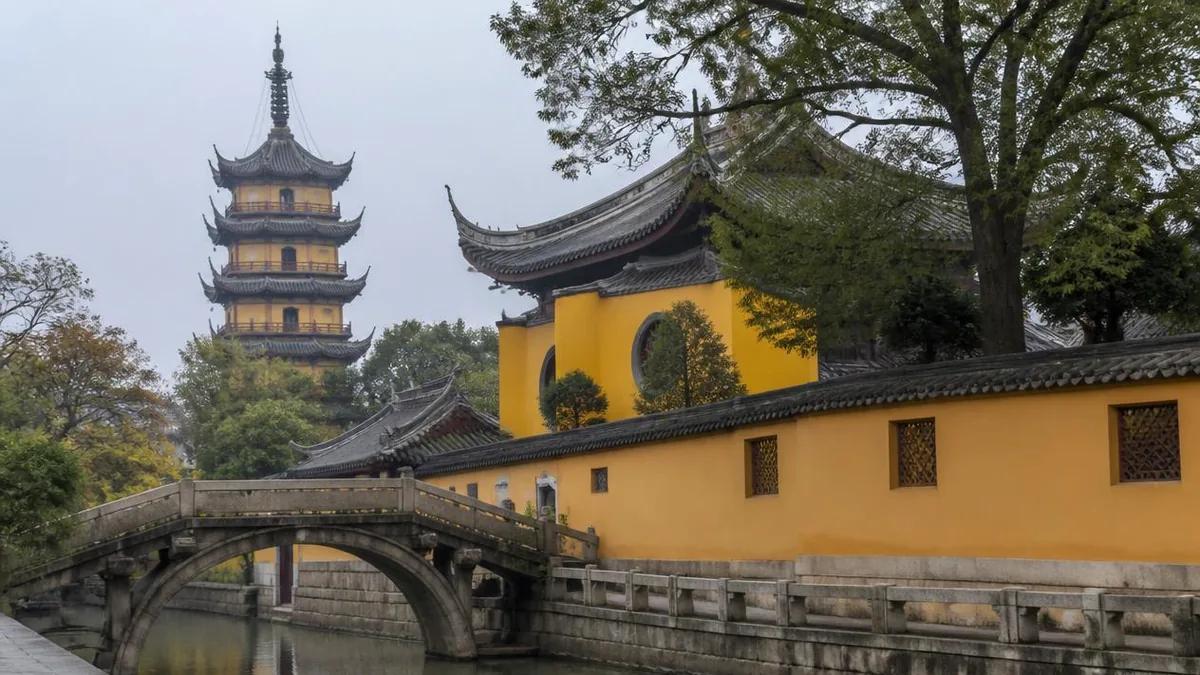
The layout runs west to east: a yellow spirit wall at the entrance, the Mahavira Hall at the centre with bell tower, bell room, arhat hall and the covered stele gallery around it, then the Hanshi Hall, and at the far east the Puming Pagoda of 1995, a timber pagoda in Tang style whose height is reported as 42.2 metres in some sources and 52 in others.
During the Cultural Revolution the temple was gutted, its images damaged and its collections seized; it served as a Red Guard headquarters and a place of detention and interrogation, and there were deaths under beating. The elder monk Xingkong took protective measures beforehand, which is why the steles, sutras and arhat images survived; he was sent to the countryside in 1968. The temple reopened after repairs from 1978 and was among the first batch of nationally designated open temples in 1980.
The bell is gone, and so is the bell that replaced it
If you take one fact away, take this: the bell Zhang Ji heard has not existed for a very long time, and neither has its most famous successor.
The Ming bell cast by Benji is gone. In the late Qing a story spread that the temple’s Tang bell had been carried off to Japan. The Japanese museum director Kono Taku recorded in a travel account published in 1908 that it had been looted around the time of the Eight-Nation Alliance, sold on through Japanese hands, and melted down for a new bell by a temple in Toyama that did not know what it had. When the Jiangsu governor Chen Kuilong asked Japan to return it in 1905, the Japanese side, having found nothing to return, temporised and cast a replacement instead.
The man who organised that replacement was Yamada Kanzan, a Japanese seal-carver and Sōtō monk who had studied in China under Wu Changshuo and knew Itō Hirobumi well. He searched Japan for the bell, failed, had a new one cast, and asked Itō to compose the inscription. So one of the two hundred-year-old bells now at Hanshan Temple was made in Japan and carries the words of a Japanese prime minister. The other, from 1906, was made in China at Chen Kuilong’s direction.
Then there is the big one: a 108-tonne bell cast for the temple in a Wuhan foundry, about 8.5 metres tall and 5.2 metres across the mouth, engraved with the Lotus Sutra at a reported 70,094 characters. Its date is given as 2005 in one account and 2007 in others.
Stand under any of them and the honest thought is there: this is the sound of a poem being maintained, not the sound the poem recorded.
Why Japan knows this poem
Hanshan Temple’s standing in Japan is not a tourism-office claim. It is documented, and it is old. The mechanism is anthologies: two Chinese poetry collections were widely read in Japan, the Tang Shi Xuan and the Santaishi, and this poem is one of the very few appearing in both. That put it in front of Japanese readers for centuries, and it remains part of the Chinese-literature curriculum in Japan as well as China.
It went deeper than reading. The Noh plays Mii-dera and Dōjōji both quote the poem, using an older textual variant — so it was embedded in Japanese theatre by the Muromachi period. In 1876 the Japanese foreign minister Soejima Taneomi visited and composed a parody skilled enough to startle his Qing hosts. Yamada Kanzan built a branch Hanshan Temple at Chōshi in Chiba prefecture in 1915, and another Hanshan-ji was founded at Ōme, west of Tokyo, in 1929. A 1940 Japanese wartime film set in China carried the song Suzhou Serenade, whose lyric names the temple’s bell.
The New Year’s Eve bell-ringing is the living end of this: a substantial annual event drawing visitors from Japan and Korea as well as China, booked and charged separately from ordinary admission. Some accounts date the modern revival to 1979; that year is repeated widely but could not be verified here against a source we could open, so treat the custom as demonstrable and the founding year as unconfirmed.
River maples or river village: a textual quarrel
The second line has a nine-hundred-year-old variant, and the temple contains the evidence. Several early texts — the Song encyclopaedia Wenyuan Yinghua, Gong Mingzhi’s Zhongwu Jiwen, Hong Mai’s collection of Tang quatrains — read the phrase as river village rather than river maples. The Noh plays quote it that way too, which tells you they worked from those older texts. But the earliest surviving source of all, Gao Zhongwu’s anthology, reads river maples, as do Wang Anshi’s Tang selection and Fan Chengda’s Suzhou gazetteer.
The Qing scholar Yu Yue, who cut the temple’s present poem stele in 1906, argued the case on the back of that stele. The Song stele by Wang Gui was lost, he noted, and Wen Zhengming’s Ming stele so worn that the disputed character could not be read; he followed the common text and wrote maples while insisting the old village reading should not be buried, ending a poem of his own with the line that one character here is worth a thousand in gold.
There is a further wrinkle. Maple Bridge was originally written with a different character meaning sealed — a functional name for a bridge on a checkpoint route — and was reinterpreted after the poem became famous. One Song account says Wang Gui simply miswrote the character when carving his stele, and the name followed the error. A modern reading proposes that the disputed words are not trees at all but the two bridges, River Village Bridge and Maple Bridge, which stand a short walk apart to this day.
None of this is settled, and all of it is visible: the stele gallery holds the recut Yu Yue stele, and the two bridges are outside.
Five old things, and how to walk them
The temple sits inside the Fengqiao scenic area, and local usage groups the site into five old things — a better itinerary than any ticket map.
The old temple is the compound above. The old bridges are Maple Bridge, an arched stone bridge about a hundred metres north of the temple, and River Village Bridge near the south gate, which for many pilgrims is the actual approach. Both are Tang in origin; both were rebuilt in the Tongzhi reign of the Qing.
The old pass is Tieling Pass, built in 1557 as a fortified gate tower against the coastal raiders known as the wokou. It was one of Suzhou’s three passes and is the only one still standing. Repaired in 1829, its upper storey became a literary shrine the following year, then decayed until a restoration in 1986–87 rebuilt the crenellations and put a single-storey hall on the platform, which measures about 15 metres across the front, 10.2 deep and 7 high. On 27 April 1949 People’s Liberation Army units broke the defensive line here and entered Suzhou through this gate.
The old town is the Fengqiao street frontage, redeveloped at the cost of most of what made it old, and the old canal is the Beijing–Hangzhou Grand Canal running past all of it. A temple, a bridge, a pass and a town exist here at all because traffic had to pass this point.
The site is rated 4A, not 5A. Reports say the scenic area became free to enter from December 2019, with the temple ticketed separately, but arrangements here have changed more than once. Confirm at the gate on the day, and if you want to strike a bell, ask first which one you are allowed to strike.
Then listen. Whatever you hear was cast within living memory. The poem is the only thing here that is genuinely twelve hundred years old, and the only thing that never needed rebuilding.
The LoreLens app can identify temple hall types, stele inscriptions and bell forms while explaining the history attached to them.
Location profile
Where it is

Frequently asked questions
Is the bell in the poem still here?
No, and none of its replacements are the original either. That is the most honest sentence anyone can say about this temple. Whatever bell was ringing in the eighth century is long gone. A large bronze bell cast under the Ming Jiajing reign by the monk Benji is also gone. A story circulated in the late Qing that the old bell had been carried off to Japan; a Japanese museum director recorded in 1908 that it had been sold on and melted down for scrap in a temple in Toyama, and when a Chinese provincial governor formally asked for it back in 1905 the Japanese side could not produce it. What stands today is two bells from around 1906 — one cast in China, one cast in Japan and inscribed by the Japanese prime minister Itō Hirobumi — plus a 108-tonne bell cast in Wuhan, about 8.5 metres tall and 5.2 metres across the mouth, engraved with the Lotus Sutra. Its completion date is given as 2005 in one account and 2007 in others.
Are the buildings Tang dynasty?
Almost none of them. The temple has burned or been destroyed repeatedly: in the fighting between Zhang Shicheng and Zhu Yuanzhang in 1366, by fire in 1618, again in 1711, and in the Taiping war in 1860. What you walk through today is essentially a rebuild of the very end of the Qing, dated to 1906, with later additions. The Puming Pagoda at the eastern end of the compound is newer still, built in 1995; its height is given as 42.2 metres in some sources and 52 metres in others, and the two figures have not been reconciled. Some individual objects are older than the halls that house them, including steles in the covered stele gallery. Read the compound as a late-Qing and modern temple that preserves a much older name and a much older story.
Did the poet-monk Hanshan actually live here?
It is doubtful, and the doubt is old and specific. The temple's name is traditionally derived from Hanshan, the eccentric Tang poet-monk usually paired with Shide, who is said to have come here in the Zhenguan era. But a Ming-dynasty account of the temple's restoration places Hanshan's hermitage here in the Yuanhe era, 806 to 820 — roughly half a century after the poem was written. The same account credits the founding of the temple to the Chan master Shitou Xiqian, who died in 790, before Hanshan is said to have reached Suzhou at all. On top of that, the temple name is not attested in surviving Tang or Song documents and appears no earlier than a fourteenth-century Suzhou gazetteer. Some scholars therefore argue that in the poem the phrase was not a proper name at all but simply meant a temple on a cold hill.
How do I visit, and is it a 5A site?
It is 4A, not 5A. The temple sits in the Fengqiao scenic area on the west side of Suzhou, on the Grand Canal, and the area is usually described in terms of five old things: the temple, the two bridges, the Tieling Pass gate tower, the old Fengqiao town street and the canal itself. Half a day covers all of it comfortably. Reports say the Fengqiao scenic area became free to enter from December 2019, while the temple itself and bell-ringing have generally been ticketed separately — but admission arrangements, opening hours and whether visitors may strike the bell all change, so confirm on the day. New Year's Eve bell-ringing is a real and long-running event here that draws Japanese groups, and it is booked and priced separately from ordinary admission.
Sources and further reading
Background references for the history and place names in this guide. Opening hours, ticketing and access change often — always confirm with official local information before travelling.