Jiangsu · Suzhou
Lion Grove Garden: The One Where the Rocks Won
Most Suzhou gardens are organised around water. This one is organised around a limestone maze that swallows the rest of the design — and both the name of the garden and the family who rebuilt it come with disputes attached.
Walk into most Suzhou gardens and the first thing that organises your movement is water. A pond sits in the middle, the buildings arrange themselves around its edge, and the path is essentially a circuit of viewpoints.
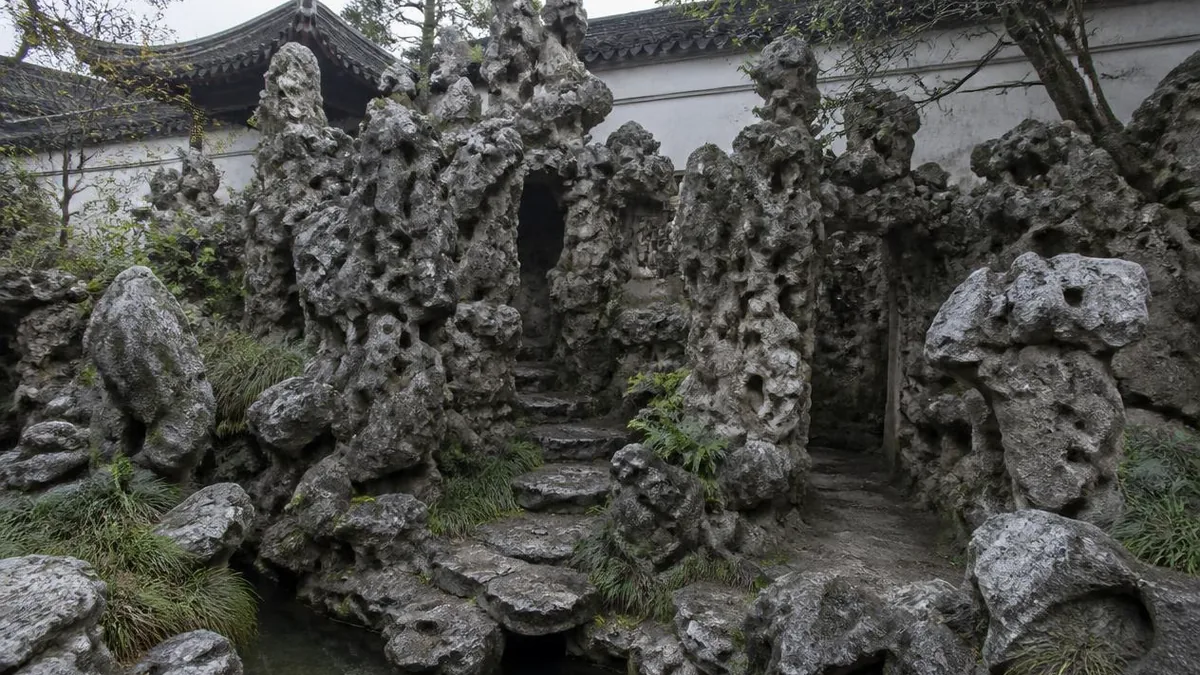
The Lion Grove Garden does something else. At 23 Yuanlin Road in Suzhou’s Gusu district, immediately next door to the Humble Administrator’s Garden and the Taiping Loyal Prince’s palace, sits a garden of roughly 1.1 hectares in which a pile of Lake Tai limestone has effectively eaten the plan. The pond is still there. But the thing people queue for, get lost in, photograph badly and remember is a grotto of about 1,154 square metres with caves on three levels, and everything else in the garden has been arranged to serve it.
One historian of Chinese gardens put the significance bluntly: of all the famous rock gardens in history, only one has survived, and this is it. That single sentence is why the garden is worth an hour even if you have already seen four others this week.
A garden where the rockery won
The rockery divides broadly into two, and the division is the first thing to notice.
The eastern mass is the dry rockery, piled mainly south of the Pointing-at-Cypress Studio, and its top carries old trees, including one so contorted it is nicknamed the Soaring Dragon. The western mass is the water rockery, where the stone runs down into the pond and the paths run along and sometimes under the water line.
Inside, the numbers get slippery. English accounts describe nine paths winding through twenty-one caves on three levels; Chinese accounts describe nine rockery ranges and twenty-one caves. Twenty-one is the number everyone agrees on. Nine is counted differently depending on whether the writer means routes or ridges — a small thing, but a good example of how garden statistics are quoted without checking.
What the maze produces is a specific and rather modern sensation: you can see the person you came with, hear them clearly, and be unable to reach them for several minutes. Visitors are funnelled into the same passages, so at busy times you queue inside a rock. The formal western entrance is the passage known as the Eight Trigrams Formation, reached across the Jade Mirror Bridge from the Pointing-at-Cypress Studio, and the celebrated stone peaks stand on top of the grotto rather than inside it.
Two stories about the name, and no verdict
The garden’s name has two competing explanations, and both are old.
The first is Buddhist and personal. The garden was made for the Chan monk Weize, known by his style name Tianru, who wanted to commemorate his own master, the abbot Zhongfeng Mingben, who had attained enlightenment at Lion Cliff on Mount Tianmu near Lin’an. On this reading the name is a memorial to a place, and the original written form of “lion” was the older Buddhist transliteration rather than the ordinary word for the animal.
The second is visual. The garden was full of bamboo, and among the rocks stood a peak that looked convincingly like a lion. On this reading the name describes what you can see. A related strand connects the lion imagery to the roaring lion of Buddhist scripture, which makes the two explanations less mutually exclusive than they first appear.
Both are in circulation in the garden’s own materials. Neither has the kind of documentary support that would settle it. Take them as two readings of the same word rather than a puzzle with an answer, and notice that the ambiguity is doing useful work: a garden that is simultaneously a memorial to a teacher and a field of animal-shaped stones is a more interesting object than either alone.
1342: built by disciples, for a monk
The founding is dated to the second year of the Zhizheng reign, 1342, under the Yuan, and the origin is monastic rather than aristocratic. Tianru’s disciples pooled money, bought land and built a Chan retreat so that their teacher would have somewhere to live. The garden formed part of the Bodhi Orthodox Monastery.
The early garden is described as small — around 6,670 square metres — and consisting essentially of bamboo and strange rocks. A Yuan-dynasty record of the garden speaks of ten thousand bamboo plants. The named features that survive in the record are the ones you still find on plaques: the Standing-in-Snow Hall, the Cloud-Reclining Chamber, the Pointing-at-Cypress Studio, the Asking-the-Plum Pavilion, and rock peaks including Lion Peak, Holding Sunlight and Spitting Moon.
Two of those names carry stories worth knowing before you see them. Pointing-at-Cypress refers to a Chan exchange, and the studio originally faced a Song-dynasty cypress that no longer exists. Standing-in-Snow refers to the Northern Song scholars Yang Shi and You Zuo, who waited outside while their teacher Cheng Yi slept, and by the time he woke the snow was a foot deep. This is a garden that expects you to have read something.
Ni Zan’s painting, and what it proves
The Lion Grove was famous fast. Poets and scholars came to sit in Chan, and wrote; the resulting poems and paintings were gathered into a collection of the garden’s scenes. Zhu Derun painted it. Xu Ben painted twelve views of it.
And in 1373 the great Yuan painter Ni Zan produced a handscroll of the Lion Grove, which is the single most cited artefact in the garden’s history.
Local tradition goes further and credits Ni Zan with designing the garden. Treat that carefully. The painting is documented; the design attribution is a strong tradition that would require the painter to have been involved three decades before the scroll. As with Wen Zhengming and the Humble Administrator’s Garden, the safe reading is that a famous painter recorded the place and later generations promoted him from recorder to author.
There is a second caveat that applies to every Chinese garden painting and is worth carrying: these are not surveys. When a modern rockery is compared to a fourteenth-century scroll and declared unchanged, the scroll is being asked to do work it was never built for.
Ruin, rebuild, ruin, rebuild
The chronology between Ni Zan and the twentieth century is the part most visitors never hear, and it is the reason the garden looks the way it does.
After Tianru died his disciples dispersed and the temple garden ran down. In 1589 a monk named Mingxing raised funds in Chang’an and rebuilt it, and it prospered again. Under the Kangxi reign the garden was separated from the temple — the moment it stopped being a monastery’s grounds and became a private property.
It was then bought by Huang Xingzu, prefect of Hengzhou, who renamed it the Wading Garden. In 1771 his son Huang Xuan came first in the imperial examinations, refurbished the family residence, and renamed the place the Garden of Five Pines. By the late Qing the Huang family’s fortunes had fallen and the garden was derelict once more.
That is at least four cycles of decay and rebuilding across roughly five hundred years, in a garden whose central attraction is made of loose stacked stone. Every one of those cycles involved repairing, replacing and adding rock.
The emperors who came, and the two copies they made
Imperial attention is a documented part of this garden’s story and it had consequences elsewhere in China.
The Kangxi emperor visited in 1703. The Qianlong emperor visited in 1765 and, by the Chinese accounts, more than once in total; he left a tablet inscribed True Delight in his own hand and wrote a set of poems about the garden. The pavilion built to house that tablet — the True Delight Pavilion — is conspicuously gilded and reads as imperial rather than scholarly, which is exactly what it is.
Then he copied it. Qianlong had versions of the Lion Grove built in the Changchun Garden of the Yuanmingyuan outside Beijing and at the Chengde Mountain Resort, where the imitation was named the Literary Garden Lion Grove. The Yuanmingyuan version is gone with the rest of that site.
This is a genuinely unusual line of transmission. Suzhou’s scholar gardens were normally the private art of men who had left or lost office. Here a specific one was inspected by an emperor and reproduced twice inside imperial parks — the private aesthetic taken up as state property, complete with a plaque saying he liked it.
1917: a pigment merchant buys a ruin
In 1917 the derelict garden was bought by Bei Runsheng, a Shanghai pigment magnate.
He spent heavily. The restoration ran to 1926, added a number of new features, and brought in a substantial collection of old stone-carved calligraphy rubbings, which is why the garden today counts something like seventy-one steles and twenty-five inscribed tablets alongside its twenty-two buildings, five carved wooden screens and thirteen ancient trees.
He also used modern materials — cement, steel reinforcement and coloured glass — and that decision has been argued about ever since. It is the honest frame for a visit: you are looking at a Yuan-dynasty conception, executed in Ming and Qing stone, consolidated in the 1920s with reinforced concrete by a man in the paint trade.
He renamed it back to the Lion Grove and prepared to open it to the public. The Japanese invasion ended that plan.
What happened next has two versions and both should be reported. The garden’s own signage says the Bei family donated the property to the government in 1949; Chinese accounts say it was taken into state ownership in 1954 from Bei Runsheng’s grandson Bei Huanzhang, after which it was repaired and opened. English sources put the public opening in 1956. Given that private property was being nationalised across the country in this period, “donated” and “nationalised” may be describing the same transaction from two directions. The dates are not reconciled and this article does not reconcile them.
The Pei connection, stated correctly
This garden is often introduced to English-speaking visitors as “I. M. Pei’s family garden,” and the detail attached to that sentence is usually wrong.
Bei Runsheng was I. M. Pei’s granduncle, not his grandfather. Several English reference sources say grandfather and the error has propagated widely. Pei’s grandfather was Bei Lit’ai, a Suzhou banker of the same generation as Bei Runsheng within the extended Pei clan of Suzhou. If in doubt, the formulation that survives checking in any language is that the garden was bought and restored by the Pei family of Suzhou.
What Pei himself described is straightforward and better than the mangled version. Born in Guangzhou in 1917 — the same year the garden was bought — and raised in Hong Kong and Shanghai, he was required by his grandfather to return to Suzhou each summer, and while there he spent time in this garden. He later credited that experience with two ideas that run through his work: that people and nature should coexist, and that a family means cohesion and history.
That is a real influence and it does not need inflating. He did not design anything here. He came here as a boy because his grandfather made him.
What to look at besides the maze
If you only do the grotto you will miss the parts that make the garden legible.
The Yanyu Hall near the entrance is divided front and back, and the two halves are decorated differently: the front was where the master of the house received male guests, the rear where the mistress received women. Beyond it the Small Square Hall is a true square with a large square window in each of two opposite walls, one framing wintersweet, the other framing what the garden calls the city’s mountain forest.
North of it stands the Nine Lions Peak, which is the garden’s own joke about its central conceit: at first glance the rock looks like nothing, then it resolves into nine lions playing, then it dissolves again. The garden’s own description says the merit lies precisely in the space between resembling and not resembling.
In the water rockery, look for the standing stone in the middle of the pond read as Bodhidharma in his monk’s cap crossing the Yangtze on a reed. In the dry rockery, find the cave called the Chessboard Cave, attached by legend to two of the Eight Immortals who got lost in the maze and settled down to play. Elsewhere: the Lakeside Pavilion that stays in your eyeline wherever you walk around the pond; the Cloud-Reclining Chamber, a square building sunk inside the rocks, whose name is a byword for a recluse; and the Hidden Fragrance and Sparse Shadow Tower, named from Lin Bu’s famous couplet about plum blossom, from which the garden claims you can actually see what the poem describes.
Two lists, one small garden, and the timing
The rating question comes up constantly and the answer is counterintuitive, so it is worth ending on.
The Lion Grove is 4A, not 5A. The 5A entry for Suzhou’s gardens is a bundle covering the Humble Administrator’s Garden, Tiger Hill and the Lingering Garden, and this garden is not in it. It is nonetheless a UNESCO World Heritage property, added in 2000 as part of the second batch of the Classical Gardens of Suzhou, and a national key protected cultural relic site since the sixth batch in 2006. Grade letters and heritage lists measure different things.
Practical consequences follow from the size. This is a small garden — about 1.1 hectares in total, roughly 0.88 of it open — with a single major attraction that can only be experienced by walking single file. It absorbs crowds worse than any other major Suzhou garden. Early on a weekday is not a nicety here, it is the difference between a maze and a corridor. After rain, some water-rockery paths flood; the garden treats this as a feature, but your shoes may not.
Everything transactional — hours, tickets, whether entry is timed, whether a combined ticket with the neighbouring garden is being sold — varies by season and by year. Confirm at the gate on the day.
Then go and stand on top of the grotto among the peaks. Six hundred years of monks, examination laureates, two emperors and one pigment merchant have all rearranged this pile of stone, and every one of them left it a maze.
The LoreLens app can identify Lake Tai rockery forms, garden hall types and inscribed tablets while explaining what they refer to.
Location profile
Where it is

Frequently asked questions
What exactly was Bei Runsheng to the architect I. M. Pei?
A great-uncle, not a grandfather. This is worth stating plainly because the English-language error is widespread, including in reference works: several sources describe Bei Runsheng, the Shanghai pigment merchant who bought the garden in 1917, as I. M. Pei's grandfather. He was not. Pei's grandfather was Bei Lit'ai, a Suzhou banker, and Chinese-language accounts consistently describe Bei Runsheng using the term for a grandfather's brother or cousin — a granduncle. Pei's own recollection matches this: it was at his grandfather Bei Lit'ai's insistence that he returned to Suzhou each summer, and while there he spent time in the garden his granduncle had purchased in 1917. If you want a formulation that is safe in any language, say the garden was bought and restored by the Pei family of Suzhou, of which I. M. Pei was a member.
Is the Lion Grove Garden a 5A site?
No, and this trips people up. It is rated 4A. The national 5A entry covering Suzhou's gardens is a bundled listing naming three components — the Humble Administrator's Garden, Tiger Hill and the Lingering Garden — and the Lion Grove is not one of them. It is, separately, a UNESCO World Heritage site: it was added in 2000 in the second batch of the Classical Gardens of Suzhou, which brought the inscribed total to nine gardens. It was also listed among China's sixth batch of national key protected cultural relic sites in 2006. So the two lists are not the same list, and a lower letter grade here does not mean a lesser garden.
How big is the rockery and how lost can you actually get?
The published figures vary in what they count. The grotto is usually given as about 1,154 square metres inside a garden of roughly 1.1 hectares, of which about 0.88 hectares is open to visitors. English sources describe nine paths threading twenty-one caves on three levels; Chinese sources describe nine rockery ranges and twenty-one caves. Take the twenty-one as the stable number and the nine as counted differently by different writers. In practice you can see and hear people a few metres away and still need several minutes of walking to reach them, which is the whole design intent. The passages are narrow, uneven, sometimes low, and after heavy rain parts of the water rockery flood. Wear shoes you can grip in.
Is anything here actually from the Yuan dynasty?
Very little that is architectural. The garden dates its founding to 1342, but it was derelict after its founding monk died, rebuilt in 1589, sold and renamed at least twice under the Qing, left derelict again in the late Qing, and comprehensively rebuilt between 1917 and 1926 with cement, steel reinforcement and coloured glass among the materials. What has the strongest claim to age is the stone itself and a group of ancient trees — the garden counts thirteen specimen trees, some of which are described as Yuan-period. The rock arrangement has been repeatedly repaired and added to, so treat individual peaks as long-standing rather than provably six hundred years old.
Sources and further reading
Background references for the history and place names in this guide. Opening hours, ticketing and access change often — always confirm with official local information before travelling.