Hebei · Chengde
Chengde Mountain Resort: Where Landscape Became Government
Walk from restrained palace courts to lakes, grassland and wooded mountains, then read Chengde's outlying temples as religious spaces within Qing political geography.
5A View location, maps and nearby scenic areasPass through Lizheng Gate and listen before seeking the postcard view. Muted timber, grey brick and compact courts come first; water, open grass and wooded ridges are released gradually. That controlled change of scale is the central experience of Chengde Mountain Resort.
This was both a summer residence and a place of government. Qing emperors escaped some of Beijing’s heat here, but also received envoys, conducted rituals and managed an empire of many peoples, languages and religious traditions.
Read five movements: palace, lake, plain, mountain, then the outlying temples beyond the wall. With one day, do not attempt all five in full; decide whether the resort landscape or temple complexes matter more.
Five landscapes, not one enormous park
The resort itself covers about 564 hectares, or 5.64 square kilometres. That figure describes the walled palace-garden. UNESCO’s property, Mountain Resort and its Outlying Temples, Chengde, includes components outside the wall, so heritage-boundary figures use a different area. They measure different things.
The small palace section gives way to lakes with islands and bridges, then a plain once used for riding and court events. The mountain district occupies most of the grounds. Major temples answer this landscape from outside the wall. Architecture grows sparser, so a roof across reeds or a temple beneath a ridge gains force from surrounding space. The 5A profile map supplies orientation; your legs reveal the real scale.
From 1703 to 1792: an imperial project across three reigns
Construction began in 1703 under Kangxi and continued through the Yongzheng and Qianlong periods, reaching its mature Qing form by 1792. Chengde was not one ruler’s holiday whim but a project refined over nearly nine decades as northern and western relationships changed.
Kangxi used the region while travelling toward the Mulan hunting grounds. Hunting combined physical training, court ceremony and politics: Qing rulers demonstrated martial identity while meeting Mongol nobles and other frontier elites. Memoranda, audiences and decisions continued outside Beijing. UNESCO inscribed the resort with its temples in 1994, recognising the relationship among buildings, water, plain, forest and sacred monuments—not isolated halls alone.
Plain buildings, carefully staged authority
The palace courts can feel unexpectedly restrained. The Hall of Simplicity and Sincerity is associated with aromatic nanmu timber rather than heavy paint. Rare material still signalled cost, but the visual language presented Chengde as disciplined retreat rather than urban spectacle.
“Resort to Escape the Heat” translates Bishu Shanzhuang, yet climate explains only part of it. Residence, audience and working spaces preserved court hierarchy: gates determined who could approach the emperor. Designers, bannermen, carpenters, masons, gardeners, translators, cooks, guards and stable workers made this moving capital function. Imperial mobility concentrated land, timber, food and skilled labour around the court; restraint should not make those costs invisible.
Lakes and the Seventy-Two Scenic Spots
Kangxi and Qianlong each named thirty-six scenic spots, forming the celebrated seventy-two. The titles joined poems, calligraphy and chosen viewpoints to the land. They were not a modern checklist: words trained visitors to connect a bend or pavilion with literary memory.
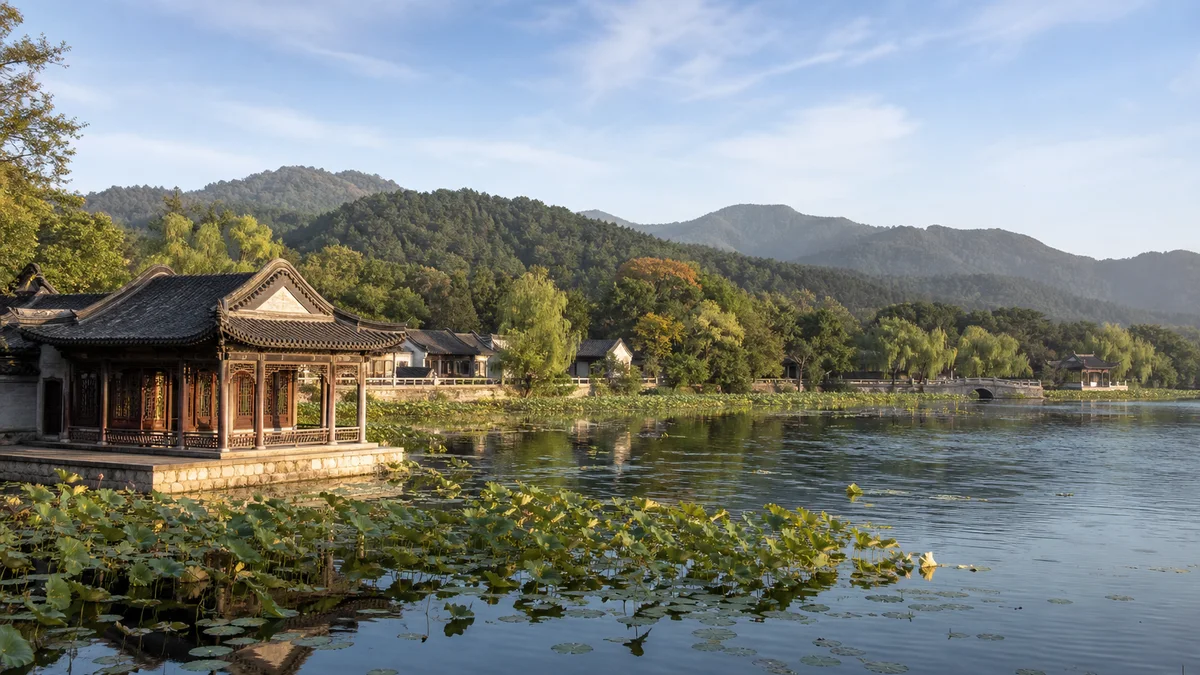
At the lakes, banks tighten and open, islands interrupt direct views, and roofs appear through willow or lotus. References to famous Chinese landscapes were reworked for northern terrain, climate and court use, not assembled as replicas. On one accessible shore, find a low roof against water, a bridge directing movement and a distant ridge with no building at its centre. The empty intervals explain the design. Water, vegetation and restored structures have changed, so this remains a managed landscape rather than a frozen Qianlong image.
Plain and mountain: leisure, logistics and surveillance
The plain accommodated horses, gatherings and spectacles associated with the Qing court’s Inner Asian equestrian identity. It also supported a large seasonal establishment. Service work and controlled access sustained what could otherwise look like effortless imperial freedom.
Mountain routes once linked valleys and viewpoints from which wall, city and outlying temples could be read together. Height brought cool air and picturesque distance, but also visibility over approaches: pleasure and security shared the terrain. Walking routes, closed zones and any hill shuttle or loop service can vary with weather, fire prevention, repair and daily operations. Check before making a distant pavilion essential to your plan.
The outlying temples were diplomacy in sacred form
“Eight Outer Temples” is a historical administrative label, not a simple count of everything built, surviving or open today. Think of a constellation beyond the resort wall, not one compound.
Puning, Putuo Zongcheng and Xumifushou served Buddhist devotion and imperial ceremony. Putuo Zongcheng entered into dialogue with the Potala Palace tradition; calling it an exotic copy misses its agency and setting. Xumifushou was built for the Sixth Panchen Lama’s 1780 visit. Mongol and Tibetan religious leaders, monks, translators and Qing officials acted within relationships of faith, patronage, negotiation and unequal imperial power. This was neither uncomplicated “ethnic harmony” nor architecture alone imposing obedience.
Visit religious spaces as religious spaces
In active or ritually meaningful areas, lower your voice and follow posted routes. Cross rather than stand on thresholds where local practice indicates; do not touch statues, murals or offerings. Ask before photographing monks or worshippers, and obey interior photography notices.
At Putuo Zongcheng, read the sequence of gates, terraces and rising walls before seeking the upper platform. At Puning, notice how front courtyards lead toward a different architectural vocabulary behind. A closed hall does not erase that spatial story. Temple hours, restoration closures and admission combinations can differ from the resort and one another. Confirm official notices; a temple pass may change scope, and transfers take time.
Build a route around one real priority
For a first resort visit, follow palace → lake → plain, adding only a feasible mountain section. This makes the change from government space to landscape legible. A full hill circuit can consume the time needed to look closely below.
For a temple block, choose two contrasts rather than racing every gate. Putuo Zongcheng with Puning shows different responses to Tibetan Buddhist patronage; Xumifushou adds the Panchen Lama story if open and reachable. Verify separate or combined admission. For a lower-strain route, remain mainly in the palace, accessible lakeside and plain. Thresholds, gravel and distance remain, while mountains and temple terraces add slopes and stairs. Ask about current step-free access, toilets, wheelchairs and transport.
Photograph relationships, then watch your footing
In the palace, frame one court through another to show hierarchy. At the lake, leave room for water and mountain around a low pavilion. A person or tree line gives the plain scale. From an authorised mountain viewpoint, connect the resort wall with temples beyond. At Putuo Zongcheng, include smaller white walls below the red central mass so the upward sequence remains visible.
Weather, haze, vegetation and access control whether a classic panorama appears; no season guarantees one. Check hall notices, keep tripods out of narrow routes and do not assume drones are permitted. Rain makes stone and shaded paths slippery; winter adds ice and wind, while summer can bring heat and storms. Shoes, water, layers and a willingness to turn back matter more than one image.
Leave with the whole landscape still unresolved
Return mentally to the quiet palace courts. They were the administrative hinge of an engineered landscape, a seasonal court and a system that used mobility, ritual and religious patronage to hold different regions in relationship.
The Eastern Qing Tombs and Western Qing Tombs arranged ancestry and legitimacy after death; Jinshanling Great Wall shows another northern meeting of terrain and state power. Chengde joins government, leisure, diplomacy and devotion in one field of view. It is both a landscape masterpiece and a record of concentrated imperial resources; its temples are sacred inheritances within an unequal political order. The calm is real, but so are the labour and negotiations that made it.
LoreLens App can identify Chengde’s halls and temples, then connect them to the larger Qing landscape.
Location profile
Where it is

Frequently asked questions
How much time should I allow for Chengde Mountain Resort and the temples?
Allow most of a day for a selective resort visit, and consider another half-day or day for two or three outlying temples. Current open areas and mountain transport can change, so choose priorities from the official map before entering.
Are the outlying temples inside Chengde Mountain Resort?
No. They stand beyond the resort wall, mainly to its north and east, with separate entrances. The UNESCO property links them historically, but a resort ticket should not be assumed to cover temple admission. Check current combinations officially.
What does the name ‘Eight Outer Temples’ mean?
It is a historical administrative label, not a reliable count of every temple built, surviving or open today, and not necessarily a current ticket name. Use the official map to identify accessible complexes.
Is Chengde Mountain Resort accessible for visitors with limited mobility?
The palace and parts of the lake and plain offer the gentlest terrain, but thresholds, uneven paving and long distances remain. Mountain paths and many temples add steep slopes or stairs. Confirm step-free entrances, toilets and any operating shuttle before relying on them.
Sources and further reading
Background references for the history and place names in this guide. Opening hours, ticketing and access change often — always confirm with official local information before travelling.