Hebei · Baoding
Western Qing Tombs: Reading an Imperial Landscape in Yixian
Follow sacred ways from stone gates to burial mounds at the Western Qing Tombs, then compare how four emperors used architecture, terrain and memory across a dispersed royal necropolis.
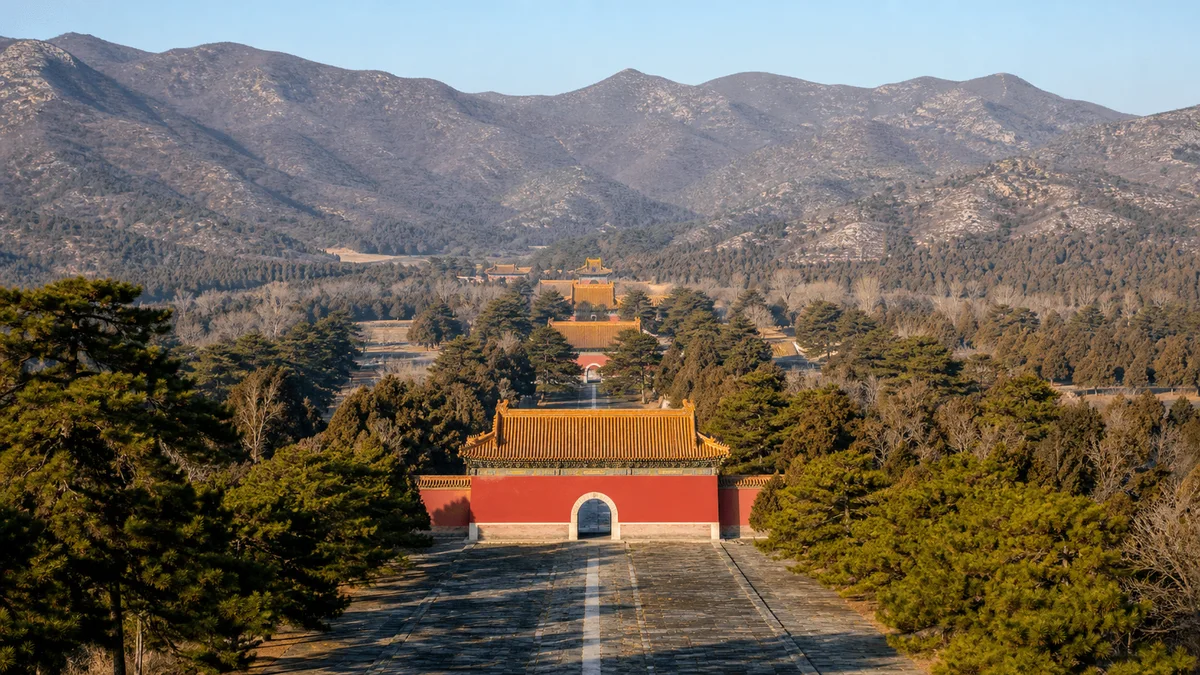
5A View location, maps and nearby scenic areasStand before a spirit-way gate and look through it. Stone animals, a pavilion roof and dark hills may align, while the burial mound remains hidden. The Western Qing Tombs reveal authority through approach, threshold and distance.
The Western Qing Tombs—Qīng Xīlíng—lie in Yixian County, Hebei. They are not one walled cemetery. Imperial, empresses’ and other royal tombs occupy separate valleys, connected by ritual hierarchy rather than one path.
Open the Western Qing Tombs 5A scenic-area profile for location and coordinates, then use the current site map to identify which complexes are open. The tourist area, protected heritage property and broad historic landscape have different boundaries.
Begin with four imperial tombs, not one monument
Tailing is the central reference. Construction began in 1730 for the Yongzheng Emperor, who died in 1735; its long sacred way and full ceremonial architecture established a new Qing royal burial area west of Beijing.
His son Qianlong returned to the Eastern Qing Tombs, but later rulers used both necropolises. In the west, Changling holds Jiaqing, Muling Daoguang and Chongling Guangxu. They span the high Qing, nineteenth-century strain and the dynasty’s end. Chongling was completed after the 1911 Revolution.
Smaller tombs are not decorative satellites. Empresses, consorts, princes and princesses received places expressing court rank and family relationship. Surviving buildings and access vary; read the map as social order across terrain.
This dispersed pattern explains why published area figures and route times differ. Some describe a heritage protection zone, others a wider scenic landscape or a particular tomb precinct. For a visitor, the useful unit is not total acreage but the distance between today’s open gates.
Walk the sacred way as a sequence of power
At Tailing, the spirit way is not empty ground. Gates, bridges, tablet pavilions, stone figures and changing enclosures controlled how a procession approached the dead ruler. Walking the long axis was part of ceremony.
Stone officials and animals present service, vigilance and court order. Groups and spacing differ among tombs, so use local labels rather than a generic Ming-tomb checklist.
Farther inward, the Long’en Gate and Long’en Hall formed the main above-ground ritual court. Beyond lie restricted thresholds, the Soul Tower, and curved treasure city around a burial mound or baoding. An underground palace is only the last chamber in a larger architecture of memory.
This progression moves from public proclamation to guarded absence. Even where later damage or restoration has altered individual buildings, the sequence still teaches who could approach, where they stopped and how imperial rule attempted to continue beyond death.
Why Yongzheng moved west remains an open question
Yongzheng first considered a site within the Eastern Qing Tombs region, then chose the Yixian landscape. Official scenic histories refer to concerns about the earlier site’s soil or geomantic fitness and praise the western terrain. Administrative practicality, drainage, materials and the emperor’s judgement also belonged to any real selection process.
Popular accounts make the move a confession: Yongzheng supposedly feared burial beside Kangxi because of disputed succession or guilt. Repetition is not proof. Records establish site reconsideration more securely than one hidden motive.
Feng shui nevertheless shaped historical decisions. Hills behind, open ground and water before, enclosing ridges and an oriented axis signalled auspicious relations among ancestor, dynasty and cosmos. It was a cultural system, not modern science; drainage and stable ground could reinforce the choice.
Stand where the axis meets the hills and keep both levels visible: the terrain is observable; its auspicious meaning is a historical interpretation; the claim that it proves Yongzheng’s private fear is legend unless supported by evidence.
Four emperors changed one architectural grammar
Tailing offers the most expansive statement of the western group. Its approach, monuments and courts use inherited Ming–Qing imperial tomb forms to present Yongzheng as founder of a legitimate new burial branch, not an exile outside the dynasty.
Changling continues much of that formal language for Jiaqing. Compare the height of its buildings, the rhythm of courtyards and the relationship between hall and mound rather than assuming “later” means a simple reduction.
At Muling, Daoguang pursued a more restrained scale after abandoning an earlier tomb project in the eastern necropolis when water and site problems emerged. The western complex is known for relatively unpainted timber surfaces and concentrated carving in its main halls. Restraint here was carefully made, not the absence of craft.
Chongling, built for Guangxu, is the last chapter. Work continued after the Qing fell, so an imperial tomb was completed without a reigning dynasty. Looting and disturbance caused damage, but its surviving plan and materials tell more than a treasure mystery.
“Serve the dead as the living” required many living hands
The classical ideal “serve the dead as one served the living” comes from older ritual tradition, not a unique inscription. It explains gates, audience-like halls, service offices, offerings and staff: death reorganised court ritual.
Emperors dominate the names, but quarry workers cut stone, kiln workers fired bricks, carpenters fitted roofs, painters renewed colour and porters moved materials. Guards and ritual staff then maintained the precincts.
Monumental burial consumed labour and resources for one family’s hierarchy, while makers remain anonymous. Women buried here are often defined through husbands or sons; interpretation should recover titles and court roles without gossip.
Look at a worn threshold or repaired roof bracket. The imperial project survives because successive, mostly unnamed people built, guarded, recorded and conserved it.
World Heritage protects a landscape, not frozen scenery
The Western Qing Tombs form part of UNESCO’s serial property Imperial Tombs of the Ming and Qing Dynasties, inscribed and extended in stages. The serial approach links tomb groups in several provinces: no single gate represents the whole tradition, and local differences matter within shared ritual and architectural principles.
Conflict, neglect, reuse, theft, fire and weather affected the complexes unevenly. Conservation works with original material and later repairs. Form and craft can remain authentic when individual tiles or timbers are replaced; pretending nothing changed is less honest.
Protection also includes sight lines, hills, water systems, old trees and the space between tombs. A new building outside a wall can still damage the designed relationship between axis and mountain. Conversely, keeping every field visually “ancient” can ignore the needs of communities who live within the larger landscape.
UNESCO status does not guarantee that every hall is accessible. Closing a chamber for moisture control, structural work or security may be part of protection rather than a service failure.
Build one coherent day from dispersed sites
For a first visit, give Tailing the morning. Walk its sequence from the outer monuments towards the mound rather than entering at the nearest inner gate. Then choose one contrast: Muling for architectural restraint, Chongling for the dynasty’s final phase, or Changling for continuity, depending on current opening.
Do not promise yourself all four imperial tombs plus every secondary compound. Transfers consume time, and a combined ticket does not necessarily mean every building, underground chamber or exhibit is open. Confirm current admission, identity-document requirements, shuttle or vehicle rules and last entry through the official scenic-area channel.
If transport is limited, ask staff which open pair can be linked reliably. Keep enough margin to return before services end. Distances that look small on a schematic map can include long roads and separate gates.
Treat any underground palace as one part of the route, not its climax. Read the above-ground sequence first; otherwise the visit collapses into a search for burial objects and misses the political landscape built around absence.
Photograph respectfully and plan for distance
The best wide composition often places a gate or stone figure against the hills, showing how architecture borrows scale from terrain. A moderate lens preserves the length of the axis; details such as roof tiles, carved ramps and unpainted timber explain differences among tombs.
Interior photography, flash, tripods, drones and professional equipment may be restricted by room and day. Follow current signs. Do not touch carved stone, cross ropes, climb mound walls or pose on offering platforms. Underground spaces are graves, not horror sets; avoid intrusive or comic staging.
Long level approaches still include bridges, thresholds, stone steps and uneven paving. Wheelchair users and travellers with limited stamina should ask which open precinct offers a continuous accessible route and whether a shuttle accepts mobility equipment. Availability can change with conservation work.
Yixian summers can be exposed and hot; winter wind moves directly along open axes. Carry water and sun protection, add windproof layers in cold weather, and use shoes that grip worn stone after rain or snow.
Leave by turning from mound to mountain
At the treasure city, the axis seems to end. Turn around. Gates and halls now recede towards the open landscape, while the mountain that framed the emperor’s afterlife stands behind you. The return view restores the living world to the composition.
The Western Qing Tombs are neither proof of perfect dynastic harmony nor a collection of palace gossip in stone. Yongzheng’s choice created a new centre; later emperors repeated and revised its grammar; workers and communities carried the material cost; revolution left the last tomb to be finished in another political age.
Respecting the site means keeping uncertainty where evidence is uncertain and distance where the dead require distance. The long approach has done its work if the mound feels less like hidden treasure and more like the final, guarded point in a landscape of power and memory.
Compare this western necropolis with the Eastern Qing Tombs to see how one dynasty distributed ancestry across two landscapes. For a different relationship between stone, terrain and modern access, continue to Baishi Mountain.
LoreLens App can help identify gates, halls, sacred-way figures and burial architecture at the Western Qing Tombs, then explain how ritual and landscape shaped their meaning.
Location profile
Where it is

Frequently asked questions
Why did the Yongzheng Emperor establish a western tomb area instead of joining his father at the Eastern Qing Tombs?
Yongzheng did establish Tailing in Yixian after considering a site in the eastern necropolis. Official and historical accounts discuss the western site's terrain, soil, drainage and geomantic suitability; later stories add political or family motives. The evidence does not reduce his decision to one certain explanation, so claims that he fled his father's judgement or followed only feng shui should be treated as interpretation, not fact.
Which tomb should I see first at the Western Qing Tombs?
Tailing, built for the Yongzheng Emperor, is the clearest starting point because it founded the western necropolis and preserves its most extensive ceremonial sequence. Then compare one different complex—often Muling or Chongling if currently open—rather than rushing among every named tomb.
Can visitors enter the underground palaces?
Access varies by tomb, conservation work and current management. A burial mound, treasure city or underground chamber shown on a map is not automatically open, and interior photography may have separate rules. Check the official scenic-area notice on the day and never try to enter a closed or damaged structure.
How much time is needed, and can I walk between all the tombs?
Allow most of a day for Tailing and one or two contrasting tomb areas. The imperial complexes are dispersed across a large landscape, so walking between all of them is impractical for most visitors. Confirm current shuttle, private-vehicle, ticket and last-entry arrangements before setting out.