Jiangsu · Nanjing
Sun Yat-sen Mausoleum: A Republic in Imperial Grammar
The 1925 competition brief asked for a Chinese tomb the public could walk into, with standing room outside for fifty thousand. What Lu Yanzhi drew is an emperor's axis with the emperor's privacy removed — and he died at thirty-four, before the funeral he had designed the stairs for.
5A View location, maps and nearby scenic areasPurple Mountain, on the eastern edge of Nanjing, has been taking in the dead for a very long time. Sun Quan, who made this city a capital in the third century, lies under Plum Blossom Hill — which is why the Ming spirit road bends around it instead of running straight. Zhu Yuanzhang, founder of the Ming, is sealed inside the hill of Duilong Fu. And on the south slope of the middle peak, higher than either of them, is the tomb of a man who spent his life trying to end the system they belonged to.
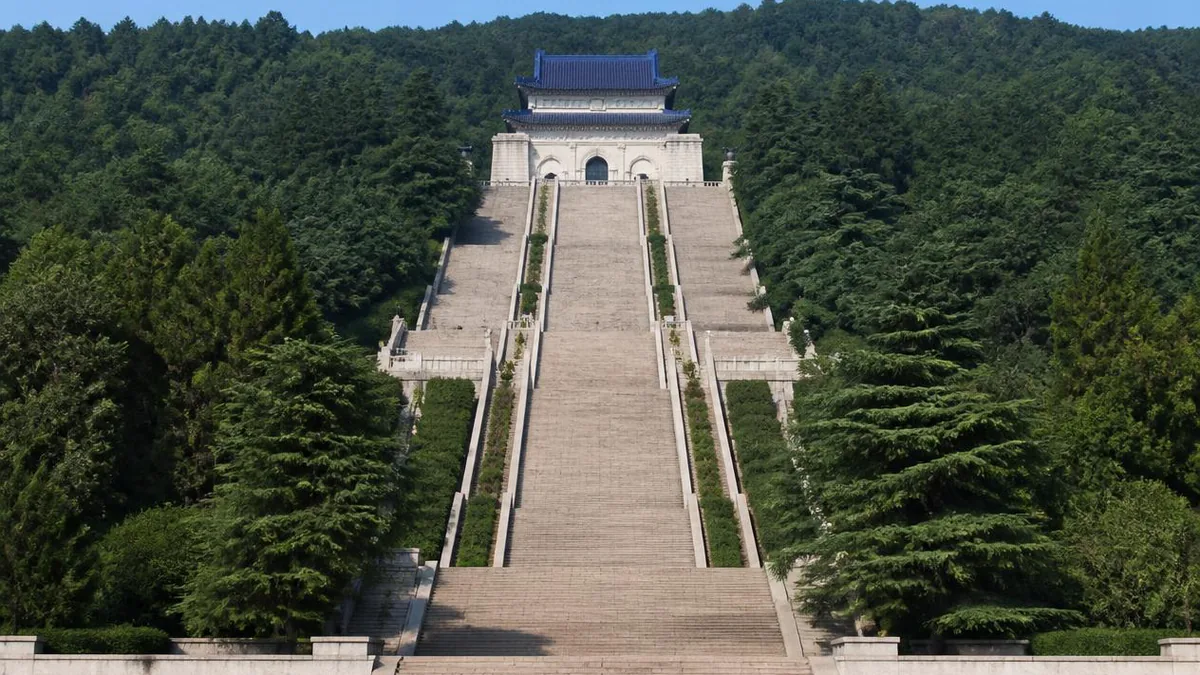
That is the problem the Sun Yat-sen Mausoleum had to solve, and you can read the solution off the ground as you climb. The vocabulary is imperial: an approach road, a gate, a stele pavilion, an axis rising through platform after platform to a hall with a double-eaved roof. The grammar is not. The design was chosen by open competition, the tomb was required to be walked into rather than sealed, and the brief demanded standing room outside for fifty thousand people.
A competition, and a brief that ruled out a tomb mound
Sun Yat-sen died in Beijing on 12 March 1925, of gallbladder cancer. He had asked the day before to be preserved as Lenin had been and to be buried at Nanjing, because that was where the provisional government of the Republic had been founded. His body was embalmed at the Peking Union Medical College Hospital and placed temporarily in the Temple of Azure Clouds in the Western Hills.
A burial preparation committee of twelve formed on 4 April 1925: choose the site, survey it, acquire the land, run a competition, tender, build.
The competition rules were adopted on 13 May and advertised in the Chinese press from 15 May, with an English notice in a Shanghai foreign paper; one English-language account gives 5 May for the advertisements, so the exact day is not settled.
The requirements are the interesting part, because three of them are anti-imperial:
- the sacrificial hall and the burial chamber had to be enterable by the public;
- there had to be open ground outside for 50,000 people to assemble;
- the style had to be “ancient Chinese,” or a new form created out of the spirit of Chinese architecture;
- stone and reinforced concrete only, no brick and timber, so it would last;
- plain and solemn, not luxurious, with construction held to 300,000 yuan.
The last figure failed spectacularly: the final cost is given as over three million.
The jury, and a thirty-one-year-old winner
More than forty entries arrived by 15 September 1925. The advisory jury was not a panel of architects: a civil engineer, Ling Hongxun; a sculptor, Li Jinfa; a painter, Wang Yiting; and a German architect, Emil Busch.
They liked one scheme for reasons about temperament rather than style — it “accorded with Chinese conceptions,” it was “plain and substantial,” its “form and spirit closely resembled Mr Sun’s own bearing.” On 20 September the committee took Lu Yanzhi’s design as first prize, Fan Wenzhao’s as second, Yang Xizong’s as third. The drawings were exhibited publicly for five days, and on 27 September the choice was confirmed and Lu appointed to run the work.
Construction was tendered in three parts to three Shanghai firms, at 443,000, 268,084 and 419,706 taels of silver. Ground was broken on 15 January 1926; the foundation ceremony followed on 12 March, the first anniversary of the death. Warlord politics slowed everything until the Nationalists took Nanjing as their capital in 1927.
Higher than the Ming founder, and nobody higher still
Site selection took three separate climbs in April 1925 by Sun’s widow Song Qingling, his son Sun Ke and members of the committee.
Two conditions came out of those walks, and both are on the record. The tomb had to be higher than Ming Xiaoling, and it had to be placed so that “no one can build a tomb higher up.” Song Qingling added a third: not on the summit, but on the gentle southern slope below it. They settled on the south face of the middle peak, Zhongmaoshan, which reaches 351 metres; the sacrificial hall stands on the tenth platform at about 158 metres.
Land acquisition was harder than site selection. Negotiations with the military authorities then holding Nanjing produced an enclosure of only 2,000 mu, far short of the plan. After 1927 the park expanded to 45,870 mu — very nearly the whole mountain.
The setting had to be built too. Purple Mountain was bare hillside by the early Republic, and planting ran from autumn 1927 to spring 1936: the dark green that makes the blue roofs legible is part of the same project.
Counting the 392 steps
The number attached to this place is 392, and it refers to the steps on the whole axis, cut from Suzhou granite. Ten platforms break them up.
The best-documented internal figure is the run from the stele pavilion to the terrace in front of the hall: 290 steps in eight flights, with a platform between each. The last three flights are 30, 42 and 54 steps, then nine more at the hall door.
The design intent behind the platforms is stated plainly in Chinese sources and is easy to verify with your own eyes: looking up, you see only steps and no platforms; looking back down, you see only platforms and no steps. The ascent hides the rest, and the descent hides the effort.
Two platforms carry objects worth stopping at. On the sixth, a pair of bronze ding presented by the Shanghai municipal government to mark the burial; the western one was hit by Japanese shell fragments in December 1937 and still shows two holes. On the seventh, a pair of pale green stone lions by the Quanzhou craftsman Jiang Wenzi, with balls in their mouths that turn but cannot come out — the lioness lost her teeth, her ball and her cub during the occupation.
The overall figures differ between sources: 700 metres horizontally from archway to hall, with the rise given as 73 metres in Chinese accounts and 70 in English ones.
Blue tile instead of yellow
The colour is the loudest statement in the building, and it is a subtraction.
Imperial roofs are yellow. Every roof here is blue glazed tile over granite walls, and blue and white together are the colours of the Nationalist party emblem. The archway at the bottom, 11 metres high and 17.3 wide, carries two gilded characters in Sun’s own hand meaning universal love; a quarrying mistake left the second column on the west side about a metre short, and the repair joint is still visible. The gate above it, 27 metres wide and 16.5 high, carries four more of his characters, from the Book of Rites: all under heaven belongs to all.
The stele pavilion holds a nine-metre granite slab from Fujian weighing tens of tonnes. What it says is the point. The committee had planned an epitaph, a biography and a record, assigned to three senior figures. In January 1928 it gave up and decided that Sun’s thought and achievements could not be summarised in text. So the stele carries only three lines by Tan Yankai — the party buried the Premier here, on 1 June 1929 — and nothing else. An imperial stele with the biography deliberately left off.
The sacrificial hall, at the top, is stone dressed as timber: dougong brackets carved in granite, a double-eaved roof, and a façade whose proportions are Western academic composition — a 3:5 rectangle flanked by two fortress-like blocks each a fifth of the width, so the whole front reads as a square. Its three lintels name the Three Principles of the People. Dimensions run roughly 28 by 22.5 by 26 metres in Chinese sources, a few metres larger in English ones.
Two sculptors, and a chamber that is not always open
Inside the hall, a 4.6-metre seated figure in white marble by Paul Landowski, the French sculptor of Polish descent who also made the Christ the Redeemer in Rio. Sun sits in a long gown and riding jacket with a scroll open flat on his knees; the base carries reliefs of his life. English accounts specify Italian marble.
Behind the hall, through a bronze door inscribed with a phrase Sun had written for the martyrs of Huanghuagang, is the burial chamber: a hemisphere 18 metres across and 11 high, faced outside in Hong Kong granite, with a sunken circular pit 4.3 metres in diameter at its centre. In the pit lies a recumbent white marble figure. The body is in a bronze coffin five metres below it.
The recumbent figure is where the record thins. Chinese sources credit a Czech sculptor whose name they render as Gao Qi, generally identified as Bohumil Kafka (1878–1942), and describe the stone as Beijing marble worked to the likeness of the embalmed body. The English-language literature on Kafka does not list the commission, and the English account of the mausoleum does not name a sculptor at all. The attribution is standard in China and unconfirmed elsewhere; say that rather than picking a side.
Whether you can go in has always varied: the 1929 rules opened the hall daily and the chamber on six dates a year, and it has closed and reopened repeatedly since. Check the day’s notice.
The architect who died before the funeral
Lu Yanzhi was born in Tianjin on 28 July 1894. His father died when he was six; he was taken to Paris by an elder sister and her husband, came back to Tianjin in 1908, entered the Tsinghua preparatory school in 1911, and took a bachelor’s degree in architecture at Cornell in 1918. He worked for Henry Murphy in New York, then in Murphy’s Shanghai office from 1921, and set up on his own with his friend Huang Tanfu.
He won this competition in September 1925 and the Guangzhou memorial hall competition the following year. He was, by all accounts, exacting to the point of nuisance: material samples had to test above the American standards of the day or he would not sign for them, and one contractor complained that the architect wanted a name that would last a thousand years and so insisted on testing everything.
He was ill from 1926 and seriously ill from September 1927. Liver cancer was diagnosed in early 1928. He died on 18 March 1929, aged 34 — two and a half months before the funeral procession climbed his stairs, and two years before the work was finished. Huang Tanfu and Poy Gum Lee completed it.
A half-length portrait of Lu hung in the southwest corner room of the sacrificial hall. It disappeared during the war and has not been replaced.
The state funeral of 1 June 1929
The burial was itself an act of construction. To bring the coffin from the Yangtze wharf at Xiaguan to the mountain, Nanjing built a fifteen-kilometre avenue — Zhongshan Road, with almost everything along it named after Sun. The city’s street plan still carries the shape of a single funeral.
The coffin left Beiping on 26 May, reached Pukou station by special train on 28 May, crossed the river aboard a warship, and lay in the party headquarters hall for three days of public homage before being sealed on 31 May.
On 1 June the procession began at four in the morning: a 101-gun salute from the Shizishan battery, a hearse under both flags, a column five or six li long, crowds reported in the hundreds of thousands. It reached the great platform at 9:20. At 9:45, 108 bearers lifted the bier and started up the steps; at 10:08 it was in the hall. Kong Xiangxi took it into the chamber and Chiang Kai-shek presided. Among those who went in were the Japanese politician Inukai Tsuyoshi, for Sun’s old associates, and the Dutch minister for the foreign envoys. Another 101 guns fired, and the country stood silent for three minutes. At noon Song Qingling and the family closed the tomb door.
Scars that were left visible
This building has been fought over, and some of the damage was not repaired away.
In December 1937 the mausoleum guard fought in the defence of Nanjing and lost twenty-four men; the greenhouses, the memorial hall to the burial and several park pavilions were destroyed. The shell holes in the bronze ding are still there. When Wang Jingwei died in 1944 an elaborate grave for him was begun on Plum Blossom Hill nearby; the surrender came first, and it was demolished in 1946 on He Yingqin’s order.
In April 1949 the advancing People’s Liberation Army was instructed to take the mausoleum intact, and the handover was negotiated rather than fought: weapons sealed, registers handed over, the guard force kept on at its existing ranks and pay.
Then the strangest year. In 1966 the state funded a full overhaul for Sun’s centenary — new tiles, resurfaced approach. In the same year Red Guards chiselled the two gilded characters off the archway and the party emblem off the stele, cemented over the flag mosaics in the ceilings, and ground three inscribed texts off the hall’s north wall. Restoration came in 1981, for the seventieth anniversary of the 1911 revolution. But the emblem on the stele had originally been carved in relief, and could only be restored incised. The repair is visible as a repair, which is more honest than the alternative.
Three tombs, one mountain
Most visitors do this hill in a day and go home unclear about what they saw, so hold the three apart.
Ming Xiaoling is the tomb of Zhu Yuanzhang and Empress Ma, begun in 1381 and finished in 1405 — twenty-five years and a hundred thousand conscripted troops. Its timber buildings burned in the fighting of 1853; what survives is stone and brick, from the dismounting archway and the twelve pairs of stone animals to the square stele pavilion of 1413 and the wall of the treasure city. Kangxi’s stele praising the Ming founder, set up in 1699 by Cao Yin, grandfather of the novelist Cao Xueqin, was smashed in the Taiping war and glued back together by Zeng Guofan; the crack shows. The burial chamber has never been opened: a non-destructive magnetic survey in 1998 traced the entrance tunnel east of the Ming tower running about 120 metres northwest to a chamber roughly 90 by 50 metres. World Heritage listing came on 3 July 2003.
Linggu Temple, about 1.5 kilometres east of the mausoleum, began in 514 and was physically moved in 1381 because Zhu Yuanzhang wanted its ground. Its Beamless Hall of 1381 is 50 by 34 metres of brick vaulting with no timber in it at all, which is exactly why it survived every fire that took the rest. From 1928 the precinct became the Nationalist war dead cemetery, and the Beamless Hall its memorial chapel.
Three centuries, three ideas of what a tomb is for, separately ticketed. The Ming founder is under a hill nobody has entered in six hundred years. The Republic’s founder is at the top of a public staircase, in a chamber the brief required to be enterable, under a stele that refuses to summarise him. Walk up slowly and count the platforms you cannot see.
The LoreLens app can read the inscriptions, roof forms and stone carving on Purple Mountain and explain what each of the three tombs was trying to say.
Location profile
Where it is

Frequently asked questions
How many steps are there, and does the number mean anything?
The figure carried by the site and by most published accounts is 392 steps on the whole axis, in Suzhou granite, arranged around ten platforms. Within that, the stretch from the stele pavilion to the terrace in front of the sacrificial hall is counted as 290 steps in eight flights, and the last three flights before the top are given as 30, 42 and 54, plus nine more at the hall door. Different counts circulate because different writers start and stop in different places — some include the twenty steps up to the gate, some do not. A popular gloss says the 392 stands for China's population at the time, 392 million; that reading is repeated everywhere and attached to no design document, so treat it as folklore rather than as the architect's arithmetic. The detail worth checking on the ground is the one that is definitely deliberate: climbing, you see only steps and no platforms; turning round at the top, you see only platforms and no steps.
Is admission free, and can I go into the burial chamber?
Admission to the mausoleum itself has been free since 12 November 2010; a ticket had been charged from 1993. In recent years a timed online booking has generally been required, and the neighbouring sites on the mountain are separately ticketed. Access to the burial chamber behind the sacrificial hall has never been continuous. The 1929 visiting rules opened the hall daily but the chamber on only six commemorative dates a year, and since then it has been closed and reopened for conservation more than once — the hall itself was partly hoarded for repairs from October 2024 into January 2025. Nothing here is stable enough to publish as a fact: check the day's notice at the gate or on the administration's own channels before you build a plan around going inside.
Is the plan really shaped like a bell?
Chinese-language accounts say so consistently, and they call it an alarm bell rather than a liberty bell — the archway and the long approach read as the bell's suspension cord, the walls and buildings as the body, the domed burial chamber as the knob on top. The reading is tied to a line in Sun Yat-sen's political testament about awakening the people, and it is old enough to appear in standard reference works. What those accounts do not supply is a statement by Lu Yanzhi himself saying he set out to draw a bell. So the honest position is that this is the received reading of the plan, universally taught and possibly authorial, but not documented as intent in anything you can point a visitor at.
How do the mausoleum, Ming Xiaoling and Linggu Temple fit together?
They are three separate sites on the same mountain, from three different centuries, under one scenic-area administration but not one ticket. Ming Xiaoling is the tomb of the Ming founder Zhu Yuanzhang and his empress, built between 1381 and 1405, and it was inscribed on the World Heritage list on 3 July 2003 as an extension of the Imperial Tombs of the Ming and Qing Dynasties. Linggu Temple is older still in origin — founded in 514 and physically moved in 1381 to clear ground for the Ming tomb — and its precinct also holds the Nationalist war dead cemetery laid out around 1928 to 1933. The Sun Yat-sen Mausoleum, 1926 to 1931, sits between them and deliberately higher than the Ming tomb. Doing all three in a day is normal and tiring; doing them without knowing which century you are standing in is the usual mistake.
Sources and further reading
Background references for the history and place names in this guide. Opening hours, ticketing and access change often — always confirm with official local information before travelling.