Beijing · Changping
Ming Tombs: Reading an Imperial Valley Beyond the Stone Animals
Follow the Sacred Way into a valley of 13 imperial tombs, then compare Changling's great hall with Dingling's excavated chambers and the difficult lessons their preservation left behind.
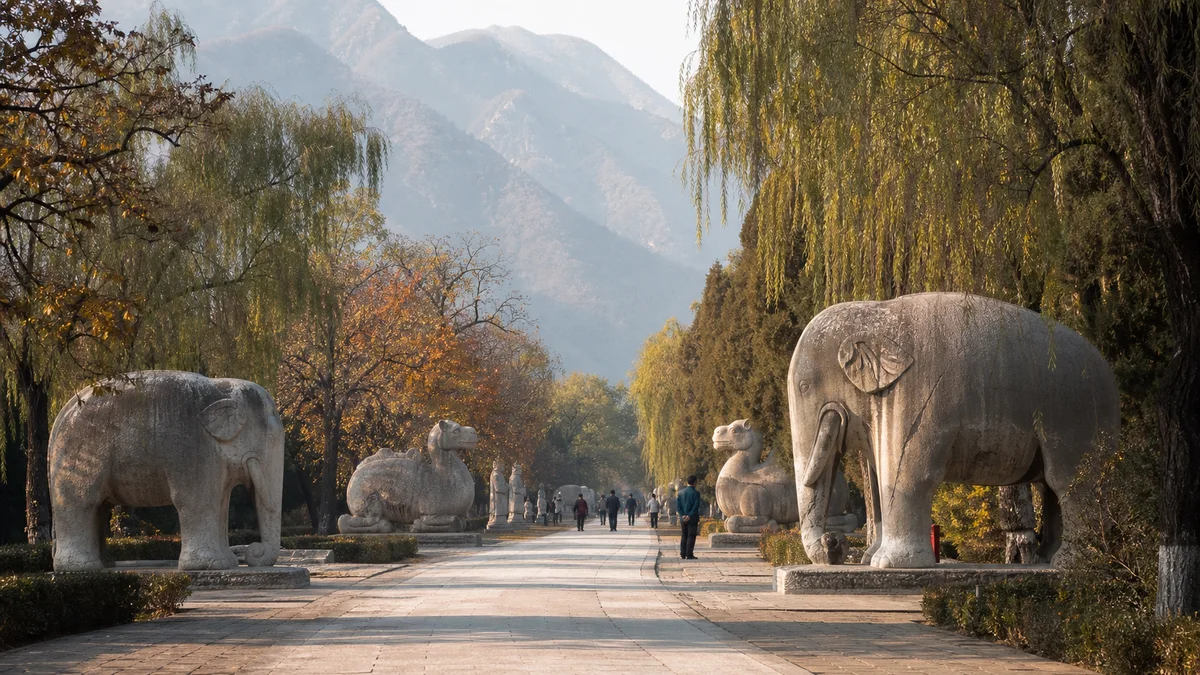
5A View location, maps and nearby scenic areasWalk between the stone animals on the Sacred Way and notice that they do not point towards one visible tomb. They face a valley. The emperor’s burial mound remains beyond the avenue, behind gates, hills and several kilometres of landscape.
That distance explains the Ming Tombs, or Míng Shísān Líng (roughly “ming shir-sahn ling”), better than a single photograph. This is a necropolis of 13 emperors, their empresses and other members of the Ming court, distributed below the Tianshou Mountains north of Beijing. The Sacred Way establishes a shared ceremonial approach; Changling, Dingling, Zhaoling and the other tombs branch away as distinct compounds.
Plan by sites, not by one walking line: use the Sacred Way to learn the valley’s grammar, then transfer to one or two tombs. Changling best explains the founding design and above-ground halls; Dingling adds the underground palace and a cautionary history of excavation; Zhaoling makes the walled tomb layout easy to read when open.
Thirteen tombs, not thirteen identical stories
The Ming dynasty had 16 emperors, but only 13 received mausoleums in this valley. The founding Hongwu Emperor lies at the Ming Xiaoling in Nanjing. The Jianwen Emperor disappeared during the civil war that brought the Yongle Emperor to power, and no confirmed imperial tomb is known. The deposed Jingtai Emperor was buried elsewhere near Beijing.
That leaves a sequence beginning with Changling, built from 1409 for the Yongle Emperor and Empress Xu, and ending with the tomb of the Chongzhen Emperor after the dynasty collapsed in 1644. Each compound responds to a shared language—gate, spirit hall, tower, walled burial mound—but varies in size, preservation and present access.
The tombs spread across a broad mountain basin. They are not thirteen chambers under one museum or stops on a compact loop. Some are several kilometres apart, many are not normally open, and farmland, villages and modern roads occupy the spaces between them. For maps and coordinates, begin with the Ming Tombs 5A scenic-area profile.
The collective landscape joined the UNESCO World Heritage property Imperial Tombs of the Ming and Qing Dynasties in 2003. World Heritage status recognises the relationship between architecture, ritual and setting; it does not mean every tomb has been excavated or prepared for tourism.
Why this valley became an imperial afterlife
The site sits in a basin protected by mountains to the north, with an opening towards the south and watercourses crossing the land. Ming planners understood these features through feng shui, a body of historical ideas about orientation, terrain, water and the placement of buildings and graves.
It is useful to take feng shui seriously as landscape planning without claiming measurable supernatural power. Mountain ridges supplied enclosure and visual authority; waterways and routes influenced approach; the southern opening connected the tomb domain back towards the capital. The result is both symbolic and physically legible.
The Yongle Emperor chose this region while rebuilding Beijing as his political centre. His palace and altar system in the city presented living rule—the Forbidden City for government and dynasty, the Temple of Heaven for state ritual—while Changling gave that rule a permanent mountain setting after death.
Later emperors placed their tombs within the same protected basin, creating lineage through geography. They did not simply copy one building thirteen times. The location of each branch valley, the ruler’s resources, construction history and later damage shaped a different compound.
The Sacred Way stages an audience with the dead
The main Sacred Way, also called the Spirit Way, is the ceremonial threshold to the necropolis. Its route passes monumental gates and a stele pavilion before entering the best-known avenue of stone figures. What looks today like a pleasant sculpture walk once announced that the imperial order continued beyond the ruler’s death.
There are 24 stone animals and 12 human figures along the avenue. Lions, xiezhi, camels, elephants, qilin and horses appear in standing and kneeling pairs; civil, military and meritorious officials wait in formal attendance. The mythical animals are part of the protective and courtly vocabulary, while camels and elephants also evoke the geographic reach imagined by the empire.
Do not treat them as playground props. Weathered surfaces reveal centuries of rain, frost and repair, and small chips are evidence of vulnerability, not invitations to test the stone. Stay off bases and animals even if another visitor climbs for a photograph.
The avenue is relatively level and is the easiest section for a slow walk, though paving, heat, ice or current barriers may affect accessibility. Most important, the path does not continue conveniently past every mausoleum. Its endpoint completes a ceremonial introduction, not a modern transport solution.
Changling: the model established by Yongle
Changling belongs to the Yongle Emperor, who seized the throne after a civil war, moved the main capital to Beijing and sponsored immense projects, including the early Forbidden City. Work on his mausoleum began in 1409, before the Beijing palace complex was complete.
Pass through its gates and read the sequence from public ceremony towards increasing enclosure. The great Ling’en Hall, or Hall of Eminent Favour, was used for memorial rites. Its vast timber frame and imposing nanmu columns recall an imperial audience hall: service to the ruler was expected to continue through ritual after death.
Beyond the hall, the Soul Tower marks the transition to the round walled mound containing the unexcavated burial palace. Visitors see architecture that points towards the hidden chamber but do not enter it. This restraint is important. An intact tomb can carry historical knowledge precisely because it has not been opened for display.
Changling is therefore the best place to understand the system above ground: courtyards, halls, gates, axial movement and the deliberate concealment of burial. Displays may add objects or reproductions, but the architecture itself is the primary source. Current hall openings and exhibition contents should be confirmed on arrival.
Dingling: what an opened tomb revealed
Dingling was built for the Wanli Emperor, who ruled from 1572 to 1620, and two empresses. In the 1950s, archaeologists located and excavated its underground palace—the first large-scale scientific excavation of a Ming imperial tomb in this group.
Descending today, visitors move through a sequence of stone chambers deep beneath the burial mound. Stone doors, platforms and the arrangement of rooms make the unseen structure of an imperial mausoleum tangible. Replicas and displays help explain where coffins and grave goods were found; they should not be mistaken for an untouched burial scene.
The excavation recovered textiles, crowns, vessels and other objects of exceptional historical value. It also exposed a painful gap between the ability to open a tomb and the ability to conserve everything inside it. Delicate silks deteriorated rapidly after meeting new air and humidity, and original wooden coffins were not preserved. During the Cultural Revolution, the imperial remains were destroyed.
These losses are not a reason to blame every individual archaeologist with hindsight, nor should they be hidden behind a simple story of discovery. Dingling changed Chinese archaeological policy: proposals to open more imperial tombs became much more cautious, and preservation before excavation gained urgency. The underground palace teaches as much about the ethics and limits of archaeology as it does about Ming burial.
Zhaoling and the problem of restoration
Zhaoling, the tomb of the Longqing Emperor and his empresses, offers another kind of encounter. Its above-ground courtyards, halls, Soul Tower and mound make the standard mausoleum sequence relatively compact and legible. Much of what visitors see, however, reflects modern restoration or reconstruction rather than untouched Ming fabric.
That does not make the site meaningless. Restoration can recover a spatial argument: where ceremonies happened, how walls controlled movement and how the visible architecture approached a hidden burial. But new surfaces should not be used as proof that every detail survives exactly as it did in the 16th century.
Compare Zhaoling with Changling’s old timber and Dingling’s excavated interior. Together they present three different kinds of authenticity: substantial historic fabric, archaeological access and reconstructed spatial form. No single tomb contains the whole story.
Zhaoling and other compounds are not guaranteed to open on every visit. Conservation work, staffing and seasonal operations can change the available choice. Treat any promised “three-tomb itinerary” as provisional until the official site confirms that day’s access.
Emperors were buried, but many others built the valley
Imperial names dominate the map, yet thousands of less visible lives sustained the necropolis. Quarry workers cut stone; carpenters raised halls; tile makers fired roofs; painters finished beams; labourers moved earth and built walls. Guards, eunuchs, ritual officials and estate workers maintained tomb ceremonies after burial.
Nearby communities also lived with an imperial landscape that controlled land and movement. Over centuries, war, underfunding, weather, reuse of materials and changing settlement patterns altered the compounds. The valley was never frozen at the instant each emperor was buried.
Empresses are part of the burial history, not footnotes to male reigns. Dingling, for example, held the Wanli Emperor with Empress Xiaoduan and Empress Xiaojing; the treatment of their coffins and remains belongs equally to the site’s difficult modern history.
Today’s custodians, conservators and local guides inherit conflicting demands: protect structures and burial dignity, explain past damage honestly, and allow public access. A closed door may be frustrating, but it can also represent care rather than neglect.
Build a route around distance and one hard choice
A useful half-day plan combines the Sacred Way with either Changling or Dingling. Choose Changling for above-ground architecture and the founding imperial story; choose Dingling if the underground palace and the history of archaeology matter more. Trying both can leave little time for observation once transfers and queues are included.
For a full day, the Sacred Way plus Changling and Dingling gives the clearest contrast. Add Zhaoling only if it is currently open and your transport is dependable. The compounds are distributed across the valley, so do not assume a path shown on a schematic map is a comfortable pedestrian connection.
Public buses, taxis, tour vehicles and seasonal internal services can each form part of the trip. Routes, drop-off points, frequency and return availability change. Confirm the current arrangement with the official scenic area or a reliable transport provider, especially late in the day. A driver waiting at one tomb may be more useful than a plan that depends on finding an empty taxi.
The Sacred Way is the gentlest walking section. Tomb compounds add thresholds and stairs; Dingling’s underground route involves a substantial descent and climb. Travellers with limited mobility should ask specifically about step-free access, lifts and open exits rather than relying on a generic “accessible” label.
Inside a tomb, curiosity needs manners
Lower your voice as you descend into Dingling. The stone chambers may feel like an archaeological exhibit, but they were created to hold real bodies and grave goods. Avoid jokes with coffin replicas, staged “ghost” poses and intrusive photographs of anything presented as human remains or funerary material.
Follow current photography and flash rules. Low light does not justify touching stone for balance or leaning equipment against a door. Condensation, dust and contact all add pressure to a controlled underground environment. If photography is restricted, use the time to notice the stone joints, door pivots and chamber sequence.
At the Sacred Way, photograph relationships rather than isolated statues. A standing and kneeling pair shows ceremonial rhythm; a person at a respectful distance provides scale; a long lens can compress officials into a silent court. Morning or late light may reveal carving, but weather, crowds and opening times are not guaranteed.
At Changling, frame the Ling’en Hall through successive gates to show hierarchy. Do not climb platforms or cross barriers for symmetry. The central axis belongs in the image, but so do the mountain ridges that explain why the tombs are here.
What feng shui cannot tell you
Return mentally to the first stone animal. It did not point to one chamber because the Ming dead were placed inside a political landscape: lineage spread across mountains, ritual moving along roads, visibility ending before burial.
Feng shui explains how Ming planners valued enclosure, direction and water; it does not prove supernatural protection. The dynasty fell. Buildings decayed and were rebuilt. One underground palace was opened before conservators were ready, and irreplaceable material was lost. Yet leaving every tomb sealed would also limit what can be known. The valley holds that unresolved tension between knowledge and restraint.
Before departing, look past the last gate towards the mound rather than searching for another dramatic object. At the Ming Tombs, the most respectful form of curiosity is to recognise where the view stops—and why some doors should remain closed.
The same mountains also shaped Beijing’s defence. Continue to Juyongguan Great Wall or compare the more distant sections in the Badaling–Mutianyu guide.
LoreLens App can help identify the Sacred Way figures, Changling’s halls and Dingling’s chamber sequence while keeping the people and preservation choices behind them in view.
Location profile
Where it is

Frequently asked questions
How many emperors are buried at the Ming Tombs?
The valley contains mausoleums for 13 of the Ming dynasty's 16 emperors, together with empresses and other members of the imperial household. The dynasty's founder was buried in Nanjing, the Jianwen Emperor has no confirmed imperial tomb, and the deposed Jingtai Emperor was buried elsewhere in Beijing.
Can I walk between the Sacred Way, Changling and Dingling?
They are separate sites across a broad valley, not one continuous pedestrian park. Walking the Sacred Way is practical, but reaching Changling, Dingling or Zhaoling commonly requires a bus, taxi, tour vehicle or other transfer. Confirm current internal transport and return options before setting out.
Which Ming tomb can visitors enter underground?
Dingling is the best-known tomb with an excavated underground palace open to visitors. Access involves substantial steps and can change for conservation, safety or operations; other tombs and exhibition halls may also alter opening arrangements. Check official information for the day of your visit.
How should visitors behave at the Ming Tombs?
Treat the valley as a burial landscape rather than a horror attraction. Keep voices low inside chambers, do not touch carvings, climb statues or stage comic photographs with coffins, and follow current rules on flash and indoor photography. These spaces hold the memory of real people as well as imperial history.