Jiangsu · Yangzhou
Slender West Lake and Daming Temple: Salt Money, and the Monk Who Went to Japan
A city moat that salt merchants turned into a five-kilometre garden scroll, and on the ridge at its head a temple that sent a blind monk across the sea on his sixth attempt — and that now holds a memorial hall copied from the building he founded in Nara.
5A View location, maps and nearby scenic areasYangzhou made its money on salt, and it spent the money in two directions.
South and east of the ridge, the merchants spent it on water: a stretch of city moat that they lined, over roughly a century, with private gardens until the banks read as one continuous composition. That is Slender West Lake, rated 5A on 18 April 2010, and part of the Grand Canal inscription on the World Heritage List in June 2014.
North, on the ridge itself, sits Daming Temple, older than all of it, and the reason a certain number of visitors here are Japanese. In 742 two Japanese monks walked into it with a request, and the temple’s abbot spent the next eleven years trying to leave China.
The two things are a twenty-minute walk apart and have almost nothing in common. Together they are the argument for coming.
A moat that turned into a scroll
The water is not a lake in any geological sense. It is the moat of Tang Luocheng and Song Dacheng — a wide channel outside the city wall running from the north city river up to the foot of Shugang ridge — and its recorded names change with the centuries: Paoshan River, Changchun River, Baoyang or Baozhang River.
What changed it was ownership of the banks. Through the Ming and especially the Qing, salt merchants of enormous wealth bought frontage along the channel and hired the best garden designers available, one villa after another, each composed to be seen from a boat. The result is a form you do not often get: not a garden, but a linear sequence of gardens, tuned to a moving viewpoint.
Li Dou’s late-eighteenth-century Yangzhou Huafang Lu — a record of the pleasure-boat world here — catalogues twenty-four named scenes along the water at the height of the Qianlong era, from Juanshi Dongtian at the city end to Shugang’s evening light at the far one, and sums up the effect in a line that is still the best short description of the place: two banks of flowers and willows all following the water, one road of towers and terraces running straight to the hill.
Shen Fu, writing in Six Records of a Floating Life, put the same observation more technically: a dozen or so garden pavilions joined into one, linked all the way to the hill, the momentum carrying through.
The name, and the joke inside it
By the late seventeenth century the nickname was already in the air. Wu Qi, who died in 1694, recorded it.
The line usually credited with fixing it is by Wang Hang (1704–1784), a poet from Hangzhou living in Yangzhou during the Qianlong reign, in a quatrain on the Baozhang River. Willows run unbroken into rough grass; an arched bridge with its ranked piers stands like a painting; and then the turn — this too is a crucible for melting gold, so it ought to be called the Slender West Lake. Transmitted versions differ by a character here and there, willow for poplar, red bridge for rainbow bridge.
Read the joke properly. Wang Hang had studied under a teacher who wrote a gazetteer of Hangzhou’s West Lake, so he knew exactly what he was invoking. Calling Yangzhou’s moat a slender West Lake does two things at once: it claims equal standing with the most famous scenic water in China, and it says out loud that what produced the view was money being burnt.
Both halves are accurate. The comparison with Hangzhou’s West Lake is worth making on the ground, because the two are opposite in kind. West Lake is a broad basin you look across. This is a narrow, bending channel you move along, with the composition changing every fifty metres — a scroll rather than a panorama.
Who paid, and how much
The Lianghuai salt administration, headquartered here, licensed the salt trade for a huge share of the empire, and the licensed merchants were among the richest private individuals anywhere in the eighteenth-century world.
Jiang Chun is the useful case because the numbers survive. He was head merchant of the salt trade for some forty years, personally organised the reception of the Qianlong emperor on six southern tours, travelled to Shandong and Tianjin to meet the imperial party, and repeatedly hosted the emperor at his Kangshan villa. Recorded contributions to the treasury under his name total 11.2 million taels of silver, close to a quarter of all recorded Lianghuai salt-merchant contributions. His garden later passed to the state against debts.
That is the engine. Imperial tours were not incidental to these gardens; they were the occasion for them. When the court announced a route, the merchants built along it.
Five Pavilion Bridge, and eighty years without pavilions
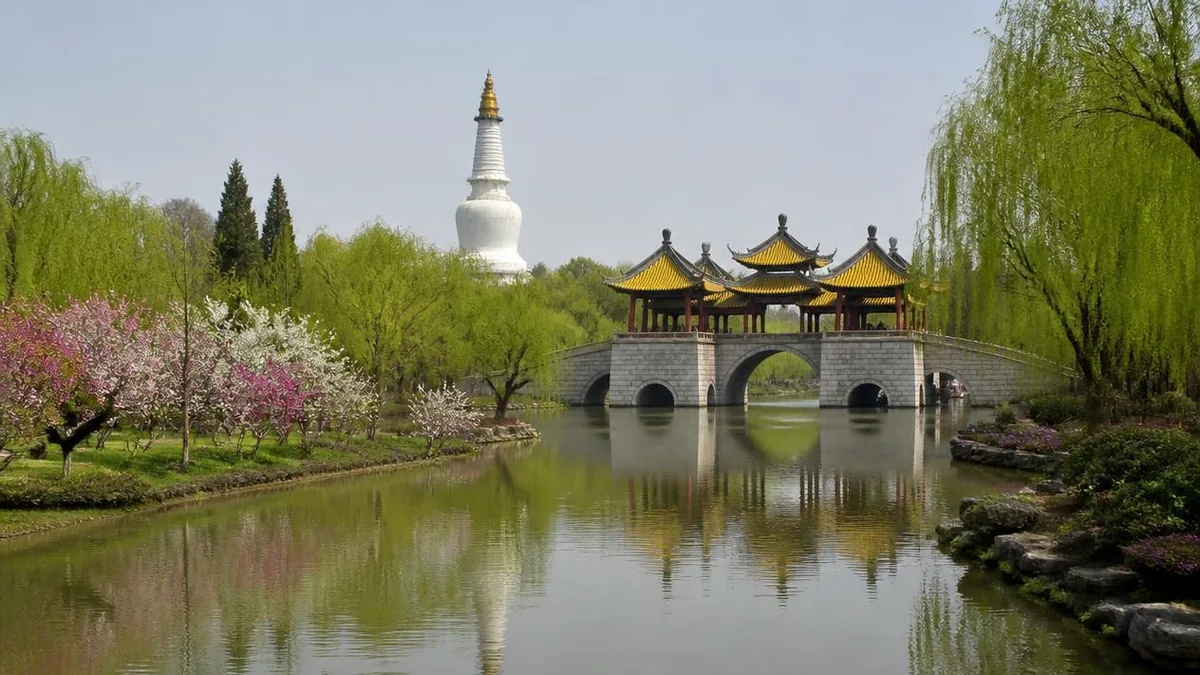
The signature object dates precisely. In 1757, Gao Heng, the salt official stationed at Yangzhou, had a new channel cut across the Lianhua embankment so that the emperor’s boats could run northwest from the city directly to Pingshan Hall, and put a bridge at the narrow point north of Lianxing Temple. That is Wuting Qiao, the Five Pavilion Bridge, also called Lianhua Qiao, the Lotus Bridge.
Its idea is borrowed and its execution is not. The model was Beihai in Beijing — the Jin’ao Yudong bridge and the Five Dragon Pavilions — and Qianlong himself remarked on the resemblance. What is original is the fusion: five pavilions on one bridge, joined by short galleries into a single continuous roof, over a substructure with four wings and fifteen openings in total. Li Dou’s line about it is the one everybody quotes: at full moon, every opening holds a moon, and the gold shimmers.
Then the part that is usually left out. In 1853 the five pavilions were destroyed in the fighting of the Taiping northern campaign, and for eighty years the structure stood as a bare bridge deck. The pavilions were rebuilt only in 1933, at a cost of 9,700 yuan, with a stele recording the restoration set in the central pavilion. Major work followed in 1942, 1954 — when reinforced concrete footings went in and the roof was changed to yellow glazed tile — 1984 and 1989.
So the object is 1757 in conception, 1933 in its most recognisable feature, and twentieth-century in most of its fabric. That is not a criticism. It is the correct caption.
The White Pagoda, and a legend with a label
Beside the bridge stands a white stupa of Tibetan type, the centre of the Qing scene called Baita Qingyun, clear clouds over the white pagoda.
The story attached to it is that Qianlong, seeing the view, remarked that it wanted only a white pagoda like Beihai’s, and that Jiang Chun had one heaped up from salt overnight so that the emperor would find it there in the morning. Chinese sources carry this with the word for hearsay in front of it, and so should you. It is a legend, and it is a legend of a very particular kind: the flattering kind a city tells when the real story — that a private merchant could in fact afford to build a pagoda on imperial whim — is almost as improbable.
Nearby, Xu Garden is much later and much smaller: built in 1915 as a shrine to Xu Baoshan, the salt-runner turned military governor of Yangzhou who was assassinated after the 1911 revolution. Local telling has it that the calligrapher who wrote the plaque despised him, and drew the enclosed element of the character for garden to look like the character for tiger — a caged animal, aimed at a man nicknamed Xu the Tiger. The garden hosts the city’s chrysanthemum show each autumn.
Twenty-Four Bridge: a disagreement you can read
Du Mu’s four lines about a moonlit night on the Twenty-Four Bridge, and a jade person somewhere teaching the flute, are among the most quoted in Chinese poetry. What they refer to has never been settled, and the arguing is worth following because the participants show their work.
The Song geography Yudi Jisheng says there were twenty-four bridges dating from the Sui, named for city gates, wards and markets, and that after Han Lingkun rebuilt the walls and re-laid the streets, some survived and some did not, so they cannot be traced.
Shen Kuo, in the supplementary Mengxi Bitan, does the fieldwork: he gives Tang Yangzhou’s dimensions and then lists the bridges by name, westernmost first, noting for each whether it still stood in his day, and explicitly excluding a group of nine that were not counted among the twenty-four. The Qing writer Liang Zhangju then counted Shen Kuo’s list and found twenty, not twenty-four — and said so.
The rival position is that Twenty-Four is simply the name of one bridge. Liang went to see the one so labelled, beside a private house, bearing large characters written by the official Tao Shu; he asked at the two neighbouring temples, and reported that the monks there would not vouch for it. His own conclusion, from Du Mu’s description of a street running nine li and thirty paces, was that the bridges must have been distributed along it and cannot be reduced to one.
The white marble bridge you photograph today, with peonies planted around it, is a 1980s restoration. It is a fine object and it settles nothing.
Collapse, and a century of putting it back
The gardens did not decline gracefully; they were foreclosed and then burnt.
After 1815 the Lianghuai salt trade contracted and the lakeside villas went quiet and derelict. The Taiping wars finished the job. Under the Guangxu reign a small part was recovered — the Five Pavilion Bridge and Xiaojinshan among it. The modern lake is essentially a twentieth- and twenty-first-century reconstruction project: the Twenty-Four Bridge, Xichuntai and Juanshi Dongtian went back in during the 1980s, Sitiao Yanyu and Shibi Liucong in 2007.
Knowing that changes how you look. This is not a surviving Qing landscape. It is a Qing composition, documented in unusual detail by Li Dou, and progressively rebuilt from that documentation over the last hundred and fifty years. The scroll is authentic; many of the individual sheets are copies, made from a good record.
Up the ridge: Daming Temple
Walk to the north end and up onto Shugang and the register changes completely.
Daming Temple takes its name from its founding period, the Daming era of the Liu Song dynasty, 457 to 464. In 601 the Sui emperor Wen ordered relic pagodas built in thirty prefectures for his sixtieth birthday, and one of them went up here as the Qiling Pagoda, climbed and written about by Li Bai, Liu Yuxi and Bai Juyi before it burned in 843.
The Qing court found the name awkward — Daming is also the name of the preceding dynasty — so the temple was called Qiling Si for a period, and in 1765, on his fourth visit to Yangzhou, Qianlong issued the name Fajing Si. It was destroyed in 1853 and rebuilt in 1870 by the salt commissioner Fang Junyi.
Two things here predate everything on the lake below. Pingshan Hall was built by Ouyang Xiu in 1048, when he was prefect of Yangzhou, as a place to rest and receive friends; the name comes from the way the hills across the river appear level with the balustrade. It has been rebuilt repeatedly by admirers ever since. And in the west garden is the spring ranked fifth under heaven in the classical grading of waters for tea.
The pagoda you see is new. Reconstruction was begun in 1988 and the tower completed in 1995 by one account, with 1996 given in others.
Jianzhen: six crossings, and one return
In 742 two Japanese monks, Yoei and Fusho, came to Daming Temple. Japan had no properly constituted ordination platform and no quorum of masters qualified to confer the full precepts, so private ordination had become a route out of tax and labour service. They wanted a master. Jianzhen, then the temple’s leading figure and credited with having ordained more than forty thousand people, asked his disciples; none would go. He went himself.
What followed took eleven years. Chinese and Japanese accounts number the attempts slightly differently and date the first to 742 or 743, but the sequence is agreed: a disciple denounced the party as pirates; a ship broke up in a storm at the Yangtze mouth; informers stopped two more attempts; a fifth voyage in 748 drifted fourteen days and put them ashore on Hainan, from which they walked back across the south. Yoei died at Duanzhou on the way. Jianzhen’s eyesight failed and did not return.
In 753, with the Japanese embassy heading home, the vice-envoy Otomo no Komaro got him aboard the second ship without the ambassador’s knowledge. He came ashore in Satsuma in the twelfth month and reached Nara in the second month of 754, aged sixty-six and blind.
There he built an ordination platform in front of the Great Buddha Hall at Todai-ji and conferred the precepts on the retired emperor Shomu, the empress dowager and hundreds of others. In 759 he was granted the former residence of Prince Niitabe and founded Toshodai-ji. He died there in 763. His disciple Ninki made a dry-lacquer seated portrait of him, eyes closed, which survives as a National Treasure and is generally called Japan’s oldest portrait sculpture.
The hall that came back
Here is the part that makes this a loop rather than a departure.
1963 was the twelve-hundredth anniversary of Jianzhen’s death, marked by Buddhist bodies in both countries. On Zhou Enlai’s instruction, a Jianzhen Memorial Hall was to be built at Daming Temple, and the architect was Liang Sicheng — the scholar who had spent the 1930s recording surviving Chinese timber buildings. Ground was broken that year; the hall was completed in 1973. It is widely described as following the form of the Kondo of Toshodai-ji in Nara.
Follow that carefully. Toshodai-ji’s main hall is a Nara-period building put up by and for a Chinese master’s community, and is one of the closest things anywhere to eighth-century Tang temple architecture. Twelve centuries later, in the monk’s home temple, China built a memorial hall modelled on Japan’s copy — because the copy had outlived the originals.
The traffic runs the other way too, and the dates are checkable. The dry-lacquer statue was shown at the Petit Palais in Paris in 1977, and in 1980 it travelled to China for what both sides called a visit home, exhibited at Yangzhou and Beijing, with the Toshodai-ji abbot Moritomo Kojun accompanying it and Deng Xiaoping’s mediation cited in the arrangements; Daming Temple was substantially restored for the occasion. The painter Higashiyama Kaii completed his ink panels for Toshodai-ji’s Mieido in 1980, one set of twenty-six titled for the fragrant wind of Yangzhou. In June 1982 the visiting Chinese premier Zhao Ziyang planted a qionghua, Yangzhou’s emblematic flower, in the Toshodai-ji grounds.
The lake below was built by men who wanted an emperor to admire them. The temple above sent away a man who could not see the country he was going to and never came back. Both are worth the walk, and the second one is why the ridge is quiet.
The LoreLens app can identify garden pavilions, bridge types and temple hall forms while explaining who built them and when they were last rebuilt.
Location profile
Where it is

Frequently asked questions
Where does the name Slender West Lake come from?
It is a comparison with Hangzhou's West Lake, and it began as a joke about money. The water was a moat, recorded over time as Paoshan River, Changchun River and Baozhang or Baoyang River. By the late seventeenth century the nickname was already circulating; Wu Qi, who died in 1694, wrote it down. The line usually credited with fixing it belongs to Wang Hang, a Hangzhou poet living in Yangzhou during the Qianlong reign, whose quatrain on the Baozhang River describes willows running unbroken into rough grass, an arched bridge like a painting, and then delivers the point: this too is a crucible for melting gold, so it ought to be called the Slender West Lake. Transmitted texts vary in a character or two. Slender is about the shape of the water and about the merchants who spent on it, not about size.
How many times did Jianzhen try to reach Japan, and when did he arrive?
Six attempts, five failures, and the sixth succeeded. The Japanese monks Yoei and Fusho reached Daming Temple in 742 to ask for a master who could confer the full precepts; when none of his disciples would go, Jianzhen decided to go himself. Chinese and Japanese accounts date the first attempt to 742 or 743 and differ on how the middle attempts are counted, but agree on the shape: informers, storms, one drift as far as Hainan, the death of Yoei on the return journey, and the loss of Jianzhen's sight. In 753 he sailed with a returning Japanese embassy, came ashore in Satsuma in the twelfth month, and reached Nara in the second month of 754. He ordained at Todai-ji, founded Toshodai-ji in 759, and died in Japan in 763.
Is the White Pagoda really built from salt overnight?
No, and the story should be labelled as a story. What is documented is that the salt merchant Jiang Chun was head of the Lianghuai salt trade for some forty years, received Qianlong on six southern tours, and contributed enormous sums to the treasury — a figure of 11.2 million taels is cited, close to a quarter of all recorded Lianghuai salt-merchant contributions. The legend that he had the pagoda heaped up from salt in a single night to satisfy an imperial remark is repeated in Chinese sources with the word for hearsay attached. Treat it as what it is: a story a city with that much money would inevitably tell about itself.
Is the Twenty-Four Bridge one bridge or twenty-four bridges?
Unresolved, and the disagreement is on the record rather than folkloric. The Song geography Yudi Jisheng says there were twenty-four bridges established under the Sui, named for gates, wards and markets, and that after Han Lingkun rebuilt the city walls some survived and some did not, so they cannot be verified. Shen Kuo's supplementary Mengxi Bitan lists Tang Yangzhou's bridges by name; the Qing writer Liang Zhangju counted that list, excluded the nine that were not among them, and found only twenty. The rival view is that Twenty-Four is the name of a single bridge; Liang went to look at the one so labelled, and reported that the monks of the neighbouring temples would not vouch for it. The white marble bridge in the scenic area today is a 1980s restoration.
Sources and further reading
Background references for the history and place names in this guide. Opening hours, ticketing and access change often — always confirm with official local information before travelling.