Jiangsu · Wuxi
The Grand Buddha at Lingshan: 700 Tonnes of Bronze, Thirty Kilometres of Welding, and a Fog That Lifted on Cue
An 88-metre standing Buddha on the shore of Lake Tai, assembled from 1,560 bronze plates on a hill that Xuanzang is said to have named on his way home from India. It is the youngest object in this guide and one of the most deliberately engineered — down to the number of steps you climb to reach it.
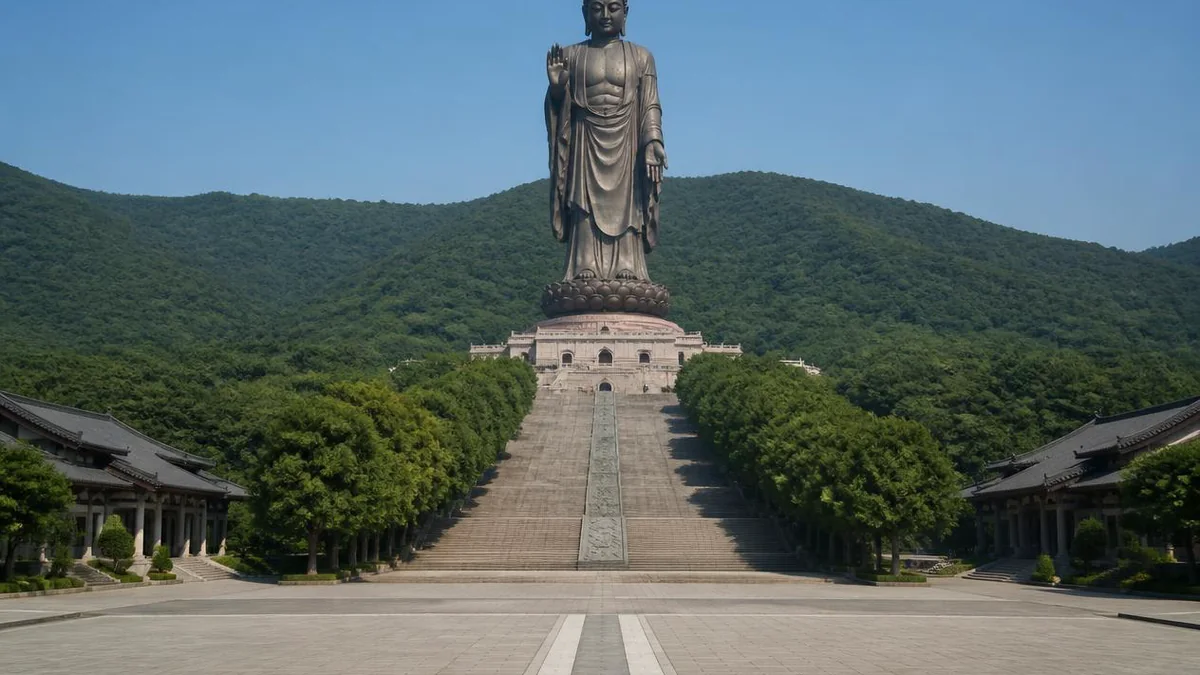
5A View location, maps and nearby scenic areasThere is a hill on the Mashan peninsula, on the northern shore of Lake Tai, and standing on the south side of it is a Buddha you can see from a long way across the water.
The number attached to it is 88 metres — seventy-nine metres of figure standing on nine metres of bronze lotus petals, with a three-tier base bringing the whole to 101.5 metres, about forty storeys. It is the largest standing open-air bronze Shakyamuni in the world.
It was consecrated on 15 November 1997, which makes it younger than most of the people who come to see it. That is not a criticism. It is the most interesting thing about it, because everything here — the hill’s name, the position, the height, the number of steps up to the base — was chosen by somebody who wrote down why.
A scheme with a gap in the east
In 1994, Zhao Puchu, president of the Buddhist Association of China, proposed a way of thinking about the country’s colossal Buddhas as a set: five Buddhas for five directions.
The north was Yungang in Shanxi. The centre was Longmen in Henan. The west was Leshan in Sichuan. The south was the Tian Tan Buddha on Lantau in Hong Kong, completed in 1993.
The east was empty, and Zhao proposed filling it here, in Jiangsu, explicitly as a bequest — Buddhist art for later generations. He was in his late eighties when he made the proposal and ninety when he flew to Wuxi to inspect the consecration preparations.
This is worth pausing on, because it inverts how these places are usually described. The Grand Buddha at Lingshan is not a monument that grew out of local devotion over centuries. It is the answer to a question somebody posed about a map.
The hill Xuanzang is said to have named
The site did bring a claim of its own, and it is a good one.
Xuanzang — the monk who went to India for scriptures in the seventh century and came back with them, the historical figure behind Journey to the West — is said in local tradition to have travelled through the southeast on his return, seen this hill with its layered green slopes, and remarked that it was no different from the Vulture Peak of the western realm. He named it Little Lingshan, after the mountain where the Buddha preached, and instructed his senior disciple Kuiji to establish the teaching here.
Kuiji is not a minor name. He was the systematiser of the Ci’en school of Chinese Buddhism, the Yogācāra tradition that Xuanzang’s translations made possible, and Xiangfu Temple at the foot of this hill was one of its centres. The temple is dated to the Zhenguan era of the Tang, which makes it about fourteen hundred years old as an institution.
Label the naming story as tradition. Then notice what the tradition does: it means the 1994 proposal did not invent a sacred site, it reactivated one that had a name, a school and a founding attribution already attached.
Three years of casting
The construction record for this statue is unusually specific, and reading it is the closest thing to watching it go up.
- 20 October 1994 — groundbreaking at Little Lingshan, with something near fifty thousand people present.
- 24 December 1994 — the casting contract signed in Beijing, at the Diaoyutai state guesthouse.
- 27 October 1995 — the main hall of Xiangfu Temple completed, its images consecrated, and the monk Mingshan installed as abbot.
- 30 May 1996 — the first bronze plate fitted.
- 18 January 1997 — the ceremony for pouring the gold into the Buddha’s head, at the Chenguang works in Nanjing.
- 3 April 1997 — topping out.
- 15 November 1997 — consecration.
The artistic design was by the Nanjing sculptor Wu Xianlin. The engineering, in its final form, is a skin: 1,560 bronze wall plates, six to eight millimetres thick, covering more than nine thousand square metres, joined by welds that total over thirty kilometres, with about seven hundred tonnes of cast bronze in the whole assembly. It is rated to withstand a force-14 typhoon and a magnitude-8 earthquake.
Thirty kilometres of welding is the figure to hold. This is a statue in the way a ship’s hull is a shape.
The fog
On the morning of the consecration, senior clergy from across China and abroad performed the rite together. The 218-step approach to the lotus base — the stair into the clouds — had been planted the whole way with gold chrysanthemums. Proceedings began at 9:15, with an account of the project by Mingshan and Zhao Puchu’s written address read out by the monk Jinghui, followed by the recitation, aspersion and consecration by a bench of elders.
And there is a weather story, told two ways.
One account has a thin mist wrapped around the statue that dispersed during the rite, so that the Buddha showed its face. The other has dense fog with visibility of about five metres, parting slowly to either side at the exact moment the ceremony was declared open, in front of a crowd it puts at over a hundred thousand — where the first account says near eighty thousand.
Both versions are in circulation and they are not compatible. What they have in common is more telling than the discrepancy: within hours of the statue’s completion, the people present had begun producing the kind of story that usually takes a site a century to accumulate.
The hand, the pillar, the wall
The site around the statue is a sequence of very large single objects, and they reward being read rather than just photographed.
The Hand of the World stands on the left of the approach: a full-size replica of the Buddha’s right hand, identical in shape and scale, forming the abhaya mudrā — the gesture of granting fearlessness, the removal of suffering. It is the one piece of the statue you can put your own hand against.
The Ashoka pillar is 16.9 metres tall, 1.8 metres in diameter, over two hundred tonnes, and carved by hand from a single block of granite — a Chinese reprise of the third-century BCE Indian emperor’s edict pillars.
And the screen wall at the entrance is about forty metres long and 7.2 metres at its highest, carrying seven characters by Zhao Puchu describing the lake as ten thousand acres of clear glass. The gate plaque is his too. Its reverse carries a Sanskrit inscription by Ji Xianlin — the philologist who spent his career on Sanskrit and Middle Indo-Aryan languages, writing on the back of the gate to the Buddha that Xuanzang’s hill was named for.
Nine dragons and an infant
The set piece added in the second phase, between 2002 and 2003, is a mechanical fountain sculpture called Nine Dragons Bathing the Buddha, and it stages the Buddha’s birth.
A gilded infant figure — 7.2 metres, twelve tonnes, carrying eighteen kilograms of gold — stands inside a bronze lotus whose individual petals run nearly six metres. The pool is circular marble, fifty-four metres across, ringed by nine flying bronze dragons four metres high and eight attendant donor figures. The music begins, the petals fold open, the figure rises and turns a full rotation inside the water the dragons throw.
The same phase added the great screen wall, the five-brightness bridge, the Buddha’s footprint altar, the five-wisdom gates, the Bodhi avenue, the relief of the subduing of demons, and the Ashoka pillar. It is a processional route, built as one.
The Brahma Palace
The third phase produced the strangest building on the site, and the one with the clearest job.
Fangong, the Brahma Palace, broke ground in September 2006 and took over eight hundred days. It is 153 metres wide and about 182 metres deep, one floor below ground and three above, with a total floor area of 72,000 square metres. Five lotus stupas rise from the roof at staggered heights, their form taken from the Vajrasana pagoda at Bodh Gaya; the tallest tops out at sixty-one metres and stands for Vairocana, the dharma-body Buddha.
Inside, it is a conference centre. It has simultaneous interpretation and international conference facilities, seats two thousand for a plenary and can run a dozen smaller sessions at once, and it was built to host the World Buddhist Forum. When it is not doing that, it stages a musical epic on the Buddha’s path to enlightenment.
A building that is a reliquary on the outside and a UN-style assembly hall on the inside is an unusual object, and it is a completely honest expression of what Lingshan is for.
What the site does with itself
Lingshan has been running an annual New Year bell-listening event since 1996. It marked two thousand years of Buddhism in China in 1998. It held a tenth-anniversary ceremony on 10 November 2007 and a twentieth on 15 November 2017, the latter gathering clergy from all three of China’s Buddhist language traditions — Chinese, Tibetan and Pali.
That is twenty years of a site building its own calendar. Combined with the 218 steps, the fifty-four-metre pool, the eighteen kilograms of gold and the 1,560 plates, it tells you what kind of place this is: one where the meaning is in the specification.
Reading the specification
Spend a day here and you notice that almost nothing has an arbitrary dimension.
Eighty-eight metres, in a country where the number eight carries the sound of prosperity. Two hundred and eighteen steps up to the lotus base. Nine dragons. A pool fifty-four metres across. Five stupas on the Brahma Palace roof, the central one at sixty-one metres, standing for a specific Buddha. Eighteen kilograms of gold on a figure 7.2 metres tall. An Ashoka pillar at 16.9 metres, carved from one stone.
This is a legible building in the way a stele is legible. Older sacred sites accumulate their meanings — a hall added under one dynasty, a spring renamed under the next, a poem carved by a passing official. Lingshan was specified. Every number was decided in a meeting in the 1990s and then executed to tolerance, and the site publishes the numbers because the numbers are the content.
You can find that cold, and plenty of visitors do. It is also, arguably, how the great Buddhist monuments of the past were made — Yungang and Longmen were state projects with budgets, quotas and supervising officials, and it is only distance that makes them look organic.
The rules changed twenty years later
Here is a fact that reframes the whole site, and it is a matter of published law rather than opinion.
China’s Regulations on Religious Affairs were revised on 14 June 2017 and took effect on 1 February 2018. Two articles bear directly on projects like this one.
Article 30 provides that only religious organisations and registered temples may build large outdoor religious statues, that such statues may be built only within temple grounds, and that building them outside temple grounds is prohibited. Approval runs upward: a provincial-level religious affairs department has thirty days to comment, and the national department then has sixty days to approve or refuse. Organisations and individuals that are not religious bodies may not build them at all.
Article 53 provides that anyone who donates towards a religious venue acquires no ownership or use rights and may draw no economic benefit from it, and that investing in or contracting the operation of a religious venue or a large outdoor religious statue is prohibited, as is commercial promotion in the name of religion. Article 72 supplies the teeth: stop-work orders, demolition within a deadline, and confiscation of unlawful gains.
The threshold is defined, too. Implementing rules put a large outdoor religious statue at any single statue over ten metres including its base, any statue over ten metres long, or any group of more than ten.
The official commentary is unusually direct about why all this was written. It names the practice of religion setting the stage while the economy sings — organisations and individuals building or leasing temples under the banner of promoting traditional culture and local development, statues put up outside religious premises and then operated for profit, registered venues packaged as corporate assets. A 2017 policy document went further: strictly forbid such statues outside religious premises, strictly control them inside, demolish those that breach planning or heritage rules or are simply crude, and hand approved ones over to religious management with no commercial operation.
The Grand Buddha predates all of it by two decades. It was proposed by the head of the national Buddhist association, and it stands on the hill behind a temple whose lineage runs to the Tang. It also sits inside a ticketed 5A scenic area with a two-thousand-seat conference centre, a scripted stage show and four fountain performances a day.
Nothing here has been found in breach of anything. The point is narrower and more useful: a project conceived exactly like this one, proposed today, would face a completely different legal test. Lingshan is the high-water mark of a way of building that the state subsequently decided to stop.
Standing under it
Walk up the 218 steps and the thing that gets you is not the height. It is the surface.
From a distance the Buddha reads as a single form, the way it was drawn. From directly underneath you can see the plates — the joints between them, the slight variation where six millimetres of bronze meets eight, the seams running away over the shoulder in every direction. Thirty kilometres of weld, all of it holding, most of it invisible from anywhere a photograph gets taken.
That is the honest experience of Lingshan. It is not old and it does not pretend to be. It is an enormous, precisely documented, entirely deliberate object, put on a hill because a man with a map noticed that the east was empty — on ground that, if the tradition is right, was named by a monk who had just walked back from India and thought it looked familiar.
The LoreLens app can identify the mudrās, deities and architectural forms across the Lingshan complex and explain what each of them is quoting.
Location profile
Where it is

Frequently asked questions
How tall is the Grand Buddha at Lingshan, exactly?
Eighty-eight metres for the figure, which is the number you will see everywhere — seventy-nine metres of body on nine metres of lotus petals. Add the three-tier base and the total is 101.5 metres, roughly forty storeys. The comparisons the site itself makes are that it stands about eight metres taller than the Statue of Liberty and seventeen metres taller than the Leshan Buddha in Sichuan, though the Leshan comparison flatters this one: Leshan is carved from a cliff in the eighth century and this is welded bronze from 1997. As a standing open-air bronze Shakyamuni it is the largest in the world, which is a precise claim and worth reading carefully — several taller Buddha statues exist, in other postures and other materials.
Why was it built here?
Because of a proposal about geography. In 1994 Zhao Puchu, then president of the Buddhist Association of China, put forward the idea of five great Buddhas for five directions: Yungang in Shanxi for the north, Longmen in Henan for the centre, Leshan in Sichuan for the west, the Tian Tan Buddha in Hong Kong for the south — and a new one in Wuxi, Jiangsu, for the east. Four of the five already existed and three of them are ancient. Lingshan was the gap in the scheme, and the scheme is why there is a Buddha on this particular hill. The site had a claim of its own: tradition holds that Xuanzang, returning from India, named this hill Little Lingshan after the Vulture Peak, and that the temple at its foot was founded on his instruction.
What is actually old at Lingshan?
The temple's lineage, and very little of its fabric. Xiangfu Temple is traditionally attributed to Xuanzang, dated to the Zhenguan era of the Tang and therefore about fourteen hundred years old as an institution, and it was a centre of the Ci'en school of Chinese Buddhism. What stands there now is a 1990s restoration: the main hall was completed on 27 October 1995, the same day the abbot Mingshan was installed. Everything else on the site is newer still — the Buddha 1997, the Nine Dragons fountain 2002 to 2003, the Brahma Palace 2006 to 2008. Come for the engineering and the ceremony, not for antiquity.
Is the Nine Dragons Bathing the Buddha show worth timing your visit around?
It is the second thing most visitors remember, and it runs four times a day — at 10:00, 11:30, 14:45 and 16:45. A gilded infant Buddha, 7.2 metres tall and twelve tonnes, carrying eighteen kilograms of gold, stands inside a giant bronze lotus in a marble pool fifty-four metres across, ringed by nine four-metre bronze dragons and eight attendant figures. Music starts, the lotus petals open, the figure rises and rotates once inside a curtain of water thrown by the dragons. It is a mechanised retelling of the Buddha's birth, and it is unembarrassed about being a spectacle. If you only have time for one thing here besides the statue, this is it.