Jiangsu · Wuxi
Huishan Ancient Town: A Hundred Ancestral Halls, the World's Second-Best Spring, and a Blind Man's Tune That Had No Name
Under a third of a square kilometre at the foot of Hui Hill sit the ancestral halls of eighty Wuxi families, a Ming garden two emperors copied for their own palaces, the spring Lu Yu ranked second in the empire, and the place a street musician's most famous piece was named after — three years before anyone wrote the name down.
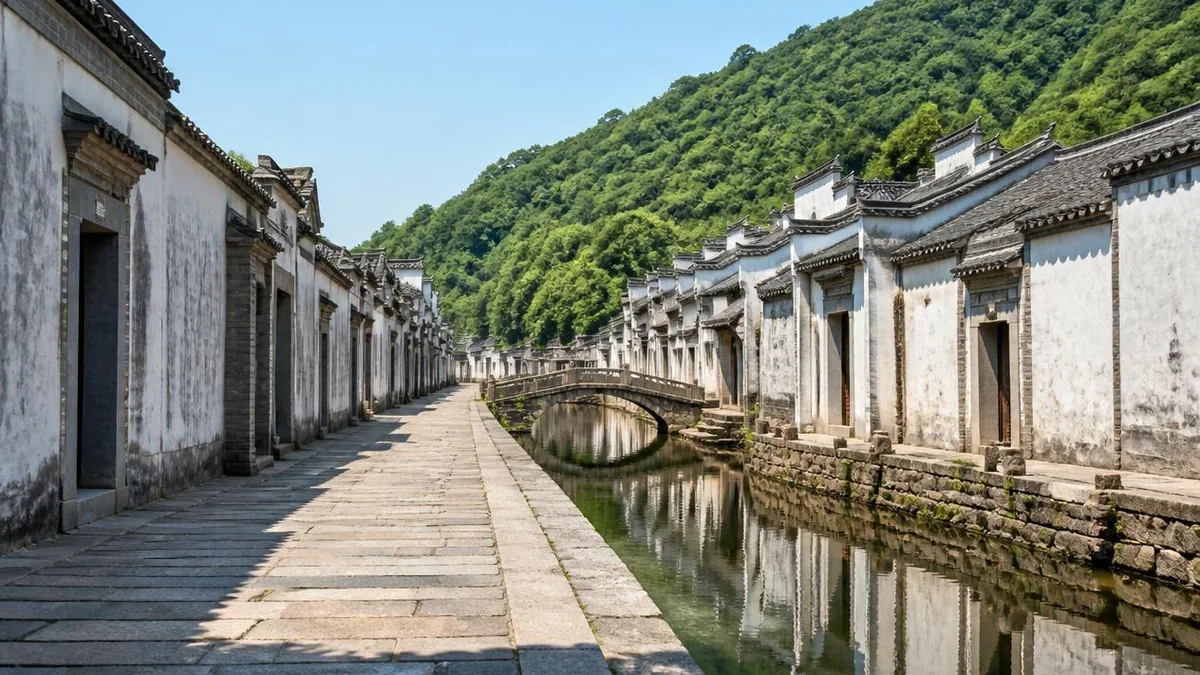
5A View location, maps and nearby scenic areasMost Chinese towns that survive as tourist sites survive because of one thing — a temple, a canal, a garden. Huishan, at the foot of Hui Hill on the western edge of Wuxi, survives because of about a hundred of them, all built for the same purpose by different families, in an area smaller than a large city park.
This is the densest concentration of ancestral halls anywhere in China, and it is the reason the place is worth a day rather than an hour.
How many halls are actually there
The number you will see quoted is 118 — 118 ancestral halls belonging to roughly eighty surnames, inside under 0.3 square kilometres. That was the peak, reached by the Republican era, and it is a genuinely extraordinary figure.
It is also not what is standing.
Wuxi’s own researchers have done the counting, and the arithmetic is worth having. A survey in 2001 identified 49 hall buildings surviving. More were lost in 2009, when Xihui Road was rerouted, and in 2010, during park construction. Rebuilding began in 2012. The present tally is 99 halls with buildings actually standing — of which about fifteen are fitted out for ritual use — plus nine more still awaiting reconstruction, which would bring the total to 108.
So: 118 historically, 49 at the low point, 99 now, 108 when the current programme finishes. When a sign says 118 it is describing the past. The site has been under national-level heritage protection since 2006.
Why here
The obvious question is why eighty families would put their memorial halls in one small valley instead of on their own land.
Part of the answer is that Hui Hill already had everything: a major Buddhist temple, the spring that Tang connoisseurs ranked second in the empire, and — later — a stream of imperial visits that made the address unimprovable. Part of it is precedent. The lineage of halls here is traced back to a Tang-dynasty temple to Lord Chunshen, the Warring States statesman of Chu, which established the valley as a place where memorial buildings belonged.
And part of it is straightforwardly social. Once the prominent families of Wuxi were here, being here was the point. The clearest evidence is that nearly half the figures enshrined in these halls are not local to Wuxi at all. Families brought their ancestors to Huishan; the ancestors did not come from Huishan. It was, among other things, a very good address.
The temple that started it
Huishan Temple was founded under the Southern Dynasties, in the fifth or sixth century, and counted as the foremost of Wuxi’s ten great monastic establishments. It belongs to the group of foundations that Tang poets meant when they wrote about the four hundred and eighty temples of the Southern Dynasties — the phrase that stands in Chinese for a vanished age of monastic wealth.
It was destroyed and rebuilt several times. After the Taiping war of the mid-nineteenth century, essentially nothing was left but rubble. The main halls standing today — the great hall, the guardian halls, the hall of compassion, the scripture library, the bell pavilion — were rebuilt in 2004, when religious activity resumed on the site.
Two older living things survive in the courtyards. A ginkgo said to have been planted by the monk Xinghai in the early Hongwu years of the Ming is now over six hundred years old. And there is an imperial stele pavilion, double-eaved, holding a single stone inscribed on all four faces with poems Qianlong wrote at Huishan on his southern tours — dated 1751, 1757, 1762 and 1780. Four sides, four visits, twenty-nine years. It is the most economical record of imperial tourism in China: one rock, four dates, one emperor who kept coming back.
Two stone pillars, and the difference between them
The best objects at Huishan are a matched pair standing ten metres apart in front of the guardian hall, and the interesting thing about them is not that they are old. It is that they disagree.
Both are eight-sided blue-stone sutra pillars of nineteen tiers, and they are almost exactly the same height. The southern one is Tang, built in 876, standing 6.26 metres, and it carries the Uṣṇīṣa Vijaya Dhāraṇī — the full text of the sutra, cut nine lines to a face, fifty-nine characters to a line, in the hand of a calligrapher named Li Duanfu. The northern one is Song, built in 1070 and standing 6.22 metres, raised by a group of local donors from Wanshou township when the temple was called Puli Chan Cloister; it carries the Great White Parasol incantation and a postscript.
That is the difference: the Tang pillar carries a sutra, the Song pillar carries a spell. Cutting the incantation instead of the scripture became the normal practice from the Song onward, and here the change is visible as two physical objects, standing side by side, put up 194 years apart by people who thought differently about what stone was for.
They needed rescuing. In November 1998 the conservation laboratory of the Nanjing Museum overhauled both, straightened them, filled losses, treated the surfaces against weathering, and — the detail that tells you how long they had been sinking — raised three tiers that had been buried underground back above the surface.
Their protection status comes with a documented disagreement. Wuxi’s own cultural-heritage authority records them as provincially protected from 1956 and elevated to national protection in 2013, in the State Council’s seventh batch. Chinese Wikipedia gives the national listing as 25 May 2006, the sixth batch. Both cannot be right, and the Wuxi archives are the more specific of the two.
Two more stones are worth finding. Jinlian Bridge — Golden Lotus Bridge — was built at the very end of the Northern Song, between 1100 and 1127, which makes it the oldest bridge in the Wuxi area: a three-span stone beam bridge, 10.7 metres long and 3.4 metres wide, six beams to a span, with grotesque fish-heads and dragon-heads carved on the end lintels and, on the railing panels, a low-relief pattern of interlaced peonies with figures among them that the country’s senior authority on historic architecture, Luo Zhewen, judged among the finest bridge ornament in China. Five characters cut into the middle span name the household that paid for it. Tradition attributes it to Li Gang, the Song chancellor who led the resistance to the Jin invasion — and a Wuxi man. It was substantially rebuilt in 1460.
And in a small pavilion west of the imperial stele there is a piece of natural brown stone, 1.99 metres long, flat, with one end turned up like a pillow, which people used to lie on. Cut into it in seal script by the Tang calligrapher Li Yangbing are two characters: listening to the pines. That is the whole object and the whole idea. Somebody in the eighth century found a rock the right shape to lie on, worked out what it was for, and labelled it.
A garden begun in 1527
The single finest thing in the town is behind a wall.
Jichang Garden was begun in 1527 by Qin Jin, a senior Ming official, on the site of former monks’ quarters belonging to the Huishan temple. He called it Phoenix Valley Retreat. It was renamed Phoenix Valley Villa in 1560, and then Jichang — roughly lodging one’s ease — by a later owner, Qin Yao, who took the word from a line by the calligrapher Wang Xizhi about lodging one’s ease among hills and streams.
The garden you walk through, though, is a Kangxi-era design. In the early years of that reign the owner Qin Deao hired Zhang Lian, the most celebrated rockery-builder of the age, together with his nephew Zhang Shi, and made one decision that defined everything after it: he piped the underground flow of the Second Spring into the garden. The water in Jichang Garden is the same water as the famous spring next door. That is why the pools and channels feel alive rather than ornamental, and the layout that resulted is essentially the layout that survives.
It covers 11,246 square metres. It has been a nationally protected site since 1988.
Kangxi came seven times. Qianlong came eleven — and took it home twice
Imperial tourism in the Qing dynasty was a serious business, and Jichang Garden was a fixture of it.
Kangxi visited seven times. His grandson Qianlong visited eleven, and left the judgement that among all the famous sights of Jiangnan, the Qin garden at Huishan is the oldest.
He then did something more consequential than praising it. He had it copied twice: once as Huishan Garden inside the Summer Palace in Beijing — which still stands, renamed Xiequ Garden, the Garden of Harmonious Interests — and once as a scene called Kuoran Dagong in the Yuanmingyuan, destroyed in 1860.
There is a small, precise pleasure available here. You can stand in a private garden in Wuxi and know that the imperial garden in Beijing is the imitation.
The family that owned it for four hundred years
The Qin of Xishan traced their descent from Qin Guan, the great Northern Song lyric poet, through an eleventh-generation descendant, Qin Weizhen, who settled in Wuxi.
What the family then did with the examination system is difficult to overstate: 34 metropolitan-degree holders, 77 provincial-degree holders, and 13 members of the Hanlin Academy. Qin Jin, the man who started the garden, held the summary title that says everything about a Ming career at that altitude — minister across five ministries in both capitals, and Grand Protector under three reigns.
They held this garden, in one family, for the better part of four centuries.
The garden was confiscated by an emperor and won back by an examination
The best story in Huishan is about a bureaucratic catastrophe and a very specific kind of recovery.
Under the Yongzheng emperor, the Qin official Qin Daoran was caught on the wrong side of a court factional fight, imprisoned, and the family garden was confiscated by the state.
It came back in 1736 — and the mechanism was his son. Qin Huitian took third place in the palace examination, the rank called tanhua, and submitted a memorial pleading his family’s case. The new emperor returned the garden. A later descendant, Qin Ruixi, spent 3,000 taels of silver repairing what a decade of state custody had done to it.
An examination result, converted directly into real property. It is the clearest illustration you will find anywhere of what the imperial examination system actually was for the families that played it well.
The second-best spring in the world
Behind another wall, a few dozen metres away, is a hole in the ground with a longer résumé than most cities.
The spring was dug during the Tang Dali era, in the second half of the eighth century, and was known simply as the Huishan spring. Then Lu Yu — author of the Classic of Tea, the founding text of the entire subject — ranked it second in the empire. The Tang connoisseur Liu Bochu independently also ranked it second. The name stuck: the Second Spring Under Heaven.
What is there is three pools. The upper and middle pools are the Tang work; the lower pool was dug in the Northern Song Mingdao era. There is a stele in the hand of Zhao Mengfu, the great Yuan calligrapher. Ming builders added carved dragon-head spouts. Under Emperor Huizong the water was shipped to the capital as tribute, and Huizong wrote out the four characters about living water at its source. Kangxi and Qianlong both drank here.
Local tradition speaks of the three perfections of the Second Spring: Lu Yu’s ranking, Su Shi’s poem about it, and Wang Shu’s calligraphy — a ranking, a poem and a piece of writing, which is a very Chinese way of saying that a spring becomes famous by what people write about it.
And on the fifteenth night of the seventh lunar month, if the sky is clear, the moon appears reflected in the lower pool. That is a real optical event with a real date, and it gave the place its poetic name: the moon reflected in the second spring.
The tune had no name
Which brings us to the most famous thing associated with Huishan, and the part almost everyone gets backwards.
Abing — his name was Hua Yanjun — was a Wuxi street musician, the son of a Daoist temple musician, who went blind in his thirties and played the erhu and pipa for money in the streets and teahouses of this city. He had a melody he had been playing for years.
It had no title. He called it a tune that had simply come to him. Neighbours who heard it nightly called it something like the song that follows the heart.
In September 1950, researchers came to Wuxi with recording equipment and captured six of his pieces. They needed names for the labels. One of them proposed calling this one Erquan Yingyue — the moon reflected in the second spring — after the local landmark up the hill.
Abing died three months later, in December 1950.
Erquan Yingyue is now probably the single most recognised piece of Chinese instrumental music in the world, played by orchestras on six continents, and the name it goes by was chosen at a recording session by someone else, weeks before its composer’s death, after a well of water a short walk from where he used to play. The spring is upstream of the tune in every sense.
The clay children
The other thing Huishan makes is small, painted, and completely tied to the halls.
Huishan clay figures have been made here for over four hundred years, and the tradition is counted among China’s three great clay-figure traditions. It was recognised as national intangible cultural heritage in 2006.
The origin is beautifully specific: the hall-keepers, the men employed to look after all those ancestral halls, made and sold clay toys to visitors as a sideline. A hundred halls generated a hundred keepers with idle hours and good river clay underfoot, and a craft came out of it.
It escaped the local market when Qianlong took a set of figures by the craftsman Wang Chunlin back to Beijing for the Summer Palace’s Tower of Buddhist Incense. A Qing writer, Qin Qi, delivered the verdict the craft still quotes: that Huishan’s clay children are finer work than Suzhou’s.
The signature piece is Da A Fu — a fat, grinning child holding a lion cub, painted in flat bright colour. It is on every souvenir shelf in Wuxi, and it started as a hall-keeper’s sideline.
Visiting
Walking the town costs nothing. The lanes, the street, and the frontages of the halls are open, and most of the halls are read from the outside in any case.
The paid attractions are the walled ones — Jichang Garden, the Second Spring, the temple precinct and the clay-figure museum — and a combined ticket for them runs about 70 yuan. Give it a half day at minimum.
What the town is actually about
Huishan is not a picturesque old town that happens to contain some monuments. It is a single-purpose district, and the purpose was memory.
Eighty families, over roughly a millennium, decided that the right place to keep their dead was a valley beside a good spring and a good temple. They built a hundred and eighteen buildings to do it, lost most of them, and have rebuilt to ninety-nine. The hall-keepers’ children’s toys became a national craft. The garden one of those families built got copied into an emperor’s palace. The spring got ranked, versified, bottled as tribute and drunk by two emperors. And a blind man who played on these streets had his untitled melody named after the spring by a stranger with a microphone, three months before he died.
Everything here is somebody trying to make something outlast them. Most of it worked.
The LoreLens app can identify individual ancestral halls at Huishan and tell you which family built them and who is enshrined inside.
Location profile
Where it is

Frequently asked questions
Are there really 118 ancestral halls at Huishan?
Not standing today, no. The 118 figure describes the peak, reached by the Republican era: 118 halls belonging to some eighty surnames packed into under 0.3 square kilometres. What survived is a different number and it has been counted carefully. A Wuxi survey found 49 hall buildings in 2001; further losses followed in 2009, when Xihui Road was rerouted, and in 2010 during park construction; rebuilding from 2012 brought the total back up. The current figure is 99 halls with buildings actually standing, of which about fifteen are arranged for ritual use, plus nine more awaiting reconstruction — which would make 108 when the work is finished. If a sign says 118, it is describing history rather than inventory.
Why did eighty families all build their halls in one small valley?
Because everything a lineage wanted to be near was already here. Hui Hill had a major temple, the empire's second-ranked spring, imperial visits that made the address prestigious, and — critically — a Tang-dynasty precedent: a hall to Lord Chunshen, the Warring States statesman, which established the valley as a place where memorial temples belonged. Once a few prominent families built here, an address at Huishan became a statement of standing, and nearly half of the figures enshrined in these halls are not even local to Wuxi. Families brought their ancestors to Huishan rather than the reverse.
What is the connection between the Second Spring and the erhu piece?
The piece was named after the place, not the other way round, and it was named very late. The blind Wuxi street musician Abing — Hua Yanjun — had been playing the melody for years without a title; he referred to it as a tune that simply came to him, and neighbours called it something like the song that follows the heart. When researchers recorded him in September 1950, they needed a name, and one of them proposed Erquan Yingyue, the moon reflected in the second spring, after the local landmark. Abing died that December. The recording session is the origin of the title, and it happened three months before the death of the man whose piece it was.
Is Jichang Garden worth seeing if I have already seen Suzhou's gardens?
Yes, and for a specific reason: it is older than most of them in continuous form, and it is the one two emperors chose to copy. Founded in 1527 on the site of monks' quarters belonging to the Huishan temple, given its present layout in the early Kangxi reign when the owner hired the celebrated rockery-builder Zhang Lian and his nephew and piped the Second Spring's underground flow into the garden, it was visited by Kangxi seven times and Qianlong eleven. Qianlong then had it reproduced twice — as Huishan Garden, now Xiequ Garden, inside the Summer Palace, and as a scene in the Yuanmingyuan. It covers 11,246 square metres and has been a nationally protected site since 1988.
How much does it cost and what needs a ticket?
Walking the town — the lanes, the hall frontages, the street — is free. The paid sites are the ones with walls: Jichang Garden, the Second Spring, the temple precinct and the clay-figure museum. A combined ticket covering them runs about 70 yuan. Budget a half day minimum; the town rewards slow walking, and most of the halls are read from the outside anyway.