Jiangsu · Wuxi
Yuantouzhu: A Banker's Orchard, a Poet's Advertising Slogan, and Thirty Thousand Cherry Trees Somebody Brought Back From Japan
A peninsula on the northwest shore of Lake Tai that a Bank of China manager began buying up around 1916, that a ring of Republican-era industrialists filled with private villas, and that now runs on a six-character line written by Guo Moruo in the late 1950s — plus a cliff inscription about two ancient kingdoms and an island 2.6 kilometres out with monkeys on it.
5A View location, maps and nearby scenic areasLake Tai is enormous, shallow, and — for most of its shoreline — not especially dramatic. The northwest corner is the exception, and the reason is a lump of rock.
At the western end of Chongshan hill, on the neck of land between Lake Tai and the smaller Lihu, a mass of stone pushes out into the water in a shape people read as the raised head of a yuan, a large soft-shelled turtle. Zhu means a spit. Hence Yuantouzhu, Turtle-Head Point — one of the two or three most visited pieces of shoreline in Jiangsu, and, unusually for a 5A scenic area, essentially a private real-estate project from the 1910s that the state later took over.
The banker with an orchard
The man who started it was Yang Hanxi, and his biography explains the project better than any description of the scenery.
His father, Yang Zonglian, had been an aide to Li Hongzhang and is counted among the pioneers of Chinese industry. Yang Hanxi himself was the first manager of the Bank of China’s Wuxi branch. He was, in other words, exactly the kind of person the lower Yangtze produced in that generation: new money with official connections, in a city getting rich on textiles.
What he bought, and when, is disputed. The provincial gazetteer and the municipal government put it at 1916 — about four hectares of lakeshore wetland, planted first as an orchard, then built on, with a lighthouse and the halls called Hengyun Shanzhuang and Wanqing Tang. Another well-circulated version has him buying sixty mu on the southwestern foot of Nandu hill, Yuantouzhu included, for 2,000 silver dollars, after the Wanqing Tang was up. A third dates the start of garden-building to 1918. Chinese Wikipedia says 1917.
The honest reading is that this was a rolling acquisition developed over more than two decades, and that the argument is about which stage to call the founding. Hengyun Shanzhuang — Crosswise Cloud Villa — was the centrepiece, and it was built in deliberate imitation of an imperial garden.
A shoreline of private villas
Once Yang had done it, everyone did it.
Through the 1920s and 1930s the officials and industrialists of Wuxi built their own villas and gardens along this shore: Wang Xinru’s Lake Tai Villa, Chen Zhongyan’s Ruopu, Zheng Mingshan’s Zheng Garden, He Jiwu’s villa, Cai Jian’s Tuilu — retreat cottage — and, at the older end of the strip, the Guangfu temple and the Taozhu pavilion. By the 1930s this was among the most sought-after stretches of scenery in eastern China.
After 1949 the villas and private gardens were taken over by the government and consolidated into a single public park. That is the essential fact about the place: Yuantouzhu is not one design. It is a dozen rich men’s weekend houses, nationalised and stitched together, with an 1980s master plan laid over the top that brought the whole area to its present figure of 539 hectares — though you will also see 500-plus hectares and five square kilometres quoted, depending on what is being counted.
The sign over the gate has been changed five times
The plaque on the entrance archway is a compressed history of twentieth-century China, and almost nobody reads it that way.
It began as Hengyun Shanzhuang — a private villa’s name over a private gate. In 1945 it became Hengyun Park: the villa had become a park. After 1949 it read simply Yuantouzhu: the place, not the owner. Then, after Guo Moruo’s line began circulating, it was changed to Taihu Jiajue — Lake Tai’s finest. In 1979 the painter Li Keran wrote out the fuller five characters, the finest place on Lake Tai. And from 1981 the plaque has been an assembly of Guo Moruo’s own handwriting, which is what hangs there now.
Owner’s name, then park, then place, then a poet’s phrase, then a famous painter’s calligraphy of the phrase, then the poet’s own hand. Five rewrites of one sign in sixty-five years.
Set into the brickwork on the right of the archway are two more words: licit crossing and asking the ford. The first records that this was an old departure quay and a mooring for boats. The second is a literary gesture — asking where the ferry is, which in Chinese carries the sense of enquiring after the way to somewhere you have only heard about. The gate is telling you that people used to leave from here, and that you have come looking for something.
The line that sold a lake
In the late 1950s — one account dates it precisely to 1959 — Guo Moruo toured Lake Tai, visited Liyuan and Yuantouzhu, and wrote a poem in exchange with his hosts. Its last two lines say that the finest place on Lake Tai is, in the end, the turtle’s head.
Guo Moruo was a poet, historian, palaeographer, archaeologist and, by then, a senior cultural official. He had just spent a day comparing natural lakeside scenery with the pavilions and terraces of a landscaped garden, and he came down on the side of the rock.
Those six characters have functioned as Wuxi’s tourism slogan ever since. They are on the gate, on the tickets, in the brochures, and quoted in nearly every account of the place — including this one. It is one of the more complete examples in China of a single couplet by a single official becoming permanent commercial infrastructure.
The cherry trees came back from a business trip
The thing most visitors actually come for in April is not on any of the old plaques.
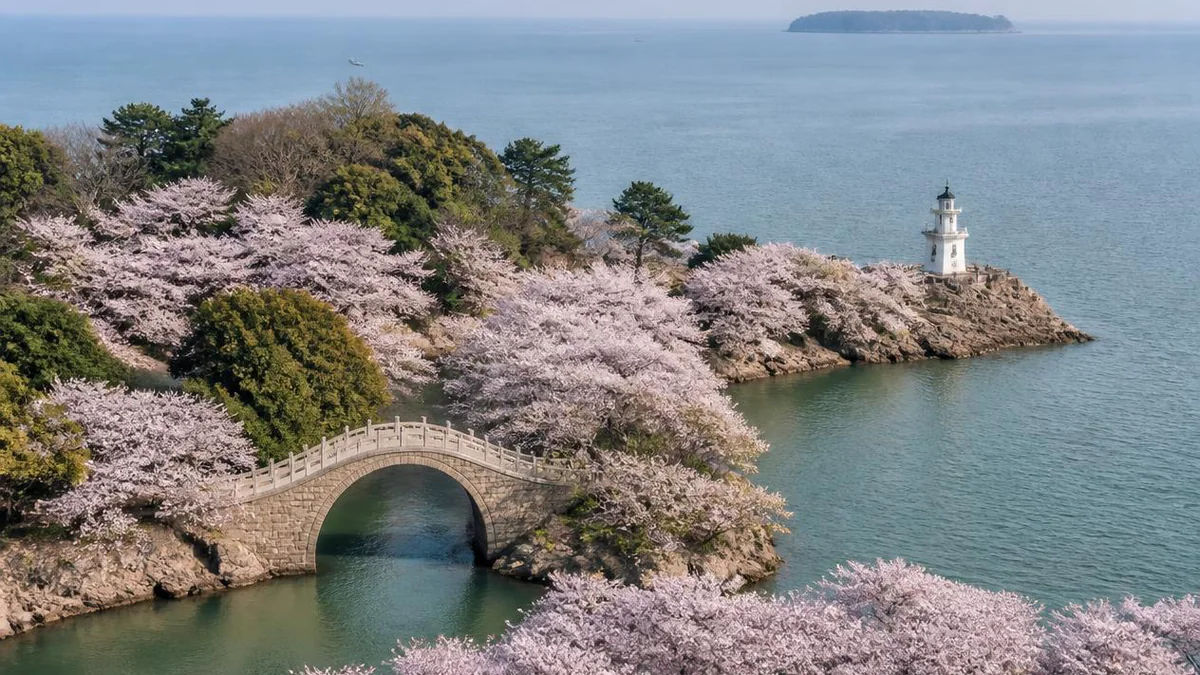
Yang Hanxi had been to Japan. He liked the cherry blossom, and when he built the Changchun Bridge in the 1930s he planted cherries down both sides of it. That makes Yuantouzhu one of the earliest large ornamental cherry plantings in China — not a recent borrowing of a Japanese fashion but a Republican-era one, made by a banker who had seen it abroad and wanted it at his weekend house.
The scale is modern. A Sino-Japanese cherry friendship grove was added, and then a dedicated Cherry Valley that now holds more than thirty thousand trees. In the first ten days of April the long causeway is pink and white on both sides and reflected in the water, and the site advertises itself as one of the world’s three great cherry-viewing destinations and China’s premier one. Treat both as claims rather than facts; the trees are real and the crowds are enormous.
The avenue people mean when they say Cherry Boulevard is the Ten-Li Fragrant Path, reached by walking right from the Chongshan gate.
What was here before the bankers
Yuantouzhu was not discovered in 1916.
A hermitage called Guangfu stood on this shore under the Xiao Liang dynasty in the sixth century. In the early Ming, spring flood on Lake Tai was listed as one of the Eight Views of Wuxi. The Qing Wuxi zhuangyuan — top graduate of the palace examination — Sun Jigao wrote the couplet about the point wanting to swallow the lake and heaven floating a single turtle out of it.
And in the late Qing, the county magistrate Liao Lun had two inscriptions cut into the cliff above the water. One reads horizontal cloud. The other reads four characters that are the best thing written anywhere on this peninsula: containing Wu and Yue.
Lake Tai sat on the boundary between the ancient states of Wu and Yue, whose century of warfare in the fifth century BCE gave Chinese the phrase about sleeping on brushwood and tasting gall. A magistrate looking at this water saw a body large enough to hold both of them — one basin containing two kingdoms that spent generations trying to destroy each other. It is carved in a spot where you can stand and look at exactly what he meant.
Gao Panlong walked here
The figure worth knowing about on this shore is not a banker or a poet.
Gao Panlong was one of the two leaders of the Donglin movement, the late-Ming faction of scholar-officials who took on the eunuch establishment over corruption and imperial governance and lost. He was a Wuxi man. He came out to this point regularly to walk at the water’s edge and compose, and a spot associated with him washing his feet at the turtle’s head is still pointed out.
In 1626, with the eunuch Wei Zhongxian’s men coming to arrest him, Gao Panlong drowned himself rather than be taken.
That is the same shoreline. Four hundred years ago it was where a man came to think, and where the thinking he did got him killed; three hundred years later it was subdivided into weekend villas; now it is a park with a slogan. The rock has not moved.
The island with the monkeys
Two and a half kilometres out in Meiliang Bay there is a small hill in the water, and the boat across is the second half of most visits.
It was called Three Hills, and locally Tortoise Hill, and it is one of the noted summits among the seventy-two of Lake Tai. It is four small peaks — a head and a tail known as East Duck and West Duck, a main summit, and one that never got a name — with a high point of 49.8 metres and an area of twelve hectares. You may see a figure of about two square kilometres in the Baidu entry; it contradicts the twelve-hectare figure in the same article, and twelve hectares is the one that matches the map.
Nobody lived there. Fishermen came for the white fish that run off its shores, sheltered from weather, moored, and cut firewood. Development began in the 1950s with bridges, pavilions and planting; the 1970s and 1980s added a tower, a pavilion holding a stele of a poem by the Ming painter Wen Zhengming, and a gull-watching pavilion on the east side. In 1990 it was stocked with macaques and renamed Taihu Fairy Island, and given a full Daoist-immortal build-out: an archway, an immortals’ bridge, a matchmaker’s grotto, a celestial street, an altar, a palace and a cave.
It is a themed island, and it is also a genuine mountain in a genuine lake with genuine monkeys that will take your food.
The lake got sick
Meiliang Bay — the water you are looking at, the bay the island sits in — is where China’s most famous drinking-water emergency happened.
Lake Tai was Wuxi’s sole water supply. On 22 May 2007 a bloom of the toxin-producing cyanobacterium Microcystis broke out in the bay. By 30 May it had degraded the water at the intake, and on 31 May the city’s taps ran yellow, green and foul-smelling. Plants supplying 70 per cent of Wuxi’s water were affected. Residents went without drinkable tap water for something between five days and a week.
How many people that was depends on the source: the most-quoted figure is two million, China Daily said more than 1.5 million, and one study puts it at 4.43 million — the spread probably reflects the difference between the urban service area and the wider municipality.
The chemistry has been worked out in detail. The stench came from volatile sulfides — methyl thiols, dimethyl sulfide, dimethyl disulfide, dimethyl trisulfide — released as an enormous mass of algae decomposed. A sample taken at the drinking-water intake on 4 June 2007 contained enough dimethyl trisulfide on its own to produce a strong septic smell. The bloom itself started roughly two months earlier than any previously documented Microcystis bloom in this lake, after an unusually warm spring, and the prevailing wind piled it up against the shoreline exactly where the intake was.
Two details are worth keeping. The first emergency response was to divert water from the Yangtze to flush the lake, and it backfired: the current it created carried the bloom into the intake and made things worse. What actually fixed it was unglamorous water treatment — potassium permanganate oxidation plus powdered activated carbon — which cleared the odour in days. The second is that there is still a scientific dispute about the trigger: one group of researchers argues the visible surface bloom and the “black water” that reached the intake were two separate events, and that an unidentified black water agglomerate was the real culprit.
Wuxi halved water prices for the month of June as compensation. Jiangsu launched a five-year rehabilitation plan; thousands of small polluting works around the basin were closed; nitrogen and phosphorus levels in Meiliang Bay have fallen consistently since 2007 and are back to early-1990s figures. Losses from that one bloom exceeded 100 million yuan, and it kept going at varying severity from April to December.
Blooms still happen every year. If you visit in high summer and the water near the shore looks like paint, that is what you are seeing, and it is the reason there are boats out there skimming.
The rest of the peninsula
Yuantouzhu is a full day if you let it be, and the point itself is only one of a dozen named views.
Luding hill is the one to climb: the highest ground on the peninsula, with a tower at the top and a panorama that takes in the whole northern lake — the classic listing calls it greeting the dawn light at Luding. Ten thousand waves rolling snow is the exposed shore where the lake breaks white against the rocks in a wind, which is most days. Morning mist on Zhongdu is exactly what it says and only exists early. There is an orchid garden in the Jiangnan style, a hall of eminent Wuxi natives — the city has produced an improbable number of them — the old Guangfu temple, and the Ten-Li Fragrant Path, which is the cherry avenue.
Do not skip the neighbour. Liyuan, a couple of kilometres round the shore on Lihu, is the landscaped garden that Guo Moruo was comparing Yuantouzhu against when he wrote the line now hanging over the gate — a designed garden of pavilions, walls and water, against a headland where the main event is a rock and an open horizon. Seeing both in one day is the only way to know whether you agree with him.
Standing on the point
The best thing to do at Yuantouzhu is walk out past the villas to the rock itself and look west, where the lake stops having a far shore.
Everything behind you was somebody’s project. The orchard was a banker’s, the villas were his neighbours’, the park was the state’s, the slogan was a poet’s, the cherry trees came off a business trip to Japan, the island out there was given its immortals in 1990. Very little of it is older than a century and none of it is accidental.
But the inscription on the cliff is about two kingdoms that stopped existing two and a half thousand years ago, the man who used to walk here drowned himself over a political fight in 1626, and the shape people named this place for is a turtle that has been putting its head out of the water for as long as anyone has been looking.
Both of those are the view.
The LoreLens app can read the cliff inscriptions and plaques at Yuantouzhu and explain who wrote them and when.
Location profile
Where it is
Frequently asked questions
When was Yuantouzhu actually built?
There are three years in circulation and they are not reconcilable. The Jiangsu provincial gazetteer and the Wuxi municipal government give 1916 — the year Yang Hanxi, first manager of the Bank of China's Wuxi branch, bought about four hectares of lakeshore wetland and began planting an orchard. Chinese Wikipedia gives 1917. A widely reproduced account gives 1918 as the year garden-building began, with Yang acquiring sixty mu of hillside and constructing the villa called Hengyun Shanzhuang. The purchase figures differ too — four hectares of wetland in one account, sixty mu bought for 2,000 silver dollars in another. Most likely these are stages of one gradual acquisition that took more than twenty years to develop, and the disagreement is about which stage counts as the founding.
Where does the name Yuantouzhu come from?
From the shape of a rock. A mass of stone juts out from the western end of Chongshan hill into the lake, and it was read as the raised head of a yuan — a large soft-shelled turtle. Zhu means a spit or islet, so the name is roughly Turtle-Head Point. It is worth knowing that the reading is old enough to have generated its own poetry: the Qing-dynasty Wuxi first-place examination graduate Sun Jigao wrote of the point wanting to swallow the lake, with heaven floating a single turtle up out of it and the hills dragging ten thousand dragons behind.
Is Yuantouzhu really one of the world's three great cherry-blossom sites?
That is the site's own claim and you should read it as marketing rather than as a finding. What is verifiable is more interesting. Yang Hanxi had travelled to Japan, liked the cherry blossom, and planted trees along both sides of the Changchun Bridge in the 1930s — which makes this one of the earliest large ornamental cherry plantings in China rather than a recent import of a Japanese fashion. The scale came later, with a Sino-Japanese friendship grove and a dedicated Cherry Valley that now holds over thirty thousand trees. Peak bloom is early April. The long avenue known as the Ten-Li Fragrant Path is reached by turning right inside the Chongshan gate.
What is the island you can see from the point?
Taihu Fairy Island, which used to be called simply Three Hills and was known locally as Tortoise Hill. It sits in Meiliang Bay about 2.6 kilometres out, one of the noted peaks among Lake Tai's seventy-two, and it is made of four small summits — a head and tail called East Duck and West Duck, a main peak, and one unnamed — the highest at 49.8 metres. Its area is usually given as twelve hectares, though the Baidu entry also carries a figure of about two square kilometres, which cannot both be right; twelve hectares is the one to trust. It was uninhabited historically, visited by fishermen after the lake's white fish and for shelter and firewood. Development began in the 1950s, and in 1990 it was turned into a monkey island and renamed, with a Daoist-themed build-out of gateways, terraces and a heavenly street.