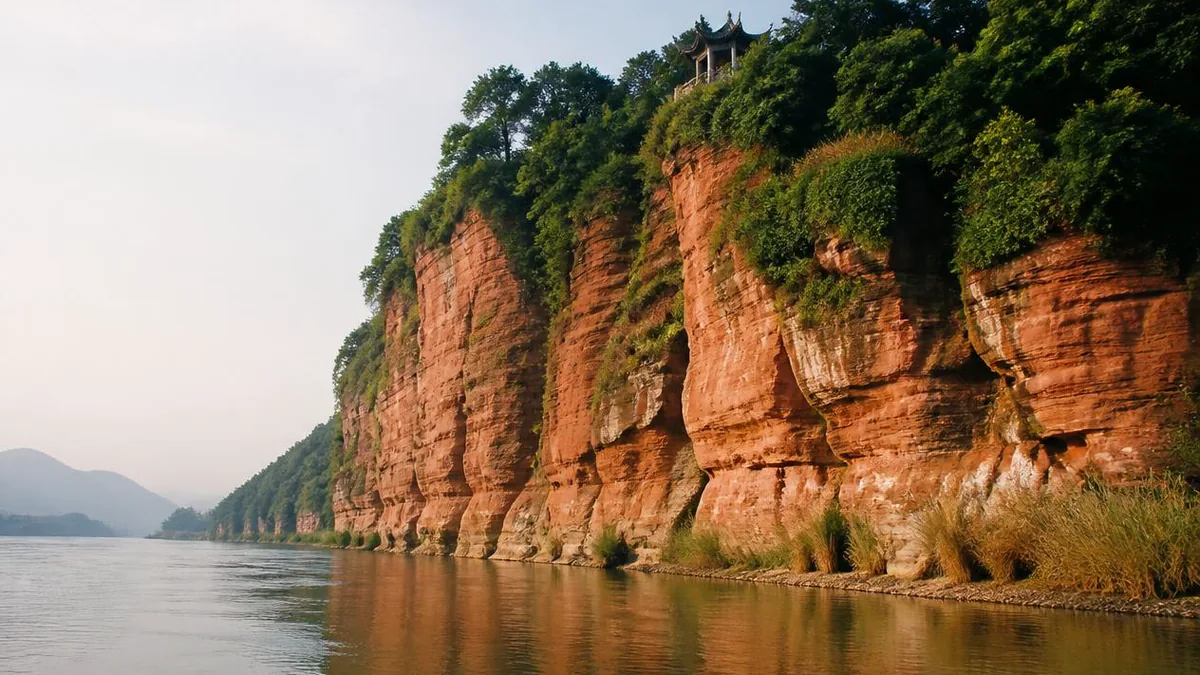
Hubei · Xianning
Red Cliffs: The Battle Site and the Famous Poem Are Not the Same Place
Two cliffs in Hubei answer to the name. The one with the 5A gate is the leading candidate for the battle of 208; the one that produced the most quoted lines ever written about that battle almost certainly is not, and the poet who wrote them said so himself, in a letter, in 1083.
5A View location, maps and nearby scenic areasMost battlefields have the opposite problem: the site is certain and the story is thin. Red Cliff has a story so thick it has been rewritten by a novelist, a puppet theatre, a manga artist and a game studio, and a site that has been argued over since at least the Tang.
The scenic area you buy a ticket for is at Chibi City, in Xianning prefecture in southern Hubei, on the south bank of the Yangtze. It is the leading candidate for the naval battle of the winter of 208, when the allied forces of Sun Quan and Liu Bei stopped Cao Cao’s southward advance with fire.
It is almost certainly not the cliff that produced the two rhapsodies and the lyric that made the name famous. Those were written two hundred kilometres downstream, by a poet who suspected he was in the wrong place.
A letter from 1083, in which the poet hedges
Su Shi was in exile at Huangzhou when he wrote the Red Cliff pieces: two fu rhapsodies and one ci lyric, all of them still anthologised, all of them set at a red rock face beside the river.
He also wrote a private letter, to the brothers Fan Zifeng, dated the fifth day of the eighth month of Yuanfeng 6 — 1083. In it he describes the hill a little west of Huangzhou jutting into the river, the rock the colour of cinnabar, and says that tradition holds this to be where Lord Cao was defeated, the place called Red Cliff. Then, in three characters, he adds: some say it is not.
He does not stop there. He works through where the Huarong road must have run, notes that Yuezhou also has a Huarong county, and concludes that in the end he does not know which is right. Then he changes register entirely and describes the evening he actually had: a friend playing the flute in a small boat, wind rising, water heaving, big fish breaking the surface, a hawk startled off the cliff, and the thought of Cao Cao and Zhou Yu feeling as close as yesterday.
That is the whole problem in one document. The most influential writing about Red Cliff was produced by a man who knew he might be at the wrong Red Cliff and wrote anyway, because the wrong cliff was doing the work he needed.
Counting the Red Cliffs
The disagreement is old and it is documented rather than folkloric.
The earliest surviving locating text is the fifth-century Jingzhou ji by Sheng Hongzhi, quoted in Tang commentary: a hundred li along the river from Puqi county, the south bank is named Red Cliff, and Wulin and Red Cliff face each other across a hundred and sixty li. Li Daoyuan’s Shui Jing Zhu puts it elsewhere. The Song geography Taiping Huanyu Ji attaches the name to a peak near Hanyang. The Tang Yuanhe Junxian Tuzhi mentions a Red Cliff market town west of Hanchuan county and says that most geographical writing calls it Cao Cao’s defeat. Later scholars have argued for Zhongxiang. Chinese surveys of the question therefore list claims for Jiayu, Puqi, Wuchang, Hanyang, Hanchuan, Huanggang and Zhongxiang.
Two constraints do most of the filtering. The records say Cao Cao’s forces withdrew north across the river after the first clash, which puts the battle on the south bank and disqualifies the northern-bank claimants outright. And the allied fleet moved upstream from Fankou or Xiakou while Cao Cao came downstream past Baqiu near present-day Yueyang, which brackets the possible stretch of river at both ends.
Within that bracket, Puqi is the most widely accepted answer, chiefly because it faces Wulin directly. Jiayu, just downstream, keeps serious defenders among historians who follow the Shui Jing Zhu. It is a shortlist, not a verdict.
A county renamed for a battle
The county here is not new. Puqi was established in 223, under Wu, and the name is usually explained by the rush matting traded at its markets. For most of two millennia it was Puqi, and Red Cliff was a hill inside it.
On 11 June 1998 the State Council approved the renaming of Puqi City to Chibi City — Red Cliff City. English-language accounts describe the change frankly as an attempt to convert a contested identification into visitor traffic, and it worked: the Three Kingdoms Chibi Ancient Battlefield scenic area was rated 5A on 29 October 2018.
The sequence is the whole modern history of the place in three steps. A candidate site acquires a monopoly on the name; the name becomes the town’s name; the town’s name then reads, to every arriving visitor, as confirmation. Nothing dishonest happened. A live scholarly question got a very effective piece of signage.
Huangzhou did something structurally similar much earlier. Its cliff is written with a different second character — chibi meaning red nose, not red wall, and the two were pronounced differently in the period, a distinction that survives in several non-Mandarin varieties. A Qing prefect of Huangzhou, Guo Chaozuo, resolved the ambiguity in the late Kangxi years by renaming the place Dongpo Chibi, Su Dongpo’s Red Cliff. That is an unusually graceful move: it claims the poet instead of the battle.
What the records say
Strip the campaign back to what the third-century record supports and it gets shorter, stranger and better.
In the seventh month of 208 Cao Cao moved south against Liu Biao, who died in the eighth month; his son Liu Cong surrendered Jingzhou without a fight. Liu Bei ran, was caught at Changban by cavalry that covered an extraordinary distance in a day, lost his baggage and most of his followers, and reached Xiakou. Lu Su brokered the alliance; Zhuge Liang argued it in person at Chaisang.
Sun Quan appointed Zhou Yu and Cheng Pu as joint commanders, left and right. That was a political balance and a battlefield liability, and the histories say so. The fleets met at Red Cliff by accident rather than design, Cao Cao’s numbers counted for less on water, and his army was already sick. He pulled back to Wulin on the north bank; Zhou Yu camped opposite.
Huang Gai proposed the fire attack, in a sentence the sources preserve: the enemy is many and we are few, we cannot last, but look at how their ships are joined bow to stern — they can be burnt and driven off. He loaded warships with kindling and oil, covered them in red cloth, sent Cao Cao a letter offering surrender, and ran them in. He was hit by a stray arrow, went into the water, was pulled out unrecognised and dumped on a latrine bunk before he could shout for Han Dang. Cao Cao retreated along the Huarong road over marsh, ordering the weak to lay brushwood and be trampled into it.
Then the detail that outranks all the others. In a letter to Sun Quan, preserved in the Jiang Biao Zhuan, Cao Cao wrote that at Red Cliff there had been sickness, that he burned the ships and withdrew himself, and that Zhou Yu had thereby gained the reputation for nothing. Elsewhere he said he was not ashamed to have run. The loser’s own account is the earliest spin.
What the novel added
Almost everything a visitor arrives already knowing comes from Romance of the Three Kingdoms, chapters 43 to 50, and it is worth separating item by item.
Straw-boat arrows. Fiction, from a real anecdote relocated. The Wei Lüe records Sun Quan sailing out to look at Cao Cao’s lines at Ruxu in 213, taking arrows until his boat listed, and turning it to even the load. No fog, no straw men, not Zhuge Liang, five years later and elsewhere.
Jiang Gan and the stolen letter. Jiang Gan was real and did visit Zhou Yu, but the Jiang Biao Zhuan places the visit after the battle, in 209, as an attempt to recruit Zhou Yu for Cao Cao. He failed, and went home praising Zhou Yu’s magnanimity as beyond the reach of argument. The novel moves him forward, hands him a forged letter, and turns a defeated recruiter into a comic dupe.
The beating of Huang Gai. No basis. In the record the feigned surrender is a letter, not a flogged back.
Pang Tong’s chain of ships. Cao Cao’s vessels are described as joined bow to stern in Huang Gai’s own words, which is why the fire spread. Nobody had to be tricked into it.
Borrowing the east wind. Entirely the novel: the seven-star altar, the robes, the escape by boat with Zhao Yun.
Guan Yu on the Huarong road. The retreat through Huarong is historical. Guan Yu waiting there and letting Cao Cao go out of gratitude is not.
The novel’s overall bias is to move credit from Zhou Yu to Zhuge Liang, and it is worth noticing that the temple culture built around the Shu figures — the Wuhou Shrine in Chengdu, where Zhuge Liang’s hall long ago overshadowed Liu Bei’s — was doing the same work by other means, centuries before the novel fixed it in print.
The east wind, without the altar
The wind is the one piece of the fictional apparatus that answers a real question. A fire attack running south to north in the twelfth lunar month needs a southeasterly, and the prevailing winter wind on this reach is northerly.
There is a meteorological explanation in circulation, and it is worth giving with its label attached rather than as fact. The old Yunmeng marshes lay northwest of the battle reach, and a lake–land breeze driven by the pressure difference between a large water body and the land around it can blow from the southeast toward it, most strongly when a cold spell breaks into warmer, wetter air. On this reading Huang Gai did not need a miracle, only a few hours of local weather that a Yangtze boatman would recognise.
Treat that as a plausible reconstruction rather than a proven one. What the sources themselves emphasise is different and less picturesque: Zhou Yu’s pre-battle assessment leans on the deep cold, the lack of fodder for horses, northern troops unused to boats and water, and disease as the predictable result. Cao Cao’s own explanation was sickness. Two of the three principals, in other words, blamed the season and the epidemiology, and neither of them mentioned wind.
What is actually old at the site
Walk in with one question: what here has a date behind it?
The cliff inscriptions do. They were listed in 2013 among the seventh batch of Major Historical and Cultural Sites Protected at the National Level, and the listing dates the group to the Song, Ming and Qing. English-language summaries of the famous two-character carving put its origin between the Tang and the Song. Both datings are centuries after 208, which means the tradition that Zhou Yu cut the characters with his sword after the victory is exactly that — a tradition, and one the heritage paperwork quietly declines to endorse.
The battlefield as a whole is a Hubei provincial protected site, registered under the Three Kingdoms period. Around it stand a wind-praying terrace and a hermitage named for Pang Tong, together with pavilions, a bronze figure of Zhou Yu and an exhibition hall. Their subject matter is instructive: the wind terrace commemorates the altar scene, and the hermitage commemorates the man who, in the novel, tricks Cao Cao into chaining his fleet. Both are monuments to episodes that are not in the histories. Published construction and rebuilding dates for them differ between sources, so it is safer to describe them as later commemorative architecture, repeatedly renewed, than to attach a year.
None of this makes the site fake. It makes it a place where the fourteenth century is on display at the location the third century probably used, and the labelling does not always distinguish the two.
Red Cliff in Japan
Among foreign audiences, Japanese readers arrive at Red Cliff with by far the densest prior knowledge, and the reason is a chain of publications that can be dated precisely.
Yoshikawa Eiji serialised his Sangokushi in newspapers from 1939 to 1943, following the novel’s plotline while rewriting the characterisation for Japanese readers; cumulative sales were reported at over 20 million copies as of 2014. Yokoyama Mitsuteru adapted Yoshikawa’s version into a monthly manga serialised from 1971 to 1987, running to 60 volumes and reported at over 80 million copies as of May 2020. Between them, NHK broadcast a puppet Sangokushi from autumn 1982 to spring 1984, 68 episodes, with puppets by Kawamoto Kihachirō.
Then the games. Koei released Sangokushi on 10 December 1985 for the PC-8801, produced by Shibusawa Kou; it went abroad as Romance of the Three Kingdoms and reached the Famicom in 1988. Japanese accounts of its development state plainly that the subject was chosen because Yoshikawa’s novel, Yokoyama’s manga and the NHK puppet series had already built the audience. Shin Sangokumusou, sold overseas as Dynasty Warriors 2, followed on 3 August 2000.
The loop closed in cinemas. John Woo’s Red Cliff, released in Japan as Reddo Kurifu, opened there on 1 November 2008 across 545 screens, and took the Mainichi Film Award for best foreign-language film.
The other Red Cliff, in Huanggang
If you have the days, see both, and see them in the right order: the battlefield first, the poem second.
Dongpo Chibi sits in Huangzhou district of Huanggang, on the north bank, downstream and east of Wuhan — the wrong side of the river for the battle, which is part of the point. Silting has left the red rock several hundred metres inland from the present channel. The standing buildings are mostly the rebuild of 1868 ordered by the prefect Ying Qi; at the end of the Qing, Yang Shoujing organised the recutting of Su Shi’s calligraphy from rubbings into 139 stone tablets, set into the pavilions and halls. It was listed as a national protected site in 2006, and a memorial museum to Su opened in Huanggang in 2010.
Both places are ticketed and neither is a quick stop off a through train. Confirm opening hours, shuttles and any closures at the gate on the day rather than from anything written earlier, including this.
Which version you are standing in
Stand on the bank at Chibi City and you are, on the balance of evidence, near where a fleet burned in the winter of 208. Stand at Huangzhou and you are where the sentences came from.
The interesting thing is how little the two have to do with each other, and how completely the second has swallowed the first. The east wind, the straw boats, the flogging, the chained ships and the mercy on the Huarong road are all later inventions, and they are the reason anybody comes. Cao Cao’s letter saying that he burned his own ships and that Zhou Yu got the credit for nothing is the earliest surviving word on the subject, and almost nobody has heard it.
Su Shi, who did more than anyone to make the name immortal, wrote down in a private letter that he was not sure he was in the right place, and then went out on the water with a flute player anyway. That remains the correct posture for a visit here. Know which layer you are looking at, and enjoy it as the layer it is.
The LoreLens app can identify cliff inscriptions, commemorative halls and battlefield markers while explaining what each one is actually dated to.
Location profile
Where it is

Frequently asked questions
Is the Red Cliff scenic area in Xianning where the battle of 208 actually happened?
It is the most widely accepted candidate, not a settled fact. The location has been argued over for more than a thousand years, and Chinese scholarship lists claims for Jiayu, Puqi, Wuchang, Hanyang, Hanchuan, Huanggang and Zhongxiang. Two constraints narrow the field: the histories place the battle on the south bank of the Yangtze, which rules out the northern-bank claimants, and they place it upstream of Fankou or Xiakou but downstream of Baqiu near present-day Yueyang. Puqi, renamed Chibi City in 1998, sits directly across the river from Wulin, where the fire is recorded as having taken hold, and the identification was already being argued in the early Tang. Jiayu, immediately downstream, is defended by scholars who follow the Shui Jing Zhu, including Rafe de Crespigny. The honest formulation is that the 5A gate stands at the leading candidate.
Did Zhuge Liang really borrow the east wind and collect arrows with straw boats?
No, in both cases. The wind altar on Nanping Mountain, the straw men, the beating of Huang Gai and the chain of linked ships are all from the novel, which covers the campaign in chapters 43 to 50. The arrow anecdote has a historical kernel, but a different one: the Wei Lüe, quoted in Pei Songzhi's commentary, records Sun Quan sailing out to inspect Cao Cao's lines at Ruxu in 213, taking so many arrows on one side that his boat began to list, and turning it around to balance the load. No fog, no straw figures, not Zhuge Liang, and not at Red Cliff. What the histories do give Huang Gai is the fire proposal, the letter offering surrender, and a stray arrow that put him in the water.
What at the site is genuinely old?
The cliff-face inscriptions are the one element with a formal dating behind it. They were listed among the seventh batch of Major Historical and Cultural Sites Protected at the National Level in 2013, and the listing dates the group to the Song, Ming and Qing dynasties; English-language accounts of the two-character carving place its origin between the Tang and the Song. Either way it postdates 208 by many centuries, so the tradition that Zhou Yu cut it himself after the victory is a tradition, not a date. The battlefield itself is a Hubei provincial protected site. The terraces, halls and hermitages you walk through are commemorative buildings named for episodes in the novel, rebuilt more than once; published construction dates for them vary and are best treated as approximate.
Can I see this Red Cliff and Su Shi's Red Cliff on the same trip?
Only with planning, because they sit on opposite sides of Wuhan. The scenic area is at Chibi City in Xianning prefecture, southwest of Wuhan on the south bank; Dongpo Chibi is in Huangzhou district of Huanggang, downstream and to the east, on the north bank. Silting has left that cliff several hundred metres back from the present river. Its standing buildings are largely the 1868 rebuild ordered by the prefect Ying Qi, and it holds the set of 139 stone tablets recut from rubbings of Su Shi's own hand under Yang Shoujing at the end of the Qing; a memorial museum to Su opened in Huanggang in 2010. Both are ticketed; confirm hours and any seasonal closures at the gate on the day.
Sources and further reading
Background references for the history and place names in this guide. Opening hours, ticketing and access change often — always confirm with official local information before travelling.