Sichuan · Chengdu
Wuhou Shrine: An Emperor's Temple That the Public Renamed
The gate says Han Zhaolie Miao — the temple of Emperor Zhaolie, Liu Bei — and his tomb is inside the walls. Everyone calls the place after his chancellor instead. That mismatch is not a mistake; it is the exhibit.
Read the gate before you go in. The characters over the entrance name this the temple of Emperor Zhaolie of Han — that is, Liu Bei, founder of the Shu Han state, who died in 223. His tomb is inside the walls. The building in front of you is an imperial ancestral temple.
Nobody calls it that. Everybody calls it the Wuhou Shrine: the shrine of the Marquis Wu, the posthumous title of Zhuge Liang, Liu Bei’s chancellor and subordinate. The museum uses the popular name. The street outside uses it. The metro uses it.
An emperor’s temple named after his employee, by public habit, and then ratified by the state. That is the thing worth two hours here.
The gate says one thing and the city says another
The formal awkwardness is visible in the plan itself, and you should walk it deliberately.
You enter through the Han Zhaolie Miao, a hard-gabled hall with a pair of Ming stone lions outside and a screen wall on the axis beyond the gate. You cross a courtyard, pass a second gate whose plaque reads, in four characters attributed to a Kangxi-era Sichuan military commander, an enlightened ruler and a good minister, a model for all time. Then comes the Liu Bei hall, seven bays wide, with a gilded seated figure three metres high wearing an imperial cap with nine strands of beads and holding a jade tablet. Attendants flank him with the state seal and the imperial sword.
Only then, and on lower ground, do you reach the Zhuge Liang hall — five bays wide, single-eaved, and roughly half the floor area of the emperor’s.
Architecturally the hierarchy is perfectly correct: the emperor is in front, higher, and larger. Culturally it lost. The Chinese phrase for what happens here is that the front hall follows court ritual and the rear hall follows family ritual, and it is the family that people come to visit.
Three separate places that became one address
The compound you walk through is a merger, and the merger took roughly a thousand years.
The tomb came first. Huiling was built for Liu Bei, with an imperial temple raised alongside it; the museum’s own pages give both 221 and 223 for the start of work in different paragraphs, and the standard historical date for the burial is autumn 223. A more specific early record has the Southern Qi emperor Xiao Daocheng, reigning 479 to 482, ordering a provincial governor to establish a shrine to the First Ruler east of the tomb, and that is treated as the ancestor of today’s entrance temple.
The Zhuge Liang shrine came separately and from somewhere else. It is credited to the Cheng Han ruler Li Xiong, who reigned 303 to 334, and it originally stood in Chengdu’s Shaocheng, the inner walled town. Around 500, in the Northern and Southern Dynasties period, it was moved out to sit beside the tomb and the imperial temple.
For most of a millennium, then, three institutions stood next to each other in an offset triangle, each with its own walls, its own gate and its own staff. They were neighbours, not a single site.
The merger of the 1390s, and what it was really for
A Ming prince ended the arrangement. Zhu Chun, enfeoffed in Shu, visited the shrine and ordered the three amalgamated on the argument that ruler and minister ought to be one body: the separate Zhuge Liang shrine was abolished and his image installed inside the emperor’s temple.
The date is not stable even in official material. The museum’s own introduction gives 1390 in one paragraph and 1391 in the next. Both are within the Hongwu reign; treat the exact year as unsettled.
The stated reason is decorous. The likely reason is less so. By the fourteenth century Zhuge Liang was drawing the crowds and Liu Bei was not, and a minister’s cult outshining an emperor’s a few metres away was an awkward look for a dynasty that cared about ritual precedence. Folding the minister into the emperor’s hall fixed the optics — the minister now stood inside the ruler’s temple, subordinate, in the correct place.
It did not fix the name. The moment the walls came down, the whole complex started being called after the man in the back hall. The museum states this outcome flatly: because Zhuge Liang’s standing among ordinary people exceeded Liu Bei’s, people habitually called the place the Wuhou Shrine. A ritual correction produced a naming defeat.
What you are actually standing in: 1671 to 1672
Nothing above survived the seventeenth century.
The compound was destroyed in the fighting at the end of the Ming — Chinese accounts commonly attribute the demolition to Zhang Xianzhong’s occupation of Chengdu. What stands today was rebuilt under the Kangxi emperor, in 1671 to 1672, under a Sichuan provincial judge named Song Kefa, and that rebuilding fixed the two-hall arrangement described above.
So the dating is worth stating bluntly, because a great many visitors do not realise it: you are looking at a late seventeenth-century compound commemorating third-century people. The seated Zhuge Liang, holding a feather fan and wearing a silk headscarf, is dated to 1672. His son and grandson stand beside him. The twenty-eight civil and military officials in the two corridors — fourteen a side, the civil wing headed by Pang Tong, the military wing by Zhao Yun — are Qing sculpture in costume borrowed largely from Qing opera. What you are reading is the Qing dynasty’s picture of the Three Kingdoms, filtered through a novel and a stage.
The one Ming survival on the axis is a pair of stone lions at the gate. Everything else timber is Qing or later.
The emperor in the garden
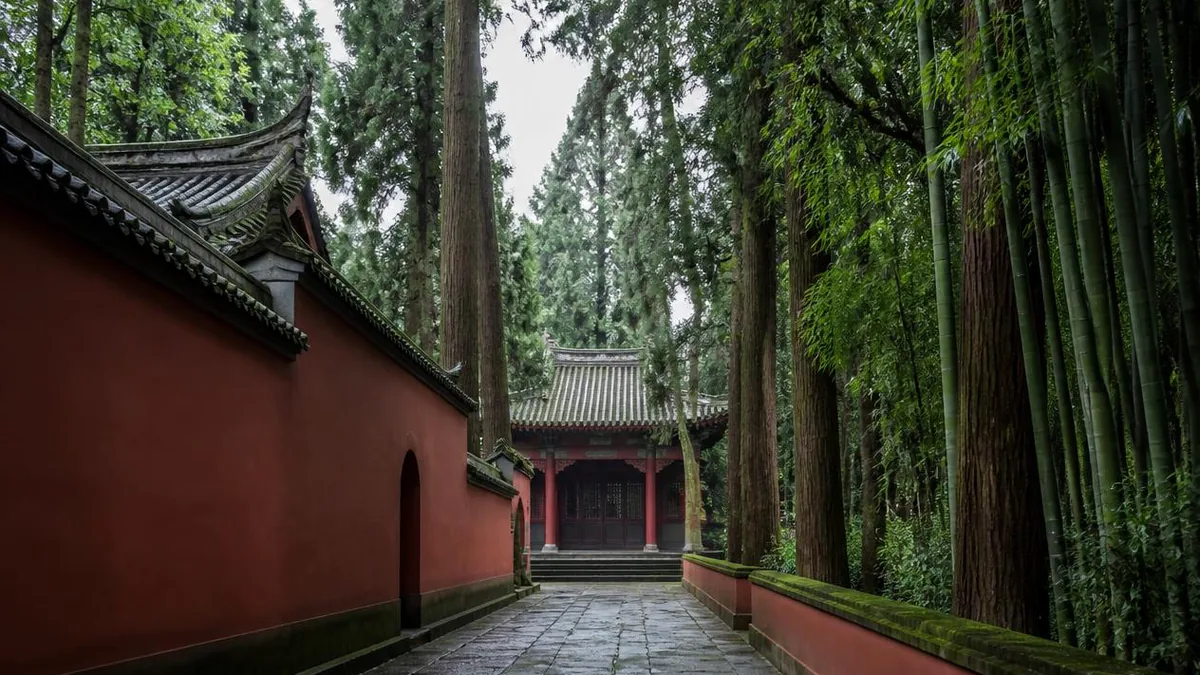
Walk west past the Zhuge Liang hall, through a corridor of red walls with bamboo behind them, and you arrive at something most visitors do not register as what it is: an imperial tomb.
Huiling has its own screen wall, gate, spirit way and offering hall. The mound behind them is given as about 12 metres high with a circumference of about 180 metres, enclosed by a brick wall. Records describe it as a joint burial of three people — Liu Bei with the consorts Lady Gan and Lady Wu, who predeceased him. The museum states that it has never been robbed and never excavated.
That last sentence is doing a lot of work, because it means the identification rests on documents rather than on contents. The case for Chengdu is strong: Chen Shou, who wrote the Records of the Three Kingdoms and had served under Shu Han, records that Liu Bei was buried at Huiling in the eighth month of 223; there is a Qing stele naming the tomb; Shu Han period patterned bricks have been found nearby.
It is not unanimous. Guo Moruo, inspecting in 1961, argued for Fengjie — Liu Bei died at Baidicheng in high summer and a body could not plausibly have been carried several hundred kilometres to Chengdu intact. A third proposal at Pengshan rests largely on landscape geomancy and lacks documentary or archaeological support. The Chengdu identification remains the mainstream position and is not considered closed.
The Tang stele, and who actually wrote on it
The oldest object on the site sits between the first and second gates, under a small pavilion, and it is easy to walk straight past.
The Tang stele, properly the Stele of the Shrine Hall of Zhuge, Marquis Wu, Chancellor of Shu, is about 367 centimetres high and 95 centimetres wide, and was cut in 809. The occasion is recorded: Wu Yuanheng, then military governor of Jiannan West Sichuan, came to pay respects with twenty-seven members of his staff and had his secretary compose a text.
That secretary was Pei Du, later one of the great chancellors of the Tang. The calligraphy on the stone is by Liu Gongchuo, and the carving by a mason named Lu Jian.
One correction is worth making, because it is the single most common error told about this stone: the calligrapher was Liu Gongchuo, not Liu Gongquan. Liu Gongquan was his younger brother and one of the most famous brush-hands in Chinese history, which is precisely why the two names get swapped. Museum material and provincial records both give Gongchuo.
The nickname stele of three perfections dates from the Ming. What the three are is itself disputed: the museum’s guide counts prose, calligraphy and carving, while other official summaries substitute the merit of the man being praised for the mason’s work. Both readings are in print; neither is folklore.
Du Fu got here first, and he described a place that no longer exists
The single most quoted poem about this site is Du Fu’s Shu Xiang, written in Chengdu:
Chéngxiàng cítáng hé chù xún? Jǐnguān chéng wài bǎi sēnsēn. Yìng jiē bì cǎo zì chūn sè, gé yè huáng lí kōng hǎo yīn. Sān gù pín fán tiānxià jì, liǎng cháo kāi jì lǎo chén xīn. Chū shī wèi jié shēn xiān sǐ, cháng shǐ yīngxióng lèi mǎn jīn.
Where is the chancellor’s shrine hall to be found? Outside the Brocade Officer’s city, where the cypresses stand thick. Green grass on the steps makes its own spring, for itself; behind the leaves an oriole sings beautifully, to no one. Three visits, pressed upon him, for a plan to settle the realm; two reigns opened and sustained by an old minister’s heart. He led the army out and died before the victory — and heroes ever since have soaked their collars.
The cypresses are still the defining plant here, and outside the Brocade Officer’s city is still roughly the right direction from the old walls.
Du Fu also left a line that is better evidence than any stele about how the site worked before the Ming merger: in one of his Meditations on Ancient Sites he notes that the Marquis Wu’s shrine has always stood close by, and that ruler and minister receive one sacrifice together. That is a Tang poet reporting joint worship in practice some six hundred years before the walls between the compounds came down. The Ming decree did not invent the arrangement. It caught up with it.
The texts on the walls, and how much of them is secure
This is a shrine to a writer as much as to a strategist, and the writing is displayed everywhere.
The Longzhong Dialogue is the founding document: Zhuge Liang’s assessment, delivered to Liu Bei before he had a state, that Cao Cao commanded a million men and held the emperor and could not be fought head-on, that Sun Quan’s position across the river was established and should be allied with rather than attacked, and that the way forward was to take and hold both Jing and Yi provinces and wait. The whole Shu Han project is a working-out of that paragraph.
The Chu Shi Biao, the memorial submitted before the northern campaign of 227, is the emotional centre — I was a commoner, farming with my own hands in Nanyang, hoping only to keep body and soul together in a disordered age, with no wish to be known among the lords — and the source of the advice that recurs on plaques here: draw near worthy ministers, keep small men at a distance.
Two hedges belong with them. First, the Later Chu Shi Biao is of contested authorship: it appears in neither the main text of Chen Shou’s biography nor his collected Zhuge Liang, reaching us through a later commentary, and has been doubted since the Qing on grounds of source, internal chronology and tone. Second, the sets of stone tablets carrying a wild-cursive Chu Shi Biao signed by Yue Fei, of which versions exist at Zhuge Liang sites across the country, rest on a postscript claiming he wrote it in 1138 at a shrine in Nanyang after a sleepless night. Specialists have long questioned that attribution; a later hand, possibly Ming, is the common alternative. Read the calligraphy as a Song-loyalist reading of Zhuge Liang, which is real, rather than as Yue Fei’s handwriting, which is not established.
The couplet that turned a shrine into a governing manual
The most consequential object in the compound is a wooden board.
Hanging by the Zhuge Liang hall is the Gongxin Lian, the attack-the-heart couplet, composed by the late-Qing Yunnanese official Zhao Fan:
If you can take the heart, insubordination dissolves of itself — those who have understood war have never been fond of it. If you misjudge the situation, leniency and severity are equally wrong — whoever governs Shu hereafter should think hard on this.
It is not a compliment. It is a rebuke, written for a specific reader, and it turns a memorial hall into a lesson about how Sichuan should be administered. That is why it, and not the statuary, is the object most often photographed by Chinese visitors, and why it has been cited by senior officials for more than a century.
The rest of the epigraphy runs the same way. Plaques praise clarity, restraint and the refusal to profit from office; the shrine now anchors a formal integrity-in-government education programme run out of the museum. A minister who died in the field in 234 remains, here, an argument about administration.
The Sanyi Miao, the temple of the three sworn brothers, sits in the same enclosure, but it is an import: founded in the early Kangxi years elsewhere in the city, burned in 1784, rebuilt in 1787, refitted in 1842, and moved here from Tidu Street in 1998. Its Liu-Guan-Zhang figures follow the novel, not the histories.
Jinli, the fair, and the honest shape of the visit
The complex today runs to about 150,000 square metres in three parts, and only one of them is old.
The Three Kingdoms heritage zone is the temple, the shrine, Huiling and the Sanyi Miao. The west zone, absorbed in 2003, was the former South Suburb Park and is built around the mausoleum of Liu Xiang, the Sichuan warlord and wartime commander who died in 1938. And Jinli is a commercial street built by the museum itself: 550 metres long, roughly 30,000 square metres, in late-Qing and early-Republican Sichuan style, opened in October 2004, extended in January 2009.
Jinli is worth walking and worth labelling correctly. The name is genuinely ancient — Chengdu’s brocade workshops gave the city its nicknames, and Zhuge Liang is quoted saying that the resources for defeating the enemy depended on brocade alone. The buildings are twenty years old. It belongs in the same category as Kuanzhai Alley: a competent modern reconstruction, not a survival.
The Chengdu Grand Temple Fair fills the site around the lunar new year, with lantern displays and folk performance. It too has a stated pedigree and a real date: revived in 2004 after a forty-five-year lapse, and hosted here since 2005.
Which brings the visit back to where it started. Almost nothing here is from the third century. The tomb mound is, and it is sealed. What the site preserves instead is fourteen hundred years of people deciding, repeatedly and against the official signage, who they had come to see. The Ming prince tried to fix the hierarchy and only fixed the walls. The name on the street is still the crowd’s.
The LoreLens app can identify Qing hall types, stele forms and temple statuary while explaining which parts of a shrine are original and which are reconstruction.
Location profile
Where it is

Frequently asked questions
Why is a temple to Liu Bei called the Wuhou Shrine?
Because visitors overruled the sign. Two separate institutions grew up here: the tomb of Liu Bei, first emperor of Shu Han, with an imperial temple beside it, and a separate shrine to his chancellor Zhuge Liang, who held the title Marquis Wu — Wuhou. They stood adjacent for centuries. A Ming prince merged them at the end of the fourteenth century on the principle that ruler and minister should form one body, and from then on the whole compound took the popular name rather than the official one. The gate still reads Han Zhaolie Miao, the temple of Emperor Zhaolie. Nobody uses it. Even the museum is called the Chengdu Wuhou Shrine Museum.
Is Liu Bei actually buried here?
Probably, and the mound is real, but it has never been opened. Huiling sits inside the same walls, a tumulus given as about 12 metres high with a circumference of about 180 metres, recorded as the joint burial of Liu Bei with two of his consorts, and described by the museum as never robbed and never excavated. The Chengdu case rests on the Records of the Three Kingdoms, whose author served under Shu Han and states plainly that Liu Bei was buried at Huiling in the autumn of 223, plus a Qing stele and Shu Han period patterned bricks found nearby. A Fengjie case, raised by Guo Moruo in 1961, argues that a body could not have been carried from Baidicheng to Chengdu intact in midsummer. A Pengshan case rests mainly on geomancy. The Chengdu identification remains the mainstream view; the dispute has not been closed.
How old are the buildings I am looking at?
Mostly Qing, from the rebuilding of 1671 to 1672, not Three Kingdoms and not even Ming. The compound was destroyed in the fighting at the end of the Ming, and a Sichuan provincial judge rebuilt it under the Kangxi emperor in the layout you walk today: Liu Bei's hall in front, Zhuge Liang's hall behind, on descending ground. The seated Zhuge Liang statue is dated to 1672. The twenty-eight civil and military figures in the side corridors wear costume borrowed largely from Qing opera. The genuinely old objects are portable: the Tang stele of 809, the plaques and couplets, the tomb mound itself.
Is Jinli an old street, and when is the temple fair?
Jinli is new. The lane next to the shrine was built by the museum itself and opened in October 2004, with an extension trading from January 2009 — a 550-metre street of some 30,000 square metres, in a late-Qing and early-Republican Sichuan vernacular style, with Three Kingdoms and Sichuan folk-culture content. The name is ancient, from Chengdu's brocade industry, but the buildings are not; treat it as Chengdu's other planned old-style quarter alongside [Kuanzhai Alley](/destinations/kuanzhai-alley/). The Chengdu Grand Temple Fair runs here around the lunar new year: revived in 2004 from a Republican-era fair that had lapsed for forty-five years, and hosted at the shrine since 2005. Dates, ticketing and evening hours change every year — check the museum notice.
Sources and further reading
Background references for the history and place names in this guide. Opening hours, ticketing and access change often — always confirm with official local information before travelling.