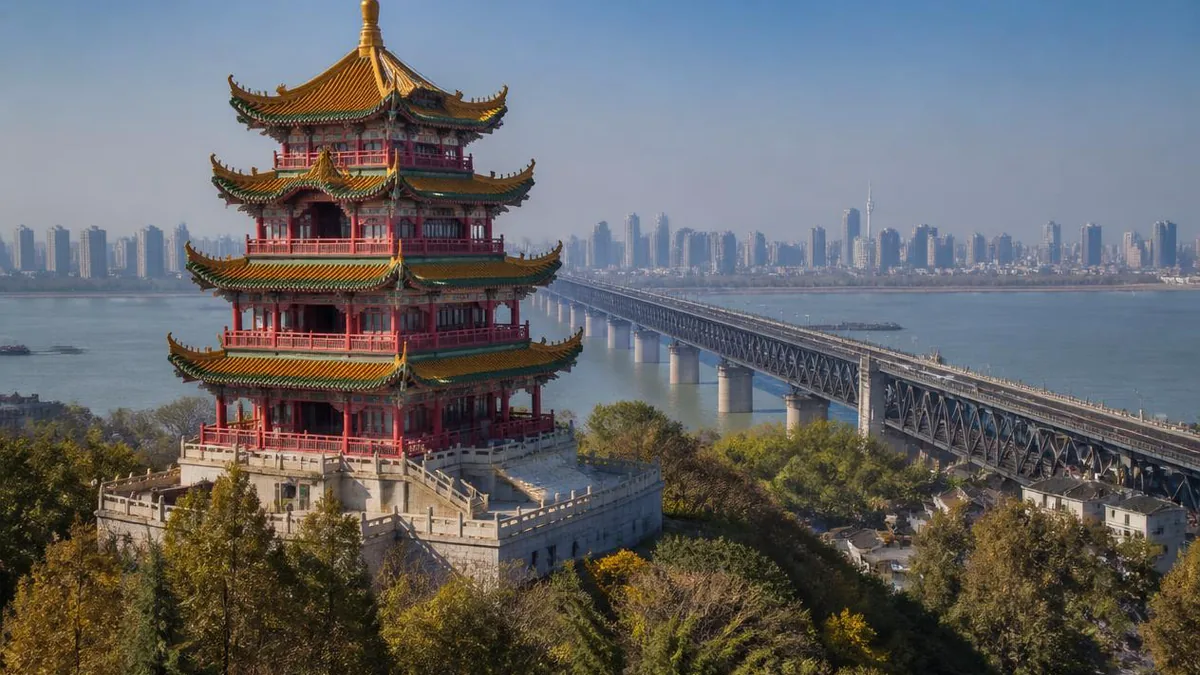
Hubei · Wuhan
Yellow Crane Tower: The Poem Outlived the Building
The tower on Snake Hill was finished in 1985, in reinforced concrete, about a kilometre from where the old one burned down in 1884. That is not the embarrassing part of the story. It is the story.
5A View location, maps and nearby scenic areasMost famous buildings ask you to believe they are old. The Yellow Crane Tower cannot, and it does not really try.
The tower on Snake Hill in Wuchang was completed in June 1985. It is reinforced concrete. It has a lift. It stands about a kilometre from where its predecessor stood, because the original ground was taken for a bridge. The last tower on the real site burned in 1884 and was never replaced; for a century, the most celebrated tower in Chinese poetry simply did not exist.
That gap is the interesting thing. A building that has been destroyed twelve times and rebuilt ten was never really the point. What survived the fires was eight lines of verse.
The tower you climb is younger than the bridge beside it
Get the chronology straight before you buy a ticket, because it reorders everything you will see.
The Wuhan Yangtze River Bridge, immediately downhill, began construction in September 1955 and opened to traffic in October 1957. The tower above it was decided on in October 1981 and finished in 1985. The bridge is the older monument by nearly three decades, and the bridge is the reason the tower is where it is.
The building itself is candid about its materials once you are inside. Five storeys are visible from outside; the interior is arranged over nine levels. The height is given as 51.4 metres, including a gourd-shaped finial of about five metres — roughly twenty metres taller than the tower it replaces. Each side of the base measures about 30 metres, against about 15 metres for the old one. It is, in other words, not a replica. It is a considerably larger building wearing the silhouette of a smaller one.
Wuhan has been honest about the status question too. The present tower was put forward in 2023 for a municipal list of protected cultural relics and did not end up on it. A forty-year-old concrete building is a landmark, not an antiquity, and the paperwork reflects that.
Twelve destructions, and one piece of bronze that got through
The demolition record is the real chronicle here, so it is worth reading as a list rather than as atmosphere.
Tradition dates the first tower to 223, when Sun Quan built the fort of Xiakou and put a lookout on the rock beside it. The source usually quoted for this, a Tang geographical compendium, was compiled roughly six hundred years afterwards; a competing folk account has the tower begin as a wineshop. Take 223 as the received date, not as a construction record.
By 765 a substantial tower existed and was described in writing. After that the pattern sets in. Fire in 1566; rebuilding in 1571; a lightning strike in 1681 that was extinguished in time; a second strike in 1702 that collapsed the building; war damage in 1856; rebuilding in 1868 under the Qing provincial administration. The usual tally is twelve destructions against ten rebuildings, seven of the losses falling in the Ming and Qing alone. A local saying paired the tower’s fortunes with the dynasty’s.
The 1868 tower was the last real one. It had three storeys, a recorded height of nine zhang two chi plus a bronze cap of seven chi, deliberately summing to a figure of nines. In 1884 it burned. What came through the fire was the bronze cap. Of everything the poets climbed, that finial is close to all that is left.
Why it moved: a bridge pier where the tower had stood
The old site has a name: Huanghu Rock, at the western end of Snake Hill, directly above the Yangtze. Snake Hill is a thin ridge — roughly 1,790 metres long, 25 to 30 metres wide, rising to about 85 metres — running east from the river into the middle of Wuchang, and facing Tortoise Hill across the water in Hanyang.
That narrows is exactly where every bridge engineer since the late Qing wanted to build. Zhang Zhidong proposed a crossing in 1906. A 1913 survey settled on the gap between the two hills. A 1937 plan drew the alignment from the Yellow Crane Tower site on the Wuchang bank across to Hanyang. When construction finally began in 1955, the approach ramp on the Wuchang side ran up Snake Hill and took the tower’s ground with it. What remained of the ruins was cleared.
So the 1981 decision was not a matter of taste. The site was under a railway and road embankment and was not coming back. The new tower went up on a higher ridge about a kilometre inland, generally identified in Chinese accounts as the Gaoguan rise of Snake Hill — further from the water, higher above it, and visible from much further away.
That last point matters. The Tang tower was a riverside lookout you came upon. The 1985 tower is a skyline object designed to be seen from the bridge.
The hundred years when Wuhan made do with a substitute
Between 1884 and 1985 the city did not simply wait, and this is the part of the story that most guides skip.
In 1904 the Hubei governor Duanfang put a two-storey Western-style fire lookout on the old tower ground. In 1907 students of Zhang Zhidong built a second structure nearby and named it the Aolüe Tower, with a couplet by Zhang himself. Neither was the Yellow Crane Tower. Both stood where it had stood, and for roughly half a century visitors photographed the Aolüe Tower, climbed it, and went home having seen what they took to be the famous view. Both were demolished in 1955 for the bridge.
There is no need to be scornful about this. It is a clean demonstration of how the site actually worked. The name had detached from the building long before the building went; a tower-shaped object in the right place, with the right river below it, did the job.
The 1985 building is the same operation carried out with a bigger budget and better documentation. The difference is that this one admits it is a reconstruction, and this one moved.
Cui Hao, and the eight lines that outlasted every building
Everything above is the frame. This is the object.
Cui Hao (died 754) left roughly forty poems. One of them settled the reputation of a building he saw once:
Xī rén yǐ chéng huáng hè qù, cǐ dì kōng yú Huáng Hè Lóu. Huáng hè yī qù bù fù fǎn, bái yún qiān zǎi kōng yōuyōu. Qíng chuān lìlì Hànyáng shù, fāng cǎo qīqī Yīngwǔ Zhōu. Rì mù xiāng guān hé chù shì? Yān bō jiāng shàng shǐ rén chóu.
The man of old has already ridden the yellow crane away; here nothing is left but the Yellow Crane Tower. The crane, once gone, does not come back; for a thousand years the white clouds have drifted on, and on. Clear across the water, the Hanyang trees stand out one by one; the sweet grass grows thick on Parrot Island. Dusk — and where is the country I came from? Mist and waves on the river make a man sad.
The Song critic Yan Yu placed it first among all Tang poems in the seven-character regulated form, and the judgement stuck through the Ming and Qing.
Read the first four lines again next to the fire record. The poem is already about absence. The crane has gone, the immortal has gone, and what remains is an empty building and some clouds. Twelve destructions later, the poem describes the site more accurately than it did when it was written.
Li Bai, and the story you should hold loosely
Li Bai’s contribution is shorter and is the reason half the visitors are here:
Gù rén xī cí Huáng Hè Lóu, yānhuā sān yuè xià Yángzhōu. Gū fān yuǎn yǐng bì kōng jìn, wéi jiàn Cháng Jiāng tiān jì liú.
My old friend takes leave of the Yellow Crane Tower, westward behind him, and goes down to Yangzhou in the third month, through mist and blossom. The lone sail’s far shape is used up in the blue emptiness; all I see is the Yangtze running to the sky’s edge.
The friend is Meng Haoran; the tower is the point of departure, which is why the poem belongs to a place rather than to a person. Li Bai has a second Yellow Crane Tower poem, written in exile, in which someone plays a flute tune called Falling Plum Blossom and he hears plums falling out of season in the fifth month — the park’s Luomei Xuan takes its name from that line.
Then there is the anecdote. Li Bai, it is said, came to write, looked up, saw Cui Hao’s poem already on the wall, and put down his brush: there is a view in front of me and I cannot say it, because Cui Hao’s poem is up there. The park has a Gebi Ting, a laying-down-the-brush pavilion, built on the strength of it.
Treat it as folklore. It surfaces in later anthologies and biographical compilations, not in Tang documents, and no contemporary record puts the two men and the wall in the same room. The story is doing something real, though: it is the earliest clear statement that at this site the text outranks the building.
What is actually old on this hill
One thing in the park predates every tower now standing, and most visitors walk past it.
The Shengxiang Stupa is a white, bell-shaped Buddhist stupa built in 1343, under the Yuan. It is 9.36 metres high on a base of a little under six metres, mostly stone. For the Ming and Qing it stood beside the Yellow Crane Tower on Huanghu Rock. When the tower burned in 1884, the stupa did not.
It was moved in 1955, along with everything else on that ground, for the bridge; accounts differ on whether a second move around 1984 put it where it now stands near the western gate, and the dates 1955 and 1984 both circulate. When it was opened during relocation, workers found a stone pillar and a sealed bronze vase inscribed with a date corresponding to 1394, along with two Qing coins and two teeth. It was listed as a national key protected site in 2013.
So the hierarchy on this hill is exactly inverted from what the signage implies. The famous tower is forty years old and in the wrong place. The unfamiliar white stupa beside the path is nearly seven centuries old — and it has also been moved.
Reading the 1985 building honestly
Inside, the tower is a museum of its own subject matter, and it is better if you read it that way rather than as a Tang interior.
The ground-floor hall carries a large ceramic mural on the white-cloud-and-yellow-crane theme, with a pair of seven-metre couplet boards on the columns. The second floor has the Tang-period Record of the Yellow Crane Tower cut into stone, flanked by murals of Sun Quan building the city and Zhou Yu holding a banquet — the Three Kingdoms layer, asserted. The third floor is given over to portraits of the poets who wrote about the place, with their lines beside them. The fourth is modern calligraphy and painting. The fifth is the view.
Note what that sequence is doing. It is not reconstructing a building; it is assembling an anthology, floor by floor, of everything that has ever been said about the site. The exterior imitates the Tongzhi-era tower of 1868. The interior is unmistakably a late-twentieth-century civic project, and the 2003 refurbishment — mainly recopying the four exterior name boards while keeping the lettering — tells you which parts are considered load-bearing.
The eaves, splayed like wings, are the one detail that survives translation into concrete intact.
The rest of the park, with dates attached
The Yellow Crane Tower Park covers a long slice of Snake Hill — around 40 hectares — and was rated a national 5A scenic area in 2007. Almost everything in it is recent, and it is worth knowing which is which.
From the west gate you pass the Shengxiang Stupa and a memorial archway inscribed with a phrase claiming the tower as the finest in the old Three Chu region. From the east gate the approach runs past a bronze statue of Yue Fei, about 6.3 metres tall, who was garrisoned in this area in the Song; then a plum grove, a goose pond, and the Baiyun Pavilion, a 41.7-metre building put up in January 1992 on the summit of Snake Hill, at about 75.5 metres elevation, on the site of a fire-watch tower.
A Mao Zedong poem pavilion, also 1992, holds stone-cut texts of his 1927 lyric on the tower and his 1956 lyric on swimming the Yangtze. Luomei Xuan, named from Li Bai’s flute line, and a large millennium bell cast for the year 2000 belong to the same wave of additions; both are modern park furniture, and I have not found a reliable construction date for the Luomei Xuan itself. Stone relief panels of Cui Hao composing his poem, and a bronze crane-and-tortoise group, round out the set.
None of this is a fault. It is simply a park built in the 1980s and 1990s around a poem.
A hill that keeps getting conscripted
Stand at the top and look at the two hills and the bridge between them, because that is the frame everything else has been fitted into.
In 1911 the Wuchang uprising broke out below this ridge, and artillery positioned on Snake Hill fired on the viceroy’s compound; the 1911 sites are a short walk away, and part of the hill is still called Shouyi — First Uprising — Park. In 1912 Sun Yat-sen stood on Snake Hill and talked about building a bridge here. In the spring of 1927, at a bleak moment, Mao Zedong wrote a lyric that ends with tortoise and snake locking the great river and his own heart rising with the waves. In 1957 the bridge finally joined the two hills, and in doing so it evicted the tower.
Every one of those events used the same two hills for the same reason: it is the narrowest point, the highest ground, and the most looked-at place in the city.
Which is why the building itself was always expendable. Twelve times it burned or fell, and each time the name went on being used — for a fire lookout in 1904, for the Aolüe Tower in 1907, for a concrete tower a kilometre inland in 1985. The crane left in the first line of the poem and never came back. The tower has been leaving for eighteen hundred years, and the address holds anyway.
The LoreLens app can identify Qing-style timber-frame profiles, Yuan stupa forms and Republican-era structures while explaining what is original and what is reconstruction.
Location profile
Where it is

Frequently asked questions
Is the Yellow Crane Tower an old building?
No. The structure standing today was decided on in October 1981 and completed in June 1985. It is a reinforced-concrete building in Qing-dynasty dress, with a lift inside, modelled on the tower of 1868 that burned in 1884. It is also not on the original site: the old tower stood on Huanghu Rock at the western tip of Snake Hill, close to the river, and that ground was taken in the 1950s for the approach ramp of the Wuhan Yangtze River Bridge. The new tower went up on higher ground roughly one kilometre away. None of this is hidden — the park says it — but a great many visitors arrive expecting a Tang building and are not told otherwise until they are inside.
How many times was the tower destroyed?
The usual count is twelve destructions and ten rebuildings, with the Ming and Qing periods alone accounting for seven losses. Named episodes include a fire in 1566, a lightning strike in 1681 that was put out, a second strike in 1702 that brought the tower down, war damage in 1856 during the Taiping campaigns, a rebuilding in 1868, and the fire of 1884 that ended the sequence. Founding is conventionally placed in 223, in the Eastern Wu period, but the earliest source usually cited for that date was written roughly six hundred years later, so treat 223 as tradition rather than as a documented construction year.
Which poems is the tower famous for, and did Li Bai really refuse to write here?
The core text is Cui Hao's eight-line regulated verse of the eighth century, ranked first among all Tang poems in that form by the Song critic Yan Yu. The other constant companion is Li Bai's four-line farewell to Meng Haoran, written as his friend sailed downriver to Yangzhou. The famous anecdote — that Li Bai looked at the view, found he could not write, and said the scene was already taken by Cui Hao's poem overhead — is a good story with a late paper trail; it circulates through anthologies and biographical compilations written centuries after the Tang. The park has a pavilion named for the laying down of the brush. Enjoy the anecdote; do not cite it as fact.
How long does the park take, and what else is nearby?
Two to three hours covers the tower and a slow loop of the park, which occupies a long stretch of Snake Hill and is bigger than it looks from the entrance. The tower itself is climbed, floor by floor, with the river view at the top. Within walking distance are the Wuhan Yangtze River Bridge, the 1911 uprising sites on and below the hill, and the old walled-city street grid of Wuchang. Metro Line 5 and several bus routes serve the gates. Ticket prices, opening hours, seasonal timed entry and whether the upper floors are open all change — check the gate or the official notice on the day.
Sources and further reading
Background references for the history and place names in this guide. Opening hours, ticketing and access change often — always confirm with official local information before travelling.