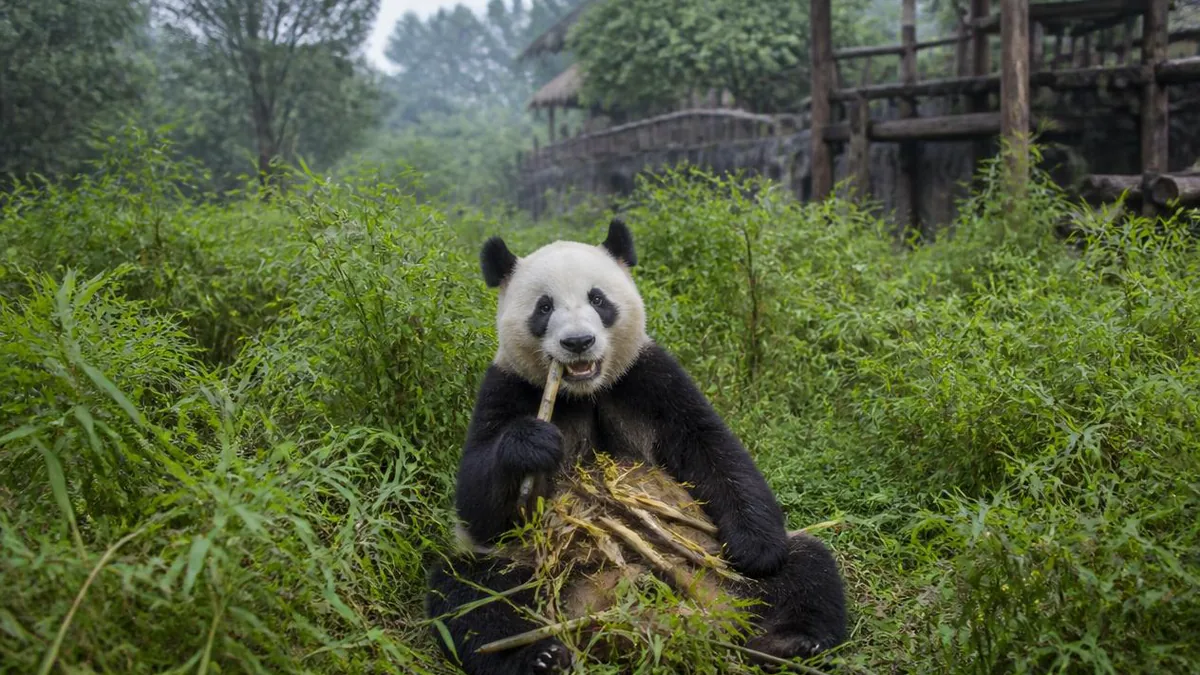
Sichuan · Chengdu
Chengdu Panda Base: A Breeding Institute That Sells Tickets
It began in 1987 with six pandas rescued from a bamboo famine, and it is still a research institution first. Everything that frustrates visitors, the early hours, the sleeping animals, the closed nursery, follows from that.
The Chengdu Research Base of Giant Panda Breeding is the most visited animal facility in China and one of the most misunderstood. Almost every complaint written about it, the crowds, the sleeping bears, the closed buildings, the sense that the interesting part is happening somewhere you cannot go, comes from a single mismatch of expectations.
Visitors arrive at what they assume is a zoo built around a charismatic animal. What is actually inside the wall is a breeding and research institution that happens to admit the public, and that has been its structure since it opened in 1987 with six giant pandas rescued from the wild.
Hold that in mind and the place becomes legible.
Six bears and a bamboo famine
The base exists because of a botanical event.
In 1983, arrow bamboo flowered across large areas of the Qionglai and Minshan ranges, the core of giant panda habitat. Bamboo dies after flowering, so a synchronised bloom means a synchronised food failure. The Sichuan forestry department sent survey teams into the mountains in May; reports in the provincial press that July turned it into a national story. The same year the China Conservation and Research Center for the Giant Panda was formally established at Wolong, but its capacity in captive breeding was still thin.
In 1985 the China Association of Zoological Gardens was founded, partly to raise non-state money for a breeding base. In 1986 the forestry ministry’s planned panda rescue centre in Chengdu collapsed when its investor absconded with the funds. The Chengdu municipal government took the site over in partnership with the zoo association; the construction ministry approved the name Chengdu Research Base of Giant Panda Breeding; the city’s parks bureau took direct control and the association raised the money.
Groundbreaking was in March 1987, the completion ceremony on 10 October 1987, and the base entered service that November. Its founding stock was six giant pandas taken in from the wild during the emergency.
That origin matters for the argument of this article. The institution was not conceived as a display collection with a research programme attached. It was conceived as a rescue and breeding operation, and the visitors came later.
The three hard problems
Captive giant panda breeding failed for decades, and Chinese researchers came to describe the failure in three parts: getting females into oestrus, achieving conception, and keeping cubs alive.
Each is genuinely difficult. Females come into oestrus once a year for a window measured in days. Captive males frequently do not mate successfully. Newborn giant pandas are among the most altricial of any placental mammal, arriving blind, pink, hairless and weighing on the order of a ten-thousandth of the mother’s mass, which leaves almost no margin for error in thermoregulation or feeding.
The tools that broke the deadlock were unglamorous: artificial insemination, semen collection and cryopreservation, hormone monitoring to pin down the ovulation window, and a body of neonatal husbandry covering incubation, hand-rearing and the management of underweight cubs.
The institutional scaffolding grew alongside. A dedicated laboratory was set up in 1997, recognised as a Sichuan provincial key laboratory in 2001, given a postdoctoral research station in 2003, and approved as a national key laboratory cultivation base in 2007. The base reports research and technical staff in the dozens, with a much larger flow of postdoctoral fellows and interns, and describes roughly 6,000 square metres of laboratory and office space alongside three rewilding sites.
The twin trick
The single most consequential technique is also the least sentimental, and it is worth explaining properly because it is usually reported as a cute anecdote.
Roughly half of captive giant panda births are twins. In the wild, a mother will generally raise one and the other does not survive; she cannot support two. In captivity that would mean discarding half the reproductive output of an already tiny population.
The solution is rotation. One cub stays with the mother while the other is kept in an incubator, and the two are swapped at intervals, so that both receive maternal milk, maternal grooming and maternal warmth while neither exceeds what the mother can sustain. Where a mother is inexperienced or unwilling, an experienced female may be used as a foster, which has a second benefit: it gives inexperienced animals rearing practice before they have cubs of their own.
The result is a survival rate for twins that the wild does not produce, and it is one of the clearest cases anywhere of a husbandry technique changing the demographic arithmetic of a species. It is also, unmistakably, an intervention. The animals in front of you are the output of a managed population, not a remnant of a wild one.
From six to more than two hundred
The population figures tell the story of the institution better than any mission statement.
By 2008 the base recorded 124 panda births with a captive population of 83. Recent accounts diverge slightly, which is normal for a number that changes with every birth, death and transfer: one account gives 260 giant pandas at the end of 2024, while the base’s own summary states more than 270. Either way, a founding stock of six has become one of the largest captive giant panda populations in the world.
The physical site grew to match. The core area was around 1,035 mu until an expansion zone opened for trial operation on 1 January 2022, taking the total to 3,570 mu, roughly 238 hectares. The enlarged site is organised into named districts, with panda houses grouped under the Boundless Hills and Adventure Valley areas and the original grounds retained as the Treasure Lake district. A landmark tower on the high ground gives a view over Chengdu.
The base also holds red pandas, reported at 201 animals at the end of 2025, along with golden snub-nosed monkeys and other endangered Chinese species. The red pandas get their own section below, because visitors reliably misidentify them.
What the base does not do, and what it does
Captive breeding raises an obvious question: what is any of it for, if the animals never leave?
Most of them will not. An adult that has grown up in an enclosure, habituated to people and to delivered bamboo, is not a candidate for release. Rewilding programmes therefore work with animals raised under deliberately restricted human contact, from birth, in large enclosed mountain habitat, and China’s principal rewilding training facility is Hetaoping in Wolong, run by the national research centre rather than by Chengdu.
The record there is mixed and should be reported as such. Xiang Xiang, a male trained at Wolong, was released in 2006 as the first captive-bred giant panda returned to the wild. His body was found in snow on 19 February 2007; investigators concluded he had fought with wild pandas over territory and food and fell from a height while fleeing. Later releases, beginning with the wild-born female Lu Xin returned to Liziping in 2009, adopted different selection and training methods. Releases continue, and so do losses.
The Chengdu base’s own role in this is specific and easy to overlook: its Dujiangyan Field Release and Breeding Research Centre, marketed as Panda Valley, is the department responsible for rewilding training, release and breeding. The animals visible at the city site are, overwhelmingly, part of the ex-situ conservation population: a genetic reserve, a research subject and a public-education asset, rather than a pipeline to the mountains.
Endangered, vulnerable, and a five-year disagreement
In 2016 the IUCN reclassified the giant panda from Endangered to Vulnerable on its Red List, citing survey evidence of a growing wild population.
China did not accept it. On 5 September 2016 the State Forestry Administration responded that it would not lower the species’ domestic protection level, and that conservation effort needed reinforcing rather than relaxing. The objection was not nationalist point-scoring; the substantive argument was that the population is split among more than thirty small subpopulations separated by roads, farmland and settlement, and that fragmentation risk is not captured by a headline count.
Five years later the two positions converged. In July 2021 Chinese authorities announced that the giant panda was no longer endangered in the wild, with a population above 1,800.
The number behind all of this is the Fourth National Survey, run from 2011 to 2014 and published in 2015, which estimated 1,864 wild giant pandas over 1.5 years old, excluding dependent young; a 2018 analysis put the total adult population near 2,060. The Giant Panda National Park, consolidating dozens of existing reserves across Sichuan, Shaanxi and Gansu, was formalised around 2020 and 2021, explicitly to address the fragmentation problem.
Vulnerable, in other words, is a description of a species that is doing better while remaining dependent on continued intervention.
The other panda
The red panda in the enclosure by the path is not a young giant panda, and the confusion is old enough to be built into the English name.
Red pandas are a separate family, Ailuridae, with no close living relatives; the giant panda is a bear. The red panda was described first, which is why the larger animal ended up borrowing its name. They share a mountain range, a bamboo-heavy diet and a false thumb, which is a case of convergence rather than kinship.
The Chengdu base has held them since the beginning, and its red panda population, reported at 201 at the end of 2025, is substantial in its own right. A large free-range red panda area of about 12,000 square metres has been developed on site. Practically, this is good news for visitors on a bad panda day: red pandas are crepuscular but far more likely to be visibly awake and moving than an adult giant panda at noon.
The only window that matters
Here is the expectation management that most write-ups omit.
An adult giant panda spends the large majority of its day asleep. Bamboo is a poor food: low in protein, high in indigestible fibre, and processed by a digestive tract that is essentially carnivore plumbing. The animal compensates by eating for long stretches and doing almost nothing else. Activity clusters around feeding.
That gives you one dependable window: the first hour or two after the gates open, which coincides with the morning feed. Arrive then and you will see animals upright, eating, climbing and occasionally falling out of things. Arrive at eleven and you will see grey-and-white shapes wedged into forks of trees.
Two seasonal caveats. Chengdu summers are hot and humid, and above a certain temperature the animals are moved into air-conditioned indoor rooms; they remain viewable through glass, but the outdoor tableau is gone. And nursery visibility is not a fixture. Giant pandas are seasonal breeders with births clustered in late summer, so whether a nursery has cubs on view depends entirely on that year’s results and on veterinary judgement about disturbance. There is no reliable way to plan for it.
Tickets, shuttles and the size of the crowd
The base publishes its own arrangements, and they are worth reading before you arrive rather than at the gate.
Entry is by online real-name booking, bookable up to 14 days ahead, with the ticket tied to the identity document you registered. Adult admission is listed at 55 yuan, students at 27, with free entry for visitors aged 60 and over and for children under 6 or under 1.3 metres. Sessions are split: from March to October, morning entry between 7:30 and 12:00 and afternoon entry from 12:00 to 17:00, with clearance from 18:00; from November to February, 8:00 to 12:00 and 12:00 to 16:30, with clearance from 17:30. The published maximum capacity is 85,000 visitors a day, which tells you what a peak holiday looks like here.
Getting there is easy by Chinese megacity standards. The base is about 10 kilometres from Tianfu Square, roughly 30 from Shuangliu airport and 50 from Tianfu airport. Metro line 3 serves it via shuttle connections at Panda Avenue station to the south gate and at General Hospital station to the west gate, and direct tourist coaches run from Chunxi Road and other city landmarks. Inside, an electric shuttle covers the long uphill stretch to the far enclosures, which is worth taking outbound so you can walk back downhill through the exhibits.
All of these figures, prices, hours, capacity and which houses are open, are adjusted seasonally and occasionally at short notice. Confirm against the base’s own announcement for your date.
Three places called the panda base
One last piece of practical disambiguation, because booking the wrong one costs a day.
The Chengdu Research Base of Giant Panda Breeding is municipal, run under the city’s park administration, and is the one inside Chengdu.
The China Conservation and Research Center for the Giant Panda is a national institution under the forestry and grassland administration, headquartered in Dujiangyan, with bases at Shenshuping in Wolong, Qingchengshan in Dujiangyan, Bifengxia in Ya’an, Hetaoping in Wolong and Mianyang. Wolong is remote, high and forested, and its animals are correspondingly more active; it is also two and a half hours from the city.
And the Chengdu base runs its own Dujiangyan site, the Field Release and Breeding Research Centre known as Panda Valley. Two organisations, two Dujiangyan facilities, similar names.
One factual note for anyone checking directories: the Chengdu base has long carried a national 4A scenic-area rating rather than 5A, and Chengdu’s municipal plans describe an ongoing campaign to have the wider Chengdu Panda International Tourism Resort certified at 5A. As of the most recent national announcements, that upgrade had not been granted. Guides that describe the base as a 5A site are running ahead of the paperwork.
Which is a fitting note to end on. This is a place whose reputation consistently outruns its documentation, and whose real achievement, turning six starving bears into a self-sustaining captive population, happens in buildings most visitors never enter.
The LoreLens app can identify enclosure species, signage and site features here while explaining the conservation science behind them.
Location profile
Where it is

Frequently asked questions
What time should I arrive, and will the pandas actually be awake?
Arrive for opening. Between March and October morning entry runs from 7:30, and from November to February from 8:00; the site clears at 18:00 and 17:30 respectively. The first hour or two after opening coincides with the morning feed, and that is the reliable window in which giant pandas are on their feet, eating bamboo and visible outdoors. For most of the rest of the day an adult giant panda sleeps, because a bamboo diet yields very little usable energy and the animal budgets accordingly. This is not a failure of the enclosure design; it is what the species does. In hot Chengdu summers the animals are moved to air-conditioned indoor rooms, where they are still viewable but through glass and usually asleep. If your itinerary only permits a midday arrival, set expectations accordingly rather than assuming something has gone wrong.
Chengdu base, Wolong, Dujiangyan: which one am I actually booking?
They are different institutions and this trips people up constantly. The Chengdu Research Base of Giant Panda Breeding is run by the Chengdu municipal government and sits inside the city, about 10 kilometres from Tianfu Square. The China Conservation and Research Center for the Giant Panda is a separate national body under the forestry and grassland administration, with its headquarters in Dujiangyan and bases at Shenshuping in Wolong, Qingchengshan in Dujiangyan, Bifengxia in Ya'an, Hetaoping in Wolong and, more recently, Mianyang. To complicate matters further, the Chengdu base has its own facility in Dujiangyan, the Dujiangyan Field Release and Breeding Research Centre, popularly called Panda Valley. So there are two unrelated panda sites in Dujiangyan belonging to two different organisations. Check which institution's booking channel you are using before you commit to a taxi.
Is the giant panda still endangered?
It depends on who is answering, and the disagreement is itself informative. In 2016 the IUCN moved the giant panda from Endangered to Vulnerable on its Red List, on the strength of survey evidence that the wild population had grown. China's State Forestry Administration responded on 5 September 2016 that it would not lower the species' domestic protection level, arguing that habitat fragmentation and other threats made the reclassification premature. Five years later the Chinese position converged: in July 2021 the authorities announced that the giant panda was no longer endangered in the wild, with a population above 1,800. The underlying figure comes from the Fourth National Survey, conducted between 2011 and 2014 and published in 2015, which estimated 1,864 wild individuals over 1.5 years old, excluding dependent young. Vulnerable is not safe; it is a lower rung on the same ladder.
Can I hold a panda or see newborn cubs?
Holding is not part of a normal visit, and the base explicitly warns visitors not to believe anyone offering paid shortcuts, including any promise of quick entry. Cub visibility is entirely a function of that year's breeding season. Giant pandas are seasonal breeders, births cluster in late summer, and whether a nursery has visible cubs on the day you arrive depends on how many were born, how they are doing, and veterinary judgement about disturbance. There is no schedule you can plan around and no way to guarantee it. If cubs are on show they will be behind glass with a queue, and the queue moves faster early. Treat any newborn you see as a bonus rather than the reason for the trip, and the visit will hold up either way.
Sources and further reading
Background references for the history and place names in this guide. Opening hours, ticketing and access change often — always confirm with official local information before travelling.