Hubei · Shiyan
Wudang Mountains: A Mountain Built to a Script
An emperor with a legitimacy problem spent a decade putting a god's biography onto a Hubei mountainside. The road from the stone gate to the bronze hall on the summit is not a walk that grew; it is a sequence somebody wrote.
5A View location, maps and nearby scenic areasMost sacred mountains grew. Wudang was commissioned.
The Taoist complex spread across this range in north-western Hubei was not assembled by centuries of donors adding halls where they could afford to. It was a state building programme, ordered by one emperor in one year, staffed by an army, and laid out along a single road so that walking up it takes you through the biography of a god in the correct order.
That is the thing to hold on to here. The mountain is the set. The route is the script.
An emperor with a legitimacy problem
Zhu Di, the Yongle emperor, took the throne from his nephew in 1402 after a three-year civil war. He was a usurping fourth son who needed the heavens to agree with him, and the deity he credited with backing him was Zhenwu, also titled Xuantian Shangdi: the Perfected Warrior, lord of the north, a martial god associated with water and the dark quarter of the sky.
Wudang was already Zhenwu’s mountain. The Tang emperor Taizong had a shrine built here after a rainmaking mission in the 620s; by the late Tang the range was listed ninth among the seventy-two blessed places, and under the Song and Yuan the imperial house repeatedly gave Zhenwu titles here.
In 1412 Zhu Di ordered it rebuilt at a scale nothing before had approached. Ming writers put the two great works of his reign in one line: build the Forbidden City in the north, build Wudang in the south. The mountain got imperial rank to match. Yongle titled it Taiyue, the Great Marchmount; the Jiajing emperor in 1552 added Zhishi Xuanyue, the Dark Marchmount that Governs the World, a title that formally placed it above the traditional Five Marchmounts.
The complex was inscribed on the World Heritage List in December 1994 as the Ancient Building Complex in the Wudang Mountains.
The workforce numbers do not agree
They appear as facts everywhere and they do not reconcile, so hold them apart.
Chinese chronologies for 1412 name the commanders: the Marquis of Longping, Zhang Xin; the imperial son-in-law Mu Xin; the vice-minister of works Guo Jin; the minister of rites Jin Chun. Under them, one account says, went more than 200,000 soldiers, civilians and craftsmen. A different stock sentence, just as widely printed, says 300,000 were employed per day.
Those are probably not rival estimates of one thing. One reads like a mobilised establishment, the other like a daily corvee return, and a decade-long project would generate both. But no source we could find reconciles them, so quote the number with its wording attached rather than pick a winner.
Duration wobbles the same way. One chronology has the works finished in 1423 and calls it twelve years; the standard summary line says fourteen. The output is agreed: thirty-three building complexes, framed in the traditional formula as nine palaces and eight temples, with a longer count of nine palaces, nine monasteries, thirty-six convents and seventy-two shrines, and further expansion under Jiajing.
Even the survival figure has two units: 53 surviving ancient buildings and over two hundred surviving structures. The first counts sites, the second counts individual halls.
The mountain is a sequence, not a collection
The pilgrim road, the old shendao, runs from the foot of the range to the summit, and it is arranged as a narrative.
Zhenwu’s legend gives the chapters. He was a prince of the Kingdom of Jingle who left home to cultivate the Way; discouraged and turning back, he met an old woman grinding an iron pestle down into a needle, understood the lesson about persistence, and returned; he attained the Way at the southern cliff; five dragons carried him to heaven; the Jade Emperor invested him on the terrace called Qiongtai.
Now the road. Xuanyue Gate, the stone archway of 1552, is the formal boundary between the human world and the immortals’; pilgrims fasted and washed here before starting. Then Yuzhen Palace, Yuanhe Temple, Yuxu Palace at the northern foot. Then Taizipo, Prince’s Slope, whose other name is Fuzhen Guan, Returning to the Perfected, with the Needle-Grinding Well below it. Then Zixiao Palace, then Nanyan, the southern cliff where he attained the Way. Then the First, Second and Third Heaven Gates, three brick-and-stone portals set into thousands of balustraded steps, and then the summit.
The gates are dramaturgy, not defence. The scenic area’s own text says so plainly: their scale was meant to deepen the pilgrim’s awe by stages, and to give exhausted climbers a target that renewed them. The topography was read the same way, as seventy-two peaks bowing to the great summit, an audience with a throne.
The Golden Hall arrived as a kit
There was already metal on this summit. A Song-period bronze pavilion is recorded on the spot, and a Yuan bronze shrine dated 1307 stood here until Yongle judged it too small, had it moved off the peak, and commissioned a replacement. That Yuan shrine survives elsewhere on the mountain and is older than anything at the top.
The Golden Hall of 1416 is the replacement, and it is the least replaceable object in the complex.
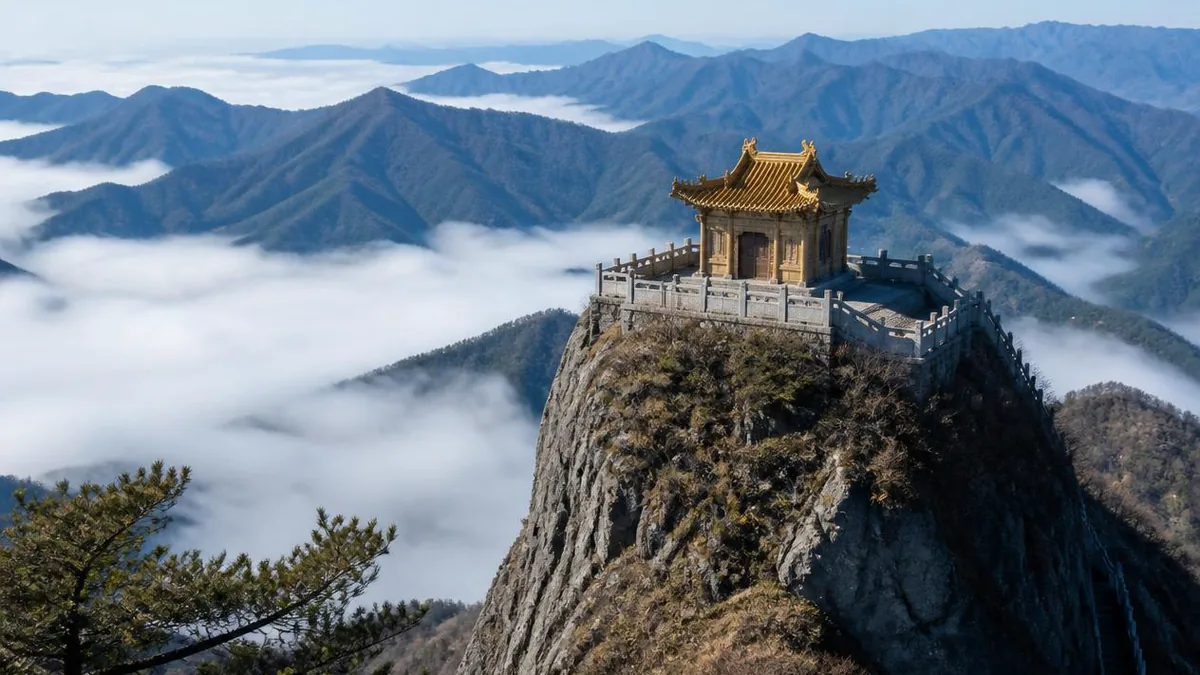
It is cast bronze, gilded, in the form of a timber hall: columns, beams, bracket sets, tile scales, window lattices and thresholds all reproduced in metal. The roof is a double-eave hip roof, the highest roof rank in Ming architecture, the form used on the throne hall of the Forbidden City. Putting it on a mountain temple is a statement about who owns the mountain.
Dimensions are modest and deliberate: three bays wide, three bays deep, about 5.45 metres high. The gilding alone is stated to have taken about 60 kilograms of gold.
The construction method is the part worth carrying up with you. The hall was cast as components in Beijing, moved by water to the old city of Junzhou on the Han, carried up Tianzhu Peak by hand, and assembled on the summit — and the joints between castings close so tightly that from a few paces it reads as a single object. It is not. It is a shipped kit, delivered by a state that could do that.
Recent investigation adds a detail about the two great slabs it sits on: fossil-bearing stone, also brought in from off the mountain.
From 1419 a stone wall enclosed the summit, the Zijincheng or Forbidden City of Wudang. After Jiajing’s expansion the convention settled: outside the wall is Taihe Palace, inside the wall is the Golden Summit.
Lightning on a metal roof
The mountain’s most famous phenomenon is called leihuo lian dian, thunder-fire refining the hall. Accounts describe fireballs rolling across the roof in summer storms and the hall standing unharmed and visibly brighter afterwards.
That is describable without mysticism. A large, continuous, well-earthed metal object on the highest point of an isolated peak is the natural strike target for kilometres. Gilded bronze conducts well, so the current runs over the outer surface and into the mountain through the stone base rather than through anything that burns; the tightness of the assembly matters too, since continuous metal leaves few gaps for arcing inward. The discharge strips soot, oxide and organic film off the gilding. A hall that has just been struck really does look cleaner.
One thing we could not verify is its current status. Popular accounts say the phenomenon became rare after lightning protection was installed on and around the summit in the late twentieth century, and that sounds mechanically plausible, but we found no official statement dating the works, so treat it as reported rather than established. The scenic area’s own text still lists it alongside its other summit effects — the dawn clearing at Tianzhu, the cloud sea surging like a tide, thunder on level ground.
None of which is a reason to be up there in a storm. The summit closes in bad weather, and it should.
Zixiao, Nanyan and the dragon’s head
Below the summit, two sites carry the architecture.
Zixiao Palace was founded in the Xuanhe era, 1119 to 1125. The recorded founding story is oddly specific: Emperor Huizong dreamed of a fire god, a diviner told him only a water god sent south could settle it, and a temple to the northern, water-aligned Zhenwu was built here. It was wrecked in the Jin invasion, rebuilt under Kublai as a site of state prayer, rebuilt again under Yongle, and expanded under Jiajing to 860 rooms.
Its main hall is the best timber framing on the mountain: the only double-eave hip-and-gable timber hall at Wudang, a post-and-lintel frame raised on three tiers of terrace, so it gains height from the slope rather than from its own storeys. National key protected site in 1982, reopened as a religious site in 1984, and seat of the Wudang Taoist Association.
Nanyan is the other one, and it is stone. The Tianyi Zhenqing Gong, a Yuan structure given its title in 1314, is set into the cliff face and carved to imitate timber — three bays each way, about 6.8 metres high, hard against a vertical drop. Outside the Liangyi Hall a carved dragon’s head projects out over the void with a censer on its snout: the Dragon Head Incense, which pilgrims used to crawl out along to plant a stick, and which the Qing authorities banned after deaths. Look at it. Do not test it.
The reservoir took a third of it
The Danjiangkou dam was begun in 1958, and in 1967 the rising water drowned roughly a third of the Wudang complex.
What went under included Jingle Palace, first of the nine palaces and named for the kingdom Zhenwu was born a prince of, along with the walled old city of Junzhou and a number of early Chu-period sites and tombs. Objects were rescued; others were carried off as building material. A replica of Jingle Palace was completed in 2006 on the north shore of Jingle Lake, and the original Lingxing Gate and tortoise-borne stele, salvaged in 1958, were listed that year as part of the protected complex.
This reframes everything upslope. The Ancient Building Complex is a survivor, not an intact set, and the upper mountain reads as coherent partly because water cannot climb.
Yuzhen Palace burned in 2003 and was lifted in 2012
Yuzhen means meeting the Perfected, and the name is a record of a failure. Zhang Sanfeng is said to have kept a hut here. The Yongle emperor sent repeated missions to find him, never did, and built a palace on the site anyway in the hope of an encounter. An emperor building a palace for a man he could not locate is an unusual entry in a state building account.
It grew: 396 rooms by the Jiajing era, more than a thousand by the Wanli era, three linked compounds behind a wall 697 metres round.
On 19 January 2003 the main hall burned down. The fire was started by an employee of a martial arts school then operating in the buildings under a contract; three bays, roughly 200 square metres, were lost. A gilt statue of Zhang Sanfeng normally kept there had been moved shortly before and survived. What remains is the tall stone terrace, whose footprint still gives the scale.
Then the water came back. Raising the Danjiangkou dam for the middle route of the South-to-North Water Diversion Project put Yuzhen Palace inside the new inundation range. The answer, begun in 2012, was to jack the surviving structures upward in place by 15 metres — the glazed-tile splayed gateway and the east and west palace gates, raised bodily rather than dismantled and rebuilt. It is described as the largest single cultural-relic protection project on the middle route. Restoration finished and the site reopened in 2024, with the central compound rebuilt and the east and west compounds left as exposed foundations with digital reconstruction on display.
Fire and water at the same gate, nine years apart. As a modern heritage-management case it is hard to better.
Zhang Sanfeng, in three separate claims
Wudang’s global fame runs through martial arts, which is why the claims need separating rather than merging.
That he existed. The History of Ming carries a biography, placing his birth in Liaodong in the late Song and crediting him with 212 years; the Tianshun emperor granted him a title. Circulating dates include 1247 to 1366. Shaowu in Fujian asserted a birthplace claim in 2014. A dynastic-history biography records an accepted tradition; it is not a registry entry.
That he is Wudang’s founder-figure. Uncontested as tradition, and materially consequential: the imperial searches and Yuzhen Palace are documented Ming state actions taken on the assumption he was alive.
That he created taijiquan. Contested, and the disagreement is well mapped. Huang Zongxi’s 1669 epitaph for Wang Zhengnan credited Zhang with an internal school set against Shaolin’s external one. The modern lineage claim was consolidated in the Republican period — Xu Yusheng’s 1921 book calls taijiquan a Song-Yuan Taoist creation, and Yang Chengfu’s own preface traces it to Zhang through Wang Zongyue and others. Against that, documentary research traces the art to Chen Wangting and the village of Chenjiagou in Wen County, Henan, from where Yang Luchan learned it as the first outsider taught by the Chen family; the Chinese Wushu Association follows that reading. Stanley Henning’s paper “Ignorance, Legend and Taijiquan” attacks the attribution and doubts the man. On the other side, a state sports commission research project led by Jiang Bailong of the Wuhan Institute of Physical Education, reviewed on this mountain in 1992, concluded that Zhang was real and Wudang boxing a genuine internal school.
One date explains why the argument has institutional weight. At the first national martial arts tournament of the Central Guoshu Institute in 1928, competitors were divided into Shaolin and Wudang divisions. From that point “Wudang” was an administrative category as well as a lineage, and categories acquire defenders.
Climb it in the order it was written
Practical scale first. The scenic area covers about 312 square kilometres, and Tianzhu Peak is given as 1,612 metres in the reference works and 1,613 by the scenic area itself. Sites are kilometres apart on mountain roads, so the shuttle pass is a requirement, not an upgrade. The official one-day itinerary lists an entrance ticket of 130 yuan plus 35 yuan for the shuttle and runs visitor centre, Taizipo, Zixiao, Nanyan, Golden Summit. Every one of those numbers, and the cable car, and the summit’s weather closures, move — confirm at the gate on the day.
Two days beats one. The standard one-day compromise is to drop the summit and end at Nanyan, and it is not a bad trade.
These are working monasteries with resident clergy, not exhibits. Cover shoulders and knees, do not tread on raised thresholds, and assume photography inside halls is prohibited unless a sign says otherwise.
If you can, walk at least one section of the old road rather than riding past it. The sequence was built to be taken in order, at walking pace, by someone getting tired. A prince who nearly gave up, an old woman with an iron pestle, a cliff where the story turns, three gates, and at the top a bronze building cast a thousand kilometres away and carried up here in pieces by people who were told to. The mountain is not the argument. The staging is.
The LoreLens app can identify Ming roof ranks, bronze and stone imitation-timber construction, and Taoist iconography while explaining the history behind them.
Location profile
Where it is

Frequently asked questions
How many people built Wudang, and how long did it take?
Both figures come in two versions, and both pairs circulate as fact. On the workforce, Chinese chronologies say the Yongle emperor in 1412 ordered the Marquis of Longping, Zhang Xin, the imperial son-in-law Mu Xin, and senior officials of the works and rites ministries to lead more than 200,000 soldiers, civilians and craftsmen; a second stock sentence says 300,000 were employed per day. These are probably different units of counting rather than a contradiction, a mobilised establishment versus a daily corvee return, but no source reconciles them, so quote whichever you use with its wording attached. On duration, one chronology runs from 1412 to 1423 and calls it twelve years; the standard summary line says fourteen. What is not in dispute is the output: thirty-three building complexes, framed as nine palaces and eight temples, with further expansion under the Jiajing emperor after 1552.
Is the Golden Hall solid gold, and what is lightning refining the hall?
It is cast bronze with a gilded surface; the scenic area states that the gilding alone consumed about 60 kilograms of gold. It was built in 1416, cast as separate components in Beijing, shipped by water to the old city of Junzhou on the Han River, carried up Tianzhu Peak by hand and assembled there, and it reproduces every timber member of a wooden hall in metal. Lightning refining the hall is the local name for what happens when a large, well-earthed metal object sits on the highest point of an isolated peak: it takes the strike, conducts the current over its surface into the mountain rather than through anything combustible, and the heat burns soot and oxide off the gilding, so it looks brighter afterwards. Popular accounts say the phenomenon became rare after lightning protection went in on the summit in the late twentieth century; we could not find an official statement dating that, so treat it as reported, and never plan a visit around a thunderstorm.
Did Zhang Sanfeng invent tai chi at Wudang?
That is three claims, and only the middle one is settled. That Zhang Sanfeng existed rests on a biography in the History of Ming, which places his birth in Liaodong in the late Song, credits him with 212 years of life, and records a title granted by the Tianshun emperor; other datings and even other birthplaces are asserted, including a 2014 claim by Shaowu in Fujian. That he is Wudang's founder-figure is uncontested as tradition, and the Yongle emperor's repeated searches for him, and the palace built in the hope of meeting him, are documented state actions. That he created taijiquan is disputed. The attribution reached print in its modern form in the Republican period; documentary research instead traces the art to Chen Wangting and the village of Chenjiagou in Wen County, Henan, which is the position the Chinese Wushu Association follows, while a state sports commission project reviewed on the mountain in 1992 concluded the opposite. The question is open.
How long do I need, and how do I get around?
Two days is the comfortable answer and one day is the common one. The sites are kilometres apart on mountain roads, so the shuttle-bus pass is effectively compulsory rather than optional; the scenic area's own one-day itinerary lists an entrance ticket of 130 yuan plus 35 yuan for the shuttle, and routes visitors from the visitor centre through Taizipo and Zixiao Palace to Nanyan and then the Golden Summit. Prices, cable-car operation, shuttle routes and summit closures in bad weather all change, so confirm at the gate on the day. The bottleneck is the last stretch of steps above the cable-car station, which funnels everyone into one narrow flight; go early or accept the queue. The frequent one-day compromise is to drop the summit and finish at Nanyan, which is the better piece of architecture anyway.
Sources and further reading
Background references for the history and place names in this guide. Opening hours, ticketing and access change often — always confirm with official local information before travelling.