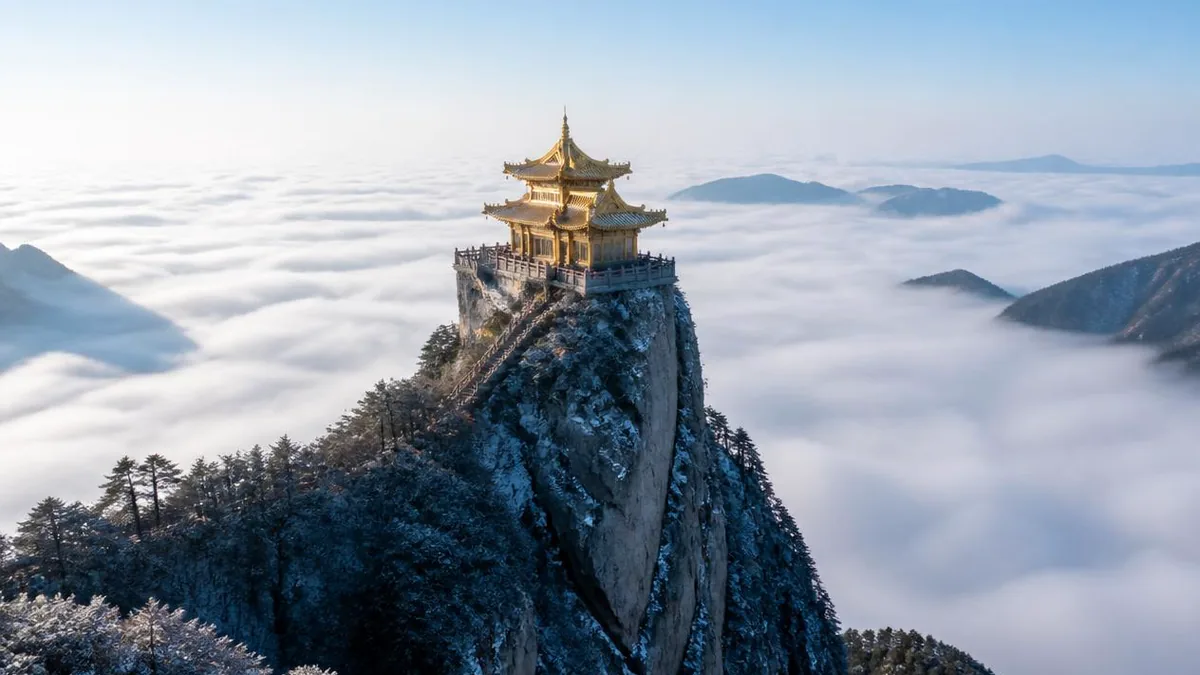
Sichuan · Leshan
Mount Emei: The Mountain That Gets Newer as You Climb
Five climate bands stacked from subtropical forest to subalpine shrub, a bodhisattva who has been here since the Song dynasty, and a Golden Summit whose gold was consecrated in 2006. The oldest object on the mountain is halfway down it.
5A View location, maps and nearby scenic areasMost sacred mountains reward reading from the bottom up: you climb through the outer temples towards the old, holy thing at the top. Mount Emei runs the other way.
The summit is the newest part of it. The gilded Samantabhadra you have seen in every photograph of the Golden Summit was consecrated in 2006. The temple behind it is a rebuild of a building that burned in 1972. Meanwhile, roughly halfway up the mountain, inside a windowless brick vault put up around 1600, sits a bronze bodhisattva on an elephant that was cast in 980.
Nothing about that is a scandal. It is simply how a timber mountain in a wet climate ages. But it changes what you are looking at, and it is worth knowing before you queue for the cable car.
One listing, two gates
The World Heritage property is called Mount Emei Scenic Area, including Leshan Giant Buddha Scenic Area. It was inscribed in 1996 as site 779, and it is a mixed property, cultural and natural at once, on criteria (iv), (vi) and (x).
That single certificate covers two places about thirty kilometres apart. They have separate gates, separate tickets and separate shuttle networks, and the Leshan Giant Buddha, carved into a cliff at a river confluence, faces this mountain from downstream. Visitors regularly arrive expecting one site and discover two days of logistics.
The mixed status is the part worth holding on to. The cultural half is a bodhisattva’s seat with roughly two thousand years of religious use. The natural half is a 154 square kilometre stack of forest with an endemic flora. They are protected together, and as the last section of this piece shows, they are also degrading together.
The mountain is a stack of climate bands
The relief is the mechanism. Baoguo Temple sits at the foot; Qingyin Ge is at about 710 metres; the terminus for almost every visitor is Jinding, the Golden Summit, at 3,077 metres; the true high point is Wanfoding, given as 3,099 metres in most Chinese and English references and 3,098 in some others.
Between bottom and top you pass through the whole sequence. Chinese climatological descriptions put a warm-temperate band at roughly 1,500 to 2,100 metres, a mid-temperate band at 2,100 to 2,500, and subarctic conditions above 2,500. Above about 2,000 metres, snow and ice cover the ground for around half the year, commonly October into April.
The summit itself is classed as an alpine subarctic climate. Monthly mean temperatures run from about −5.7°C in January to 11.6°C in July, with an annual mean near 3°C, and precipitation falls on more than 250 days a year, over seventy percent of it between June and September.
The vegetation tracks that exactly: subtropical evergreen broadleaf forest at the base, mixed evergreen and deciduous above about 1,500 metres, then conifer, then subalpine shrubland above roughly 2,800 metres. The lower forest is described as the largest and most intact surviving stand of the evergreen broadleaf forest that once covered the whole Sichuan Basin. You are walking through the reason for criterion (x).
Why Puxian, and what the first-temple claim really says
Emei is the seat of Puxian, Samantabhadra, the bodhisattva of practice and vows, conventionally shown riding a white elephant. That places it in a set of four: Manjusri at Mount Wutai, Ksitigarbha at Jiuhua, Avalokitesvara at Putuoshan, and Puxian here. Emei is the highest of the four.
UNESCO’s description also states that this is the site of the first Buddhist temple built in China, in the first century CE. That sentence should be handled carefully rather than repeated. The conventional claim for China’s first Buddhist foundation is the White Horse Temple at Luoyang, traditionally dated to 68 CE. Both claims rest on tradition rather than on an excavated founding layer, and neither has been settled against the other. Note that the listing says it; do not let it decide anything for you.
Temple counts diverge too, and for a boring reason. Chinese sources commonly say about 26 working monasteries; UNESCO says over thirty; other accounts count 76 Ming and Qing monasteries. The spread is a counting rule, not a dispute: it depends on whether hermitages, ruins and rebuilt shells are included.
The oldest object on Emei is halfway up it
Wannian Temple, on Camel Ridge, is where the mountain’s deep history is physically located.
Its foundation is attributed to the monk Huichi in the Eastern Jin, when it was called Puxian Temple; it was renamed Baishui Temple by Huitong in 876. In 980, under the Northern Song, the monk Maozhen restored it and cast a bronze Samantabhadra riding an elephant, about 7.35 metres tall and commonly given as some 62 tonnes. It is a first-grade protected national relic, and it is the single most important object on the mountain.
The building that holds it is almost as interesting. After a fire in the Wanli period, the temple was rebuilt by imperial order around 1600 to 1601, and the Beamless Brick Hall was added to mark the seventieth birthday of the emperor’s mother. It is roughly 17 metres high and about sixteen metres square, and it contains no timber at all: a brick vault whose interior mimics columns, arches and window lattices in masonry, with five small white stupas on the dome and rows of miniature Buddhas across the walls.
Then the test. In 1946 fire destroyed the temple again, and the Beamless Brick Hall was the only structure left standing. The rest was rebuilt in stages after 1949, with further halls added in 1986 and bell and drum towers in 1991.
A brick vault outlived every wooden hall around it, twice. That is the whole architectural argument of Mount Emei in one building.
The Golden Summit is a project from 2004
Jinding is both the peak at 3,077 metres and the name people use for Huazang Temple, the highest Buddhist temple in the Han Chinese heartland.
The temple is first recorded in 1377, and it has burned repeatedly. The most recent loss is specific and recent: on 8 April 1972, at about half past nine in the morning, the wooden temple was being used to transmit a local television signal, a generator caught fire, and the blaze ran for two days. The surviving relics amount to a Ming bronze monument, a Ming bronze doorway and a Qing bronze statue.
In 2004 the Mount Emei Buddhist Association launched a Golden Summit revival and renovation plan. Huazang Temple was rebuilt, and alongside it went up the 48-metre figure of Puxian facing the ten directions: a reported 660 tonnes, designed by the Taiwanese architect Chu-Yuan Lee, hollow, with a Maitreya inside and funerary urns set around it. The complex opened on 18 June 2006, with around three hundred senior monks and three thousand visitors present. In March 2016 the figure was closed again for regilding, with a reported plan to apply 160,000 gold leaves at a cost near 20 million yuan.
The rebuild has been called inauthentic and invented, and defended as a revival of something that existed for six centuries before it burned. Both readings are available. What is not available is the idea that you are photographing something ancient. The oldest structure on the summit ridge is the Puxian Hall behind the main hall, recorded as built in 1615 and standing a little over eight metres.
Buddha’s Glory is a glory
The summit sells four wonders: sunrise, the sea of clouds, Buddha’s Glory, and the holy lamps. Three of these have plain explanations and one does not.
The glory is the famous one, and it is optics. Stand on the cliff with the sun behind you and cloud below and in front. Uniformly sized water droplets refract and backscatter sunlight straight back along the line it came from, towards the antisolar point. That point is, by definition, exactly where the shadow of your own head falls. Concentric coloured rings form around it, and if the cloud is close enough your shadow is thrown onto it, magnified by the absence of anything to judge distance against. That magnified figure is a Brocken spectre; the rings are the glory.
The consequence is the part worth carrying up: you cannot share it. Each observer’s antisolar point sits at their own eye, so six people standing in a row each see rings around their own head and none around anyone else’s. Ulloa and Bouguer recorded precisely this in the Ecuadorian Andes before the effect acquired a German mountain’s name.
None of this makes the summit less worth standing on. It makes it a very good place to stand: a cliff edge above a cloud-generating basin, at an altitude where the cloud deck is usually below you. The holy lamps, points of light reported on the mountainside at night for centuries, have no settled explanation; luminous fungi, marsh gas and distant reflections have all been proposed, and no one has closed the case.
The macaques are a management problem, not a mascot
The monkeys on the paths are Tibetan macaques, Macaca thibetana, the largest macaque species in the world. Males commonly weigh 13 to 19.5 kilograms, with a recorded maximum near 30; the tail is a stump. They live in mixed-sex groups in which females stay for life and males disperse around eight years old, and studies at Emei and Huangshan found that an alpha male’s tenure averaged only about a year. Groups split when they reach roughly forty to fifty animals.
What visitors meet is a provisioned population. Vendors sell nuts to feed them; the animals take food from hands, grab at clothing and bags, and bite when crowded or when an offered snack is pulled back. That is a learned economy, not a personality. The scenic area operates designated monkey zones with staff on duty, which tells you how routine the incidents are.
Practical handling: keep food and plastic bags out of sight and inside a closed pack, do not hold anything out, avoid direct staring and bared teeth (both are threats in macaque), let go if a bag is taken, and keep small children off the ground where troops gather. A bite or a scratch is a same-day medical matter.
Walking it in segments
The full historic pilgrim route from the foot is roughly 50 kilometres of path and takes several days. Almost nobody does all of it now, but the segments still make sense individually.
Baoguo Temple at the base is the gateway and the administrative centre. It began in the Wanli period as Huizong Hall, a deliberately syncretic foundation that put Puxian in the middle with the Daoist figure Guangchengzi and the recluse Lu Tong to either side; it was moved to its present site under the Shunzhi reign and renamed Baoguo by the Kangxi emperor in 1703, then enlarged in 1866. It holds a fourteen-storey Ming bronze pagoda about six metres tall, incised with the Avatamsaka Sutra, and a bell cast in 1564. Fuhu Temple is a short walk away.
Qingyin Ge at 710 metres sits where the Black Dragon and White Dragon streams meet, with paired bridges and the Ox-Heart Rock in the water between them. Above it, Baiyun Gorge, the Thread of Sky, runs about 130 metres long and six metres wide, narrowing to three, on a plank walkway. Then Hongchunping, the Ninety-Nine Bends, and Jiulao Cave, the mountain’s largest at around 1,500 metres: the first 120 metres walkable, a 160-metre maze section beyond that, and a crawl-width fissure below.
Higher up come Xixiangchi, Leidongping and Jieyin Hall, where the summit cable car starts. The standard modern day is shuttle bus from the foot to Leidongping, a walk to Jieyin Hall, then the cable car. In winter the upper road ices and chains or closures are routine, and cable cars stop in high wind. Shuttle routes, cable-car operation and ticketing all shift by season and by day: confirm at the gate rather than from any published schedule, including this one.
What the natural half is holding on to
The biological inventory is the argument for criterion (x). Around 3,000 plant species are recorded, some accounts saying 3,200, of which roughly 100 are described as endemic to the area. Faber’s fir, Abies fabri, was first described from this mountain. So was Magnolia omeiensis.
Animals run to about 2,300 species: 51 mammals, 256 birds, 34 reptiles, 33 amphibians, 60 fish and over a thousand insects. Red panda, Asian golden cat, Asian black bear and mainland serow are on the mammal list; the Chinese giant salamander is on the amphibian one. The restricted-range birds are the ones ornithologists come for, including the Emei Shan liocichla, the grey-hooded parrotbill, the golden-fronted fulvetta and two leaf warblers named after the mountain.
Now the uncomfortable line. The threat identified in the literature for Faber’s fir is not logging or tourism. It is acid rain from industry around Chengdu. That is the same class of atmospheric chemistry that appears in the conservation reporting for the Leshan Giant Buddha downstream. One listing, two sites, one air mass.
A footnote on the geology, because the name travels further than the mountain. The Emeishan Traps are a Permian flood basalt province named after this place, with a main eruptive phase around 262 to 259 million years ago covering upwards of 250,000 square kilometres, and they are linked to the Capitanian extinction. The province is named for the mountain. The mountain is not the volcano.
Read it downward
Start at the top if the weather offers it, because weather here does not wait. But do not stop there.
The summit gives you the vertical facts: three thousand metres of relief, a cloud deck below the cliff, and if the sun cooperates, a ring of colour around the shadow of your own head that no one else can see. Then come down through the bands. Conifer, then mixed forest, then the broadleaf canopy that used to cover a whole basin, with a macaque troop working the handrail somewhere in the middle.
Stop at Wannian Temple on the way. Go into the brick hall, which has no wood in it and therefore burned in neither 1946 nor any of the fires before it, and look at a bronze elephant that has been carrying the same bodhisattva since 980. Then think about the 48-metre figure you photographed at nine that morning.
The mountain has been Puxian’s seat for a very long time. Most of what stands on it today is not old, because timber and lightning and generators do what they do at 3,000 metres in a wet climate. The continuity is the dedication, not the fabric. That is worth more than a fake antiquity, and it is available to anyone willing to walk down instead of straight to the bus.
The LoreLens app can identify temple halls, Buddhist iconography and mountain vegetation zones while explaining the history behind them.
Location profile
Where it is

Frequently asked questions
Is Mount Emei the same World Heritage Site as the Leshan Giant Buddha?
Yes, and this catches people out. UNESCO inscribed one property in 1996 under the name Mount Emei Scenic Area, including Leshan Giant Buddha Scenic Area, site 779. It is a mixed listing, cultural and natural, on criteria (iv), (vi) and (x), which is unusual: fewer than forty properties worldwide carry both. But one listing does not mean one place. The mountain and the Buddha are separate scenic areas roughly thirty kilometres apart, with separate gates, separate tickets, separate shuttle systems and separate opening arrangements. Nothing you buy at one admits you to the other. Most itineraries give the Buddha half a day and the mountain a full day or two, and the road between them takes about an hour. Treat them as two trips that happen to share a certificate.
How old is the golden Samantabhadra statue on the Golden Summit?
It was opened on 18 June 2006, so it is two decades old. The figure stands 48 metres, weighs a reported 660 tonnes, shows Puxian with faces to the ten directions, and was designed by the Taiwanese architect Chu-Yuan Lee as part of a Golden Summit revival plan launched in 2004 by the Mount Emei Buddhist Association. Huazang Temple beside it is also a modern rebuild: the earlier timber temple burned on 8 April 1972, when the building was in use as a television relay station and a generator fire ran for two days. Only a Ming bronze monument, a Ming bronze doorway and a Qing bronze statue came through. The summit has been criticised as invented and defended as restored; what is not in dispute is the date. If you want genuinely old fabric on this mountain, look lower down.
What is Buddha's Glory, and can I plan a trip around seeing it?
It is a glory, sometimes with a Brocken spectre inside it, and it is ordinary optics rather than a sign. Stand on a cliff edge with the sun behind you and cloud below and in front: uniformly sized water droplets refract and backscatter sunlight straight back towards the antisolar point, which is exactly where the shadow of your own head falls. That is why the coloured rings always centre on you, and why a companion standing beside you sees rings around their head and not yours. Ulloa and Bouguer described it in the Andes before Europe named the effect after the Brocken. You cannot plan for it. The summit records precipitation on more than 250 days a year, which is both why cloud seas are common and why total whiteouts are common. Treat sunrise, cloud sea and glory as three separate lotteries drawn on the same morning.
Are the monkeys actually a problem?
They are wild animals that have been fed for generations, which is a different thing from tame. The species is the Tibetan macaque, the largest macaque in the world; males commonly reach 13 to 19.5 kilograms, with a recorded maximum near 30. Groups along the paths take food from hands, pull at clothing and bags, and will bite if crowded or if a held-out snack is withdrawn. The scenic area runs designated monkey zones with staff on duty. The practical rules are simple: keep food and plastic bags out of sight, do not hold anything out, do not stare or show your teeth, do not try to retrieve a bag they have taken, and keep small children close and off the ground where the troops gather. If you are bitten or scratched, treat it as a medical matter the same day.
Sources and further reading
Background references for the history and place names in this guide. Opening hours, ticketing and access change often — always confirm with official local information before travelling.